A collection of out-of-copyright and rare books from the Cambridge University Library and other world-class institutions that have been digitally scanned, made available online, and reprinted in paperback.
To save content items to your account,
please confirm that you agree to abide by our usage policies.
If this is the first time you use this feature, you will be asked to authorise Cambridge Core to connect with your account.
Find out more about saving content to .
To save content items to your Kindle, first ensure no-reply@cambridge.org
is added to your Approved Personal Document E-mail List under your Personal Document Settings
on the Manage Your Content and Devices page of your Amazon account. Then enter the ‘name’ part
of your Kindle email address below.
Find out more about saving to your Kindle.
Note you can select to save to either the @free.kindle.com or @kindle.com variations.
‘@free.kindle.com’ emails are free but can only be saved to your device when it is connected to wi-fi.
‘@kindle.com’ emails can be delivered even when you are not connected to wi-fi, but note that service fees apply.
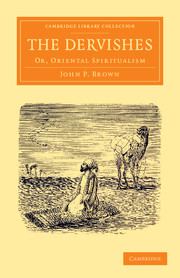
An American diplomat and self-taught scholar of the history and languages of the Islamic world, John Porter Brown (1814–72) published in 1868 this illustrated account of the Dervish orders of the Near East. Assisted closely by followers of this Sufi ascetic path while in Constantinople, Brown based his research on original Turkish, Arabic and Persian manuscripts. The work also includes extracts from other scholarly works on Dervish history, fleshing out this engaging introduction to a devout way of life and the philosophy underpinning it. As a Freemason, Brown was struck by the relationship between some Masonic and Dervish tenets, and he highlights parallels between the Christian and Islamic faiths in order to forge a better understanding of the traditions and beliefs of the people of the Near East for the benefit of Western readers.
Despite a frustrated ecclesiastical career - his ongoing failure to secure the See of St David's embittered him - Giraldus Cambrensis (Gerald of Wales, Gerald de Barry, c.1146–1220/3) composed many remarkable literary works, initially while employed as a royal clerk for Henry II and, subsequently, in semi-retirement in Lincoln. Eight volumes of his works were compiled as part of the Rolls Series of British medieval material. Noted for his vigorous Latin and anecdotal style, Giraldus gives a vivid portrait of medieval Britain and the intrigues of the Angevin court. Volume 2, edited by historian J. S. Brewer (1809–79) and published in 1862, contains the 'Gemma ecclesiastica', Giraldus' handbook on sacraments and morals, addressed to his clergy. Comprising the Latin text with an editorial preface in English, it gives a vivid picture of the medieval ecclesiastical world, and also illuminates nineteenth-century interest in the period.
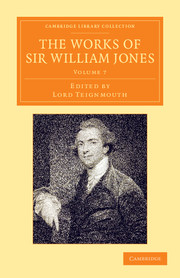
A renowned Enlightenment polymath, Sir William Jones (1746–94) was a lawyer, translator and poet who wrote authoritatively on politics, comparative linguistics and oriental literature. Known initially for his Persian translations and political radicalism, Jones became further celebrated for his study and translation of ancient Sanskrit texts following his appointment to the supreme court in Calcutta in 1783. He spent the next eleven years introducing Europe to the mysticism and rationality of Hinduism through works such as his nine 'Hymns' to Hindu deities and his translation of the Sanskrit classic Sacontalá. Volume 7 of his thirteen-volume works, published in 1807, addresses Jones' significant jurisprudential work, containing his 'Charges' as a supreme court judge. It also contains Jones's most controversial work, his Institutes of Hindu Law (1794), a translation from Sanskrit which Jones considered his masterpiece, although postcolonial scholars argue that it cemented Britain's imperial control over India.
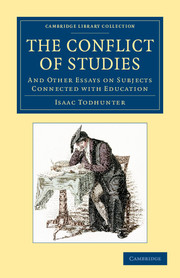
The nineteenth century was a time of great reform in education, with debate focusing on such questions as who should be educated, in what manner, and to what degree. Given the technical advances brought about by the Industrial Revolution, rigorous mathematical education was seen by many as essential. A mathematician, educator and examiner for the University of Cambridge, Isaac Todhunter (1820–84) was also known as a prolific and very successful author of mathematics textbooks. In his day, he was considered an influential, albeit somewhat conservative, figure in mathematical education. In these six essays, first published in 1873, he discusses topics raised by the reform movement (for which he had little sympathy), such as the examination system, teaching methods and materials. Born of Todhunter's vast experience in the field, this work reflects an insider's perspective and remains relevant to students and scholars interested in the history of mathematics teaching and the University of Cambridge.
Born in Scotland, James Fergusson (1808–86) spent ten years as an indigo planter in India, the profits from which allowed him to embark upon a second career as an architectural historian. Although he had no formal training, he became one of the most respected researchers in the field, particularly in Indian architecture. He made numerous trips around India in order to study and document its cave temples, publishing his first book on the subject in 1845. In 1880, he returned to the subject, collaborating with the archaeologist James Burgess (1832–1916) as part of the Archaeological Survey of India. It was Fergusson who first categorized the temples, suggesting that they could be classified through reference to the religious order and function. Illustrated with more than 150 maps, plans and drawings, this work of impressive scope remains of relevance to students of Indian architecture and history.
Consciously modelling himself on the Venerable Bede, William of Malmesbury (c.1090–c.1142) was one of the most learned of all the medieval chroniclers. In this second volume of a two-volume set, published between 1887 and 1889, editor William Stubbs (1825–1901) presents the last three books of William's Gesta regum anglorum ('Deeds of the English Kings'), which are concerned with post-Conquest events up to the reign of Henry I. Although William's reliance on contemporary chroniclers makes these books less independently valuable, they nonetheless contain much interesting material drawn from the author's own experience. The Gesta is followed by the Historia novella ('Modern History'), a later work in annalistic form - covering events from 1128 to 1142, including the 'anarchy' of King Stephen's reign - which seems to have been unrevised and unfinished before William's death. Stubbs' substantial preface provides a detailed critique of the literary and historical value of William's Latin writings.
Sir Thomas Duffus Hardy (1804–78) was Deputy Keeper of the Public Record Office and an experienced medieval manuscript scholar, having edited the Monumenta historica Britannica after his mentor Henry Petrie's death. Hardy was closely involved with the Rolls Series of publications of medieval manuscripts in public ownership, a government-backed project, of which this catalogue (consisting of three volumes in four parts) forms part. His stated aim was to list 'all the known sources, printed or unprinted, of English history' in a handbook for historical researchers. Each item is located and described, and, where Hardy has examined the original, the first and last lines are given. Where known, the author's life is briefly outlined. Part 2 of Volume 1, published in 1862, covers materials relating to the Anglo-Saxon period, 751–1066. The appendix provides bibliographical details of those manuscripts listed in the catalogue that had by that point been printed.
A rich resource for medieval historians, the Liber rubeus de Scaccario is a register, or book of remembrance, first compiled in the clerical offices of the Exchequer during the reign of Henry III. It contains documents from the post-Conquest period up to the year 1230. Including deeds and grants, as well as records of serjeanties and material from pipe rolls and various other sources, it has been deemed second only to the Domesday Book in importance for its wealth of genealogical and geographical information. The various records were brought together in order to provide a convenient single source for establishing legal precedents, and it remained in use throughout the middle ages. This three-volume edition was prepared by the archivist Hubert Hall (1857–1944) and published in 1896. Among the documents in Volume 3 are the Constitutio domus regis (c.1135) and selected writs of privilege.
Despite a frustrated ecclesiastical career - his ongoing failure to secure the See of St David's embittered him - Giraldus Cambrensis (Gerald of Wales, Gerald de Barry, c.1146–1220/3) composed many remarkable literary works, initially while employed as a royal clerk for Henry II and, subsequently, in semi-retirement in Lincoln. Eight volumes of his works were compiled as part of the Rolls Series of British medieval material. Volume 3, edited by historian J. S. Brewer (1809–79) and published in 1863, consists of Latin texts with an editorial preface in English, continuing from Volume 1, Giraldus' polemical-apologetic account of the St David's affair, and a life of the eponymous saint. Giraldus is noted for his vigorous Latin and anecdotal style, and this volume gives a vivid portrait of medieval Britain and the power struggles of the Angevin court, while also illuminating nineteenth-century interest in the period.
William Elmsall was the deputy steward of Wakefield manor in 1709. He is taken to be the compiler of this comprehensive record of the state of the manor and its accounts in that year. After the work's value to the study of eighteenth-century English social and economic history was recognised by the Yorkshire Archaeological Society, publication followed in 1939. The book was edited by John Charlesworth (b.1865), a fellow of the Society of Antiquaries, who transcribed and edited parish registers and other documents of historical importance. Contained in this work are lists of the names of the lords, freeholders, officers, bailiffs, and all the towns and villages within the manor. The book also includes decrees covering rent and fines and the fees of gaolers and bailiffs, as well as information on the succession of the lords of Wakefield manor.
The records of the medieval English courts were compiled into manuscript 'year books', organised by regnal year of the monarch. The year books for the regnal years 20–2 and 30–5 of Edward I (1239–1307) were edited for the Rolls Series by Alfred Horwood (1821–81), and published in five volumes between 1863 and 1879, with translations provided for the Anglo-Norman text. Horwood notes that the quantity of cases is surprising given the size of the population. He attributes this to confidence among the people in the king's justice, but also points out that the law's delays during this period were notorious, and that in 1289 the king had effectively purged most of his judges on the grounds of corruption. This volume, published in 1879, contains cases from the four law terms of the years 1305–7, ending at the death of Edward I.
Despite a frustrated ecclesiastical career - his ongoing failure to secure the See of St David's embittered him - Giraldus Cambrensis (Gerald of Wales, Gerald de Barry, c.1146–1220/23) composed many remarkable literary works, initially while employed as a royal clerk for Henry II and, subsequently, in semi-retirement in Lincoln. Eight volumes of his works were compiled as part of the Rolls Series of British medieval material. Noted for his vigorous Latin and anecdotal style, Giraldus gives a vivid portrait of medieval Britain – he revived the ethnographic monograph, lapsed since antiquity – and of the intrigues of the Angevin court. Volume 5, edited by clergyman and historian James F. Dimock (1810–76) and published in 1867, contains Giraldus' treatises on Ireland, his earliest works. The Latin text provides an outstanding contemporary source, while the English editorial preface illuminates nineteenth-century interest in the period.
Published in 1822, but completed in manuscript form almost 100 years earlier, this work was designed to accompany Beschi's earlier Grammar of Common Tamil. While the latter enabled the student to speak the language, this reissue offers a way into reading Tamil's classical literature with its complexity of thought and technique. One of the earliest and most distinguished pioneers in the field of Tamil studies, C. G. Beschi (1680–1747) was a Jesuit missionary in Madura, as well as a translator and composer of Tamil poetry. Since this treatise was not previously formally printed, this translation by B. G. Babington (1794–1866), from the original Latin, is based on a collation of texts, transcriptions and copies. In his preface, Babington outlines errata and problems stemming from this process, and makes explanatory notes where necessary. The work nevertheless remains a groundbreaking study of an ancient and complex language by a sensitive and thorough scholar and a gifted translator.
The playwright and critic John Oxenford (1812–77) had an acute aptitude for languages. Although he translated both Molière and Calderón into English, he specialised in German translations and set high standards, not least with his rendering of several works by Johann Wolfgang von Goethe (1749–1832). Among the greatest literary figures of his day, Goethe combined considerable achievements as a poet, novelist and playwright with his diverse interests in natural science and politics. This two-volume translation of his autobiography first appeared in 1848–9. In Volume 2, Goethe recalls how he first arrived in the small city of Weimar, which grew into an important cultural centre, due in no small part to his extended residence there. Also included are letters from Switzerland along with notes from the time he spent in Italy during the 1880s. Goethe's Italian travels would be highly significant for his artistic development and outlook.