A collection of out-of-copyright and rare books from the Cambridge University Library and other world-class institutions that have been digitally scanned, made available online, and reprinted in paperback.
To save content items to your account,
please confirm that you agree to abide by our usage policies.
If this is the first time you use this feature, you will be asked to authorise Cambridge Core to connect with your account.
Find out more about saving content to .
To save content items to your Kindle, first ensure no-reply@cambridge.org
is added to your Approved Personal Document E-mail List under your Personal Document Settings
on the Manage Your Content and Devices page of your Amazon account. Then enter the ‘name’ part
of your Kindle email address below.
Find out more about saving to your Kindle.
Note you can select to save to either the @free.kindle.com or @kindle.com variations.
‘@free.kindle.com’ emails are free but can only be saved to your device when it is connected to wi-fi.
‘@kindle.com’ emails can be delivered even when you are not connected to wi-fi, but note that service fees apply.
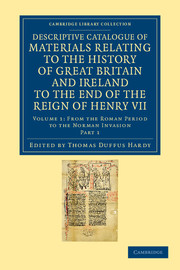
Sir Thomas Duffus Hardy (1804–78) was Deputy Keeper of the Public Record Office and an experienced medieval manuscript scholar, having edited the Monumenta historica Britannica after his mentor Henry Petrie's death. Hardy was closely involved with the Rolls Series of publications of medieval manuscripts in public ownership, a government-backed project, of which this catalogue (consisting of three volumes in four parts) forms part. His stated aim was to list 'all the known sources, printed or unprinted, of English history' in a handbook for historical researchers. Each item, from early mentions of Britain in Herodotus to medieval chronicles and saints' lives, is located and described, and, where Hardy has examined the original, the first and last lines are given. Where known, the author's life is briefly outlined. The first part of Volume 1 (published in 1862) includes sources from the classical period and the Dark Ages up to 750 CE.
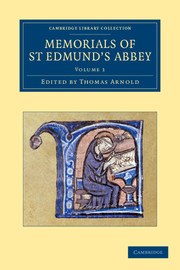
Bury St Edmunds possessed one of the wealthiest abbeys in England. This three-volume collection of Latin documents relating to the abbey was edited with English side-notes by Thomas Arnold (1823–1900) and published between 1890 and 1896. Volume 1 contains lives of the Saxon king Edmund (martyred by the Vikings), the miracles attributed to him, and Jocelyn de Brakelond's late twelfth-century chronicle of the abbey. In the preface, Arnold examines the manuscript sources that survive from Bury, analyses the legend of St Edmund, and discusses similarities between the cult of Edmund and that of St Cuthbert at Durham. Jocelyn's biography of Abbot Samson (d.1211) is one of the best-known manuscripts. Abbo of Fleury's Passio Sancti Eadmundi was commissioned by Ramsey Abbey around 985 and describes Edmund's death and sainthood. The accounts of his miracles were written by Herman the archdeacon around 1090 and by Abbot Samson a century later.
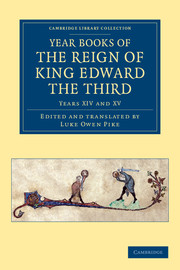
The records of the medieval English courts were compiled into manuscript 'year books', organised by regnal year of the monarch, and further subdivided into the four law terms. The year books of the reign of Edward III (1312–77), beginning at the eleventh year (1337) and continuing to the twentieth (1346), were to have been edited for the Rolls Series by Alfred Horwood (1821–81), who had previously edited the year books of Edward I, but he died while the first volume was in proof. The work was taken over by L. O. Pike (1835–1915), the set of fifteen books being published between 1883 and 1911. (Horwood chose his start date because the year books of Edward II and the first part of the reign of Edward III already existed in modern editions.) This volume contains reports from Michaelmas Term, 14 Edward III, to Hilary Term, 15 Edward III.
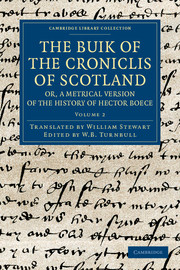
Hector Boece (c.1465–1536) was a Scottish humanist historian, educated in Dundee and Paris, where he became a friend of Erasmus. His Latin Scotorum historia, covering the period from 330 BCE until 1437, was published in 1527, and rapidly translated into French and Scots. It was continued by several authors, indicating that it was accepted as a definitive account of the formation of Scottish national identity, though, inevitably, many of the earlier parts rely on legend and tradition rather than on historical sources. Dedicated to James V, it is biased in favour of his ancestors, and, via Holinshed, was the source for Shakespeare's Macbeth. This verse translation was completed for James V by the courtier William Stewart in 1535, but not published until the Rolls Series edition by W. B. Turnbull in 1858. Volume 2 takes the story up to the eleventh century, and includes the story of Macbeth.
Marathi, an official language of Maharashtra and Goa, is among the twenty most widely spoken languages in the world. The southernmost Indo-Aryan language, it is also spoken in Gujarat, Madhya Pradesh, Karnataka, and Daman and Diu, and is believed to be over 1,300 years old, with its origins in Sanskrit. First published in 1805, this grammar of Marathi (then known as Mahratta) was compiled by the Baptist missionary William Carey (1761–1834) during his time in India. Its purpose was to assist Carey's European students at Fort William College in their learning of the language, and it is comprehensive in ITS coverage, providing numerous examples. Containing detailed descriptions of Marathi's Devanagari alphabet, its word and sentence formation, and its complex tense, voice, gender, agreement, inflection, and case systems, the work remains an invaluable resource for linguists today. Carey's 1810 dictionary of Marathi is also reissued in this series.
William Howard Russell (1820–1907) is today credited with having shaped the image and role of the modern war correspondent. His dispatches for The Times during the Crimean War were so influential that they led to military reforms and the fall of the Aberdeen Government. Moreover, his unflinching accounts of the appalling and insanitary conditions endured by ill-provisioned troops helped inspire the work of Florence Nightingale. He was not afraid to highlight poor leadership and planning, and was quick to praise the heroism of the 'common' soldier. Wearing military-style clothes, he obtained his information through his easy relationships with junior officers, helped by his fondness for brandy and cigars. This volume, published in 1856, includes his last Crimean dispatches, concluding with poignant descriptions of visits by the soldiers to the battlefields to erect memorials to their fallen comrades.
Hector Boece (c.1465–1536) was a Scottish humanist historian, educated in Dundee and Paris, where he became a friend of Erasmus. His Latin Scotorum historia, covering the period from 330 BCE until 1437, was published in 1527, and rapidly translated into French and Scots. It was continued by several authors, indicating that it was accepted as a definitive account of the formation of Scottish national identity, though, inevitably, many of the earlier parts rely on legend and tradition rather than on historical sources. Dedicated to James V, it is biased in favour of his ancestors, and, via Holinshed, was the source for Shakespeare's Macbeth. This verse translation was completed for James V by the courtier William Stewart in 1535, but not published until the Rolls Series edition by W. B. Turnbull in 1858. Volume 1 contains Books I–VI and covers wars with the Romans and Irish migration to Scotland.
The playwright and critic John Oxenford (1812–77) had an acute aptitude for languages. Although he translated both Molière and Calderón into English, he specialised in German translations and set high standards, not least with his rendering of several works by Johann Wolfgang von Goethe (1749–1832). Among the greatest literary figures of his day, Goethe combined considerable achievements as a poet, novelist and playwright with his diverse interests in natural science and politics. This two-volume translation of his autobiography first appeared in 1848–9. In Volume 1, Goethe tells the story of his life from the day he was born until the publication of The Sorrows of Young Werther, which attained cult status almost immediately after it was released in 1774. As the protagonist of his own story, Goethe reflects here on how he himself came of age.
Published as part of the Rolls Series in 1861, these collected letters date mainly from 1235–53, when, as bishop of Lincoln, their author presided over the largest diocese in England. Both a scientist and a theologian, Robert Grosseteste (c.1170–1253) boasts what the medieval historian R. W. Southern describes as 'a rarely paralleled breadth of intellectual interests'. His letters are invaluably illustrative of the social conditions of the time. He writes heatedly and earnestly on such topics as the laws concerning illegitimacy, the condition of the Jews and the liberties of the Church, with a violence of opinion that was 'balanced, indeed prompted, by a deep concern for the souls of ordinary people'. Henry Richards Luard (1825–91) puts Grosseteste's writing into context in his preface, while useful summaries of each letter in the contents list, and commentary provided in the side-notes, make the Latin text accessible to modern readers.
Daughter of the music publisher Vincent Novello, Mary Cowden Clarke (1809–98) grew up in London amid her father's literary and artistic circle. Charles and Mary Lamb were family friends, and their Tales from Shakespeare (1807) inspired the young Mary to become a scholar of the Bard. This monumental concordance - which took twelve years to compile and a further four to see through the press - was first published between 1844 and 1845 in eighteen monthly parts, and then in book form in 1845. The preface opens with a statement that reflects Cowden Clarke's great admiration and ambition: 'Shakspere [sic], the most frequently quoted, because the most universal-minded Genius that ever lived, of all Authors best deserves a complete Concordance to his Works.' It was to remain the standard work of its kind for half a century and is still a fascinating and diverting source of information on Shakespeare's extraordinary vocabulary.
Scottish writer Christian Isobel Johnstone (1781–1857) enjoyed a prolific career as a journalist and novelist. She established several periodicals with her second husband, and was the only female journalist to edit a major periodical until the 1860s. Written under the pseudonym Margaret Dods (the name of the landlady of the Cleikum Inn, in Scott's St Ronan's Well), the first edition of this housekeeping guide, published in 1826, contains not only recipes and cooking advice but also instructions for food preservation, as well as other useful domestic hints, and two pieces, probably by Scott himself, about the inauguration and the final meeting of the Cleikum Club. This second edition was published in 1827 and contains additions including a compendium of French cookery, an enhanced section on confectionery and a further 200 recipes. Several further editions were printed subsequently, providing Johnstone with a steady income for the rest of her life.
Sir Thomas Duffus Hardy (1804–78) was Deputy Keeper of the Public Record Office. He was closely involved with the Rolls Series of publications of medieval manuscripts in public ownership, of which this catalogue (consisting of three volumes in four parts) forms part. His stated aim was to list 'all the known sources, printed or unprinted, of English history'. Each item is located and described and where Hardy has examined the original, the first and last lines are given. Where known, the author's life is briefly outlined. The third volume, published in 1871, provides historical sources ranging from 1200 (the first full year of King John's reign) to the death of Edward II in 1327. This volume features 20 plates illustrating some of the types of manuscripts catalogued. A fourth volume, left uncompleted at Hardy's death, was to have continued the catalogue to the end of Henry VII's reign (1509).
Despite a frustrated ecclesiastical career - his ongoing failure to secure the See of St David's embittered him - Giraldus Cambrensis (Gerald of Wales, Gerald de Barry, c.1146–1220/3) composed many remarkable literary works, initially while employed as a royal clerk for Henry II and, subsequently, in semi-retirement in Lincoln. Eight volumes of his works were compiled as part of the Rolls Series of British medieval material. Volume 1, edited by historian J. S. Brewer (1809–79) and published in 1861, with an introduction in English to the Latin texts, consists of Giraldus' polemical-apologetic account of his life and the St David's case, and a collection of his letters, poems, and prefaces. Giraldus is noted for his vigorous Latin and anecdotal style, and this volume gives a vivid portrait of medieval Britain and the power struggles of the Angevin court, while illuminating nineteenth-century interest in the period.
The records of the medieval English courts were compiled into manuscript 'year books', organised by regnal year of the monarch, and further subdivided into the four law terms. The year books of the reign of Edward III (1312–77), beginning at the eleventh year (1337) and continuing to the twentieth (1346), were to have been edited for the Rolls Series by Alfred Horwood (1821–81), who had previously edited the year books of Edward I, but he died while the first volume was in proof. The work was taken over by L. O. Pike (1835–1915), the set of fifteen books being published between 1883 and 1911. (Horwood chose his start date because the year books of Edward II and the first part of the reign of Edward III already existed in modern editions.) This volume contains reports from Easter Term, 14 Edward III, to Trinity Term, 14 Edward III.
Hector Boece (c.1465–1536) was a Scottish humanist historian, educated in Dundee and Paris, where he became a friend of Erasmus. His Scotorum historia, covering the period from 330 BCE until 1437, was published in 1527, and rapidly translated into French and Scots. It was continued by several authors, indicating that it was accepted as a definitive account of the formation of Scottish national identity, though, inevitably, many of the earlier parts rely on legend and tradition rather than on historical sources. Dedicated to James V, it is biased in favour of his ancestors, and, via Holinshed, was the source for Shakespeare's Macbeth. This verse translation was completed for James by the courtier William Stewart in 1535, but not published until the Rolls Series edition by W. B. Turnbull in 1858. Volume 3, on the period from Malcolm II to the death of James I, also contains an extensive glossary.
The archaeologist Edward Dodwell (c.1776–1832) published this two-volume work in 1819. Elected an honorary member of Berlin's Royal Academy in 1816, Dodwell had been educated at Cambridge, toured France and Germany, and lived in Rome and Naples. Writing extensively on Greek antiquity, he made three tours of Greece, where he produced hundreds of drawings, recording in particular the Athenian Acropolis and the city walls of Argos. He also collected coins and discovered or acquired many valuable artefacts, notably bronzes and vases. Including reproductions of his accomplished illustrations, Volume 2 covers the end of his tour of 1805 and the whole of his final tour of 1806. Dodwell touches on the culture of contemporary Greece, covering also the Echinos ruins, the pass of Thermopylae, and the artefacts of Corinth. His detailed account, mixing travelogue with serious scholarship, remains of interest and relevance to classical archaeologists.
Bury St Edmunds possessed one of the wealthiest abbeys in England. This three-volume collection of Latin documents relating to the abbey was edited by Thomas Arnold (1823–1900) and published between 1890 and 1896. Volume 3 contains a variety of records. The Cronica Buriensis covers the years 1020–1346 in a manuscript of c.1400, and the Brevis Cronica, possibly by Thomas Croftis, c.1479, covers 1020–1471. There is also a collection of fifteenth-century letters, excerpts from Cambridge manuscripts relating to Bury St Edmunds, an account of the fourteenth-century dispute between the abbey and Bishop Bateman of Norwich, and a description of the fire of 1465 that completely gutted the church. The appendices include by-laws of 1477 concerning the town weavers, a charter of privileges of 1447, and another life of St Edmund. A glossary and index to all three volumes are also provided, along with English side-notes throughout.
The nineteenth-century academic and university administrator Henry Richards Luard (1825–91) was a major contributor to the Rolls Series. His edition of the Flores historiarum, published in three volumes in 1890, remains the standard work. This Latin chronicle, compiled at St Albans and Westminster, is largely a version of Matthew Paris's Chronica majora to 1259; subsequent annals are independent and serve as a significant primary source for the last years of Henry III and the reigns of Edward I and Edward II. Volume 3, covering 1265 to 1326, contains the majority of these independent annals, including some which are the work of the Westminster monk Robert of Reading. This volume also includes an introduction discussing the historical value of the chronicle and an exceptionally thorough index, which is invaluable for navigating all three volumes. English side-notes to the text are provided throughout.
In the mid-1440s, French knight Jean de Wavrin (c.1400–c.1473) took on the monumental task of compiling the first full-length history of England, spanning almost two millennia. Wavrin, who belonged to a noble family of Artois, was a chronicler under Philip the Good and Charles the Bold, Dukes of Burgundy. During his military career, he often fought on the side of the English, and was keen to keep the kingdom as an ally. He gathered a unique collection of records and used his own first-hand observations to write a work that provides a fascinating insight into the interests and methods of a medieval historian. Part of the Rolls series of publications of historical documents, this volume, published in 1864, was translated and edited by the archivist and antiquarian Sir William Hardy (1807–87). It ranges from Albion's mythical origins to the abdication and conversion of King Cædwalla of Wessex.
The records of the medieval English courts were compiled into manuscript 'year books', organised by regnal year of the monarch, and further subdivided into the four law terms. The year books of the reign of Edward III (1312–77), beginning at the eleventh year (1337) and continuing to the twentieth (1346), were to have been edited for the Rolls Series by Alfred Horwood (1821–81), who had previously edited the year books of Edward I, but he died while the first volume was in proof. The work was taken over by L. O. Pike (1835–1915), the set of fifteen books being published between 1883 and 1911. (Horwood chose his start date because the year books of Edward II and the first part of the reign of Edward III already existed in modern editions.) This volume contains reports from Hilary Term, 17 Edward III, to Trinity Term, 17 Edward III.