Cambridge Editions present the works and correspondence of great thinkers and writers. Introductions, explanatory notes and textual apparatus accompany a reliable version of the text, aiding scholars and students alike.
To save content items to your account,
please confirm that you agree to abide by our usage policies.
If this is the first time you use this feature, you will be asked to authorise Cambridge Core to connect with your account.
Find out more about saving content to .
To save content items to your Kindle, first ensure no-reply@cambridge.org
is added to your Approved Personal Document E-mail List under your Personal Document Settings
on the Manage Your Content and Devices page of your Amazon account. Then enter the ‘name’ part
of your Kindle email address below.
Find out more about saving to your Kindle.
Note you can select to save to either the @free.kindle.com or @kindle.com variations.
‘@free.kindle.com’ emails are free but can only be saved to your device when it is connected to wi-fi.
‘@kindle.com’ emails can be delivered even when you are not connected to wi-fi, but note that service fees apply.
Ambrose’s tenure as metropolitan bishop of an imperial capital brought him into considerable contact with the eastern emperor Theodosius I, who frequently resided in Milan during his visits to the West, especially from 388 to 391. Ambrose’s engagement with the emperor was confrontational. For instance, early in his stay, at a church service, Theodosius sought to take communion with the priests at the altar, as was the custom in Constantinople, but according to the church historian Sozomen (Ecclesiastical History 7.25.9), Ambrose told him to return to his seat. This was a harbinger of the complex power dynamic that would characterize the relationship between emperor and bishop in the coming years. In 390, after a general was murdered by rioters in the city of Thessalonica, troops were let loose on the city’s residents, many of whom were slaughtered.
As noted in the introduction to Hilary’s Sermon, Honoratus founded a monastic community sometime between 400 and 410 on an island off the coast of what is now Cannes in southern France. Then called Lerina, the island is now called Île Saint-Honorat de Lérins. Inspired by the desert fathers he had visited during his travels, Honoratus initiated at Lérins a style of monastic living that stressed individual ascetic pursuits within a communal context. It has been described as a monastery of hermits in community. As time went on, however, and due to the influence of the writings of Augustine and John Cassian – the latter dedicated his second set of Conferences to Honoratus and Eucherius (another monk of Lérins, who was chosen bishop of Lyon around 434) – the monastery of Lérins came to place more emphasis on the communal aspects of monastic living.
The Life of Hypatius was likely written in the mid-fifth century by Callinicus, the second abbot of the monastery that Hypatius founded across the Bosporus Strait from Constantinople. From a literary perspective, the text is a fairly conventional example of a late antique Greek hagiography; it owes much in structure, tenor, and phrasing to the period’s most well-known hagiography, Athanasius’ Life of Antony. Based on evidence internal to the narrative, Hypatius would have lived from 366 to 446 and would have, along with two companions, set up their community some three miles south of Chalcedon around 400 in an otherwise unoccupied compound that included an apostolic church (that doubled as a martyrium), palace, and monastery built by the imperial official Rufinus. During the early years of Hypatius’ residence here, the site hosted the Synod of the Oak, an event that ultimately deposed John Chrysostom, although Hypatius was personally absent during the trial. Two of the Egyptian monks known as the Tall Brothers – Ammonius and Dioscorus – died during their stay, and their remains were deposited within the church.
Between 400 and 410, Honoratus, the scion of a noble Gallic family, founded a monastic community on the island of Lérins (modern Île Saint-Honorat de Lérins, just off the coast of Cannes in southern France). A charismatic figure, Honoratus inspired many men from Gaul and elsewhere, including his relative Hilary, to take up the ascetic life at Lérins. Some years later, around 427 or 428, when the island monastery had become an unqualified success, Honoratus left to become bishop of Arles, although he died shortly thereafter in 430. His successor as bishop, Hilary, commemorated the first anniversary of Honoratus’ death in 431 with a sermon delivered to the Christian community of Arles on his life and virtues. Having only been in office for a year, Hilary used the sermon to provide a kind of apologia for his own episcopal leadership, presenting himself as Honoratus’ handpicked and personally trained successor. Hilary served as the bishop of Arles until his own death in 449.
This is the only work that survives by Socrates Scholasticus, a figure traditionally believed to be a lawyer, despite no evidence indicating as much. His Ecclesiastical History was likely written late in the reign of Theodosius II, covering the period from Emperor Constantine to Emperor Theodosius II (from 305 to 439). Like his fellow fifth-century historians Theodoret of Cyrrhus and Sozomen, Socrates, who likely wrote his work before they wrote theirs, picks up his narrative of church history where Eusebius of Caesarea left off in his Ecclesiastical History and tracks the activity of bishops, priests, monks, emperors, imperial officials, and military figures as they operate within the then-new cultural matrix of an imperialized Christianity. He draws on the original writings of many of his subjects and incorporates material from Eusebius of Caesarea’s Life of Constantine, Rufinus of Aquileia’s Ecclesiastical History, and the lost work of Gelasius of Caesarea, among other sources. While Socrates avoids the triumphalist tone that defined the writings of his predecessor Eusebius, he nevertheless uses his work to argue that the world benefits from a strong relationship between Christian worship and state power.
Caesarius was born in the Burgundian city of Chalons-sur-Saône around 470. At the age of seventeen, he entered the island monastery of Lérins. But after a few years he was sent to Arles to regain his health, which he had ruined through intense asceticism. Aeonius, the bishop of Arles and a relative of Caesarius, ordained him to the diaconate and the priesthood, then appointed him the abbot of Trinquetaille, a monastery in the suburbs of Arles. When Aeonius died in 501 or 502, Caesarius succeeded him as bishop, a position that embroiled Caesarius in the politics of the area, in which the interests of the Visigoths, the Franks, and the Gallo-Romans were often in conflict. He became the most prominent bishop in the Gallic church when pope Symmachus of Rome confirmed him as metropolitan and papal vicar for Gaul in 514. He presided over a number of synods and councils in Gaul, the most important being the Council of Orange in 529, which condemned the teaching on grace that predominated in southern Gaul in favor of a modified Augustinian position.
Tertullian (ca. 170–225) was a Christian writer whose work provides some of the scant evidence we have for North African Christianity of that era. Little is known about his life, and details from later Christian writers like Jerome and Eusebius are dubious at best. What we can say with certainty is that Tertullian became increasingly rigorist over the course of his life – with respect to ethics, doctrine, and communal boundaries. Indeed, his increasing rigorism aligned him with a broader movement of rigorists in the North African Christian community, the Church of the New Prophecy (traditionally known as Montanism). This Christian revivalist movement began in Phrygia during the mid-second century but migrated to various regions throughout the Mediterranean basin, including Carthage. The Church of the New Prophecy understood the history of salvation as one marked by increasingly intense moral rigor: the Old Testament patriarchs were allowed conduct (polygamy, for example) that was prohibited by Jesus and the apostles in the New Testament. Indeed, God’s revelation continued in the oracular statements of “new prophets” like Montanus, Priscilla, and Maximilla, statements that were understood as equally authoritative utterances of the Spirit.
In his autobiographical Confessions, Augustine (354–430) recounted his own circuitous path to Christianity. When he later became bishop of Hippo in North Africa, Augustine oversaw the reception of converts into the church. So Augustine was intimately aware of dynamics of conversion and the many forms it could take from both personal and pastoral experience. In Sermon 279, which was preached in Carthage on Sunday, June 23, 401, Augustine touches upon several facets of conversion to Christianity.
Whereas Poem 2.1.12, “On Himself and Concerning the Bishops,” unleashes Gregory’s invective against, in his view, corrupt, ambitious, and self-centered clergy members, Oration 43.1, “Funeral Oration for Basil the Great, Bishop of Cappadocian Caesarea,” presents a radically positive image of a bishop. The text is a long eulogy for Bishop Basil of Caesarea (ca. 329–378) delivered three years after his death, which makes it almost precisely contemporaneous to Poem 2.1.12. Basil was Gregory’s friend, and the careers of the two men overlapped significantly: they shared some of the same education at Athens; they practiced asceticism together in the early 360s on Basil’s property in Pontus; they were ordained to the priesthood around the same time; and both were thrust into the politics of provincial church life almost immediately after their ordinations. While their relationship was perhaps more complicated than Gregory’s idealized portrait suggests, here readers get a sense for the lifestyle, ascetic regimen, theology, and pastoral concern that Gregory valued in Christian leaders. The sections translated here pertain to Basil’s episcopacy (the sections about his education, monastic retreat, and priesthood have been omitted for brevity).
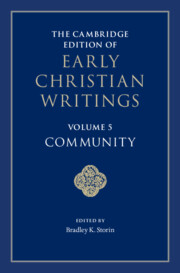
The Cambridge Edition of Early Christian Writings provides the definitive anthology of early Christian texts, from ca. 100 CE to ca. 650 CE. Its volumes reflect the cultural, intellectual, and linguistic diversity of early Christianity, and are organized thematically on the topics of God, Practice, Christ, and Community. The series expands the pool of source material to include not only Greek and Latin writings, but also Syriac and Coptic texts. Additionally, the series rejects a theologically normative view by juxtaposing texts that were important in antiquity but later deemed 'heretical' with orthodox texts. The translations are accompanied by introductions, notes, suggestions for further reading, and scriptural indices. The fifth and final volume focuses on the theme of community within early Christian writings-how Christians joined the community, how they managed the community, how they conceptualized the community, and how they policed the community. It will be an invaluable resource for students and academic researchers in early Christian studies, history of Christianity, theology and religious studies, and late antique Roman history.