Cambridge Editions present the works and correspondence of great thinkers and writers. Introductions, explanatory notes and textual apparatus accompany a reliable version of the text, aiding scholars and students alike.
To save content items to your account,
please confirm that you agree to abide by our usage policies.
If this is the first time you use this feature, you will be asked to authorise Cambridge Core to connect with your account.
Find out more about saving content to .
To save content items to your Kindle, first ensure no-reply@cambridge.org
is added to your Approved Personal Document E-mail List under your Personal Document Settings
on the Manage Your Content and Devices page of your Amazon account. Then enter the ‘name’ part
of your Kindle email address below.
Find out more about saving to your Kindle.
Note you can select to save to either the @free.kindle.com or @kindle.com variations.
‘@free.kindle.com’ emails are free but can only be saved to your device when it is connected to wi-fi.
‘@kindle.com’ emails can be delivered even when you are not connected to wi-fi, but note that service fees apply.
This volume of Proclus' commentary on Plato's Timaeus records Proclus' exegesis of Timaeus 27a–31b, in which Plato first discusses preliminary matters that precede his account of the creation of the universe, and then moves to the account of the creation of the universe as a totality. For Proclus this text is a grand opportunity to reflect on the nature of causation as it relates to the physical reality of our cosmos. The commentary deals with many subjects that have been of central interest to philosophers from Plato's time onwards, such as the question whether the cosmos was created in time, and the nature of evil as it relates to physical reality and its ontological imperfection.
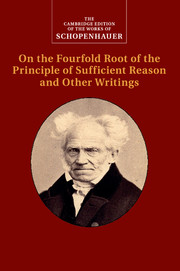
This volume of translations unites three shorter works by Arthur Schopenhauer that expand on themes from his book The World as Will and Representation. In On the Fourfold Root he takes the principle of sufficient reason, which states that nothing is without a reason why it is, and shows how it covers different forms of explanation or ground that previous philosophers have tended to confuse. Schopenhauer regarded this study, which he first wrote as his doctoral dissertation, as an essential preliminary to The World as Will. On Will in Nature examines contemporary scientific findings in search of corroboration of his thesis that processes in nature are all a species of striving towards ends; and On Vision and Colours defends an anti-Newtonian account of colour perception influenced by Goethe's famous colour theory. This is the first English edition to provide extensive editorial notes on the different published versions of these works.
Thomas Love Peacock (1785‒1866) is one of the most distinctive prose satirists of the Romantic period. The Cambridge Edition of the Novels of Thomas Love Peacock offers the first complete text of his novels to appear for more than half a century. Crotchet Castle (1831), his sixth novel, contains all the humour and social satire for which Peacock is famous. Its lively farce is more ambitious than that of the earlier works in its range of cultural and intellectual targets, including progressivism, dogmatism, liberalism, sexism, mass education and the idiocies of the learned. The book constitutes an artistic, political and philosophical miscellany of sorts, thematically unified in its satirical emphasis on folly and dispute – and on the folly of dispute itself. This edition provides a full introduction, chronology, annotations and detailed textual and scholarly apparatus.
Thomas Love Peacock (1785–1866) is one of the most distinctive prose satirists of the Romantic period. The Cambridge Edition of the Novels of Thomas Love Peacock offers the first complete text of his novels to appear for more than half a century. Nightmare Abbey (1818), Peacock's third novel, is a spirited satire that shows Peacock to be a perceptive observer and engaged critic of the literary and political preoccupations of his time. While the novel has often been characterized in popular culture either as a burlesque of the Gothic novel or a mere spoof of Romantic gloom and doom, this edition recognizes it as a purposeful critique of Romanticism. Explanatory notes illustrate the ways in which several characters are caricatures of prominent Romantic writers, including Peacock's close friend Shelley as well as Coleridge and Byron, and also identify the various sources, some previously unsuspected, from which Peacock created their dialogue.
Proclus' Commentary on Plato's dialogue Timaeus is arguably the most important commentary on a text of Plato, offering unparalleled insights into eight centuries of Platonic interpretation. This edition offered the first new English translation of the work for nearly two centuries, building on significant advances in scholarship on Neoplatonic commentators. It provides an invaluable record of early interpretations of Plato's dialogue, while also presenting Proclus' own views on the meaning and significance of Platonic philosophy. The present volume, the third in the edition, offers a substantial introduction and notes designed to help readers unfamiliar with this author. It presents Proclus' version of Plato's account of the elements and the mathematical proportions which bind together the body of the world.
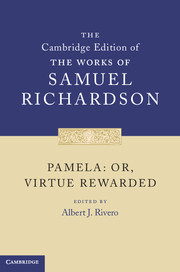
Pamela: Or, Virtue Rewarded is perhaps the most influential novel published in Britain in the eighteenth century. On its first publication in 1740, it became an immediate bestseller. Its epistolary structure, tight plotting and didactic message were praised, imitated, but also criticised and satirised. This new critical edition of Samuel Richardson's first novel features an authoritative text based on the first edition, general and textual introductions, extensive explanatory notes and textual apparatus. Appendices provide bibliographical descriptions of all lifetime editions as well as the editions of 1801 and 1810, Richardson's introduction to the second edition (fully annotated), and the illustrations and Richardson's index from the octavo edition. The publication of this volume heralds the first full scholarly edition of Richardson's complete works, a long-awaited event in eighteenth-century studies.
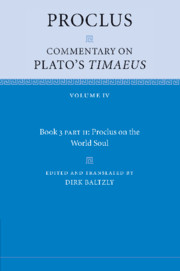
In the present volume Proclus describes the 'creation' of the soul that animates the entire universe. This is not a literal creation, for Proclus argues that Plato means only to convey the eternal dependence of the World Soul upon higher causes. In his exegesis of Plato's text, Proclus addresses a range of issues in Pythagorean harmonic theory, as well as questions about the way in which the World Soul knows both forms and the visible reality that comprises its body. This part of Proclus' Commentary is particularly responsive to the interpretive tradition that precedes it. As a result, this volume is especially significant for the study of the Platonic tradition from the earliest commentators onwards.
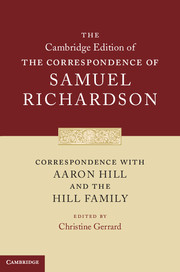
Samuel Richardson (1689–1761) was an established master printer when, at the age of 51, he published his first novel, Pamela, and immediately became one of the most influential and admired writers of his time. Not only were all Richardson's novels written in epistolary form: he was also a prolific letter-writer himself. This volume in the first ever full edition of Richardson's correspondence includes his letters to and from Aaron Hill, the poet, dramatist and entrepreneur (1685–1750). Hill was Richardson's earliest literary friend and advisor as he embarked on a new career as a novelist. This correspondence offers fascinating insight into the compositional processes not just of the two Pamela novels, but of Richardson's later novels Clarissa and The History of Sir Charles Grandison. The volume also contains Richardson's correspondence with Hill's three literary daughters, which forms an invaluable chapter in the history of women's writing and literary criticism.
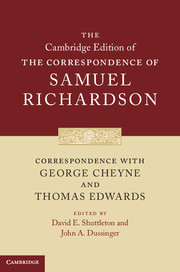
Samuel Richardson (1689–1761), among the most important and influential English novelists, was also a prolific letter writer. Beyond its extraordinary range, his correspondence holds special interest as that of a practising epistolary novelist, who thought long and hard about the letter as a form. The Cambridge Edition of the Correspondence of Samuel Richardson is the first complete edition of his letters. The present volume contains his correspondences with Dr George Cheyne and Thomas Edwards, linked not only by their pronounced medical content but also by their generally unguarded character. An early admirer of Richardson's Pamela (1740–41), Cheyne elicits some of the novelist's most significant statements concerning his own literary practice and tastes. Edwards, an astute literary critic as well as notable sonneteer, draws Richardson into expressing some remarkable insights as a close reader of poetry and prose.
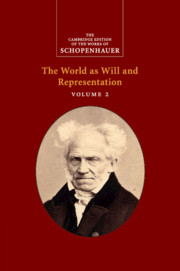
The purpose of the Cambridge Edition of the Works of Schopenhauer is to offer translations of the best modern German editions of Schopenhauer's work in a uniform format for Schopenhauer scholars, together with philosophical introductions and full editorial apparatus. The World as Will and Representation contains Schopenhauer's entire philosophy, ranging through epistemology, metaphysics, philosophy of mind and action, aesthetics and philosophy of art, to ethics, the meaning of life and the philosophy of religion. This second volume was added to the work in 1844, and revised in 1859. Its chapters are officially 'supplements' to the first volume, but are indispensable for a proper appreciation of Schopenhauer's thought. Here we have his most mature reflections on many topics, including sex, death, conscious and unconscious desires, and the doctrines of salvation and liberation in Christian and Indian thought. Schopenhauer clarifies the nature of his metaphysics of the will, and synthesizes insights from a broad range of literary, scientific and scholarly sources. This new translation reflects the eloquence and power of Schopenhauer's prose, and renders philosophical terms accurately and consistently. It offers an introduction, glossary of names, bibliography, and succinct editorial notes.