Cambridge Editions present the works and correspondence of great thinkers and writers. Introductions, explanatory notes and textual apparatus accompany a reliable version of the text, aiding scholars and students alike.
To save content items to your account,
please confirm that you agree to abide by our usage policies.
If this is the first time you use this feature, you will be asked to authorise Cambridge Core to connect with your account.
Find out more about saving content to .
To save content items to your Kindle, first ensure no-reply@cambridge.org
is added to your Approved Personal Document E-mail List under your Personal Document Settings
on the Manage Your Content and Devices page of your Amazon account. Then enter the ‘name’ part
of your Kindle email address below.
Find out more about saving to your Kindle.
Note you can select to save to either the @free.kindle.com or @kindle.com variations.
‘@free.kindle.com’ emails are free but can only be saved to your device when it is connected to wi-fi.
‘@kindle.com’ emails can be delivered even when you are not connected to wi-fi, but note that service fees apply.
This is the first edition of a Latin text unlike any other surviving one : at first sight an extensive, jumbled list of words with explanations, on closer inspection a window on the teaching of Latin shorthand in North Africa c. AD 400, when we find notarii, those trained in shorthand, prominently employed everywhere in state and church. The text reveals in detail how that training could relate to literary Latin and the classical Roman past. The single manuscript of it in our possession descends from a copy that must have been in Anglo-Saxon England by AD 700, and we can see how it was used for the earliest Latin glossary from that context. The edition seeks to make this story accessible both in general and in detail, with copious indices for those who may wish to consult it from various viewpoints: classical and later Latin, linguistic and historical.
The Cambridge Edition of the Complete Fiction of Henry James provides, for the first time, a scholarly edition of a major writer whose work continues to be read, quoted, adapted and studied. Published in two volumes in 1880, Washington Square dramatises the plight of Catherine Sloper, a rich heiress, whose father, a successful doctor, identifies her one suitor, Morris Townsend, as a fortune-hunter. The novel thus draws on the sentimental tradition, which it develops with subtle, sympathetic irony, in a realist direction. This edition is the first to provide a full account of the context in which the book was composed and received, and to include the original illustrations by Punch-cartoonist George Du Maurier. Extensive explanatory notes enable modern readers to understand its nuanced historical, cultural and literary references, and its complex textual history.
Samuel Richardson (1689–1761), renowned English novelist and master printer, was also a prolific letter writer. The Cambridge Edition of the Correspondence of Samuel Richardson is the first complete edition of his letters. These three volumes contain his correspondence, much of it published for the first time, with two fascinating women: Dorothy, Lady Bradshaigh (1705–85) and her sister Elizabeth, Lady Echlin (1704–82). Lady Bradshaigh was Richardson's most prolific and important correspondent, challenging him about a range of issues, literary and otherwise, including his intentions for Clarissa and Sir Charles Grandison, in an iconoclastic style. Lady Echlin lived in Ireland for much of her life and provided Richardson with information on Irish issues, including the Dublin editions of his novels. The scholarly apparatus in this volume furnishes a wealth of material about these women's lives and their milieu, affording many insights into eighteenth-century English and Irish social and literary history.
Samuel Richardson (1689–1761) was a prominent eighteenth-century printer and businessman as well as an important and influential English novelist. He was also a prolific letter writer. This volume in the first ever full edition of Richardson's correspondence offers a fascinating glimpse of the writer in his final years - at the height of his professional powers but facing the challenging circumstances of physical decline and commercial conflict. The collection of miscellaneous letters addresses a variety of issues ranging from details of Richardson's printing operation to his mentorship of women writers including Sarah Fielding, Anna Meades and Frances Sheridan. Other correspondents of note include Samuel Johnson, Meta Klopstock, Thomas Sheridan and Tobias Smollett. Taken together this series of letters draws an intimate picture of Richardson's professional and personal circles as they exchange family gossip, business advice, literary anecdotes and news of the day.
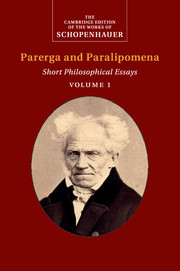
With the publication of the Parerga and Paralipomena in 1851, there finally came some measure of the fame that Schopenhauer thought was his due. Described by Schopenhauer himself as 'incomparably more popular than everything up till now', the Parerga is a miscellany of essays addressing themes that complement his work The World as Will and Representation, along with more divergent, speculative pieces. It includes his 'Aphorisms on the Wisdom of Life', reflections on fate and clairvoyance, trenchant views on the philosophers and universities of his day, and an enlightening survey of the history of philosophy. The present volume offers a new translation, a substantial introduction explaining the context of the essays, and extensive editorial notes on the different published versions of the work. This readable and scholarly edition will be an essential reference for those studying Schopenhauer, the history of philosophy, and nineteenth-century German philosophy.
Proclus' commentary on Plato's dialogue Timaeus is arguably the most important commentary on a text of Plato, offering unparalleled insights into eight centuries of Platonic interpretation. It has had an enormous influence on subsequent Plato scholarship. This edition offers the first new English translation of the work for nearly two centuries, building on significant recent advances in scholarship on Neoplatonic commentators. It provides an invaluable record of early interpretations of Plato's dialogue, while also presenting Proclus' own views on the meaning and significance of Platonic philosophy. The present volume, the fifth in the edition, presents Proclus' commentary on the Timaeus, dealing with Proclus' account of static and flowing time; we see Proclus situating Plato's account of the motions of the stars and planets in relation to the astronomical theories of his day. The volume includes a substantial introduction, as well as notes that will shed new light on the text.
This is the first edition to assemble all of the earliest known works by Samuel Richardson (1689–1761), one of the most influential authors in the English tradition. Richardson's exercises in conduct-writing, religious controversialism, anti-theatrical polemic, occasional verse, literary criticism – and his popular and surprisingly revealing edition of Aesop's Fables – resonate throughout his later work while claiming ample legitimacy of their own. Readers familiar with only Pamela, Clarissa and Sir Charles Grandison will gain a fresh appreciation of the genesis of and the historical and cultural complexities at work in these famous novels, and readers new to Richardson will encounter an agile writer who invites closer consideration. A lengthy introduction situates the constituent works in Richardson's career as well as in the period more broadly, and the extensive textual apparatus records the bibliographical histories of the texts and their treatment by their present editor.
Pamela in Her Exalted Condition follows the heroine of Richardson's hugely popular first novel into married life. In the process, he explores both the experience of women beyond the stage of courtship and provides a fascinating insight into the social and cultural life of the mid eighteenth century. The first ever scholarly edition of the novel, this volume features a critically edited text, general and textual introductions, full annotations and textual apparatus. Appendices describe all the editions published in Richardson's lifetime as well as early nineteenth-century editions. The original illustrations from the popular octavo edition of 1742 and Richardson's index are reproduced. The publication of this novel in the Cambridge edition allows the sequel to Pamela to take its rightful place in the critical study of Richardson's development as a novelist.