To save content items to your account,
please confirm that you agree to abide by our usage policies.
If this is the first time you use this feature, you will be asked to authorise Cambridge Core to connect with your account.
Find out more about saving content to .
To save content items to your Kindle, first ensure no-reply@cambridge.org
is added to your Approved Personal Document E-mail List under your Personal Document Settings
on the Manage Your Content and Devices page of your Amazon account. Then enter the ‘name’ part
of your Kindle email address below.
Find out more about saving to your Kindle.
Note you can select to save to either the @free.kindle.com or @kindle.com variations.
‘@free.kindle.com’ emails are free but can only be saved to your device when it is connected to wi-fi.
‘@kindle.com’ emails can be delivered even when you are not connected to wi-fi, but note that service fees apply.
We have seen in preceding chapters that molecular lines are excellent tracers of interstellar gas, of star-forming regions, and of the interactions of stars on their environments in the Milky Way Galaxy and in external galaxies. Observations of molecular emissions, supported by detailed modelling, allow a rather complete physical description to be made of the regions where these molecules are located, even when the galaxies are not spatially resolved. But what about pregalactic situations in the Universe? These include some of the most active areas of research in modern astronomy. Did molecules have a role to play in pregalactic astronomy, and if so could molecular emissions help to trace processes occurring very early in the evolution of the Universe? When did molecular processes begin to play an important role? What are the best tracers of the first galaxies in the Universe?
In this chapter we show that molecules were likely to be present from the era of recombination after the Big Bang and certainly played an important role in the formation of protogalaxies and of the first stars. Whether molecules generated detectable signatures of those very early events is problematic, at least with our present range of astronomical instrumentation. However, it seems likely that we shall soon find molecular signatures of the post-recombination era. Once the first stars appeared and seeded their environments with metallicity, the formation of the first galaxies was modulated by molecules and it should certainly be possible to trace their formation using molecular emissions.
The preceding chapters in this book have demonstrated that to trace particular astronomical features in the Milky Way or in external galaxies by using molecular line emissions, the astronomer needs to choose lines corresponding to appropriate transitions. The transitions to use will, obviously, be those whose upper levels are readily populated in the gas that is to be observed. In many situations, the most important excitation mechanism to the upper level is collisional, and H2 is often the main collisional partner.
For example, we have seen that the CO(1–0) transition is appropriate for searching for and detecting cold neutral gas with a kinetic temperature of ∼10 K, where the number density of hydrogen molecules is ∼103 cm−3. However, observations of radiation emitted in this transition cannot reveal, say, the presence of either cold or warm gas at a density of, say, ∼105 cm−3, because collisional de-excitation of the upper level occurs before radiation in the (1–0) line can occur. Therefore, to observe gas at higher densities, observers must use more highly excited CO lines that have larger spontaneous radiation probabilities (assuming that these highly excited levels are sufficiently populated at the prevailing temperature). Alternatively, observers may use a line from some other molecular species that has more appropriate fundamental properties for the physical conditions in the gas to be observed. Of course, as we have seen in Chapters 8 and 9, complications introduced by high optical depths in the lines observed may also make it difficult to infer physical properties in the observed regions. The simple physics in the above arguments is encapsulated in the concept of critical density (see Section 2.3).
Studying the interstellar medium of the Milky Way Galaxy gives us the opportunity of identifying in detail the various components of the medium. The equivalent components in distant galaxies may be unresolved, but contribute to the overall emission. We show in Chapter 6 how to deal with emission from unresolved regions. In this chapter we consider the various distinct types of region in the Milky Way that can be explored through molecular line absorptions and emissions. We show that the chemistry in each of these molecular regions is dominated by one or more of the chemical drivers discussed in Chapter 3. The sensitivity of the chemistry to particular physical parameters, discussed in Chapter 4, may be an important concern in some cases. For most molecular regions, we identify a well-known example of each type, which is not necessarily typical but is one in which the consequences of the chemical driver are prominently displayed. We also list some molecular tracers useful in describing the physical conditions in these different situations. We emphasise in particular the tracers of density and temperature for Milky Way conditions. The aim of this chapter is to show how tracer molecules can reveal the nature, origin, and evolution of many types of region in the Milky Way. Tracers of conditions in galaxies external to the Milky Way are considered in Chapter 6.
In Chapter 8 we covered the basic formulae and recipes that astronomers use to derive physical quantities from molecular observations. These simple LTE analyses provide observers with rough estimates of the density and temperature of the gas at equilibrium. However, molecular observations can also provide much further insight into the physical conditions and the history and dynamics of the gas if interpreted with the right tools. In this chapter we describe the chemical and radiative transfer models that have been developed over many years and we show how a careful use of such tools makes molecules into powerful diagnostics of the evolution and distribution of molecular gas in the interstellar medium. It is now possible for the observer to use well-established modelling codes to exploit the information contained in the observational data and to determine a rather complete description of the observed interstellar material. This chapter discusses the inputs required and the outputs expected from such models.
Chemical Modelling
Owing to the large range of densities and temperatures present in the interstellar medium, significant changes in the energetics and dynamics of the gas can occur, leading to large variations in the chemical abundances. For decades now, chemical simulations (based on the processes described in Chapter 3) have provided astrochemists with predictions of molecular abundances as a function of the physical conditions. However, the interpretation of chemical models is not a trivial task and demands a detailed knowledge of the way the chemical model is developed.
The first detections of molecular emissions from species such as CO and HCN in external but relatively nearby galaxies were made in the 1970s. From the 1990s, detections were made of CO emission from high-redshift objects, culminating in the remarkable identification in 2003 of high-excitation CO in a gravitationally lensed quasar at a redshift of 6.4. At that time, this was the most distant quasar known. In standard cosmology a redshift of 6.4 represents material when the Universe was merely a few percent of its present age. The discovery of molecular emission in such a distant object demonstrated that chemistry was occurring very early in the evolution of the Universe, and its products – molecules – must therefore also be widespread. In more recent years, it has been firmly established that chemistry in external galaxies can be complex and well developed. So the question arises: Can we use molecular emissions from distant galaxies to explore the physical conditions in them and their likely evolutionary status, as we can do for various regions of the Milky Way (cf. Chapter 5)?
There are a couple of points to be borne in mind, before simply applying the ideas in Chapter 5 to external galaxies. The most important one is that – apart from the nearest objects – most galaxies will be spatially unresolved; the telescope beam will usually encompass the entire galaxy being observed, so that emissions from many types of region are compounded. However, the detection of, say, CO, SiO, and CH3OH emissions in a spatially unresolved galaxy does not mean that they occur in the same region of that galaxy: the first molecule may indicate the presence of cold tenuous clouds, the second strong shocks, and the third dense star-forming cores. External galaxies will, in general, contain the variety of regions and sources similar to those that we can identify in the Milky Way.
In this chapter we summarise briefly the notation of molecular spectroscopy, with examples of transitions used to identify molecular species in the interstellar medium. We also describe how radiation is transported in the interstellar medium, introducing ideas that will be needed in Chapters 8 and 9. Finally, we discuss the processes that determine level populations of molecules in the interstellar medium.
Molecular Spectroscopy
Whereas most atomic spectra are determined simply by transitions between individual electronic states, molecular spectra are more complex because molecules have additional degrees of freedom associated with vibration and rotation. Each electronic state of a molecule possesses a manifold of vibrational levels, and each of those vibrational levels has a ladder of rotational levels associated with it. Electronic transitions in molecules therefore occur between specific vibrational and specific rotational levels in each electronic state. The equivalent of a single atomic line corresponding to an electronic transition is – for a molecule – replaced by a set of many lines (see Figure 1.2 for part of the H2 electronic transition B–X, between the two lowest electronic states, showing the vibrational and rotational structure). These electronic transitions often lie in the ultraviolet spectrum.
Molecules also possess transitions that have no counterpart in atoms. Molecules may undergo transitions between specific rotational states of vibrational states, that is, ro-vibrational transitions. These transitions usually occur in the near-infrared range. Pure rotational transitions may also occur between rotational states of the same vibrational level. These tend to lie in the far-infrared, or in the millimetre to submillimetre range of the electromagnetic spectrum.
In Chapter 3 we saw that the chemistry producing molecular tracers in interstellar space is driven in a variety of ways: by electromagnetic radiation at UV and X-ray wavelengths; by ionisation caused by cosmic ray particles; by reactions on grains or in their icy mantles; and in chemistry induced by gas dynamics. In many types of region, some or all of these processes may act together; in others, one of them may dominate. The atomic and molecular tracers produced reflect the nature of the chemical drivers that are operating.
However, there is another complication. Each chemical driver does not always operate at the same rate; a driver may vary from place to place in the interstellar medium of a galaxy, or from galaxy to galaxy, or even from time to time. For example, the local UV radiation field in a galaxy with a transient high star-formation rate may be much more intense than the value corresponding to the mean intensity in the Milky Way Galaxy. Similarly, cosmic rays are accelerated by magnetohydrodynamical events and so locations of high dynamical activity may have much greater fluxes of cosmic rays than in more quiescent regions. Also, chemistry on dust grains is obviously affected by the dust:gas ratio and by the nature of the surfaces of the dust; both of these may vary from place to place within the Milky Way Galaxy, and from galaxy to galaxy. Finally, gas dynamical events causing shocks or turbulent mixing can be an important driver of the chemistry.
It is clear that molecular line emissions can yield important information about the physical conditions of the gas and dust in our own as well as in external galaxies. What is not so clear is how to transform observational results into such physically meaningful information. This chapter aims at providing some simple recipes to aid the observer in achieving this goal. In this chapter we describe the relationships between the observable quantities in submillimetre molecular astronomy and the physical information that the observer would like to obtain. Inevitably, several approximations are made in order to derive such information, depending on the spectral and spatial resolution available, as well as the number of observable molecular transitions of any one species.
We start by relating what we measure with submillimetre and radio telescopes, that is, the antenna temperature, Ta, to the fundamental molecular constants and the relevant astronomical parameters. What we would like to know are the column densities of the observed species and the gas temperatures and number densities of the local gas. We shall describe first how to obtain these quantities if the gas is in Local Thermal Equilibrium (LTE), that is, where the level populations are dominated by collisions in a gas at a uniform temperature. The methods of obtaining this information depend on the types of molecule involved. We conclude this chapter by discussing the conversion of column densities into fractional abundances compared to the total hydrogen abundance, quantities that are directly comparable to the predictions of chemical models. In Chapter 9 we describe some approximations routinely used when LTE does not apply.
It is a relatively straightforward matter to use freely available computer codes and lists of chemical reactions to compute abundances of molecular species for many types of interstellar or circumstellar region. For example, the UDfA, Ohio, and KIDA websites (see Chapter 9) provide lists of relevant chemical reactions and reaction rate data. Codes to integrate time-dependent chemical rate equations incorporating these data are widely available and provide as outputs the chemical abundances as functions of time. For many circumstances, the codes are fast, and the reaction rate data (from laboratory experiments and from theory) have been assessed for accuracy. The required input data define the relevant physical conditions for the region to be investigated.
These codes and databases are immensely useful achievements that are based on decades of research. However, the results from this approach do not readily provide the insight that addresses some of the questions we posed in Chapter 1: What are the useful molecular tracers for observers to use, and how do these tracers respond to changes in the ‘drivers’ of the chemistry? Observers do not need to understand all the details of the chemical networks (which may contain thousands of reactions), but it is important to appreciate how the choice of the tracer molecule may be guided by, and depend on, the physical conditions in the regions they wish to study.
Molecules pervade the cooler, denser parts of the Universe. As a useful rule of thumb, cosmic gases at temperatures of less than a few thousand K and with number densities greater than one hydrogen atom per cm3 are likely to contain some molecules; even the Sun's atmosphere is very slightly molecular in sunspots (where the temperature – at about 3200 K – is lower than the average surface temperature). However, if the gas kinetic temperatures are much lower, say about 100 K or less, and gas number densities much higher, say more than about 1000 hydrogen atoms per cm3, the gas will usually be almost entirely molecular. The Giant Molecular Clouds (GMCs) in the Milky Way and in other spiral galaxies are clear examples of regions that are almost entirely molecular. The denser, cooler components of cosmic gas, such as the GMCs in the Milky Way Galaxy, contain a significant fraction of the nonstellar baryonic matter in the Galaxy. Counterparts of the GMCs in the Milky Way are found in nearby spiral galaxies (see Figure 1.1). Although molecular regions are generally relatively small in volume compared to hot gas in structures such as galactic jets or extended regions of very hot X-ray–emitting gas in interstellar space, their much higher density offsets that disparity, and so compact dense objects may be more massive than large tenuous regions.
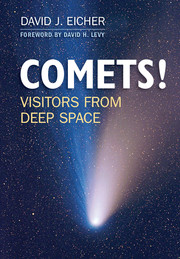
Join David J. Eicher in this fast-paced and entertaining journey through the history, present, and future of these important yet mysterious cosmic bodies. From ancient times, humans have been fascinated by 'broom stars' and 'blazing scimitars' lighting up the sky and moving against the fixed background of stars. The Great Comets of our time still receive in-depth attention - ISON, Hale-Bopp, Hyakutake, West, and others - while recent spacecraft encounters offer amazing insight into the earliest days of the solar system. In this guide you will discover the cutting-edge science of what comets are, how they behave, where they reside, how groups of comets are related, and much more. The author carefully explores the ideas relating comets and life on Earth - and the danger posed by impacts. He finishes with practical, how-to techniques, tips, and tricks on how to successfully observe comets and even to capture your own images of them.
The first step in understanding anything about a comet is to understand where it is. And the knowledge about where comets are, how they move, where they come from, and how they start in toward the inner solar system has changed dramatically over the years. Comets provide a good framework for understanding the distance scale of the solar system, as well as contemplating individual objects and why they behave the way they do.
When someone reports a suspected comet discovery, the first thing astronomers do is to make precise astrometric (positional) measurements of the object as it moves along its orbit. They want to make these accurate measurements of the comet’s position over a reasonably long arc – that is, over three or more measurements over the span of several days or a week – in order to calculate a preliminary orbit for the object. To do this, they need more than just careful positional measurements. They also consider the comet’s center of mass, gravitational perturbations that may be influencing the comet by planets or asteroids, and the modeling of nongravitational forces – that is, any outgassing from the comet itself that would influence its orbit.