To save content items to your account,
please confirm that you agree to abide by our usage policies.
If this is the first time you use this feature, you will be asked to authorise Cambridge Core to connect with your account.
Find out more about saving content to .
To save content items to your Kindle, first ensure no-reply@cambridge.org
is added to your Approved Personal Document E-mail List under your Personal Document Settings
on the Manage Your Content and Devices page of your Amazon account. Then enter the ‘name’ part
of your Kindle email address below.
Find out more about saving to your Kindle.
Note you can select to save to either the @free.kindle.com or @kindle.com variations.
‘@free.kindle.com’ emails are free but can only be saved to your device when it is connected to wi-fi.
‘@kindle.com’ emails can be delivered even when you are not connected to wi-fi, but note that service fees apply.
About 13.8 billion years ago, for reasons we do not yet understand, the Universe came into existence. Matter as we know it did not exist and even the forces by which bits of matter and radiation interact with each other were different than they are today. Our knowledge of physics is good enough now for us to calculate the conditions prevailing back to an incredible 0.000000000000000000000000000000000000000000001 seconds (10−45 s) after it all started. Of course, this does not get us all the way back to zero or before (if the word “before” has a meaning in this context), but we think we can speak with a fair degree of confidence about how things proceeded thereafter.
By 0.000000000001 seconds of age, the four forces of nature that now exist – gravity, strong and weak nuclear, and electromagnetic – were in place, and by the age of several hundred seconds the Universe contained the familiar matter that continues to exist today, the stuff of which ordinary atoms are made. A major turning point occurred at the age of about 380,000 years, when the Universe cooled enough for electrons to combine with the available nucleii, which were mostly protons and helium. At this point, atoms started to form and it suddenly became possible for photons of light to travel long distances without being absorbed. Before this time the Universe was opaque, and our best telescopes will not be able to look back beyond this era.
From the evidence brought to light by research in archaeoastronomy, it seems that humans have been constructing instruments to supplement their sensory equipment for many thousands of years. Stone markers, crude sighting devices, and methods for keeping track of monthly and seasonal events were in common use worldwide. The culmination of these naked-eye observations was Tycho Brahe's Uraniborg Observatory – located on an island near Elsinore castle in Denmark – that obtained planetary orbit determinations near the end of the 16th century so accurate that Kepler was finally able to figure out the true shape (elliptical) of the planetary orbits.
But it was Galileo's use of the telescope a few years later that brought home in dramatic fashion the realization that there are strange and wonderful phenomena in the heavens that we cannot see with the naked eye. The phases of Venus, craters on the Moon, moons circling the planet Jupiter, and details of sunspots on the face of the Sun were among the new discoveries revealed by this instrumental extension of the human apparatus.
We have been constructing bigger and better telescopes ever since, continuing right up to the present day. But we have also discovered that restricting our attention to the wavelengths that our eyes can detect is a major limitation. Astronomical objects in general, and the Sun in particular, look markedly different at radio, infrared, visible, ultraviolet, and x-ray wavelengths. By exploring those differences we can begin to understand what it means for the Sun or a star to look so different in x-rays or radio than in visible light.
From the point of view of determining our climate, the Earth is basically a large rock floating in cold, empty space with an enormously bright searchlight shining on one side of it. If the Earth were not rotating and did not have an atmosphere, then the side being illuminated would be hotter than boiling water and the dark side would be solidly frozen. A rotating Earth would be more evenly heated, like a rotisserie chicken being cooked, but without an atmosphere the average temperature around the globe would still be below the freezing point of water. The warming due to the atmosphere, known as the greenhouse effect, is necessary to keep the Earth habitable.
What we call “climate” is a complex interaction between the heating of the Sun and the processes that distribute this heat over the planet. This chapter provides a perspective on the forces determining the overall climate of the Earth. The goal is to provide the “big picture,” the global climate and its relation to the Solar input as an organic whole. We will then be in a position to discuss the major causes of climate variability, and the role played by the Sun in climate change. As we will see, in the 20th century the natural changes due to the Sun's variable radiation were overwhelmed by the human influences on global climate.
It would be overly optimistic of us to think that we have any accurate understanding of the conditions that make life possible. We do know that life exists on Earth, that it does not seem to have ever existed on the Moon, and that it may or may not have existed on Mars and Venus. If there is life elsewhere, such as on a moon of Jupiter, we have not yet found it. This means that we have exactly one data point, and it is dangerous to generalize from a single example. After all, in recent years we have seen many types of solar systems containing the thousands of exoplanets that have been discovered, and realized that most of them are very different in format from our own solar system. Generalizing from our own solar system turned out to be very wrong.
Still, as far as we can tell, light and heat have been of central importance. The Earth would not have life on it if the Sun had not brought the surface temperature of our planet above the freezing point of water, but well below the boiling point. We are not in a good position to argue that this range of temperatures is absolutely essential for life, but it is generally necessary for the types of life that we see here.
Several of the earlier chapters in this book have mentioned how safe and sheltered we are, living on the surface of the Earth beneath a protective blanket of atmosphere and magnetic field. Conversely, when we venture outside of our safe haven, we step into hazardous territory. “Empty” space is actually far from empty: it is filled with high-energy particles and radiation, bullets of matter shooting in all directions, clouds of hot plasma thrown out by the Sun, and extremes of heat and cold (simultaneously). Not all of the hazards come from the Sun: on February 15, 2013, a meteoroid – a rock from elsewhere in the solar system – exploded in our upper atmosphere and sent shock waves across central Russia so strongly that 4000 windows were blown out, injuring over 1000 people with the fragments of glass and otherwise. Many thousands of smaller objects hit the Earth every day, but again our atmosphere protects us from all but the largest ones.
The Sun is one of the major sources of energetic particles and radiation which affect the Earth. The solar corona, even when it is not producing a major eruption, is so hot that the enormous gravitational pull of the Sun cannot completely contain it. The result is an expansion of its million-degree plasma into interplanetary space to form a “solar wind,” which roars outward at supersonic speeds of hundreds of miles per second. Rapid, intense explosions in coronal active regions, known as “solar flares,” produce bursts of x-rays, gamma rays, and high-energy particles at the Earth.
Our Sun is a fairly ordinary star, a bit brighter than most but not exceptionally so. There are many stars much bigger and brighter, while most stars are smaller and fainter. The Sun is not an especially variable or active star, and it has no enormous chemical or magnetic peculiarities. It is not a very young star, nor is it old and nearing the end of its life. It is, in short, truly exceptional in only one way: it is very close to the Earth – in fact, at just the right distance to make life as we know it possible.
Most of us do not worship the Sun as did many in ancient civilizations, but we certainly should not take for granted the light and heat that it provides. Left to itself, the Earth would be a fantastically frigid rock at near absolute-zero temperature. If the Sun had been slightly more massive, its high temperature would have made the Earth's surface hot enough to melt lead. A smaller Sun would have left the Earth unbearably cold and possibly subject to high levels of radiation, since smaller stars tend to have higher levels of activity, giving off devastating ultraviolet and x-rays. Distance also matters. Had the Earth been closer, we might be as infernally hot as Venus; farther away and we might have been as cold and arid as Mars. We are in the position of Goldilocks, living at just the right distance from a just-right star.
The Sun is basically a hot ball of gas, powered by nuclear reactions at its core and eventually radiating that power out into space at its outer surface. The temperature at the core is millions of degrees, so that the “light” produced there is mainly x-rays. But this light must travel through an enormous amount of matter to get to the surface of the Sun, being scattered, absorbed, and re-emitted so many times that an astounding 100,000 years and possibly ten times more are needed for the energy generated in the core to get to the surface.
This energy is spread over a larger and larger area as it moves outward. The average temperature of the radiation drops as it moves out, but in such a way that the total – that is, the local intensity multiplied by the area of the larger and larger surface – remains a constant. By the time the energy reaches the visible surface of the Sun, the temperature has dropped to about 5800 K (10,000°F). This puts the radiation emitted into the visible part of the spectrum – our eyes almost certainly having adapted to the available wavelengths, thereby making them the “visible” part.
The everyday sun dazzles the eye on a clear day. But about every year and a half, millions of people who are lucky enough to be in the right place on Earth see the brilliance of the Sun covered up. When even a single per cent is left visible, the sky remains blue and the event is not very spectacular. But when that last per cent disappears, the light level drops by an additional factor of 10,000, the sky turns black with pinkish color all around the horizon, the birds go home to roost and, as observers throughout the centuries have described, “day turns to night.”
OBSERVING ECLIPSES
A total solar eclipse is an astounding sight, one that seems to awaken primal fears. Those who see one never forget it, and often come back to see more. The world of travel has advanced, and it is much easier now to fly off, as one of us did, to Siberia in 2008, to China in 2009, to Easter Island in 2010, to Australia in 2012, and to Gabon in 2013, than it was for scientists of 1936 to travel in a private railway car to Siberia, or even for Thomas Alva Edison and other scientists in 1879 to travel from the eastern United States out to Iowa.
Putting observing instruments into space is difficult, expensive, nerve-wracking, and often frustrating. Launch opportunities are limited, the risk of failure is high, and it usually requires many years for a project to reach completion. Why then would any one want to do science this way?
The problem is that the Earth has an atmosphere. This is good news for humans, of course. Life as we know it would not be possible without an oxygen-rich atmosphere, which also acts as a shield against harmful solar radiation and energetic particles known as cosmic rays (which are also deflected up toward the poles by the Earth's magnetic field – another type of shield). Our atmosphere prevents most meteors from hitting the ground – except for an occasional larger one – and it provides a greenhouse warming that brings global temperatures up to habitable levels, as we will discuss in the next chapter.
Most of these benefits to life are bad news for astronomers. From ground level we do not have direct access to cosmic rays, so it is difficult to study their origin; we do not have direct access to the bits of dust and rock floating through the solar system, to help determine the history of formation of the planets; we cannot, from the ground, directly measure the solar energetic particles to study the origin and effects of solar storms.
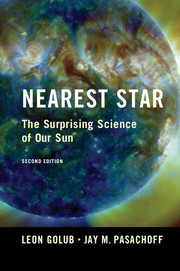
How did the Sun evolve, and what will it become? What is the origin of its light and heat? How does solar activity affect the atmospheric conditions that make life on Earth possible? These are the questions at the heart of solar physics, and at the core of this book. The Sun is the only star near enough to study in sufficient detail to provide rigorous tests of our theories and help us understand the more distant and exotic objects throughout the cosmos. Having observed the Sun using both ground-based and spaceborne instruments, the authors bring their extensive personal experience to this story revealing what we have discovered about phenomena from eclipses to neutrinos, space weather, and global warming. This second edition is updated throughout, and features results from the current spacecraft that are aloft, especially NASA's Solar Dynamics Observatory, for which one of the authors designed some of the telescopes.
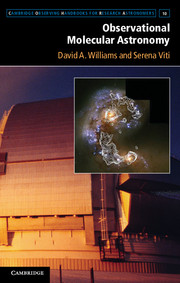
Molecular line emissions offer researchers exciting opportunities to learn about the evolutionary state of the Milky Way and distant galaxies. This text provides a detailed introduction to molecular astrophysics and an array of useful techniques for observing astronomical phenomena at millimetre and submillimetre wavelengths. After discussing the theoretical underpinnings of molecular observation, the authors catalogue suitable molecular tracers for many types of astronomical regions in local and distant parts of the Universe, including cold gas reservoirs primed for the formation of new stars, regions of active star formation, giant photon-dominated regions and near active galactic nuclei. Further chapters demonstrate how to obtain useful astronomical information from raw telescope data while providing recommendations for appropriate observing strategies. Replete with maps, charts and references for further reading, this handbook will suit research astronomers and graduate students interested in broadening their skill to take advantage of the new facilities now coming online.