To save content items to your account,
please confirm that you agree to abide by our usage policies.
If this is the first time you use this feature, you will be asked to authorise Cambridge Core to connect with your account.
Find out more about saving content to .
To save content items to your Kindle, first ensure no-reply@cambridge.org
is added to your Approved Personal Document E-mail List under your Personal Document Settings
on the Manage Your Content and Devices page of your Amazon account. Then enter the ‘name’ part
of your Kindle email address below.
Find out more about saving to your Kindle.
Note you can select to save to either the @free.kindle.com or @kindle.com variations.
‘@free.kindle.com’ emails are free but can only be saved to your device when it is connected to wi-fi.
‘@kindle.com’ emails can be delivered even when you are not connected to wi-fi, but note that service fees apply.
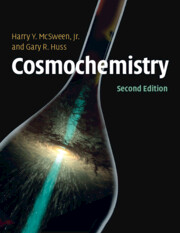
Cosmochemistry is a rapidly evolving field of planetary science and the second edition of this classic text reflects the exciting discoveries made over the past decade from new spacecraft missions. Topics covered include the synthesis of elements in stars, behaviour of elements and isotopes in the early solar nebula and planetary bodies, and compositions of extra-terrestrial materials. Radioisotope chronology of the early Solar System is also discussed, as well as geochemical exploration of planets by spacecraft, and cosmochemical constraints on the formation of solar systems. Thoroughly updated throughout, this new edition features significantly expanded coverage of chemical fractionation and isotopic analyses; focus boxes covering basic definitions and essential background material on mineralogy, organic chemistry and quantitative topics; and a comprehensive glossary. An appendix of analytical techniques and end-of-chapter review questions, with solutions available at www.cambridge.org/cosmochemistry2e, also contribute to making this the ideal teaching resource for courses on the Solar System's composition as well as a valuable reference for early career researchers.
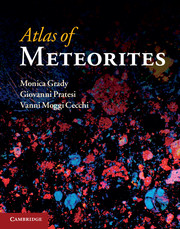
A complete visual reference for meteorite classification, this atlas combines high resolution optical microscope images with detailed descriptions. It provides a systematic account of meteorites and their most important classification parameters, making it an essential resource for meteorite researchers. Each chapter starts with a description of the meteorite class, with a summary of the mineralogical, chemical and isotopic characteristics of the group. The full-color images are taken in plane- and cross-polarized light and reflected light, and arranged to highlight textural variations in meteorites. Specimens are grouped to show the effects of increasing thermal alteration and shock, as well as variations in chondrule size and type. Chapters on iron meteorites, pallasites and mesosiderites are included, photographed as mounts in reflected light, to show the range of textural variations that accompany these meteorites. Images from the book can be downloaded from www.cambridge.org/9780521840354.
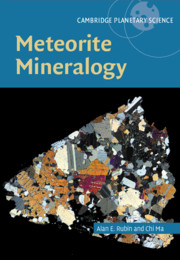
Meteorites are fascinating cosmic visitors. Using accessible language, this book documents the history of mineralogy and meteorite research, summarizes the mineralogical characteristics of the myriad varieties of meteorites, and explains the mineralogical characteristics of Solar System bodies visited by spacecraft. Some of these bodies contain minerals that do not occur naturally on Earth or in meteorites. The book explains how to recognize different phases under the microscope and in back-scattered electron images. It summarizes the major ways in which meteoritic minerals form – from condensation in the expanding atmospheres of dying stars to crystallization in deep-seated magmas, from flash-melting in the solar nebula to weathering in the terrestrial environment. Containing spectacular back-scattered electron images, colour photographs of meteorite minerals, and with an accompanying online list of meteorite minerals, this book provides a useful resource for meteorite researchers, terrestrial mineralogists, cosmochemists and planetary scientists, as well as graduate students in these fields
Meteorites are delivered to Earth from at least 100 different asteroids as well as from the Moon and Mars. A significant fraction of micrometeorites and interplanetary dust particles are from comets. Some of the meteorite parent bodies melted and differentiated; they developed metal cores and basaltic crusts. Other bodies never melted, preserving materials formed in the solar nebula. Some unmelted asteroids were thermally metamorphosed; many were aqueously altered. Meteorites suffered shock damage on their parent bodies, ranging from fracturing and brecciation to impact melting and devolatilization. After their formation, many samples experienced thermal metamorphism, aqueous alteration, and shock metamorphism to different extents; some were altered and/or shocked more than once.
As discussed in Chapter 2, quasicrystals are an unusual form of matter with orderly, but nonperiodic atomic arrangements. They can display diffraction patterns with otherwise forbidden rotational symmetry, e.g., fivefold, eightfold, and higher axes of symmetry (Levine and Steinhardt 1984; Shechtman et al. 1984). Princeton physicist Paul Steinhardt spent decades searching for natural quasicrystals, a quest documented in his book, The Second Kind of Impossible (Steinhardt 2019).
Every academic field has its share of confusing technical terms. Their redeeming feature is that they lend precision to scholarly discussion, but in some cases, a word may have different meanings in different contexts. For example, the word abduction has specific definitions in the legal realm (a kidnapping); formal logic (a syllogism with a major premise that is certain and a minor premise that is merely probable); and anatomy (the action of moving a part of the body away from the midline). Technical terms also bedevil meteoritics; some terms don’t have exactly the same meaning as in common parlance. In some cases, the following definitions differ from those approved by the International Astronomical Union (IAU), but the set presented here is precise and self-consistent. We recommend its adoption by astronomers, geologists, cosmochemists, and planetary scientists. Terms are arranged topically, not alphabetically.
It is not the purpose of this chapter to present a comprehensive overview of crystallography and crystal chemistry. Excellent discussions of those topics can be found in the classic Crystallography and Crystal Chemistry: An Introduction by F. D. Bloss (1971) as well as in several more recent texts including those by Klein and Dutrow (2007) and Nesse (2012). Here we cover only the most salient points about crystallography to facilitate understanding of topics and terms presented elsewhere in this book without explanation.
More than half a century ago, Buzz Aldrin surveyed the lunar landscape, noted its starkness and ash-colored hues, and declared it a site of “magnificent desolation.” Extraterrestrial mineralogy is the study of minerals from our parental molecular cloud as well as from the Moon, Mars, asteroids, and similarly desolate places. The information gathered from detailed analyses of these phases has provided a deeper understanding of the myriad processes that can produce minerals in the Solar System and its erstwhile stellar neighborhood.
During the earliest stages of thermal metamorphism on parent asteroids, primary feldspathic chondrule glass in primitive chondrites began to devitrify to form fine-grained clinopyroxene and crystalline feldspar (Figure 11.1). This resulted in a significant increase in the thermoluminescence (TL) sensitivity of the whole rocks. In some cases, the reaction leading to the crystallization of feldspar may have been catalyzed by water, consistent with the evidence for aqueous alteration in the most primitive ordinary and carbonaceous chondrites.
Many meteoritic minerals can be identified microscopically in reflected light; these include both opaque and nonopaque phases. The appearance of numerous opaque minerals is discussed in detail in two comprehensive books by Paul Ramdohr (1969, 1973).
The first significant step in meteorite classification was taken in 1802 by British chemist Edward Howard who showed that the meteoritic stones and irons he analyzed all contained Ni. This criterion was used to distinguish meteorites from terrestrial rocks, but the reliability of this distinction was soon undermined by two essentially metal-free falls: the Stannern eucrite in the Czech region of the Austrian Empire in 1808 and the Luotolax howardite in Finland in 1813. It became apparent to researchers that, although most stony meteorites contained metallic Fe-Ni, a few did not. This realization somewhat hampered subsequent classification efforts because a few large collections included a handful of metal-free terrestrial rocks posing as meteorites. Some of these “meteorwrongs” were covered with dark crusts, probably desert varnish or weathering rinds.
Mercury is the smallest and innermost major planet (Figure 9.1); from the perspective of Earth-bound observers, it never appears more than 28° from the Sun. It is locked in a state of spin-orbit coupling: its rotation period (58.646 Earth days) is exactly two-thirds of its year (87.969 Earth days). Mercury is named after the Greco-Roman messenger to the gods, perhaps because of its rapid apparent day-to-day movement with respect to the Sun. Compared to the other major planets, Mercury has the most eccentric orbit (e = 0.2056), the highest inclination relative to the ecliptic (7.007°), and the smallest axial tilt (0.01°). It has a weak magnetic field (~1.1 percent as strong as Earth’s) and no natural satellites.
A typical meteoroid enters the Earth’s atmosphere at 18–20 km s−1. During the traverse, the surface of a chondritic meteoroid reaches temperatures of 1,180–1,410°C and melts to depths of ~0.3–1.0 mm due to friction with the surrounding air. The surface of the meteoroid ablates, exposing a new surface that also melts and ablates; this process can be repeated several times.