To save content items to your account,
please confirm that you agree to abide by our usage policies.
If this is the first time you use this feature, you will be asked to authorise Cambridge Core to connect with your account.
Find out more about saving content to .
To save content items to your Kindle, first ensure no-reply@cambridge.org
is added to your Approved Personal Document E-mail List under your Personal Document Settings
on the Manage Your Content and Devices page of your Amazon account. Then enter the ‘name’ part
of your Kindle email address below.
Find out more about saving to your Kindle.
Note you can select to save to either the @free.kindle.com or @kindle.com variations.
‘@free.kindle.com’ emails are free but can only be saved to your device when it is connected to wi-fi.
‘@kindle.com’ emails can be delivered even when you are not connected to wi-fi, but note that service fees apply.
Ordinary chondrites, the most abundant meteorites, constitute about 80% of meteorite falls and are essential to our understanding of cosmochemistry. They provide important information about planetary accretion, the early Solar System, and the geological history of asteroids, including such processes as thermal metamorphism, shock metamorphism, and aqueous alteration. This comprehensive guide begins with meteorite classifications and useful definitions, followed by a discussion of fall phenomena and terrestrial weathering. It provides a detailed overview of the three main ordinary-chondrite groups, which include the most primitive, least-processed meteorites known. Compositional differences among these samples furnish clues to the nature of processes operating in the solar nebula 4.5 billion years ago. These rocks also disclose information on the nature and origin of chondrules, matrix material, and metallic iron-nickel grains. This book is a valuable resource for graduate students and research professionals interested in meteorites and planetary science, as well as amateur meteorite enthusiasts.
The proceedings of IAU Symposium 393 bring together leading voices in planetary science, exoplanet research, and astrobiology, with a special focus on discoveries enabled by the James Webb Space Telescope (JWST). Topics covered include atmospheric characterization of exoplanets, detection of biosignatures, the dynamics of protoplanetary disks, and studies of Solar System bodies such as comets and Kuiper Belt objects. This volume also highlights international initiatives in public engagement and education, demonstrating how planetary science is expanding globally and becoming more inclusive. Featuring insights from researchers and educators across multiple continents, this collection captures the multidisciplinary essence of planetary exploration and the search for life beyond Earth. It is a valuable resource for astronomers, planetary scientists, astrobiologists, and educators who wish to understand the scientific breakthroughs and collaborative spirit driving a new era of discovery.
Despite five decades of analysis, many aspects of Mars crater morphology and evolution remain enigmatic, and it seems likely that new types of data will be needed to find the answers. As a final section in this chapter, we offer new approaches to solving these questions. Finding the answers will require a new orbital data set. Our recommendation is for a new data set that is comparable to many that have been collected for other planets in the Solar System and thus well within the capabilities of the National Air and Space Administration (NASA) and other international space agencies.
We take the younger examples, as illustrated in Chapter 4, and show some of the common ways that craters may be modified. Even craters that are classified as morphologically fresh may have experienced modification. This might take the form of chemical weathering of the floor or deposition of eolian or ice deposits within the crater cavity.
This chapter reviews impact craters throughout the Solar System, looking first at craters formed on Earth, where we have the best field knowledge. We then investigate craters formed on airless rocky bodies (the Moon and Mercury), where the cratering process is not affected by atmospheric effects. We follow this with a glimpse of craters on volatile-rich bodies that also lack an atmosphere, specifically Ganymede, 1 Ceres, and Charon. Here the target material is most likely water ice. Finally, we examine craters formed on bodies with thick atmospheres (Venus and Titan) to see what landforms may have been formed by the interaction of the projectile and the ejecta with the atmosphere.
Here we delve into greater detail of the morphology of individual craters. We review what the freshest, and hence the most likely youngest, craters look like.
We introduce the mode of formation of craters on planetary surfaces to set the stage for comparisons of crater morphology throughout the Solar System and on Mars specifically.
In this chapter, we explore more of the ejecta diversity. There is a much wider range of morphologies, particularly when smaller diameter craters or craters formed in the Northern Plains are considered.
We consider the types of information available to the planetary geomorphologist to investigate craters on Mars. This information primarily takes the form of images, as well as topographic and compositional data, collected from Mars orbit by a variety of spacecraft. We then review aspects of the chronology of Mars, from the earliest geologic epoch (the Noachian) until the most recent (the Amazonian), and how the rocks formed during these time periods are distributed across the planet. We discuss that what can be observed on Mars today is not the way in which the planet has appeared throughout its history.
Here we delve more deeply into differences in the ejecta and show some of the rare features and characteristics associated with the freshest examples of craters. When trying to understand the flow processes displayed by the ejecta, these features no doubt provide additional details on the emplacement process as well as illustrate the potential variability across the planet as a function of geographic location.
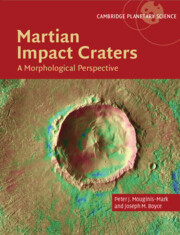
Our exploration of Mars has revealed a world as fascinating as Earth, with a changing climate, giant volcanoes, former oceans, polar ice caps, and numerous impact craters. This book provides a comprehensive summary of the morphology and distribution of meteorite craters on Mars, and the wealth of information these can provide on the crustal structure, surface geology, climate and evolution of the planet. The chapters present highly illustrated case studies of landforms associated with impact craters to highlight their morphological diversity, using high-resolution images and topographic data to compare these features with those on other bodies in the Solar System. Including research questions to inspire future work, this book will be valuable for researchers and graduate students interested in impact craters (both terrestrial and extra-terrestrial) and Mars geology, as well as planetary geologists, planetary climatologists and astrobiologists.
Thirty years on from the discovery of the first exoplanets, our focus is now turning to the search for signs of possible life on these worlds through the detection of atmospheric biosignatures. In parallel, the search for extraterrestrial intelligence and technosignatures is being revolutionised as the new era of time-domain survey astronomy gets underway. Together with new planetary science missions within the Solar System, the search for life beyond Earth is entering a new data-rich era. But, when the discoveries come, what will they mean and how should they be communicated to the scientific community and wider society in the era of social media and fake news? This volume distils the latest multi-disciplinary perspectives, encompassing the nature of life in a cosmic context, astronomical search methods and interpretative frameworks, as well as insights into the cultural and societal impacts of such a high-profile discovery.