To save content items to your account,
please confirm that you agree to abide by our usage policies.
If this is the first time you use this feature, you will be asked to authorise Cambridge Core to connect with your account.
Find out more about saving content to .
To save content items to your Kindle, first ensure no-reply@cambridge.org
is added to your Approved Personal Document E-mail List under your Personal Document Settings
on the Manage Your Content and Devices page of your Amazon account. Then enter the ‘name’ part
of your Kindle email address below.
Find out more about saving to your Kindle.
Note you can select to save to either the @free.kindle.com or @kindle.com variations.
‘@free.kindle.com’ emails are free but can only be saved to your device when it is connected to wi-fi.
‘@kindle.com’ emails can be delivered even when you are not connected to wi-fi, but note that service fees apply.
In Chapter 7 we were essentially concerned with the first three factors in the Drake equation that were introduced in Section 6.1.1, namely, the rate R at which suitable stars are formed, the probability pp of planets forming around a suitable star, and nE the average number of suitable planets in a habitable zone. We now move on to consider how we could determine the next factor, pl, the probability of life app earing on a suitable planet in a habitable zone.
In this chapter we concentrate on the detection of life that is based on complex carbon compounds and liquid water, i.e. carbon-liquid water life. We thus concentrate on life that resembles life on Earth. In doing so we do not assume that alien life is based on the same carbon molecules as terrestrial life. It might use mirror image isomers of some molecules used by terrestrial life, a carbon compound other than DNA to carry genetic information, or carbon compounds other than proteins to carry out the various functions performed by proteins in terrestrial life. But it is still carbon-liquid water life. Only in Chapter 9 will we free ourselves of this selfimposed (but reasonable) carbon-liquid water restriction. There, in the search for extraterrestrial intelligence (SETI) we will search for evidence of technological civilization regardless of the chemical basis of the life-forms.
In searching for signs of carbon-liquid water life, we are at least looking for something that we know to be possible. Another justification stems from fundamental chemistry. No element other than carbon has anywhere near the same facility to form compounds of sufficient complexity, diversity and versatility to supp ort the many processes of life (Section 1.1.2). Few liquids app roach water in its ability to act as both a solvent and a reactant. Ammonia is a possible alternative to water at low temperatures (at a pressure of 1 bar it is liquid from 195 K to 240 K), but it is pure speculation whether a low-temperature form of life could use ammonia in place of water. A third justification is that we know how to detect evidence of carbon-liquid water life. Apart from SETI, we have a poorer idea of how to detect life that has an entirely different chemical basis from ours, particularly as we are restricted to detection from afar.
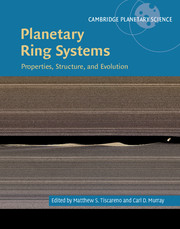
Planetary rings are among the most intriguing structures of our solar system and have fascinated generations of astronomers. Collating emerging knowledge in the field, this volume reviews our current understanding of ring systems with reference to the rings of Saturn, Uranus, Neptune, and more. Written by leading experts, the history of ring research and the basics of ring–particle orbits is followed by a review of the known planetary ring systems. All aspects of ring system science are described in detail, including specific dynamical processes, types of structures, thermal properties and their origins, and investigations using computer simulations and laboratory experiments. The concluding chapters discuss the prospects of future missions to planetary rings, the ways in which ring science informs and is informed by the study of other astrophysical disks, and a perspective on the field's future. Researchers of all levels will benefit from this thorough and engaging presentation.
Edited by
David A. Rothery, The Open University, Milton Keynes,Neil McBride, The Open University, Milton Keynes,Iain Gilmour, The Open University, Milton Keynes
Edited by
David A. Rothery, The Open University, Milton Keynes,Neil McBride, The Open University, Milton Keynes,Iain Gilmour, The Open University, Milton Keynes
Edited by
David A. Rothery, The Open University, Milton Keynes,Neil McBride, The Open University, Milton Keynes,Iain Gilmour, The Open University, Milton Keynes
Edited by
David A. Rothery, The Open University, Milton Keynes,Neil McBride, The Open University, Milton Keynes,Iain Gilmour, The Open University, Milton Keynes
In astronomical terms, the Solar System is our backyard. Set against the vast number of stars in our Galaxy, the colossal number of other galaxies in the observable universe and the incredible distances involved, our Solar System is an extremely tiny part of the Universe. However, this is where we live. It is where life on Earth developed, and it gives us our only vantage point from which to view the rest of the Universe.
Unlike other planetary systems, the objects in our Solar System are close enough to visit with space probes and to study long-term and (in some cases) in reasonable detail using telescopes. As well as revealing the splendour and diversity of the worlds that make up the Solar System, these studies allow us to try and understand ‘what makes the Solar System tick’. By doing this, we not only attempt to understand the system in which life evolved, but also gain an insight into the likely diversity of individual planetary bodies and their possible histories all over the Universe.
One of the more fundamental questions often asked is, ‘why is the Solar System the way it is?’ In answering this question, we have to address more detailed questions such as, how were the planets made? What were the planets made from? Were all the planets made from the same material? Why do they look so different? Do all the planets have the same internal structure? Does their surface appearance change with time? The answers to these questions lie in the physical and chemical processes that act on the bodies within the Solar System. Understanding these processes allows us to appreciate how the planets and the other Solar System bodies have formed and have been changed over time, and hence why they look the way they do today. In this book, you will be looking at these processes in detail.
Edited by
David A. Rothery, The Open University, Milton Keynes,Neil McBride, The Open University, Milton Keynes,Iain Gilmour, The Open University, Milton Keynes
Edited by
David A. Rothery, The Open University, Milton Keynes,Neil McBride, The Open University, Milton Keynes,Iain Gilmour, The Open University, Milton Keynes
In this chapter, you will be taking a closer look at the minor bodies of the Solar System. Although most asteroids and comets may seem tiny compared to the planets, they have an important role to play in shaping the appearance of planetary surfaces. You considered this when looking at impact cratering processes in Chapter 4. Furthermore, the study of fragments of asteroids that land on the Earth as meteorites can give us crucial information on the elemental abundances of the material that formed the solar nebula from which the planets were made. This was discussed in Chapter 2, and will be considered again in Chapter 9. Similarly, the study of comets (remotely using telescopes, via the dust particles that they release, and by space probe encounters) gives us information about the processes involved in the formation of the Solar System. For these reasons, the minor bodies of the Solar System can be of major importance.
Before we look at the minor bodies themselves, we need to consider the orbits of bodies in the Solar System in more detail than we have so far. Understanding orbits is key to understanding the motion of the planets, their moons, tidal heating process, and even the structure of the ring systems around the giant planets. Subject to minor variations driven by mutual interactions, planetary orbits are stable over hundreds of millions of years. However the gravitational influence of the planets can cause the orbits of minor bodies to change significantly, enabling them to migrate from one region of the Solar System to another, or even to be put on a collision course with the Earth.
Orbits and Kepler's laws
The German astronomer Johannes Kepler (1571-1630) worked at a time when it was generally believed that the orbits of celestial bodies must be based on circles. Complex schemes using smaller circles superimposed on larger ones were devised to try to account for the apparent paths of the planets across the heavens. However, Kepler realized that the motion of Mars could be described simply by an ellipse. From this starting point, Kepler went on to formulate three laws of planetary motion, which remain fundamental to understanding the functioning of the Solar System. They apply not only to the movements of planets around the Sun, but to all bodies orbiting under the influence of gravity.
Edited by
David A. Rothery, The Open University, Milton Keynes,Neil McBride, The Open University, Milton Keynes,Iain Gilmour, The Open University, Milton Keynes
Edited by
David A. Rothery, The Open University, Milton Keynes,Neil McBride, The Open University, Milton Keynes,Iain Gilmour, The Open University, Milton Keynes
Edited by
David A. Rothery, The Open University, Milton Keynes,Neil McBride, The Open University, Milton Keynes,Iain Gilmour, The Open University, Milton Keynes
Edited by
David A. Rothery, The Open University, Milton Keynes,Neil McBride, The Open University, Milton Keynes,Iain Gilmour, The Open University, Milton Keynes
Edited by
David A. Rothery, The Open University, Milton Keynes,Neil McBride, The Open University, Milton Keynes,Iain Gilmour, The Open University, Milton Keynes
Edited by
David A. Rothery, The Open University, Milton Keynes,Neil McBride, The Open University, Milton Keynes,Iain Gilmour, The Open University, Milton Keynes