To save content items to your account,
please confirm that you agree to abide by our usage policies.
If this is the first time you use this feature, you will be asked to authorise Cambridge Core to connect with your account.
Find out more about saving content to .
To save content items to your Kindle, first ensure no-reply@cambridge.org
is added to your Approved Personal Document E-mail List under your Personal Document Settings
on the Manage Your Content and Devices page of your Amazon account. Then enter the ‘name’ part
of your Kindle email address below.
Find out more about saving to your Kindle.
Note you can select to save to either the @free.kindle.com or @kindle.com variations.
‘@free.kindle.com’ emails are free but can only be saved to your device when it is connected to wi-fi.
‘@kindle.com’ emails can be delivered even when you are not connected to wi-fi, but note that service fees apply.
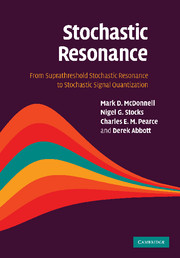
Stochastic resonance has been observed in many forms of systems, and has been hotly debated by scientists for over 30 years. Applications incorporating aspects of stochastic resonance may yet prove revolutionary in fields such as distributed sensor networks, nano-electronics, and biomedical prosthetics. Ideal for researchers in fields ranging from computational neuroscience through to electronic engineering, this book addresses in detail various theoretical aspects of stochastic quantization, in the context of the suprathreshold stochastic resonance effect. Initial chapters review stochastic resonance and outline some of the controversies and debates that have surrounded it. The book then discusses suprathreshold stochastic resonance, and its extension to more general models of stochastic signal quantization. Finally, it considers various constraints and tradeoffs in the performance of stochastic quantizers, before culminating with a chapter in the application of suprathreshold stochastic resonance to the design of cochlear implants.
This is a comprehensive discussion of complexity as it arises in physical, chemical, and biological systems, as well as in mathematical models of nature. Common features of these apparently unrelated fields are emphasised and incorporated into a uniform mathematical description, with the support of a large number of detailed examples and illustrations. The quantitative study of complexity is a rapidly developing subject with special impact in the fields of physics, mathematics, information science, and biology. Because of the variety of the approaches, no comprehensive discussion has previously been attempted. This book will be of interest to graduate students and researchers in physics (nonlinear dynamics, fluid dynamics, solid-state, cellular automata, stochastic processes, statistical mechanics and thermodynamics), mathematics (dynamical systems, ergodic and probability theory), information and computer science (coding, information theory and algorithmic complexity), electrical engineering and theoretical biology.
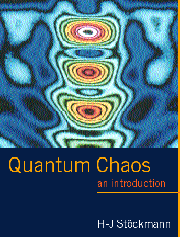
This book introduces the quantum mechanics of classically chaotic systems, or quantum chaos for short. The author's philosophy has been to keep the discussion simple and to illustrate theory, wherever possible, with experimental or numerical examples. The microwave billiard experiments, initiated by the author and his group, play a major role in this respect. Topics covered include the various types of billiard experiment, random matrix theory, systems with periodic time dependences, the analogy between the dynamics of a one-dimensional gas with a repulsive interaction and spectral level dynamics, where an external parameter takes the role of time, scattering theory distributions and fluctuation, properties of scattering matrix elements, semiclassical quantum mechanics, periodic orbit theory, and the Gutzwiller trace formula. This book will be of great value to anyone working in quantum chaos.
Lattice Gas Hydrodynamics describes the approach to fluid dynamics using a micro-world constructed as an automaton universe, where the microscopic dynamics is based not on a description of interacting particles, but on the laws of symmetry and invariance of macroscopic physics. We imagine point-like particles residing on a regular lattice, where they move from node to node and undergo collisions when their trajectories meet. If the collisions occur according to some simple logical rules, and if the lattice has the proper symmetry, then the automaton shows global behavior very similar to that of real fluids. This book carries two important messages. First, it shows how an automaton universe with simple microscopic dynamics - the lattice gas - can exhibit macroscopic behavior in accordance with the phenomenological laws of classical physics. Second, it demonstrates that lattice gases have spontaneous microscopic fluctuations which capture the essentials of actual fluctuations in real fluids.
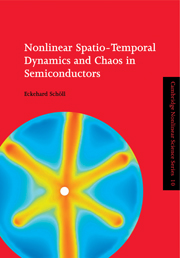
Nonlinear transport phenomena are an increasingly important aspect of modern semiconductor research. Nonlinear Spatio-Temporal Dynamics and Chaos in Semiconductors deals with complex nonlinear dynamics, pattern formation, and chaotic behaviour in such systems. In doing so it bridges the gap between two well-established fields: the theory of dynamic systems, and nonlinear charge transport in semiconductors. This unified approach is used to consider important electronic transport instabilities. The initial chapters lay a general framework for the theoretical description of nonlinear self-organized spatio-temporal patterns, like current filaments, field domains, fronts, and analysis of their stability. Later chapters consider important model systems in detail: impact ionization induced impurity breakdown, Hall instabilities, superlattices, and low-dimensional structures. State-of-the-art results include chaos control, spatio-temporal chaos, multistability, pattern selection, activator-inhibitor kinetics, and global coupling, linking fundamental issues to electronic device applications. This book will be of great value to semiconductor physicists and nonlinear scientists alike.
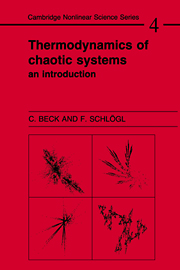
This book deals with the various thermodynamic concepts used for the analysis of nonlinear dynamical systems. The most important invariants used to characterise chaotic systems are introduced in a way that stresses the interconnections with thermodynamics and statistical mechanics. Among the subjects treated are: probabilistic aspects of chaotic dynamics; the symbolic dynamics technique; information measures, the maximum entropy principle; general thermodynamic relations; spin systems; fractals and multifractals; expansion rate and information loss; the topological pressure; transfer operator methods; and repellers and escape. The more advanced chapters deal with the thermodynamic formalism for expanding maps, the thermodynamic analysis of chaotic systems with several intensive parameters and phase transitions in nonlinear dynamics.
This book describes the manifestations of chaos in atoms and molecules. The study of chaos is today one of the most active and prolific areas in atomic physics. This is the first attempt to provide a coherent introduction to this fascinating area. In line with its scope, the book is divided into two parts. The first part (chapters 1–5) deals with the theory and principles of classical chaos. The ideas developed here are then applied to actual atomic and molecular physics systems in the second part of the book (chapters 6–10) covering microwave driven surface state electrons, the hydrogen atom in a strong microwave field, the kicked hydrogen atom, chaotic scattering with CsI molecules and the helium atom. The book contains many diagrams and a detailed references list.
This book describes the statistical mechanics of classical spin systems with quenched disorder. The first part of the book covers the physics of spin-glass states using results obtained within the framework of the mean field theory of spin glasses. The technique of replica symmetry breaking is explained in detail, along with a discussion of the underlying physics. The second part is devoted to the theory of critical phenomena in the presence of weak quenched disorder. This includes a systematic derivation of the traditional renormalization group theory, which is then used to obtain a new 'random' critical regime in disordered vector ferromagnets and in the two-dimensional Ising model. The third part of the book describes other types of disordered systems, relating to new results at the frontiers of modern research. The book is suitable for graduate students and researchers in the field of statistical mechanics of disordered systems.
This book is an introduction to the patterns and dynamics of sustained nonequilibrium systems at a level appropriate for graduate students in biology, chemistry, engineering, mathematics, physics, and other fields. Our intent is for the book to serve as a second course that continues from a first introductory course in nonlinear dynamics. While a first exposure to nonlinear dynamics traditionally emphasizes how systems evolve in time, this book addresses new questions about the spatiotemporal structure of nonequilibrium systems. Students and researchers who succeed in understanding most of the material presented here will have a good understanding of many recent achievements and will be prepared to carry out original research on related topics.
We can suggest three reasons why nonequilibrium systems are worthy of study. First, observation tells us that most of the Universe consists of nonequilibrium systems and that these systems possess an extraordinarily rich and visually fascinating variety of spatiotemporal structure. So one answer is sheer basic curiosity: where does this rich structure come from and can we understand it? Experiments and simulations further tell us that many of these systems – whether they be fluids, granular media, reacting chemicals, lasers, plasmas, or biological tissues – often have similar dynamical properties. This then is the central scientific puzzle and challenge: to identify and to explain the similarities of different nonequilibrium systems, to discover unifying themes, and, if possible, to develop a quantitative understanding of experiments and simulations.
A second reason for studying nonequilibrium phenomena is their importance to technology.
In this chapter, we will use the amplitude equations introduced in the previous two chapters to gain an understanding of defects and fronts in stripe patterns near onset. Our discussion also serves to illustrate more advanced applications of the amplitude equations, in particular the ability to treat patterns that vary spatially.
The importance of defects in patterns was introduced in Section 4.4.Adefect can be thought of as a local imperfection in an otherwise perfect pattern, and experimental and natural patterns often contain many defects, either due to the effect of boundaries or due to a spatially inhomogeneous initial condition. To approach the complicated realistic case of many defects, it is useful first to study single isolated defects and then attempt to build an understanding of natural patterns from these elementary ingredients. In Section 4.4.2, we introduced the notion of a topological defect, namely one that can be identified from properties of the pattern far from the location of the defect (such as the winding number of the phase, Eq. (4.58)), where the pattern approaches the ideal state. These defects are particularly important because they can persist for long times and so are robust. We will focus on two types of topological defects in stripe states, dislocations, and grain boundaries.
We first discuss the structure of stationary defects. Since defects represent deviations from the ideal pattern, the intensity of the pattern is reduced in their vicinity. The region over which the intensity is reduced, and where the pattern strongly deviates from the ideal one, is called the core of the defect.
In the previous chapter, we introduced and used a one-dimensional amplitude equation to study slow spatiotemporal modulations of a stripe pattern but with the restriction that the spatial variation could only be longitudinal (in the direction normal to the stripes). In the present chapter, we extend the previous chapter in two ways to study patterns that depend on two extended coordinates. The first generalization is the obvious one, which is to write down a two-dimensional amplitude equation that can treat a stripe pattern with modulations that vary along, as well as normal to, the stripes. The second generalization is to study superpositions of stripe states with different orientations, which will allow us to study quantitatively the periodic lattice states that we discussed in Section 4.3. It turns out that many useful insights about the stability of, and competition between, lattice states can be obtained by using just the zero-dimensional (no spatial dependence) amplitude equation similar to Eq. (4.6) to describe each stripe participating in the superposition. At the end of the chapter, we will discuss briefly the more general but also more difficult case of using a two-dimensional amplitude equation to describe general slow distortions of each stripe associated with lattice states and other stripe superpositions.
The two-dimensional amplitude equation that describes modulations along as well as normal to stripes turns out to have two different forms depending on whether the system is rotationally invariant (for example, Rayleigh–Bénard convection) or anisotropic (for example, a liquid crystal or a conducting fluid in the presence of a magnetic field). We first discuss the two-dimensional amplitude equation for rotationally invariant systems.
In Section 2.2 of the previous chapter we used a simplified mathematical model Eq. (2.3) to identify the assumptions, mathematical issues, and insights associated with the linear stability analysis of a stationary uniform nonequilibrium state. In this chapter, we would like to discuss a realistic set of evolution equations and the linear stability analysis of their uniform states, using the example of chemicals that react and diffuse in solutions (see Fig. 1.18). Historically, such a linear stability analysis of a uniform state was first carried out in 1952 by Alan Turing [106]. He suggested the radical and highly stimulating idea that reaction and diffusion of chemicals in an initially uniform state could explain morphogenesis, how biological patterns arise during growth. Although reaction–diffusion systems are perhaps the easiest to study mathematically of the many experimental systems considered in this book, they have the drawback that quantitative comparisons with experiment remain difficult. The reason is that many chemical reactions involve short-lived intermediates in small concentrations that go undetected, so that the corresponding evolution equations are incomplete. Still, reaction–diffusion systems are such a broad and important class of nonequilibrium systems, prevalent in biology, chemistry, ecology, and engineering, that a detailed discussion is worthwhile.
The chapter is divided into two halves. In the first part, we introduce the simple model put forward by Turing, and give a careful analysis of the instability of the uniform states. In the second part, we apply these ideas to realistic models of experimental systems.
The waves that are most familiar in daily life are sound waves, light waves, electrical waves, water waves, and mechanical waves (say a standing wave on a piano string). These familiar waves have the property that their magnitude decreases as they propagate away from their source or, for standing waves, once their source is turned off. The decrease in magnitude is a result of dissipative effects in the medium such as fluid viscosity, electrical resistance, or friction that drain energy from the wave and that restore the medium to thermal equilibrium.
These familiar waves have the additional property of often being accurately described by a linear evolution equation such as the wave equation. Because the evolution equation is linear, one can superimpose sinusoidal waves to get localized pulses of arbitrary shape, and these pulses can also propagate. (For example, clapping your hands once loudly creates a localized sound pulse that propagates away.) Because each Fourier component in the superposition is itself damped in typical media, the propagating pulses also damp out and disappear over time. Even in the absence of damping, dispersive effects can cause the different Fourier components to travel at different speeds so, again, waves and pulses change their shape and decrease in magnitude during propagation.
We have seen in earlier chapters that sustained nonequilibrium systems allow many dynamical states that can propagate or exist in a local spatial region but are such that these states do not damp out over time or they preserve their shape and speed as they propagate away from a source.
The linear stability analysis of Chapter 2 predicts that a small perturbation about a uniform state will grow exponentially in magnitude when the uniform state becomes unstable. Over time, the magnitude of a perturbation will grow so large that the nonlinear terms that were neglected when deriving the linearized evolution equation can no longer be ignored. These nonlinear terms play a fundamental role in the resulting pattern formation: they saturate the exponential growth, and they select among different spatial states. It is the essential role of nonlinearity in a spatially extended system that makes the study of pattern formation novel and hard.
We can gain a great deal of insight about the nonlinear regime of pattern formation by considering spatially periodic patterns. This is natural when considering the fate of a single exponentially growing Fourier mode of the linearized evolution equations associated with a linear stability analysis. Nonlinearities in the evolution equations for the system generate spatial harmonics (Fourier modes with wave vectors nq with n an integer) of this growing mode so that the finite-amplitude solution maintains the periodicity over the length 2π/q. A key role of the nonlinearity is to quench the exponential growth of the solution, leading to steady spatially periodic solutions for a stationary instability, and nonlinear oscillations or waves for an oscillatory instability. If this steady or periodic solution is to be physically relevant, we must also require that it be stable with respect to small perturbations. Thus we will study the existence and stability of steady or oscillatory spatially periodic (for qc ≠ 0) solutions.
This appendix provides some of the background for Chapter 4, especially for Eq. (4.14), by reviewing some of the elementary bifurcation theory that is often discussed in an introductory undergraduate course on nonlinear dynamics. Bifurcation theory is concerned with the change in the nature of solutions as parameters are varied. The changes can involve changes in the numbers or types of attractors, in the structure of the basins of attraction, or in even more subtle details of the phase space that are not easily detected by experiment. Sufficiently close to the onset of a bifurcation of a fixed point, a combination of a perturbation expansion and of nonlinear changes of variables can reduce the evolution equations to a much simpler dynamical system (usually a few odes) called a normal form. The normal form captures the essential behavior of the evolution equations sufficiently close to the bifurcation point and can be used to classify the possible bifurcations. For our purposes, the classification and associated language (e.g. pitchfork, Hopf, and other kinds) are the more important topics so we do not show how to reduce a set of equations describing a physical system to normal form, which can involve lengthy calculations, even with a computer mathematics program.
We begin our discussion by analyzing the bifurcations of some simple one variable dynamical systems and then discuss how these systems are related to the normal forms of more complicated evolution equations.
This appendix describes and gives some examples of multiple scales perturbation theory. This is a widely used technique in applied mathematics, physics, engineering, and other fields that systematically yields approximate solutions to ordinary and partial differential equations for which there is a small parameter e such that the mathematical problem can be solved without too much effort when the small parameter is set to zero. In the context of pattern formation, the formalism provides a systematic way to analyze the spatiotemporal behavior of fields near the supercritical instability of a spatially uniform state. Near such a bifurcation, for reasons clarified by the multiple scales theory, the physical system can be accurately analyzed as a slowly varying spatiotemporal modulation of a fast oscillatory behavior in space or in time.
The perturbation theory is based on two key features. First is the idea of multiple scales, which is to introduce scaled space and time coordinates that capture the slow modulation of the pattern. These new scaled variables will be treated as mathematically independent of the original variables that are used to describe the pattern state itself. The second key feature is the use of what are known as solvability conditions. In the formalism, these conditions arise as mathematical statements that prevent a resonant driving of a higher-order term by a lower-order term that would cause the perturbation method to fail after a short time. The lowest-order nontrivial solvability condition often ends up being an evolution equation for a slowly varying multiplicative factor of the unperturbed solution, what we have called an amplitude equation.