Refine search
Actions for selected content:
237315 results in Physics and Astronomy
Dedication
-
- Book:
- Advanced Linear Algebra
- Published online:
- 27 May 2025
- Print publication:
- 12 June 2025, pp v-vi
-
- Chapter
- Export citation
1 - Vector Spaces
-
- Book:
- Advanced Linear Algebra
- Published online:
- 27 May 2025
- Print publication:
- 12 June 2025, pp 1-37
-
- Chapter
- Export citation
Preface
-
- Book:
- Machine Learning in Quantum Sciences
- Published online:
- 13 June 2025
- Print publication:
- 12 June 2025, pp xv-xvi
-
- Chapter
- Export citation
Preface
-
- Book:
- A First Course in Magnetohydrodynamics
- Published online:
- 05 June 2025
- Print publication:
- 12 June 2025, pp xiii-xviii
-
- Chapter
- Export citation
2 - Linear Mappings
-
- Book:
- Advanced Linear Algebra
- Published online:
- 27 May 2025
- Print publication:
- 12 June 2025, pp 38-82
-
- Chapter
- Export citation
B - Essentials of Electrodynamics
-
- Book:
- A First Course in Magnetohydrodynamics
- Published online:
- 05 June 2025
- Print publication:
- 12 June 2025, pp 453-458
-
- Chapter
- Export citation
Acknowledgments
-
- Book:
- Machine Learning in Quantum Sciences
- Published online:
- 13 June 2025
- Print publication:
- 12 June 2025, pp xvii-xix
-
- Chapter
- Export citation
Index
-
- Book:
- Machine Learning in Quantum Sciences
- Published online:
- 13 June 2025
- Print publication:
- 12 June 2025, pp 306-308
-
- Chapter
- Export citation
6 - The MHD Riemann Problem
- from Part I - 1-D MHD in Ten Weeks
-
- Book:
- A First Course in Magnetohydrodynamics
- Published online:
- 05 June 2025
- Print publication:
- 12 June 2025, pp 183-240
-
- Chapter
- Export citation
Contents
-
- Book:
- Advanced Linear Algebra
- Published online:
- 27 May 2025
- Print publication:
- 12 June 2025, pp vii-x
-
- Chapter
- Export citation
A - Mathematical details on principal component analysis
-
- Book:
- Machine Learning in Quantum Sciences
- Published online:
- 13 June 2025
- Print publication:
- 12 June 2025, pp 258-259
-
- Chapter
- Export citation
4 - The Fundamentals of Magnetohydrodynamics
- from Part I - 1-D MHD in Ten Weeks
-
- Book:
- A First Course in Magnetohydrodynamics
- Published online:
- 05 June 2025
- Print publication:
- 12 June 2025, pp 99-122
-
- Chapter
- Export citation
2 - Selected Applications of Hydrodynamics
- from Part I - 1-D MHD in Ten Weeks
-
- Book:
- A First Course in Magnetohydrodynamics
- Published online:
- 05 June 2025
- Print publication:
- 12 June 2025, pp 26-68
-
- Chapter
- Export citation
3 - The Hydrodynamical Riemann Problem
- from Part I - 1-D MHD in Ten Weeks
-
- Book:
- A First Course in Magnetohydrodynamics
- Published online:
- 05 June 2025
- Print publication:
- 12 June 2025, pp 69-98
-
- Chapter
- Export citation
8 - Selected Topics
-
- Book:
- Advanced Linear Algebra
- Published online:
- 27 May 2025
- Print publication:
- 12 June 2025, pp 230-251
-
- Chapter
- Export citation
Contents
-
- Book:
- A First Course in Magnetohydrodynamics
- Published online:
- 05 June 2025
- Print publication:
- 12 June 2025, pp vii-xii
-
- Chapter
- Export citation
10 - Excursion: Problems in Machine Learning
-
- Book:
- Advanced Linear Algebra
- Published online:
- 27 May 2025
- Print publication:
- 12 June 2025, pp 272-302
-
- Chapter
- Export citation
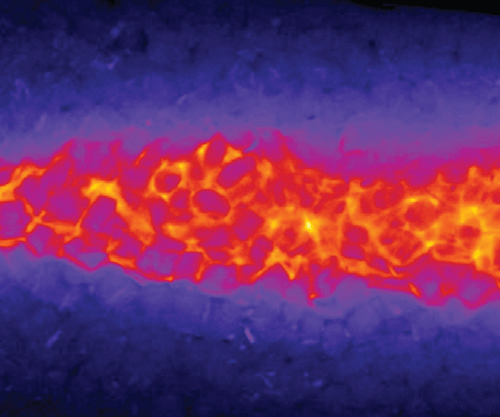
Effective reaction kinetics of steady mixing fronts in porous media
-
- Journal:
- Journal of Fluid Mechanics / Volume 1013 / 25 June 2025
- Published online by Cambridge University Press:
- 11 June 2025, A4
-
- Article
-
- You have access
- Open access
- HTML
- Export citation

Tailoring formations of self-organising hydrofoil schools towards high-efficiency
-
- Journal:
- Journal of Fluid Mechanics / Volume 1012 / 10 June 2025
- Published online by Cambridge University Press:
- 11 June 2025, A26
-
- Article
-
- You have access
- Open access
- HTML
- Export citation
-
We present new unconstrained simulations and constrained experiments of a pair of pitching hydrofoils in a leader–follower in-line arrangement. Free-swimming simulations with matched pitching amplitudes show self-organisation into stable formations at a constant gap distance without any control. Over a wide range of phase synchronisation, amplitude and Lighthill number typical of biology, we discover that the stable gap distance scales with the actual wake wavelength of an isolated foil rather than the nominal wake wavelength. A scaling law for the actual wake wavelength is derived and shown to collapse data across a wide Reynolds number range of $200 \leqslant Re \leqslant 59\,000$. Additionally, vortex analysis uncovers that the leader’s wake wavelength-to-chord ratio, $\lambda /c$, is the key dimensionless variable to maximise the follower’s/collective efficiency. When $\lambda /c \approx 2$ it ensures that the follower’s leading edge suction force and the net force from a nearby vortex pair act in the direction with the foil’s motion thereby reducing the follower’s power. Moreover, in both simulations and experiments mismatched foil amplitudes are discovered to increase the efficiency of hydrofoil schools by 70 % while maintaining a stable formation without closed-loop control. This occurs by (i) increasing the stable gap distance between foils to push them into a high-efficiency zone and (ii) raising the level of efficiency in these zones. This study bridges the gap between constrained and unconstrained studies of in-line schooling by showing that constrained-foil measurements can map out the potential efficiency benefits of schooling. These findings can aid in the design of high-efficiency biorobot schools.


Inferring obscured cosmic black hole accretion history from AGN found by JWST/MIRI CEERS survey
-
- Journal:
- Publications of the Astronomical Society of Australia / Volume 42 / 2025
- Published online by Cambridge University Press:
- 11 June 2025, e095
-
- Article
-
- You have access
- Open access
- HTML
- Export citation
-
This study presents the black hole accretion history of obscured active galactic nuclei (AGNs) identified from the JWST CEERS survey by Chien et al. (2024) using mid-infrared (MIR) SED fitting. We compute black hole accretion rates (BHARs) to estimate the black hole accretion density (BHAD), $\rho_{L_{\text{disk}}}$, across $0 \lt z \lt 4.25$. MIR luminosity functions (LFs) are also constructed for these sources, modeled with modified Schechter and double power law forms, and corresponding BHAD, $\rho_{\text{LF}}$, is derived by integrating the LFs and multiplying by the luminosity. Both $\rho_{\text{LF}}$ extend to luminosities as low as $10^7 \, {\rm L}_{\odot}$, two orders of magnitude fainter than pre-JWST studies. Our results show that BHAD peaks between redshifts 1 and 3, with the peak varying by method and model, $z \simeq$ 1 - 2 for $\rho_{L_{\text{disk}}}$ and the double power law, and $z \simeq$ 2 - 3 for the modified Schechter function. A scenario where AGN activity peaks before cosmic star formation would challenge existing black hole formation theories, but our present study, based on early JWST observations, provides an initial exploration of this possibility. At $z \sim 3$, $\rho_{\text{LF}}$ appears higher than X-ray estimates, suggesting that MIR observations are more effective in detecting obscured AGNs missed by X-ray observations. However, given the overlapping error bars, this difference remains within the uncertainties and requires confirmation with larger samples. These findings highlight the potential of JWST surveys to enhance the understanding of co-evolution between galaxies and AGNs.


