To save content items to your account,
please confirm that you agree to abide by our usage policies.
If this is the first time you use this feature, you will be asked to authorise Cambridge Core to connect with your account.
Find out more about saving content to .
To save content items to your Kindle, first ensure no-reply@cambridge.org
is added to your Approved Personal Document E-mail List under your Personal Document Settings
on the Manage Your Content and Devices page of your Amazon account. Then enter the ‘name’ part
of your Kindle email address below.
Find out more about saving to your Kindle.
Note you can select to save to either the @free.kindle.com or @kindle.com variations.
‘@free.kindle.com’ emails are free but can only be saved to your device when it is connected to wi-fi.
‘@kindle.com’ emails can be delivered even when you are not connected to wi-fi, but note that service fees apply.
This chapter picks up on the idea of the mainstream, introduced in the previous chapter, and also the concept of ‘music worlds’, briefly discussed earlier in the book. It elaborates further upon both, developing a concept of a musical universe comprising both a mainstream and multiple alternative music worlds. The chapter concludes with an empirical demonstration of some of these ideas.
Continuing and further developing the theme of meaning from the previous chapter, this chapter explores how music is used by listeners, particularly in the context of their identity work, and how this affects their tastes. It is argued that our stronger musical preferences are often for pieces, artists or genres who have in some way become bound up with our identities and the ongoing work of maintaining them.
This chapter picks up and further develops the idea of ‘networks’, which has been introduced in earlier chapters. Drawing upon formal social network analysis and the body of literature associated with it, it explains how we might think about networks in relation to music, how and why they develop and why they are important. There is an extended discussion of social capital and its relevance to music.
Illuminating the shared world of Clara and Robert Schumann, this volume takes a renewed look at the Schumanns and reconsiders them both as individual artists and as a couple who each charted their trajectories with the other in mind. It focuses on key aspects of their artistic and cultural environments amid the creative and political ferment of nineteenth-century Germany and traces their critical reception from their own time to the present day. The topics range from personal and professional relationships to their socio-cultural environment and their influence on subsequent generations of musicians, giving fresh perspectives on established themes and introducing new material and sources particularly in relation to Clara. The book broadens and re-evaluates existing understandings of the Schumanns and makes scholarship currently better known in the German-speaking sphere accessible to English-language readers.
Brimming with fresh insights, this volume offers a comprehensive overview of the personal, cultural, intellectual, professional, political and religious contexts in which immensely gifted brother and sister Fanny Hensel (née Mendelssohn) and Felix Mendelssohn Bartholdy lived and worked. Based on the latest research, it explores nineteenth-century musical culture from different yet complementary perspectives, including gender roles, private vs public music-making, cultural institutions, and reception history. Thematically organised, concise chapters cover a broad range of topics from family, friends and colleagues, to poetry, art and aesthetics, foreign travel, celebrity and legacy. With contributions from a host of Mendelssohn and Hensel experts as well as leading scholars from disciplines beyond musicology it sheds new light on the environments in which the Mendelssohns moved, promoting a deeper understanding their music.
Germaine Tailleferre (1892–1983) is now remembered largely because she was a member of Les Six, a group of French composers active in the late 1910s and early 1920s. Tailleferre encountered many obstacles, most notably a difficult personal life including two brief marriages to men who were unsupportive of her musical career; it is also true that critics tended to focus on her gender rather than her musical style. This Element tells the fascinating story of Tailleferre's life and long career and, most significantly, explores the development of her musical style and her role in the development of neoclassicism in France. In recent years, international performers have rediscovered her appealing, lively music and have at last started to bring Tailleferre to wider audiences. This Element will contribute to the rediscovery of Tailleferre and will reveal her to be a significant force in twentieth-century French music.
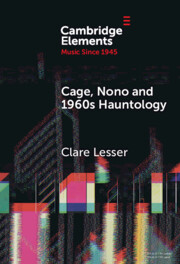
'What does it mean to follow a ghost?' Posing this question in Specters of Marx (1993), Jacques Derrida introduces the philosophical concept of 'hauntology' and the 'medium of the media' through the Shakespearian trope that time is 'out of joint'. Replete with ghostly crackles, hiss, pops and static, analogue media occupied a pivotal role in experimental music and praxis in the twentieth century, particularly during the 1960s, when composers such as John Cage and Luigi Nono systematically exploited the affordances of records and tape in composition and performance. Exploring hauntology's ghostly interplay with music and technology, this Element considers lost futures, past usage and future implications for hauntological music from the late 1930s to the twenty-first century.
The Biffoli-Sostegni manuscript, MS 27766 of the Bibliothèque du Conservatoire royal de Bruxelles, is the only volume of sixteenth-century polyphony with a secure provenance in a female convent. Its extraordinary survival is made all the more important by its origin at the Florentine convent of San Matteo in Arcetri, the convent in which Suor Maria Celeste Galilei, daughter of Galileo Galilei, spent the last two-thirds of her life. This Element uses archival sources related to San Matteo to create a historical context for the manuscript's music and the lives of the nuns for whom it was written. Analysis of the music is accompanied by both notated and audiovisual musical examples, performed by the UK all-female early music ensemble, Musica Secreta.
Over a century after his death, Debussy remains prominent in concert programmes and international scholarly research. This collection showcases the latest developments in the field. It reflects new preoccupations in aesthetics, using an array of archival sources to piece together Debussy's literary tastes and influences, and drawing on philosophy and contemporaneous ideas about perception and cognition to explore the perceived links between Debussy's music, emotion and nature. The volume is notable for its embrace of the composer's earliest and latest works, which are often seen as unrepresentative of the 'real' Debussy. Its fresh approaches to analysis give new focus, in particular, to rhythm, metre, and the dance. It also reflects the current musicological preoccupation with performance and recording. Debussy Studies 2 ends with an assessment of the ways in which the scholarly debates immediately after his death have continued to influence our understanding one hundred years on.
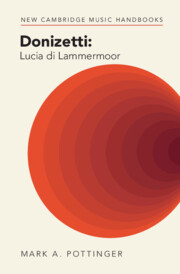
Donizetti's opera, based on Walter Scott's novel, is a staple of the bel canto operatic repertoire and famed above all for its vocally challenging and frequently reinterpreted 'mad scene' that precedes the lead character's death. This handbook examines the impact Lucia has had on opera and investigates why, of all of Donizetti's seventy operas, this particular work has inspired so much enthusiastic interest among scholars, directors and singers. A key feature is the sheer mutability of the character Lucia as she transforms from a lyric bel canto figure to a highly charged coloratura femme fatale, fascinating not just to opera historians but also to those working on sound studies, literary theories of horror and the gothic, the science of the mind, gender theory and feminist thought. The book places Lucia within the larger contexts of its time, while underlining the opera's central dramatic elements that resonate in the repertoire today.
The barline is a ubiquitous feature of musical notation. It appears throughout Debussy’s music, just as it does in the music of Mozart and Stravinsky. The barline has myriad functions and can produce diverse responses. It may be an audible component of musical notation or rather the trigger for an audible event or performers may go out of their way to render it inaudible. Debussy’s arabesque-like melodic lines and flowing parallel chords seem to invite the interpreter to overlook the barline and seek cues for agogic stress or accent elsewhere in the notation. However, a tendency on the part of some performers to delay the arrival of the first beat after a barline produces its own form of stress, which may not be supported by duration or accent. This chapter explores changing performance styles, drawing evidence from the earliest recordings of Debussy to the most recent.
Reading was one of Debussy’s favourite occupations, without doubt one of the activities that nourished and sustained him the most. Still, any attempt to uncover greater detail about the kind of reader Debussy actually was, remains a complicated, almost archaeological task. Although the sale of scores, manuscripts and several books sent to Debussy offers some leads, it does not make it possible to reconstruct their precise importance or to show their full diversity. In order to understand Debussy’s literary inclinations as fully as possible, it is thus necessary to examine other sources, such as letters, books sent to him, testimonies of friends, as well as the diaries and notebooks that have been miraculously preserved – notably those in which he noted references to works likely to interest him and even specific sentences that he particularly liked. By cross-checking these various elements, I sketch a portrait of a composer through one of his most essential passions.
With Debussy’s adoption of a markedly nationalist position at the onset of World War I, in appending the epithet ‘musicien français’ to his name, it was by no means evident during the years immediately following his death that he would, in time, become one of the most influential figures for later twentieth- and early twenty-first-century composers in France and elsewhere. While his music endured in the interwar years, his musical and aesthetic concerns were largely rejected or eclipsed. In 1956 Boulez identified Debussy as forming part of a peculiarly French axis of aesthetic modernists – Debussy-Cézanne-Mallarmé, ‘a solitary church spire’ and ‘an excellent ancestor’. This chapter investigates ways in which Debussy’s music and ideas implicated themselves within the work of composers active after 1945 from Messiaen, Jolivet, Dutilleux and Ohana through the work of Boulez and Barraqué to his continued influence on various branches of contemporary French composition, not least the Spectralists.