To save content items to your account,
please confirm that you agree to abide by our usage policies.
If this is the first time you use this feature, you will be asked to authorise Cambridge Core to connect with your account.
Find out more about saving content to .
To save content items to your Kindle, first ensure no-reply@cambridge.org
is added to your Approved Personal Document E-mail List under your Personal Document Settings
on the Manage Your Content and Devices page of your Amazon account. Then enter the ‘name’ part
of your Kindle email address below.
Find out more about saving to your Kindle.
Note you can select to save to either the @free.kindle.com or @kindle.com variations.
‘@free.kindle.com’ emails are free but can only be saved to your device when it is connected to wi-fi.
‘@kindle.com’ emails can be delivered even when you are not connected to wi-fi, but note that service fees apply.
The role of conscience in healthcare decision-making is explored in this important intervention in the fields of Health Law and Ethics, Medicine, Nursing and Philosophy. It takes a broad approach to conscience, looking beyond the standard examples of conscientious objection to argue that conscience permeates healthcare decisions. However, it also shows that not all decisions of conscience are worthy of legal or societal protection and that these are interests to be weighed rather than rights. Instead, conscience should be protected only when the individual exercising conscience abides by specific responsibilities. Additionally, the book explores the important issues of complicity with healthcare decisions and institutional or organisational conscience and argues they play an oversized role in general discussions of conscience. It further claims that we ought to pay much more attention to conscientious provision. The book concludes by looking at ways to more effectively regulate claims of conscience.
This book brings together all the existing evidence on recovery capital measurement and its application to addiction recovery, and is the 'go to' book on this topic for researchers, policy makers, practitioners and people in recovery.
This book explores the critical issue of how to manage the ever-increasing demand for social care in Britain's ageing society, putting forward workable solutions for integrating paid-for and unpaid care into a single framework based on the strengths of the community.
This edited volume examines the responses of long-term care homes for older people in Western Europe to the COVID-19 pandemic. In doing so, it highlights the institutional, organisational and management challenges facing care homes, both in continuing to provide services to an increasingly ageing population and in future public health crises.
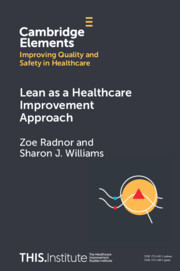
Lean is one of the most widely used improvement approaches in healthcare. With origins in manufacturing, it focuses on improving efficiency, eliminating waste, and streamlining processes. This Element provides an overview of the evidence for the use of Lean in healthcare, summarises the supporting tools and techniques, and emphasises the importance of developing an organisational culture committed to continuous improvement. The authors offer two case studies of attempts to implement Lean at scale, noting that, despite its popularity, implementation is not straightforward. Challenges include terminology that isn't always easy to grasp, perceived dissonances between the manufacturing origins of Lean based on repetitive, standardised, automated production and the human-centred world of healthcare, and problems with fidelity. The authors make the case that there is a lack of a robust evidence base for Lean and call for well-designed studies to advance the implementation of Lean and associated process improvement techniques in healthcare. This title is also available as open access on Cambridge Core.
The need for healthier, more resilient societies has never been more urgent. This timely book reveals how empowered and organized communities can lead this change. It offers policymakers, academics and activists real-world examples of organizing and collective actions from across the global North and South.
Communication is central to the experience of illness and the provision of healthcare. This book showcases the insights that can be gained into health communication by means of corpus linguistics – the computer-aided linguistic analysis of large datasets of naturally occurring language use known as 'corpora'. The book takes readers through the stages that they must go through to carry out corpus linguistic research on health communication, from formulating research questions to disseminating findings to interested stakeholders. It helps readers anticipate and deal with different kinds of challenges they may encounter, and shows the variety of applications of the methods discussed, from interactions in Accident and Emergency departments, to online discussions of mental illness, and press representations of obesity. Providing the reader with a wide range of clear case studies, it makes the relevant methods and findings accessible, engaging and inspiring. This title is also available open access on Cambridge Core.
Are you a medical student preparing for the UKMLA exam? A practical companion to the textbook, The UKMLA Applied Knowledge Test: Practice Questions provides a comprehensive revision tool for any student looking to succeed in the exam. The book features over 500 multiple choice questions (MCQ) covering all the clinical presentations and conditions required for the examination. Each MCQ includes five answer options and explanations for both the correct and incorrect answers are provided, allowing readers to test the knowledge gained from the main textbook and supporting student recall and comprehension. Conveniently organised into 18 areas of clinical practice, the book follows the General Medical Council's exam content map and is ideal for on-the-go revision. An essential preparation resource for UK based medical students, and students sitting the PLAB examination.
Practice single-best-answer questions on psychiatry, representing all presentations and conditions listed by the GMC in their content map for the MLA AKT, and referred to by the keywords in this book. All questions are specifically tailored to the level of knowledge required for foundation clinical practice in the UK, and comprehensive in breadth, separating out the different conditions and presentations listed by the GMC, and covering them all. Not only are correct answers provided, but also explanations for all the available answer options. Every question is supported by an individual topic in the companion book which is specifically authored to cover the knowledge required for foundation clinical practice in the UK.
Practice single-best-answer questions on hormones and glands, representing all presentations and conditions listed by the GMC in their content map for the MLA AKT, and referred to by the keywords in this book. All questions are specifically tailored to the level of knowledge required for foundation clinical practice in the UK, and comprehensive in breadth, separating out the different conditions and presentations listed by the GMC, and covering them all. Not only are correct answers provided, but also explanations for all the available answer options. Every question is supported by an individual topic in the companion book which is specifically authored to cover the knowledge required for foundation clinical practice in the UK.
Practice single-best-answer questions on the nervous system, representing all presentations and conditions listed by the GMC in their content map for the MLA AKT, and referred to by the keywords in this book. All questions are specifically tailored to the level of knowledge required for foundation clinical practice in the UK, and comprehensive in breadth, separating out the different conditions and presentations listed by the GMC, and covering them all. Not only are correct answers provided, but also explanations for all the available answer options. Every question is supported by an individual topic in the companion book which is specifically authored to cover the knowledge required for foundation clinical practice in the UK.
Practice single-best-answer questions on otorhinolaryngology, representing all presentations and conditions listed by the GMC in their content map for the MLA AKT, and referred to by the keywords in this book. All questions are specifically tailored to the level of knowledge required for foundation clinical practice in the UK, and comprehensive in breadth, separating out the different conditions and presentations listed by the GMC, and covering them all. Not only are correct answers provided, but also explanations for all the available answer options. Every question is supported by an individual topic in the companion book which is specifically authored to cover the knowledge required for foundation clinical practice in the UK.