To save content items to your account,
please confirm that you agree to abide by our usage policies.
If this is the first time you use this feature, you will be asked to authorise Cambridge Core to connect with your account.
Find out more about saving content to .
To save content items to your Kindle, first ensure no-reply@cambridge.org
is added to your Approved Personal Document E-mail List under your Personal Document Settings
on the Manage Your Content and Devices page of your Amazon account. Then enter the ‘name’ part
of your Kindle email address below.
Find out more about saving to your Kindle.
Note you can select to save to either the @free.kindle.com or @kindle.com variations.
‘@free.kindle.com’ emails are free but can only be saved to your device when it is connected to wi-fi.
‘@kindle.com’ emails can be delivered even when you are not connected to wi-fi, but note that service fees apply.
This chapter examines religious lyric from approximately 1530 to 1630, from the birth of the spiritual canzoniere with Vittoria Colonna to the definitive edition of Angelo Grillo's landmark Pietosi affetti. Mixing devotion with desire, spiritual Petrarchists looked to incite readers to religious fervour using imagery that could be sensuous, erotic, or even perverse. In the Counter-Reformation in particular, this verse became increasingly corporeal and gender-ambiguous: sensual blazons of the body of Mary Magdalene; male-authored impersonations of saintly women; fantasies of touching, kissing, or penetrating Christ's wounds. Such verse is evidence of writers’ exploration of the surprising space between gender norms that was opened up by the Counter-Reformation.
Singing my grace and Your pain, perhaps I will become, in so great a sea, a siren.
‒ Angelo Grillo
Petrarch needed to be purged. There was widespread agreement on this opinion during the Counter-Reformation. One famous anonymous letter submitted to the Congregation of the Index during the pontificate of Pope Gregory XIII (1572–1585) described Petrarch as dux et magister spurcarum libidinum—“guide and teacher of filthy lust.” Concern was not limited to the censors. The religious poet Gabriele Fiamma (c. 1533–1585) announced in the prefatory letter to his influential Rime spirituali (1570) his plan to cleanse poetry of its impurities, stating that “although [Petrarch’s] words are not shameful, they are however amorous, and like tinder to a fire,” one that might engulf young readers in flame. But curing the fever and fire of Petrarchism turned out not to be so simple. Such poetry was simply too popular. And so carnal lyric appetites were not eradicated in the late sixteenth and early seventeenth centuries so much as redirected: they were channeled into religious verse. The role of the lyric beloved came increasingly to be filled not by Laura lookalikes, but by Christ, Mary, and the saints. The present chapter explores how Petrarchism—and the fluid perception of gendering for both poet and beloved—evolved as amorous and spiritual lyric melded.
Conjugal verse—lyric about marital love, rather than unrequited desire— is emblematic of Petrarchism's potential utility for sociohistorical study. This subgenre was popular in Italy in the wake of the Council of Trent (1545–1563), following the Church's renewed emphasis on marriage's sanctity. These poems have been mostly excluded from historical examinations, which focus on dowry contracts, court proceedings, and wills—documents that tend to present marriage as societally necessary but personally unfulfilling. Yet conjugal lyric celebrates marriage as a source of emotional and sexual gratification, demonstrating a shared social value around marital love in Counter-Reformation Italy, and suggesting the need to revise the standard scholarly timeline that locates the birth of love-based marriage in Protestant England.
Keywords: Giovanni Pontano; Vittoria Colonna; Pietro Bembo; Berardino Rota; Bernardo Tasso; Giuliano Goselini; early modern marriage
So perfectly enflamed was he with the most ardent love for his wife that for all his life he never loved any woman but her.
‒ Francesco Melchiori, writing about the poet Giuliano Goselini
What would Petrarch's love poetry have looked like had the love been requited? It is hard to know, because his poetry for Laura is so essentially about passions unfulfilled. However, Petrarch did have the opportunity, at least, to write of love realized. As Gordon Braden has noted, though the poet was never married, he had two children for whom he apparently felt a deep fondness; yet the woman or women who gave birth to these children cannot be found in his verse. Braden has voiced frustration at Petrarch's refusal to record experiences of domestic affection: “It is hard for modern readers not to miss that poetry and to feel that its lack measures the oppressive narrowness of Petrarchan lyricism.”
Yet a number of Petrarch's followers did step off this “narrow” path. Francesca Turina, featured in Chapter 2 for her friendship with Capoleone Ghelfucci, published a great quantity of verses for her husband in the late sixteenth and early seventeenth centuries. Among these, in her 1628 collection, was a trio of sonnets about her first pregnancy and the miscarriage that ended it. She describes great grief at the event, narrating how her mourning was both entwined with, and eased by, the love she shared with her husband.
Nor did the ancients portray Venus only with beautiful hair, but also with a beard … so that the goddess bore the signs of both male and female.
‒ Vincenzo Cartari
In the twenty-first century, it is increasingly common to understand gender and sexuality as fluid. Ours is not, however, the first generation in history to arrive at this insight. The popular Renaissance mythography by Vincenzo Cartari (c. 1531–after 1571), Le imagini de i dei de gli antichi (Images of the Gods of the Ancients, 1556), is an example of the extent to which early modern readers felt at ease in the unsettled expanse between traditional markers of gender. In his catalogue of the iconographic tradition of Venus, beside the helpful marginal marker Venere con la barba (Bearded Venus), Cartari describes how sometimes the ancients represented the goddess with facial hair, as in a sacred statue found on Cyprus “whose face and mien appeared to be that of a man, but who was dressed as a woman.” In the 1571 edition, a woodcut was added, which provided a double portrait of Venus, side by side in two guises: on the left, shrouded in traditional women's mourning garments for Adonis, her fallen lover; on the right, the bigendered, bearded Venus, with male face and feminine attire (fig. 0.1).
An early modern, gender-fluid portrayal of the goddess of love is a fitting opening for this book, which reveals how Italian men and women used Petrarchism as a vehicle with which to move fluidly between the poles of conventionally constructed masculinity and femininity. What is surprising is not so much that these poets worked in the space between prescriptive gender norms. The presence of the bearded Venus in a text as widely circulated as Cartari’s, without commentary or caveat, is evidence enough of comfort with that ambiguity. Rather, it is the willfulness with which they challenged traditional models, exploring radically alternative concepts of what it meant to be a man or woman in early modern Italy.
In the history of Western gender, the Italian Renaissance was a watershed moment, when a confluence of cultural developments disrupted the patriarchal attachment to hierarchical, binary thinking.
A variety of sociopolitical, domestic, and cultural factors enabled early modern Italy's uniquely cooperative culture, by which male and female poets were able to share the literary arena. Synthesizing the most important historical and literary studies of early modern gender from the last three decades, this chapter describes how social changes dovetailed with the rise of print culture in Italy, creating a situation in which women could enter into dialogue with men in manuscript and print. The focus here is on the late Cinquecento and early Seicento (about which significantly less has been written than earlier periods), an examination of a generation of writers who had only ever known a world in which women published in significant numbers alongside men.
For like Caeneus, I have changed sex and form, but not desire.
‒ Capoleone Ghelfucci
The last chapter closed with Pietro Bembo and Vittoria Colonna, progenitors of the Petrarchist movement. This chapter picks up with a poet born shortly after their deaths in 1547. Francesca Turina Bufalini (1553–1641) was a poet of domestic and spiritual verse active in the late Cinquecento and early Seicento. In recent years, Turina has begun to garner scholarly attention, especially for her autobiographical verse, much of which describes her affective bonds for her parents, husband, children, and grandchildren. Another important personal relationship serves to frame the current chapter: Turina's friendship with the writer Capoleone Ghelfucci (1541–1600). Compatriots of Umbria and taken by a common religious fervor, Turina and Ghelfucci developed an abiding creative and spiritual bond. The two traded letters and poems. They encouraged and commented on each other's writing, especially her romance, “Il Florio,” and his religious epic, the Rosario della Madonna (1600). Around the end of the sixteenth century, Ghelfucci compiled for Turina an amorous canzoniere, a manuscript that is now preserved in the Biblioteca Comunale of Arezzo.
One sonnet from this manuscript collection is a particularly suggestive text with which to think through the poets’ relationship, and by extension, the nature of the broader dialogue between male and female poets of this generation in Italy—how the conversation around gender, spoken in the language of Petrarchism, continued to evolve from where we left off in the previous chapter.
The capacity of the lyric voice to take on a life removed from the author's gender identity is nowhere clearer than in Petrarchism's rich tradition of ventriloquized verse. During the Italian Wars (1494–1559), men adopted women's voices, after the model of Ovid's Heroides, as a new way to explore the tragedies of battle. In the second half of the sixteenth century, literary giants such as Tasso and Guarini exchanged amorous verse in which one writer played the role of the female beloved. In the same decades, women writers assumed male personae as a means to experiment with erotic verse. Men's and women's engagement in poetic ventriloquism demonstrates the malleability of gendered lyricization and its usefulness in testing the boundaries of societal norms.
Keywords: Niccolo da Correggio; Vittoria Colonna; Giambattista Guarini; Torquato Tasso; Angelo Grillo; Niccolo Machiavelli; Barbara Salutati
Your Penelope sends this missive to you, O Ulysses, slow of return that you are—yet you write nothing back to me.
‒ Ovid, “Penelope to Ulysses”
Your Penelope cannot have waited longer nor with more expectation for her Ulysses than I did for you.
‒ Petrarch, “Letter to Homer”
The Heroides of Ovid (43 BCE–17 CE) is a collection of fifteen Latin verse epistles, written from the perspective of famous heroines of epic and myth. The titular heroines, commonly referred to as “abandoned women,” write to absent male lovers; the first letter in the collection, from Penelope to Ulysses, is quoted in the epigraph above. Other classical writers had composed ventriloquized literature before this, but Ovid's Heroides is unique on at least two counts: first, the letters are poetry rather than prose; and second, they are both very personal and very intimate. As Laurel Fulkerson writes, “the poems focus on such a small portion of human experience.” Classical scholars have written of the considerable rhetorical and selffashioning agency of Ovid's heroines, who seem to take on a life of their own.
Hugely popular in the Middle Ages and Renaissance, Ovid's collection was published across Europe in the original Latin and in vernacular translations and was often accompanied by elaborate commentaries.
Correspondence verse was part of a broader vogue in Renaissance Italian literature of using contemporary, identifiable speakers. In contrast to the standard vagueness surrounding the identity of the beloved in amorous lyric, correspondence verse was often printed with the full names of both poetic participants. These poems are artistically mediated portrayals of speech, to be sure. Even so, these publicly circulated documents tell us how actual men and women imagined speaking in a variety of relationships— courtships, friendships, mentorships—highlighting Petrarchism's capacity as a socially embedded practice. This chapter also demonstrates how attention to book history suggests an alternate gendered genealogy for the subgenre of correspondence verse, where women played a more significant role than has been previously recognized.
Keywords: Pietro Bembo; Vittoria Colonna; lyric anthology; Tullia d’Aragona; Benedetto Varchi; Celio Magno
I could be happy and content with you in the lowest, darkest part of Styx … Sailing those waves would be little to you, to free me from pain and torment.
‒ Orsatto Giustinian to Celio Magno
The Canzoniere that Petrarch left behind after his death in 1374 can appear manifestly unsocial. This is especially true when considered beside the great range of correspondence verse that littered the poetic landscape in the Italian Middle Ages. The last chapter mentioned the influence of medieval contrasti and tenzoni fittizie, such as those found in the thirteenth-century manuscript Vaticano Latino 3793. One might also call to mind something like Dante's famous tenzone with Forese Donati, and the former's jabs about the latter's impotence; or Dante's circulation of a poem about dreaming of his lady in Love's arms, and the memorable reply from Dante da Maiano that he should wash his testicles in cold water. Beside such examples of poetic thrust and parry, Petrarch—so great a fan of reclusion that he authored an entire treatise on the virtues of the solitary life—seems to stand apart, the author of a volume of lyric about a man chasing the ghost of a girl through the woods solus.
And yet, despite first impressions and Petrarch's best, loneliest intentions, there is much that relates to the collective in his verse. The first line of the proemial sonnet famously posits an audience, addressing readers directly in the second person plural: “You who listen in scattered rhymes” (Voi ch’ ascoltate in rime sparse).
This chapter explores Petrarch's gendered portrayal in early modern printings of his lyric, with particular attention to Alessandro Vellutello's edition of 1525. Vellutello rejected Petrarch's own ordering, rearranging the poems into a linear, amorous plotline, and adding such paratexts as a “biography” of Laura and a map of the lovers’ environs. Often dismissed by sixteenth-century humanists and modern-day scholars alike, Vellutello's Petrarch was the most popular of the period, embraced by readers who were enamored of its hybridity between critical edition and fan fiction. Theorizing a gendered contrast between Petrarchan fame and celebrity, I explore the evolution of Petrarch in the early modern imagination, an investigation that underpins subsequent chapters’ examinations of how Petrarchan imitators used literature to remake gender.
Keywords: book history; incunabula; Pietro Bembo; fame; Giolito; Masculinity
The difficulty in writing about the great figures of the past is that in every age they have been reinterpreted to demonstrate the new relevance of their greatness.
‒ Leo Braudy
This is a book about Petrarch (1304–1374); but this chapter begins with the figure of Cesare Borgia (1475–1507). The favorite son of Pope Alexander VI— who was perhaps the most infamous bishop of Rome in the long history of that post—Borgia was one of Italy's most lethal military mercenaries, tasked with commanding the papal armies in a bloody campaign through Central Italy. He was idolized by Machiavelli, who hailed him in The Prince as the model of unmerciful rulership. And, in 1503, he was also the dedicatee of a particularly fine edition of Petrarch's love poetry.
This edition of Petrarch's lyric was printed by Girolamo Soncino (fl. 1488–1533) in Fano, a town east of Florence, along the Adriatic coast in the Marches. Petrarch had titled his collection Rerum vulgarium fragmenta (Fragments of vernacular things); this particular volume bore the name Opere volgari di Messer Francesco Petrarca (Vernacular Works of Sir Francesco Petrarch), combining the poet's lyric collection with the Trionfi (Triumphs), as was common in the period. The printing featured a splendid typeface, designed by Francesco Griffo, the same punchcutter who had invented the italic font for Aldus Manutius (c. 1450–151
Writing the Past in Twenty-first-Century American Fiction examines contemporary novels profoundly shaped by a sense of historical consciousness. Authors including Ben Lerner, Colson Whitehead, Dana Spiotta, Hari Kunzru and Garth Greenwell each use flashbacks, historical parallels and non-sequential narrative arrangements to emphasise the re-emergence, in a twenty-first-century context, of historical structures and circumstances. This study explores how these frequent moments of temporal slippage amount to a 'falling out of time', as characters are forced to confront the past crises which continue to exert pressure on their own contemporary moment.
A lonely damsel imprisoned within a castle or convent cell. The eavesdropping of a prisoner next door. The framed image of a woman with a sinister past. These familiar tropes from 1790s novels and tales exploded onto the English literary scene in 'low-brow' titles of Gothic romance. Surprisingly, however, they also re-emerged as features of major Victorian poems from the 1830s to 1870s. Such signature tropes - inquisitional overhearing; female confinement and the damsel in distress; supernatural switches between living and dead bodies - were transfigured into poetic forms that we recognise and teach today as canonically Victorian. The Gothic Forms of Victorian Poetry identifies a poetics of Gothic enclosure constitutive of high Victorian poetry that came to define key nineteenth-century poetic forms, from the dramatic monologue, to women's sonnet sequences and metasonnets, to Pre-Raphaelite picture poems.
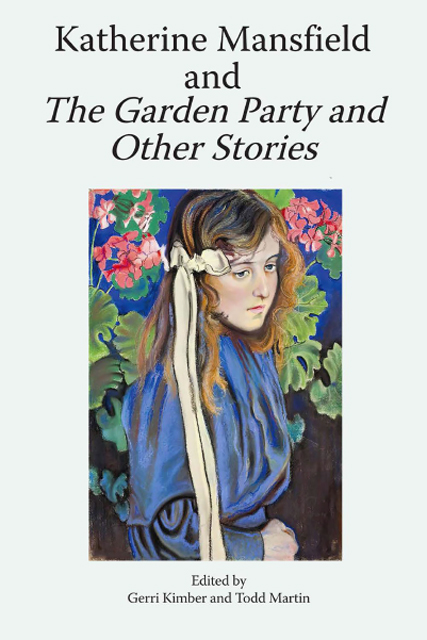
New scholarship on Katherine Mansfield's The Garden Party and Other Stories together with creative work inspired by Mansfield. The last collection of short stories published in her lifetime, The Garden Party and Other Stories would solidify Katherine Mansfield's place as the most prominent modernist short story writer of her generation. Early reviewers of the collection commented on the similarities it shared with her previous collection, Bliss and Other Stories; however, while contemporary reviews were mixed, many emphasised the psychological power of her stories, praising how she was able to bring her characters to life in a way simple action could not. While it contains some of Mansfield's most sophisticated and well-loved stories, several of the stories in The Garden Party initially appeared in the Sphere, and thus were often dismissed as inferior. Mansfield herself felt some of these stories fell short of her desired effect, though recent scholarship has revealed their greater complexity. The essays in this volume, by both seasoned and newer Mansfield scholars, work to continue this conversation. The collection also includes Mansfield-inspired short fiction, two translations of memorial poems dedicated to Mansfield by Chinese and French contemporaries with accompanying notes, and a recently re-discovered book review by Mansfield. In addition, Sydney Janet Kaplan provides a reflection on her personal meeting with Christopher Isherwood, a writer heavily influenced by the life and work of Mansfield.
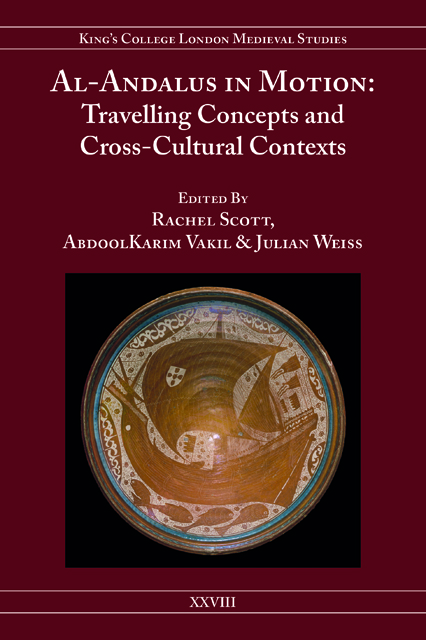
At a time when the discourse of a clash of civilisations has been re-grounded anew in scaremongering and dog-whistle politics over a Hispanic 'challenge' to America and a Muslim 'challenge' to European societies, and in the context of the War on Terror and migration panics, evocations of al-Andalus - medieval Iberia under Islamic rule - have gained new and hotly polemic topicality, championed and contested as either exemplary models or hoodwinking myths.
The essays in this volume explore how al-Andalus has been transformed into a 'travelling concept': that is, a place in time that has transcended its original geographic and historical location to become a figure of thought with global reach. They show how Iberia's medieval past, where Islam, Judaism and Christianity co-existed in complex, paradoxical and productive ways, has offered individuals and communities in multiple periods and places a means of engaging critically and imaginatively with questions of religious pluralism, orientalism and colonialism, exile and migration, intercultural contact and national identity. Travelling in their turn from the medieval to the contemporary world, across Asia, Africa, Europe and the Americas, and covering literary, cultural and political studies, critical Muslim and Jewish studies, they illustrate the contemporary significance of the Middle Ages as a site for collaborative interdisciplinary thinking.
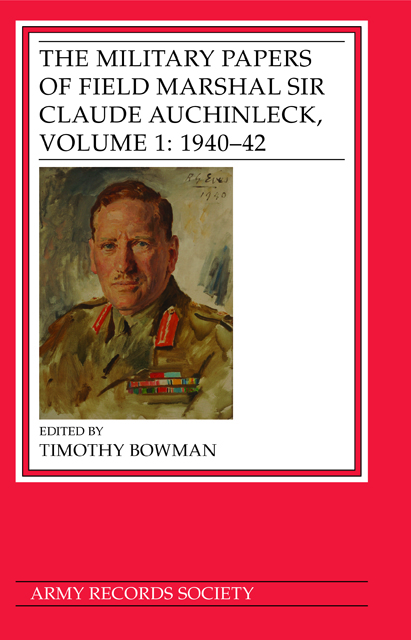
Key documents relating to Auchinleck's career up to the First Battle of El Alamein in July 1942, including his time as Commander-in-Chief of the Indian Army and of the Middle East Theatre.
I THINK you will allow me no inconsiderable share of credit for the cordial manner in which I have lauded the excellencies of the Scottish Barristers, when I tell you, that those whom I have particularly described to you, are each and all of them Whigs—most of them fervent, nay, bigotted Whigs, or, as Dr Parr would say, χυιγ-ωτατοι. Nor will it diminish the merits of my liberality, when I inform you, that the friend, under whose auspices my inspection of Edinburgh has been chiefly conducted, so far from regarding these eminent men with the same impartial eye of which I have made use, has well nigh persuaded himself into a thorough conviction, that their talents and attainments are most extravagantly over-rated in common opinion; and has, moreover, omitted no opportunity of detracting from them in private, when he may have heard me expatiate upon their praises. There are only two exceptions to this—Mr Cranstoun and Mr Jeffrey. The former he cannot help admiring and loving for the beautifully classical style of his eloquence, and, indeed, of all his attainments; but I think it forms no small ingredient both in his love and admiration that Mr Cranstoun happens to be sprung from one of the greatest of the old Border families, and so, it may be supposed, to have been nourished in infancy with the same milk of romantic and chivalrous tradition, of which he himself imbibed so largely then, and with the influences of which even now his whole character and conversation are saturated and overflowing; for I have already said enough to satisfy you, that few men can quote the words of the poet with more propriety than Mr Wastle:
The Boy is Father of the Man,
And I could wish my days to be
Linked each to each in natural piety.
In regard to Jeffrey, his mode of thinking may perhaps appear something still more peculiar. In the first place, indeed, the talents of this remarkable man are of such an order, that it is quite impossible a man of such talents as Mr Wastle should not admire them.