To save content items to your account,
please confirm that you agree to abide by our usage policies.
If this is the first time you use this feature, you will be asked to authorise Cambridge Core to connect with your account.
Find out more about saving content to .
To save content items to your Kindle, first ensure no-reply@cambridge.org
is added to your Approved Personal Document E-mail List under your Personal Document Settings
on the Manage Your Content and Devices page of your Amazon account. Then enter the ‘name’ part
of your Kindle email address below.
Find out more about saving to your Kindle.
Note you can select to save to either the @free.kindle.com or @kindle.com variations.
‘@free.kindle.com’ emails are free but can only be saved to your device when it is connected to wi-fi.
‘@kindle.com’ emails can be delivered even when you are not connected to wi-fi, but note that service fees apply.
No futurism is worthwhile unless it includes indigenous knowledges.
Kodwo Eshun, ‘The Algorithmic Poetics’ (2017a)
Kgositsile's ‘Towards a Walk in the Sun’ (1971) is a future memory. The poem interweaves and enfolds indigenous knowledges from Southern Africa with new political and aesthetic imperatives of exile in the Black world to produce otherwise possibilities. The ‘otherwise’ ‘bespeaks the ongoingness of possibility, of things existing other than what is given, what is known, what is grasped’ (Crawley 2016: 24). Kgositsile harnesses the otherwise from the Tswana literary corpus in his care, which enshrines the cosmologies, languages, mythologies, forms of being and relating, and terms of humanity, which he in turn refashions and transforms to reconfigure the political present in Black America. This chapter focuses on the cosmology of the sun and the native sons to reveal the infinitely generative nature of the Black Arts Movement archive in twenty-first-century African American social movements. In their quest to construct continuities between the past and the future, to walk in the footprints of their predecessors, twenty-first-century Black movements mine the Black arts archive in fashioning a radical imagination that responds to the unfinished project of white supremacy and Black liberation.
It is within this context that the Houston-based arts collective Otabenga Jones & Associates (OJ&A) retrieved ‘Towards a Walk in the Sun’, adapting it to operate within the realm of visual and material culture, as well as the sonic archive. The poem's radical convergence of two world systems – South African and African American literary classics, aesthetics, and oralities — spurred on that art collective's responses, which are generative and offer new reflections on discourses of Afrofuturism. Further, in framing OJ&A's work as part of dreamkeeping, a practice of intergenerational and ancestral dialogue that converges pastpresentfuture, here I theorize dreamkeeping as a musical practice of ‘digging in the crates’. Within this practice, rap's self-referential method and citational practices function as a naming device indexical of Black alternative histories of thought, sounding the antiphonic utterance across space and time.
This chapter investigates political powers of the erotic in order to open ecologies of futures beyond the dominant culture's anti-Black linear progress narrative. It centres around the death of a revolutionary that gives others the will to live. It is about death rituals ferried from Tswana customs and funeral rites, whose import across the Atlantic soothes the hearts of African Americans. It is about grief and embracing its underside, finding love as a propulsive force towards engaging in purposeful action. This affective poetics is studied in this chapter as it is manifested in Kgositsile's personal life and work and rendered in his short story ‘The Favorite Grandson’ (Black World, November 1972), which revisits and transmutes feelings surrounding the death of his grandmother. He translates that context into the political context of Malcolm X's death in his essay ‘Brother Malcolm and the Black Revolution’ (Negro Digest, November 1968), republished as ‘Malcolm X and the Black Revolution: the Tragedy of a Dream Deferred’ in another crucial BAM text Malcolm X: The Man and His Times (1969), edited by John Henry Clarke.
I frame this chapter with a lesser-known medium from Kgositsile's literary corpus, a short story which, in its personal nature, reveals the world of interiority, interrogating his devastation and grief. The story, which includes a letter written by the narrator when he was only a child, recreates intimate dialogues between beloved grandma and grandson, in which the elder matriarch offers comforting wisdom that becomes salve and guidance, in turn giving the boy a will to live. She reminds him of the dualities of being: life and death, destruction and construction, and beginnings and endings, all within a dynamic of continuity. The boy writes:
Mami, I do not know what has happened to me since a few days after they took you to the village graveyard. I do not understand it any more than I understand some of the things you have told me. Once, for instance, you said that every natural loss results in some gain; the way of nature's balance, you said it was. Is death such a loss? If it is, what gain results from it? And what then is life? (1972: 57)
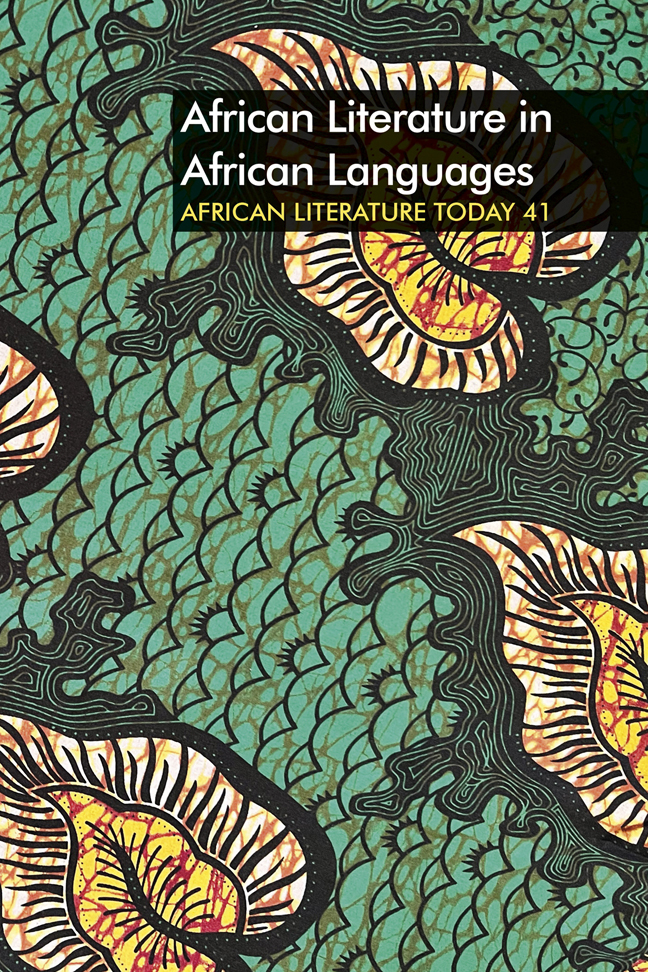
Interrogates and explores African literature in African languages today, and the continuing interfaces between works in indigenous languages and those written in European languages or languages of colonizers.
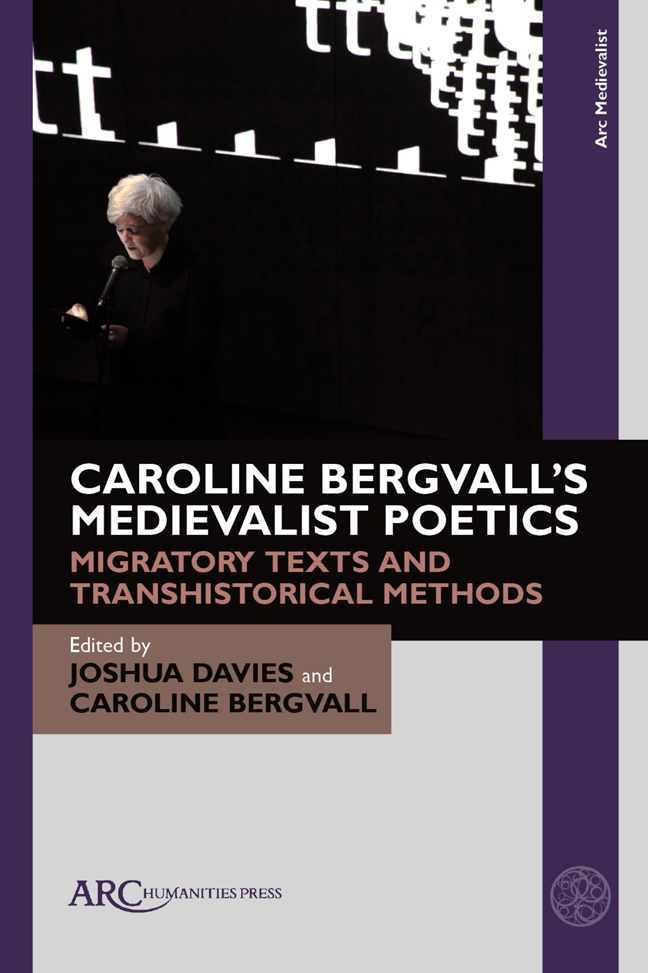
Caroline Bergvall's celebrated trilogy of interdisciplinary medievalist texts and projects - Meddle English (2011), Drift (2014), and Alisoun Sings (2019) - documents methods of reading and making that are poetically and politically alert, critically and culturally aware, linguistically attuned, and historically engaged.
Drawing on the wide-ranging body of criticism dedicated to Bergvall's work and material from Bergvall's archive, together with newly commissioned texts by scholars, theorists, linguists, translators, and poets, this book situates the trilogy in relation to key themes including mixed temporalities; interdisciplinarity and performance; art and activism; and the geopolitical, psychosexual, and social complexities of subjectivity. It follows routes laid down by the trilogy to move between the medieval past and our contemporary moment to uncover new forms of encounter and exchange.
This historical anthology of Korean poetry, ancient, medieval, and premodern Korean songs and poems highlights the evolution of poetic composition in the vernacular. The book is a manifesto of the uniquely Korean poetic tradition, which flourished quite separately along with the literary tradition retained by the men of letters devoted to the scholarship in classical Chinese. The beauty of the Korean language and the tradition of verse-making in it are sumptuously demonstrated by this book, which contains both the original texts in the unique Korean orthography of phonograms and the translator's English version that runs in parallel with the original poems.
This book is a new history of early modern gender, told through the lyric poetry of Renaissance Italy. In the evolution of Western gender roles, the Italian Renaissance was a watershed moment, when a confluence of cultural developments disrupted centuries of Aristotelian, binary thinking. Men and women living through this upheaval exploited Petrarchism's capacity for subjective expression and experimentation - as well as its status as the most accessible of genres - in order to imagine new gendered possibilities in realms such as marriage, war, and religion. One of the first studies to examine writing by early modern Italian men and women together, it is also a revolutionary testament to poetry's work in the world. These poets' works challenge the traditional boundaries drawn around lyric's utility. They show us how poems could be sites of resistance against the pervading social order - how they are texts capable not only of recording social history, but also of shaping it.
One day in 2001, John O’ Carroll, then a lecturer at the University of the South Pacific, sent me a book with a note, ‘Someone sent me this book to review but I can't read a word of it. Could you please have a look at it?’ The book was Subramani's Ḍaukā Purān. I had read all the great works of literature, was moved by them, couldn't put down Don Quixote, The Brothers Karamazov, or James Joyce's Ulysses or the seven-volume Princeton translation of the Vālmīki Rāmāyaṇa. But occasionally one came across a text that moved you in a different way, a text that made you feel that you were not just reading it but ‘speaking’ and ‘writing’ it as if it were reading you. One such text was V. S. Naipaul's extraordinary A House for Mr Biswas. John O’Carroll's request posed a different kind of challenge as the book was written in a language that triggered a kind of return of the repressed: after all, it was in my mother tongue, a language that was my own secret and which I had never used in an academic discourse. But what an experience its reading was! I read the book over two or three days. I was in a daze for this was a great book, the kind of book that I would quite unabashedly place alongside the very best in the world. I had read much and had been moved by books. But this book hit me in a way so different from anything else. I don't know when I felt that Subramani was writing this book or when I was acting as the amanuensis to his voice. The book was followed by the equally magnificent Fījī Māṁ (Fiji Maa) some 18 years later. These two books have placed Subramani in the pantheon of great writers of world literature. The achievement is extraordinary, magnificent, formidable, even inimitable. They are the absolute, the defining, the definitive texts of the subaltern. Writers and critics had commented on sundry subaltern writing: how these works signified the silent underside of a national literary project, the latter invariably written in a borrowed European language (principally English and French, occasionally in Spanish and Portuguese) or in a dominant vernacular such as Hindi, Urdu, Bengali, Tamil or Arabic.
When the subaltern finally speaks, she stumps theory or at least challenges theory to find ways of accommodating her voice. Her texts explore heterogeneous life practices, those forms of knowledge that refuse dissolution into a grand post-Enlightenment narrative of reason. The life worlds of gods and spirits require cultural investment of a very different kind. Subramani's novels in the Fiji Hindi demotic finally say to postcolonial theorists, ‘the subaltern has spoken, or this is how she will speak if only you would depart from your own source texts in metropolitan languages and read her in her own language’. What this book has claimed is that these extraordinary novels are defining texts of the subaltern, in fact great performative texts through which we can rethink the incomplete project of postcolonialism, enter into alternative, nontotalizing historicities and explore traces that have eluded received modes of historical expression. To understand the theoretical ramifications of the subaltern voice that comes across loud and clear in the comic-realist mode in which these novels are written, I want to return to the challenging essay from which I have borrowed the question, ‘Can the subaltern speak?’ that heads this Conclusion. The author of the question, Gayatri Chakravorty Spivak, published the original version of the essay in 1985. The essay, expanded, was re-issued in 1988. Eleven years later, again modified and extended, it formed the core of the ‘History’ section of Spivak's most important work on postcolonial reason.
I began this book with an autobiographical note about an encounter with Subramani's first novel that provided me with a different kind of literary experience. It was an experience that was linked to my body, to a language that had remained hidden within me, a language of which I was ‘deprived’ but which had not found a proper aesthetic outlet until the arrival of Ḍaukā Purān. Gayatri Chakravorty Spivak's essay had appeared some years before its publication, and the novel, together with Subramani's second, Fiji Maa, is in many ways a response to the challenge posed in Spivak's essay. As it appears in the ‘History’ component of A Critique of Postcolonial Reason, the essay is prefaced by two interconnected prefaces: the first on the location of the subaltern within the Law of Reason and the second on the elisions in colonial archives.
Imagine a Spanish reader faced with the first part of Miguel de Cervantes’ Don Quixote on its publication in 1605 (the second part is published in 1615). This reader (whom I assume is male) would have read the first part of Cervantes’ novel (running into some 500 pages) with some familiarity with the genres of narrative fiction. He would have read the anonymously written picaresque tale Lazarillo de Tormes (1554), a text noted a number of times in Don Quixote itself, and Francisco de Quevedo's The Swindler, which, although written in 1608, possibly earlier, remained unpublished until 1626 but may have circulated in holograph versions. This reader's frame of reference, indeed his horizon of expectations for a novel that parted company from the earlier celebrated chivalric romances noted in Cervantes’ own Prologue, would have been limited to these works. Cervantes, whose primary target in his picaresque novel is the enormously popular fourteenth-century Spanish chivalric romance Amadís de Gaula (Amadís of Gaul) and whose work ‘definitively initiates [the] break between the romance and the novel’, had made his point of departure from the established conventions of the genre of romance clear in his Prologue. Like Socrates appropriating someone else's voice, Cervantes wrote,
And since this work of yours intends only to undermine the authority and wise acceptance that books of chivalry have in the world and among the public […] you should strive, in plain speech, with words that are straightforward, honest, and well-placed […]. Another thing to strive for: reading your history should move the melancholy to laughter […] and if you accomplish this, you will have accomplished no small thing.
The imaginary Spanish historical reader I speak of had two relatively minor works as his point of reference (if he had seen Quevedo's tale in holograph), and he would have asked the usual questions: ‘Is Cervantes better?’ ‘Can he improve on the earlier works?’ ‘Is the content serious?’ ‘Can a modern, colloquial language such as Spanish carry the weight of high literature?’ ‘Can a work of literary art be written in a low mimetic mode, and moreover in the vernacular?’
Part of the aesthetics, one might even say the romance, of writing a novel in Hindi was, for me, using the Devanāgarī script. At the time I started writing my novel, the Roman script was coming into vogue. A fellow writer, Raymond Pillai, had written a play in Hindi using the Roman script. To me, Hindi in Roman script looked unadorned, robbed of its grace and poetry. If this is how Hindi was to survive, then it seemed an insidious, degraded survival; just a temporary reprieve. The trend had to be resisted.
I had learnt Hindi only up to the secondary school level. My first attempt at writing fiction was in Devanāgarī. I wrote a highly sentimental novel in the style of the popular writers of romance. My teachers rightly dismissed it as trash.
I returned to creating in Hindi after I had established myself as a writer in English, three decades later. What I remembered of the Devanāgarī script had receded to the far corner of my memory. I had to bring it to the fore, and work like a medieval monk, arduously forming each letter and word, re-capturing their curve and swirl, putting them together like a jeweller inserting tiny gems to form an ornament. I sensed the old rhythms returning. Devanāgarī was my link with life that I had left behind. The words fell on the page, looking so unfamiliar, unlike the characters I saw in Hindi textbooks. That did not deter me. At no time did I doubt about the worthiness of the writing project. In fact, I was struck by the originality of what was appearing in front of me. I was confident enough to read the pages, as they emerged in slow increments, to a real scholar of the language – Pandit Vivekanand Sharma. He taught Hindi at the university. He came to my office at the University of the South Pacific every morning, an embroidered shawl thrown over his shoulder, and heard me, Scheherazade, telling a thousand and one tales to a tyrannical Sultan who would behead me if I failed. I was hugely relieved seeing the Sultan chortle, guffaw, and at times breaking into uncontrollable laughter. I was assured that the story would live.