To save content items to your account,
please confirm that you agree to abide by our usage policies.
If this is the first time you use this feature, you will be asked to authorise Cambridge Core to connect with your account.
Find out more about saving content to .
To save content items to your Kindle, first ensure no-reply@cambridge.org
is added to your Approved Personal Document E-mail List under your Personal Document Settings
on the Manage Your Content and Devices page of your Amazon account. Then enter the ‘name’ part
of your Kindle email address below.
Find out more about saving to your Kindle.
Note you can select to save to either the @free.kindle.com or @kindle.com variations.
‘@free.kindle.com’ emails are free but can only be saved to your device when it is connected to wi-fi.
‘@kindle.com’ emails can be delivered even when you are not connected to wi-fi, but note that service fees apply.
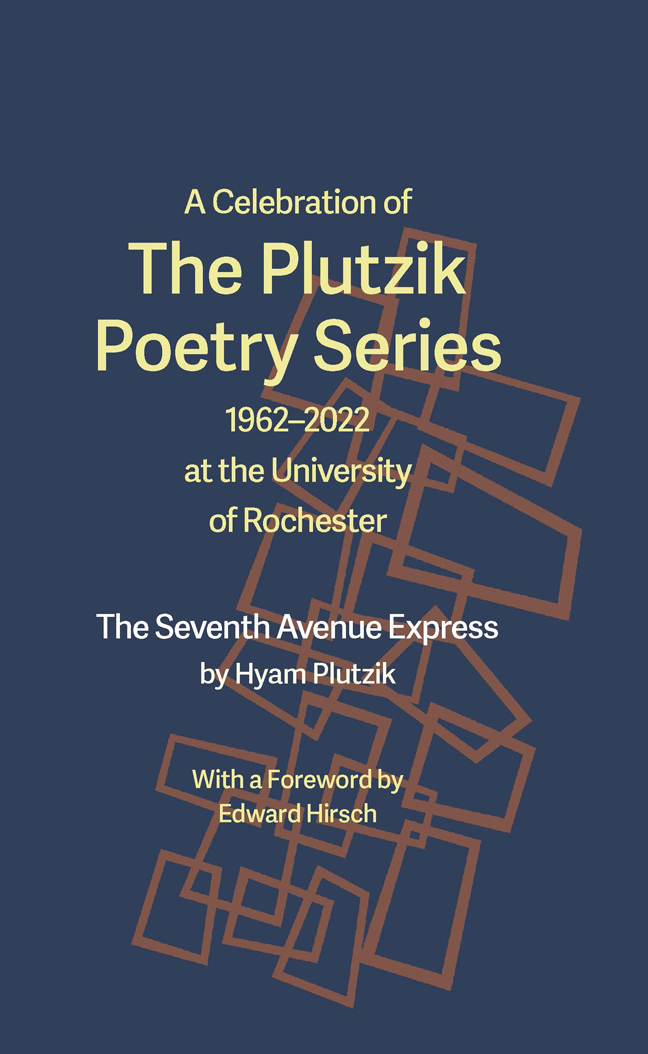
The Plutzik Poetry Series was established at the University of Rochester in tribute to its beloved literature professor Hyam Plutzik (1911-1962). Over the past six decades, the series has welcomed more than three hundred distinguished writers to campus, including US and British poets laureate as well as Nobel and Pulitzer Prize winners and National Book Award finalists and winners. The Plutzik Poetry Series is the longest continuous reading series on any American campus.
Hyam Plutzik made his Whitmanian bid in “The Seventh Avenue Express” to write a long modern poem of the American city. It was 1934. He was twenty-three years old and feeling his way toward his own particular poetic, something he would later describe as “passionately impersonal” and yet nourishing to selfhood (“The Poetic Process”). His remarkable first book, Aspects of Proteus, was still fifteen years away.
Plutzik is writing here at the heart of the Depression. Desperation is palpable everywhere. People are out of work. They have a hunted look, lost, desolate. The crowd that so elated Whitman is foundering in poverty. The setting is the New York subway system. It is hard to see or hear clearly. The yellow light is scant and artificial, the noise deafening. The train is an express, not a local, and it is rushing headlong through an underground world that is dark and dank, gritty, ghostly, and infernal.
I admire the epic ambition in “The Seventh Avenue Express.” Like Whitman, Plutzik was working as a reporter in Brooklyn when he roamed the city streets and moved among the populace. Reading and rereading his poem on the way to work in Manhattan—I also ride the #2 line, which is still the Seventh Avenue Express—I found myself catapulted into the past, into a time that still resonates today. It is hard to discern the faces of other commuters because everyone is masked and guarded. We, too, are working through an era of extreme strangeness.
Plutzik’s update on Whitman makes me think of more mature and accomplished long poems by two of his older contemporaries: Federico García Lorca’s Poet in New York (1929–30) and Hart Crane’s The Bridge (1930). These poems have the same time signature as “The Seventh Avenue Express.” They are on the same wavelength. Like Lorca, Plutzik found the city alien and hostile to nature. He roamed everywhere and found the atmosphere surreal. Like Crane, Plutzik tried to hold on to an American ideal in the face of a faltering American dream. He also wrote through a sunken urban squalor to find a grail of holy light.
Like Lorca and Crane, Plutzik wanted to extend Whitman’s American vision into the contemporary world. Like them, he also had to contend with the overwhelming influence of T. S. Eliot’s The Waste Land (1922).
In a finite, involuted world, the world of the here and now, are imprisoned men confronted by glimmerings of the not-here and bearing in their eyes the knowledge of the not-now. It is a tunneled world they live in, and both sound and thought, matter and aspiration, are driven back upon themselves; they cannot escape and are frustrated. Here men stand with their hands, upraised—not in adoration of the gods but to protect themselves from the material forces which would undo them. In their very resistance they are degraded. But in their resistance, too, they are noble, for there are others sitting and standing beside them that are already too brutalized to resist; time and the forces of nature move by them without meaning: stolidly they sit in the earth, symbols of the destroyed and the destroying. On the streets they are not seen, in the sunlight; only here, in the accursed earth do they congregate—evil memories and forebodings that would be forgotten by the others, the real, who though harried by hunger and the obduracy of their surroundings, still are staunch, still hold up their hands in defiance.
What do we do, we men? We read the stories of ourselves, but our thoughts are on something outside ourselves, something to be possessed and which will give us forgetfulness. For always our comrade death is implicit, hinting his betrayal. Ever to each he turns some facet of his darkness. One will die, and tonight. Another, in woman’s compassion and in beauty, knowing death as an ultimate hatefulness, will meanwhile spurn it by struggling against the lesser. Another is the self-killer, whose hand the involuted world has driven back into his skull. Another is a woman mourning—after her child’s death and thus her own; of this there is no philosophy. Another already lies in the grave, but is in our company. Another is the watcher, knowing death with the knowledge of all. His mind too is driven back into its caverns by the walls of the repellant universe; and he sees that this which confounds us is as breath in the nostrils, not a severed ill but parcel of this lost road of time on which we move, this tunnel we follow astray.
Hyam Plutzik wrote “The Seventh Avenue Express” in 1934–35. He was then working as a reporter for the Brooklyn Daily Eagle while taking a break from his graduate studies at Yale. After a six-year hiatus in Brooklyn and the Connecticut countryside, he finally returned to New Haven in 1940. Plutzik submitted the poem to the competition for the 1941 Albert Stanburrough Cook Prize, but it was rejected in favor of his alternative selection, “Death at The Purple Rim.” (Plutzik had won the Cook Prize in 1933 for “The Three,” making him the only poet to have twice won the prestigious award.)
Its publication here thus marks the first appearance of “The Seventh Avenue Express” in print. Anthony Hecht declined to include it in his 1987 edition of the Collected Poems in deference to Plutzik’s decision not to publish it as part of his first collection, Aspects of Proteus (1949).
It is perhaps not surprising to grasp Plutzik’s reluctance: his other two long poems had attracted greater approval from the poetry establishment. In 1933, Stephen Vincent Benét had been one of the Cook Prize judges, and Arthur Davidson Ficke was particularly impressed with “Purple Rim” in 1941. It is more likely, though, that Plutzik’s reluctance to see “The Seventh Avenue Express” in print is because of its subject matter. Plutzik was at heart a pastoral poet who preferred not to write much about cities with their grittiness and clamor: the setting for “The Three” was a mythological landscape of Olympian gods and goddesses, while “Death at The Purple Rim” was set in the bucolic Connecticut landscape that he called home for nearly half of his life.
Nor is it surprising to see Plutzik choosing to begin his poem with mathematical imagery. At Trinity, Plutzik excelled in that subject and seriously considered mathematics as a profession. The opening lines to “The Seventh Avenue Express” initially describe the subway in somewhat neutral terms, only hinting subtly at what is to come:
In a world finite but Euclidean,
Over parallel lines that never meet—
Twin bands of steel, luminous under the lamps—
The Seventh Avenue Express runs swift
And rhythmless, its windows throwing pale
And fretful cubes of light on tunnel walls …
But this cool, mathematical imagery quickly becomes stark and dystopic,
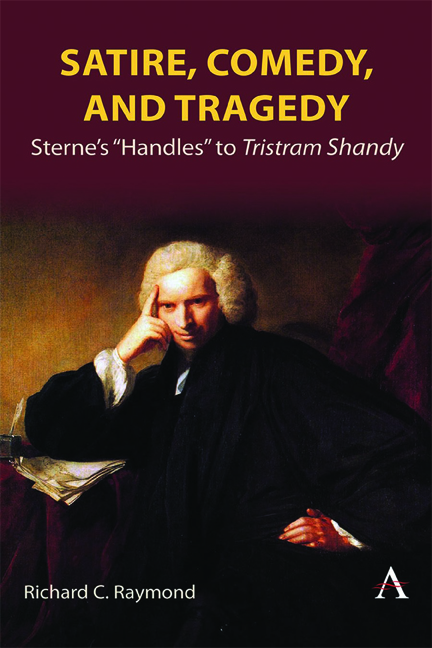
The first four chapters of the book provide a close reading of the satiric, comic, and tragic action of Laurence Sterne's novel in the context of criticism from the twentieth and twenty-first centuries. Chapter 5 provides a summary of Chapters 1-4, focusing on Sterne's purpose in revising satiric plot structures and in blurring the lines between fiction and autobiography. Chapters 6-8 then examine Sterne's themes from Tristram Shandy that inform his letters, sermons, and other fiction; Chapter 9 discusses the international reception of Tristram Shandy and argues for using writing-to-learn strategies to teach Sterne's greatest novel to undergraduate and graduate students.
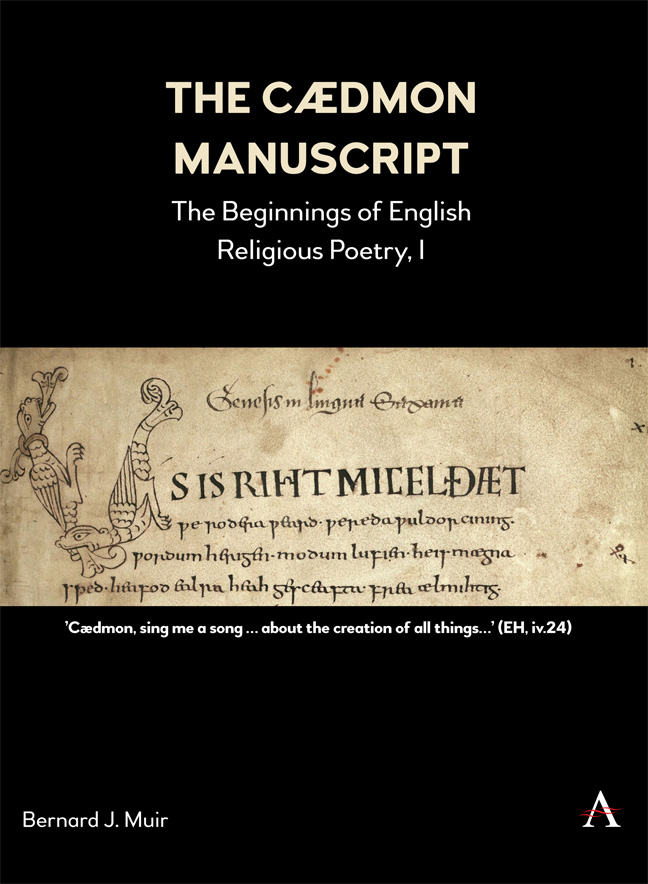
The Cædmon Manuscript is one of three extant anthologies of English Christian poetry produced in England before 1000 CE. It is a collection of four religious poems in Old English based on Biblical materials. They have the editorial names Genesis, Exodus, Daniel and Christ and Satan. This edition consists of an Introduction, Bibliography, Codicological and Paleographical Analysis, an Art-Historical Commentary and an edition of the four poems.
Aphra Behn (1640-1689), a prolific and popular playwright, poet, novelist, and translator, has an extensive corpus of literature that plays a key role in literary history as the work of a female author. Based upon word counts, Quantitative Literary Analysis of the Works of Aphra Behn chronicles Behn's obsession with the mystery and power of love and early modern passions through her entire oeuvre. Love, for Behn, is an external power, sometimes figured as the boy god Cupid or an abstraction, that enters the body with pain and pleasure and leaves the victim searching for understanding. The book follows two threads of argument: one using quantitative measures to indicate passages for significant close reading of preferred language and the other focused upon her use of small words like thou, sir, or said. Situating her writings in the conflicts of Early Modern discourses on the passions, the book demonstrates that Behn's language reveals generic patterns for representing love that include a warning about its potential to destroy the body and condemn the soul. Taken as a whole, Behn's literary production is an extraordinary examination of the early modern concept of love at a moment of change in the language and meaning of the passions.
Kgositsile was born on 18 February 1938 in rural Dithakong, on the outskirts of Mafikeng. The town of Mafikeng as a colonial urban centre under the British protectorate is historically important. In the early nineteenth century, the capital of the Batlhaping sub-branch of the Barolong people was in Dithakong (erstwhile Dithakwaneng). Towards the mid-nineteenth century, the sub-branch of Kgositsile's lineage of the Barolong, the Molema, settled in small, clustered villages on the banks of the Molopo River, producing a flourishing urban area that the Dutch called ‘the Stadt’, or ‘the city’. Towards the end of that century, in 1895 Mafeking was selected as a location for the British colonial administrative offices of the Bechuanaland Protectorate outside the colony of Bechuana (now Botswana). This administration leased land from the Tswana chief immediately adjacent to the village clusters.
As a British protectorate, Mafeking became the ground for territorial fighting between the Dutch and the British during the Anglo-Boer war, with both sides waging a fierce battle for that region between 1899 and 1900 in what is known as ‘the Siege of Mafeking’. As a ‘final frontier’, Mafeking was a prime location, as it was near both the border and the railway between Bulawayo and Kimberly. The latter was a booming mining town at the time since diamonds had been discovered there in the 1860s. The ‘Siege of Mafeking’ also politically conscientized a young Barolong court interpreter and journalist, Solomon Plaatje, who, funded by the Tswana chief Silas Molema, founded the newspaper Koranta ea Becoana (Newspaper for Batswana) and later, Tsala ea Becoana (Friend of Batswana).
Plaatje's work through the newspaper medium addressed the Batswana directly, asking them to maintain a love for the Setswana language, cultures, and identity. He asked them to use Setswana even when the British were teaching them English language and mannerisms; he asked them to love their language, pray in it, study it, and develop it. This sensibility was crucially instilled in him by the womenfolk of his matricentric upbringing, whom Plaatje acknowledges in his various published works.
Kgositsile's work demonstrates how monopolized colonial geographies and politics of knowledge can be reconfigured through poetics of the body. In his poetry, his body is mobilized as a body of knowledge that enshrines principles of interconnectivity, interrelationality, and interdependence with other living bodies, human and non-human. His political commitment to Black liberation and solidarity in the Black world is fortified by gestures of intimacy, interiority, depthoffeeling, ‘breathing together’, and belonging. At the foundation of this sensibility is the bedrock of the matriarchive that attuned him to his feelings as a legitimate place from which to fashion a political identity as poet of the revolution. The matriarchive underlines his erotic registers and poetics that are productive in asserting and affirming his purposeful action: to his mother, he writes of the ‘slow sadness of your smile’ and ‘the slow sadness in your eye / remains fixed and talks’ (1975a: 9). Her unwavering eye, fixed and articulate, is ‘stronger than faith in some god who never spoke our language’ (1971: 28). Galekgobe's enunciating eye transmits knowledge in his mother tongue that he receives as gospel: her sadness commands a course of action to overturn the conditions that would have her live in so-called maids’ quarters in white suburbs of the white man's city, in the country of her birth. Her eye becomes his faith, the clear conscience and compass that orients his purpose in exile – ‘the determined desire / past the impotence of militant rhetoric’ (1971: 28). While the matriarchive entangles his political sensibilities with poetics of the body, it also demands – beyond the poetry – political action.
The matriarchive is his navigation system in exile, an internal guide with coordinates in a rich and substantive repository of mother tongue, Tswana oral/aural cultures, Southern African cosmologies, and philosophies of being. Kgositsile grounds his felt sense of self and orientation to the world in a creative grammar of geopoetics. In his poem to Madikeledi, ‘sadness’ appears thrice, which he writes of as ‘more solid’ than any system that ‘tried to break our back’, and which ‘strength[ens] the fabric of his heart, for us’ (1971: 80–1).
There is a throughline of continuity that Kgositsile aims to draw from the cultures, customs, and sense of community instilled in his homeplace by his mothers and bring to the cultures and politics of Johannesburg and those of the larger Black world. This is a non-linear line that he conceptualizes as a coil. The coil enables his poetics and politics to operate within cosmologies of Southern Africa and their conceptions of the human, temporality, spatiality, knowledge, and intersubjective relationality. The coil, harnessed for its etymology – to ‘gather together’ –, locates the aspirations and objectives of Kgositsile's life and work in an ongoing intergenerational interlocution contiguous with the structuring of the human as an onto-triad comprising of the living dead, the living, and the not-yet-born. This coil has been fashioned to suture Black America to Black South Africa, their oral/aural and literary traditions, histories, and politics. In his work, he devised several working terms and phrases that I have tasked myself with developing as critical theories from elsewhere with which we can disrupt and rupture the dominant, dehumanizing, hierarchical, gendering, differentiating, and mechanizing Europatriarchal terms of order. I have termed these poetics of possibilities. Much ink has been spilled pontificating on the crucial need for decolonial theory and concepts, but very few worlds, archives, vocabularies, practices, tools, material steps, processes, procedures, and approaches have been offered as interventions in these discourses.
My book has brought these poetics to the surface as an offering at this critical juncture in which the field of Black studies is preoccupied with imagining the human and the world anew to upend anti-Blackness and challenge the dominant paradigm of western civilization and its cosmologies of being, knowing, and doing. Kgositsile's work and the poetics of possibility it offers are crucial on many levels. This book draws from his work written in the 1960s and 1970s, critical decades that occasioned mass decolonization in Africa and the rest of the third world. Even though South Africa was not one of those countries that witnessed independence, I contend that Kgositsile, due to the internationalist nature of his work, should be read in the canon of decolonial theorists and poets of this era who sought to provide critical analysis of imperialism, culture, and liberation.
African cultures and cosmologies can provide a wealth of inexhaustible resources for the project of epistemic decentring. Having exhausted technoscientific reason and confronted the civilizational consequences of its impasses, new metaphors are required for the future. We must heed the call for a renewal of the very sources of the imaginary and of a thought coming from an elsewhere.
Felwine Sarr, Afrotopia (2019: 80, my emphasis)
When South African poet and statesman Keorapetse Kgositsile (1938–2018) was instructed by senior members of his party, the African National Congress (ANC), to flee the country into exile in 1961, he packed among his meagre belongings a corpus of Tswana literary classics. To him, they enshrined a set of valuables, of knowledge systems, aesthetic practices, cosmologies, and mythologies he could marshal to counter colonial modernity's anti-Black warfare. As a revolutionary writer, he used the worlds from these classics as a basis to assert the existence of other forms of being, knowing, and belonging that were otherwise to the Eurocentric, racist, capitalist, and Christian social orders imposed by colonialism and apartheid. The Tswana literatures that accompanied him into exile were material representations of the values instilled in his formative years, used as bridges to connect politics of the homeplace with those of his unfolding exile travels and writing life.
He arrived with this treasure trove in the nascent cultural and political ferment of the Black Power and Black Arts Movements (BAM) in the United States of America in 1962. He harnessed that Tswana archive – comprising dramas, novels, and an anthology of poetry – in his five collections of poetry published in the States with the intent to foster continuities between the African American struggle and the struggles of Black South Africa. Further, he understood the Black experience as connected, thereby embracing Black world politics as fundamentally opposed to the culture of Jim Crow, colonialism, and apartheid. Operating in this world of Blackness he sought to bridge geographical and linguistic chasms, to foster political solidarities through cultural relations with Black diasporans.
His literary corpus published in the States, as well as his political activities, illustrate an assertion of the existence of otherworlds within the dominant paradigm of anti-Blackness.
The previous chapter saw Kgositsile mobilize the names-songs-places dynamic to anchor his work in the bedrock of his beginnings, the homeplace of his formative years, in a poetics that centralizes the body as the most intimate of contact zones from which to foster revolutionary poetry and political solidarities. The matriarchive informed, shaped, and held together the zone of relationality and Black radical sociality through the internetworked bodies of the mothers, bodies of land, bodies of water, bodies of knowledge, and celestial bodies. In setting up this chapter's concerns as being continuous with the previous one, here I offer a recap of my findings from chapter 2. Kgositsile settled on the umbilical cord as a connective tissue between his mother and himself, the son, while birth rituals generated a poetics of relation between the mother, the land in which it is buried, and the son. Further, in his shifting and sifting, he linked the bodies of his mothers and bodies of land with celestial bodies: ‘the son must move on to set like the sun and lie buried in the west, or rise again to burn in this place with newborn fire’ (1973a: 64). Here the son is exiled from the land and enlists imageries from cosmological phenomena to transubstantiate himself from the son to the sun, setting in the west, and returning with ‘newborn fire’. The choice of ‘newborn’ sets his meditation up in a dialogue with the matriarchive that makes it possible for the new-to-beborn, ‘rising again’, a (re)birth – ‘Mother, what is my name?’ – to undergird his liberatory purpose that must always be tied to the collective.
The bodies of water, central and fundamental to these relational poetics grounded in the matriarchive, are the principle of creation and creativity, recreation and regeneration that make it possible for Kgositsile to fashion poetics of death and rebirth, destruction and recreation, and flowering creativity and creation in the desolation of exile. The bodies of water in the previous chapter located the matriarchive of his formative years in continuity and locution with those encountered in exile. These were understood as held together, or, to harness the uses of the coil, gathered together by forces of the Limpopo and Mississippi Rivers, which confluence in the Atlantic and other oceans.