To save content items to your account,
please confirm that you agree to abide by our usage policies.
If this is the first time you use this feature, you will be asked to authorise Cambridge Core to connect with your account.
Find out more about saving content to .
To save content items to your Kindle, first ensure no-reply@cambridge.org
is added to your Approved Personal Document E-mail List under your Personal Document Settings
on the Manage Your Content and Devices page of your Amazon account. Then enter the ‘name’ part
of your Kindle email address below.
Find out more about saving to your Kindle.
Note you can select to save to either the @free.kindle.com or @kindle.com variations.
‘@free.kindle.com’ emails are free but can only be saved to your device when it is connected to wi-fi.
‘@kindle.com’ emails can be delivered even when you are not connected to wi-fi, but note that service fees apply.
William Marshall (1745–1818), an experienced farmer and land agent, published this work in 1795, and early in 1796 produced a second edition (reissued here), 'with large additions'. The two-volume work was intended as a practical guide for the owners or managers of large estates on how to establish and maintain timber plantations, both for their financial value and also as important decorative elements in the landscaping of the surroundings of the owner's house. The work covers the practical issues of planting, propagating and transplanting, and discusses the choice of trees for different commercial purposes, and the planning and maintenance of hedgerows, as well as ornamental buildings. Volume 2 begins with an account of the Linnaean system of plant classification and its sexual basis, and supplies both an alphabetical list of trees and shrubs in their Latin Linnaean classes, and an index of plants under their English names.
Employed early in his career by Sir Joseph Banks, the botanist John Lindley (1799–1865) is best known for his recommendation that Kew Gardens should become a national botanical institution, and for saving the Royal Horticultural Society from financial disaster. As an author, he is best remembered for his various works on taxonomy and classification. This work, one of his most famous, was first published in 1846; reissued here is the revised third edition of 1847. Lindley describes his motive as being 'to make his countrymen acquainted with the progress of Systematic Botany abroad' given that the 'superficial and useless system of Linnaeus' was now consigned to history. The work, nonetheless an important milestone in the development of plant taxonomy, gives an overview of the various classification systems used since that of John Ray, and goes on to define the vegetable kingdom in terms of classes and 'alliances' of plants.
The botanist Robert Brown (1773–1858) is regarded as one of the most significant figures in the advancement of plant science in the nineteenth century. After studying at Aberdeen and Edinburgh, he made the acquaintance of Sir Joseph Banks via William Withering, and in 1801 was appointed as naturalist on Matthew Flinders' expedition to Australia. Brown made extensive collections of animals and minerals, but his 3,400 plant specimens from Australia, Tasmania and Timor were the foundation of his work for the rest of his life, as an active member of the Linnean Society, as Banks's librarian, and as an under-librarian in the British Museum. This two-volume collection of his 'miscellaneous botanical works', edited by John J. Bennett, Brown's assistant at the British Museum, was published in 1866–7. It has not been possible to reissue the accompanying quarto volume of plates. Volume 2 contains 'Systematic Memoirs' and 'Contributions to Systematic Works'.
Mrs C. W. Earle (1836–1925) was born into the minor aristocracy as Maria Theresa Villiers. After training as an artist, she married Captain C. W. Earle, who inherited family property which enabled a comfortable lifestyle with a town house in London and a small property with a large garden in Surrey. Earle's designs for her garden were much admired by her artistic and literary circle, and she was encouraged to write down her gardening advice. This work, published in 1899, followed on from the success of her Pot-Pourri from a Surrey Garden (1897). It contains a similar collection of writings on gardening, cookery, travel and art, in chapters which follow the horticultural year from September to August. An introductory section describes with verve and good humour the critical reception of Earle's earlier book, and her reasons for writing another.
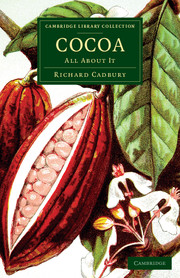
In Britain, the name of Cadbury has been synonymous with chocolate ever since John Cadbury opened his factory in 1831. This book, written by Richard Cadbury (1835–99) under the pen name 'Historicus', was published in 1892. It describes the natural history of the tropical American cocoa plant, its spread in cultivation across the world, and the history of its use. He also deals with the manufacturing process, as exemplified by the Cadbury factory at Bournville, surrounded by the model housing and leisure facilities which the family built for its workers. The processing of cocoa beans into solid and drinking chocolate is described in detail, with emphasis on the developments in machinery which simplified production. A chapter deals with the importance of the vanilla plant for flavouring, and an appendix gives guidance on the cultivation of cocoa trees. This remains a fascinating account of one of the world's most popular indulgences.
Mrs C. W. Earle (1836–1925) was born into the minor aristocracy as Maria Theresa Villiers. After training as an artist, she married Captain C. W. Earle, who inherited family property which enabled a comfortable lifestyle with a town house in London and a small property with a large garden in Surrey. Earle's designs for her garden were much admired by her artistic and literary circle, and she was encouraged to write down her gardening advice. In 1903 she published this work, the third in a very successful series of writings about gardening, cookery, travel and art, but the emphasis in this book is very much on the importance of diet to health, though there are plenty of other topics. The final section of the book contains the last letters home of Mrs Earle's son Sydney, a captain in the Coldstream Guards, who was killed late in 1899 during the Boer War.
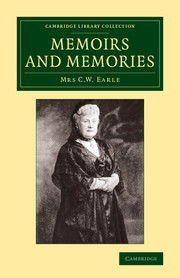
Mrs C. W. Earle (1836–1925) was born into the minor aristocracy as Maria Theresa Villiers. After training as an artist, she married Captain C. W. Earle, who inherited family wealth which enabled a comfortable lifestyle with a town house in London and a small property with a large garden in Surrey. Earle's designs for her garden were much admired by her circle, and she was encouraged to write down her gardening advice. She published three volumes of Pot-Pourri from a Surrey Garden (also reissued in this series) between 1897 and 1903, but these works were not restricted to gardening, and contained thoughts on travel and art, and also on the importance of diet to health. Published in 1911, these reminiscences are dedicated to her grandchildren, and contain her parents' history as well as her own memories of a privileged upbringing among the literary and artistic giants of mid-Victorian England.
Eleanor Vere Boyle (1825–1916), who re-created the gardens of Huntercombe Manor in Berkshire in the 1870s, was a talented artist as well as an author, illustrating both poetry and books for children. Coming from an aristocratic family, and in later life a friend of Queen Alexandra, she produced sketches and watercolours admired by Ruskin and Landseer, and Tennyson and Bulwer Lytton contributed to her anthologies of poetry. One of a number of late nineteenth-century female writers on gardens (many of whose works have been reissued in this series), she was interested in the natural history of the garden rather than in botanical principles. This work, published in 1895, describes the sights, sounds and smells of her garden through the seasons of 1894, with frequent digressions on the weather, birds and animals, the folklore connected with individual plants, literary references, and observations on other gardens visited, in both Britain and Europe.
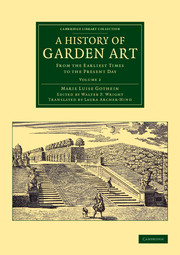
Marie Luise Gothein (1863–1931) published this scholarly two-volume history of garden design in German in 1913. Its second edition of 1925 was translated into English by Laura Archer-Hind, edited by gardening author Walter P. Wright (1864–1940), and published in 1928. The highly illustrated work is still regarded as among the most thorough and important surveys of its kind. It begins by examining evidence from both archaeology and literature, as well as climate and soil conditions, to discuss the gardens of ancient Egypt and Assyria, and continues to survey developments worldwide until the twentieth century. Individual gardens, technical innovations, and fashions in horticulture are all discussed in detail. Volume 2 considers northern European gardens of the Renaissance, the cultural importance of Louis XIV's France, the impact of the introduction of foreign plants, and gardening in Europe, the Far East and North America up to the early twentieth century.
Jane Loudon (1807–58), the Mrs Beeton of the Victorian gardening world, wrote several popular books on horticulture and botany specifically for women. Her enthusiasm for plants and gardening was encouraged by her husband, the landscape designer John Claudius Loudon, whom she married in 1830. Her Instructions in Gardening for Ladies (also reissued in this series) was enormously successful, and she followed it up in 1842 with this volume on botany, in which she uses the natural system of classification. The 'grand object' of the work is 'to enable my readers to find out the name of a plant when they see it … or, if they hear or read the name … to make that name intelligible to them'. She takes her readers through the botanical orders, using a familiar plant as an exemplar for each, and then presents de Candolle's systematic description of plant species.
The innovative gardener and writer William Robinson (1838–1935), many of whose other works are reissued in this series, was sent by The Times as its horticultural correspondent to the Paris International Exposition of 1867. As a result of his visit, he produced two books, one on gardening trends in France, and this work of 1869 on the parks and gardens of Paris and its environs (including Versailles), and on the fruit and vegetable farming which fed the famous Parisian food markets such as Les Halles. Robinson admired especially the small planted open spaces, squares and courtyards in Paris, which had no equivalent in London, and which he claimed were 'saving [its inhabitants] from pestilential overcrowding, and making their city something besides a place for all to live out of who can afford it'. This highly illustrated work will interest not only historians of horticulture but also lovers of Paris.
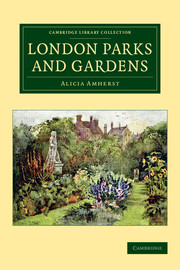
Brought up among the extensive grounds of her family home at Didlington Hall in Norfolk, Alicia Amherst (1865–1941) was a keen gardener from an early age. Especially interested in socially beneficial gardening, she sat on the board of the Chelsea Physic Garden from 1900, encouraged the growing of smoke-resistant flowers in poor urban areas, and promoted the greater use of allotments and school gardens during the First World War. Long regarded as a significant work for its thorough yet accessible approach, this well-researched historical and horticultural survey first appeared in 1907 under her married name of the Honourable Mrs Evelyn Cecil. Beautifully illustrated throughout, it covers London's royal and other parks as well as less obvious green spaces such as squares, burial grounds, and Inns of Court. A map and plant lists are also included. Amherst's History of Gardening in England (1895) is also reissued in this series.
The horticulturalist John Lindley (1799–1865) worked for Sir Joseph Banks, and was later instrumental in saving the Royal Horticultural Society from financial disaster. He was a prolific author of works for gardening practitioners but also for a non-specialist readership, and many of his books have been reissued in this series. The first volume of this two-volume work was published in 1834, and the second in 1837. At a time when botany was regarded as the only science suitable for study by women and girls, Lindley felt that there was a lack of books for 'those who would become acquainted with Botany as an amusement and a relaxation', and attempted to meet this need. The first volume, in the form of engaging letters to a lady, was originally intended to stand alone. Illustrated with detailed botanical drawings, it schools the student in botanical form and taxonomy as well as nomenclature.
Mrs C. W. Earle (1836–1925) was born into the minor aristocracy as Maria Theresa Villiers. After training as an artist, she married Captain C. W. Earle, who inherited family property which enabled a comfortable lifestyle with a town house in London and a small property with a large garden in Surrey. Earle's designs for her garden were much admired by her artistic and literary circle, and she was encouraged to write down her gardening advice. With the help of her niece, Lady Constance Lytton (who provides an appendix on Japanese flower arranging), she published this book, the first of three, in 1897, and it was a great and immediate success. The reader is addressed directly and engagingly on topics ranging from gardening and cookery books to planting schemes, healthy recipes, interior decoration, and the rearing of boys and girls, together with plenty of practical advice on all aspects of gardening.
The botanist Robert Brown (1773–1858) is regarded as one of the most significant figures in the advancement of plant science in the nineteenth century. After studying at Aberdeen and Edinburgh, he made the acquaintance of Sir Joseph Banks via William Withering, and in 1801 was appointed as naturalist on Matthew Flinders' expedition to Australia. Brown made extensive collections of animals and minerals, but his 3,400 plant specimens from Australia, Tasmania and Timor were the foundation of his work for the rest of his life, as an active member of the Linnean Society, as Banks's librarian, and as an under-librarian in the British Museum. This two-volume collection of his 'miscellaneous botanical works', edited by John J. Bennett, Brown's assistant at the British Museum, was published in 1866–7. It has not been possible to reissue the accompanying quarto volume of plates. Volume 1 contains 'Geographico-Botanical Memoirs' and 'Structural and Physiological Memoirs'.
William Marshall (1745–1818), an experienced farmer and land agent, published this work in 1795, and early in 1796 produced a second edition (reissued here), 'with large additions'. The two-volume work was intended as a practical guide for the owners or managers of large estates on how to establish and maintain timber plantations, both for their financial value and also as important decorative elements in the landscaping of the surroundings of the owner's house. The work covers the practical issues of planting, propagating and transplanting, and discusses the choice of trees for different commercial purposes, and the planning and maintenance of hedgerows, as well as ornamental buildings. Volume 1 includes a review of the writings on landscape by such figures as Horace Walpole, (one of whose essays is reproduced), giving insights into the economic as well as the aesthetic aspects of landscape gardening in its golden age.
Employed early in his career by Sir Joseph Banks, the botanist John Lindley (1799–1865) is best known for his recommendation that Kew Gardens should become a national botanical institution, and for saving the Royal Horticultural Society from financial disaster. As an author, he is best remembered for his works on taxonomy and classification. A partisan of the 'natural' system rather than the Linnaean, Lindley published this 1841 work, the fourth edition of his Outline of the First Principles of Botany, under a new title to emphasise not only that it was 'much extended, and, it is hoped, improved', but also that it was a textbook for students of 'structural, physiological, systematical, and medical' botany. He defines the different elements of a plant, and provides a checklist for identification of plant families, before discussing the various 'natural' systems of classification, including his own, and the different practical uses of plants.
This two-volume milestone work, published in 1776, was the first major publication of William Withering (1741–99), a physician who had also trained as an apothecary (his Account of the Foxglove, and Some of its Medical Uses is also reissued in this series). The first systematic botanical guide to British native plants, the present work uses and extends the Linnaean system of classification, but renders the genera and species 'familiar to those who are unacquainted with the Learned Languages'. Withering offers 'an easy introduction to the study of botany', explaining the markers by which the plants are classified in a particular genus, and giving advice on preserving specimens, but the bulk of the work consists of botanical descriptions (in English) of the appearance, qualities, varieties, common English names, and uses of hundreds of plants. The book continued to be revised and reissued for almost a century after Withering's death.
Employed early in his career by Sir Joseph Banks, the botanist John Lindley (1799–1865) is best known for his recommendation that Kew Gardens should become a national botanical institution, and for saving the Royal Horticultural Society from financial disaster. As an author, he is best remembered for his works on taxonomy and classification. A partisan of the 'natural' system of Jussieu rather than the Linnaean, Lindley writes, in his preface to this 1830 work, that it was originally created for his own use, to avoid having recourse to 'rare, costly and expensive publications' available only in the libraries of the wealthy. His intention is to give a 'systematic view of the organisation, natural affinities, and geographical distribution of the whole vegetable kingdom', as well as of the uses of plants 'in medicine, the arts, and rural or domestic economy'. The work is important in the history of taxonomy.
The first career of Robert Sweet (1783–1835) was as a gardener in private employment and as a nurseryman. He turned in 1826 to botanical writing, having already published Hortus suburbanus Londinensis (1818), and the first of the five-volume Geraniaceae (1820–30). The first edition of this work was published in 1826, and this revised second edition in 1830. Sweet uses Jussieu's 'natural' system of classification, but concedes that 'we still consider the addition of the Linnaean classes and orders, of great use, as they are so readily attained by the young Botanist'. He provides nine two-column closely packed pages of source works in which images of the plants cited in this unillustrated work can be found, and which also testify to the breadth of his own research in producing a reference work which is comprehensive as a record of plants then growing and flowering in British gardens.