To save content items to your account,
please confirm that you agree to abide by our usage policies.
If this is the first time you use this feature, you will be asked to authorise Cambridge Core to connect with your account.
Find out more about saving content to .
To save content items to your Kindle, first ensure no-reply@cambridge.org
is added to your Approved Personal Document E-mail List under your Personal Document Settings
on the Manage Your Content and Devices page of your Amazon account. Then enter the ‘name’ part
of your Kindle email address below.
Find out more about saving to your Kindle.
Note you can select to save to either the @free.kindle.com or @kindle.com variations.
‘@free.kindle.com’ emails are free but can only be saved to your device when it is connected to wi-fi.
‘@kindle.com’ emails can be delivered even when you are not connected to wi-fi, but note that service fees apply.
The history of medicinal plants is intimately connected with the history of botany. Primitive man, in constant terror of diseases, lived at the mercy of nature. From the earliest times, tribal priests and medicine men (witch doctors) used various plants, minerals and animal organs, usually in association with strange rituals and incantation, to drive out the evil spirits which they believed to be the cause of the disease. Astonishingly, these magical rites seemed to help. In some primitive tribes, a victim of disease was half-buried in soil for several days to exorcise the malevolent spirits that had possessed him. Among the extremes of treatments was the chipping of holes in the skull to release the tormenting evil spirits. This theory of demoniacal possession lasted many centuries and exists even today in areas where people still live in primitive societies.
Records of early civilisation in all parts of the world reveal that a considerable number of drugs used in modern medicine were in use even in the ancient times. The use of plants for curing various human ailments figured in ancient manuscripts, such asThe Bible,The Rig-Vedas,The Iliad and The Odyssey and the History of Herodotus. Over 6000 years ago, the ancient Chinese were using drug plants. The Egyptians, Babylonians, Sumerians, Greeks and Romans, all developed their respective characteristic Materia Medica. On the other side of the world, the Aztecs, Mayans and Incas had all developed primitive medicine. Some of the ancient Egyptian textbooks ‘papyri’ (such as the Edwin Smith Papyrus and the Ebers Papyrus), written in early 1600 BC, indicate that the Egyptians had an amazingly complex Materia Medica. Apart from the names of many medicinal plants then known, the papyri also included several hundred recipes or prescriptions for various diseases.The Edwin Smith Papyrus (about 1750 BC) is now one of the prized collections of the New York Academy of Medicine.
In India, the ayurvedic system of medicine has been in use for over 3000 years. Charaka and Susruta, two of the earliest Indian authors had sufficient knowledge of the properties of the Indian medicinal plants. Their medical works the Charaka Samhita and the Susruta Samhita are esteemed even today as treasures of literature on indigenous medicine.
We are in the midst of a biological revolution. Molecular tools are now providing new means of critically testing hypotheses and models of microevolution in populations of wild, cultivated, weedy and feral plants. They are also offering the opportunity for significant progress in the investigation of long-term evolution of flowering plants, as part of molecular phylogenetic studies of the Tree of Life. This long-awaited fourth edition, fully revised by David Briggs, reflects new insights provided by molecular investigations and advances in computer science. Briggs considers the implications of these for our understanding of the evolution of flowering plants, as well as the potential for future advances. Numerous new sections on important topics such as the evolutionary impact of human activities, taxonomic challenges, gene flow and distribution, hybridisation, speciation and extinction, conservation and the molecular genetic basis of breeding systems will ensure that this remains a classic text for both undergraduate and graduate students in the field.
In 1775, the physician and botanist William Withering (1741–99) was informed of a folk cure for dropsy that had as its active ingredient the plant foxglove (Digitalis purpurea). Ten years later, after thorough trials on more than 150 patients, Withering published this monograph on the medicinal applications of the plant, not least to keep less experienced doctors from administering it to patients without the proper caution, given the plant's toxicity. Withering was the first doctor to employ foxglove as a remedy for congestive heart failure, which is now the primary disease treated by foxglove-derived pharmaceuticals, and the results from his trials broadly reflect those produced by modern physicians. Withering's first major publication, A Botanical Arrangement of All the Vegetables Naturally Growing in Great Britain (1776), which includes observations on the medicinal applications of British plants, is also reissued in this series.
Understanding ecosystem structure and function requires familiarity with the techniques, knowledge and concepts of the three disciplines of plant physiology, remote sensing and modelling. This is the first textbook to provide the fundamentals of these three domains in a single volume. It then applies cross-disciplinary insights to multiple case studies in vegetation and landscape science. A key feature of these case studies is an examination of relationships among climate, vegetation structure and vegetation function, to address fundamental research questions. This book is for advanced students and researchers who need to understand and apply knowledge from the disciplines of plant physiology, remote sensing and modelling. It allows readers to integrate and synthesise knowledge to produce a holistic understanding of the structure, function and behaviour of forests, woodlands and grasslands.
This 1878 account of a scientific tour of Morocco and the Atlas mountains in 1871 was compiled from the journals of Sir Joseph Hooker (1817–1911) and his travelling companion, the geologist John Ball (1818–89). Their plan had been for Hooker to publish their findings soon after the journey, but his work as Director of Kew Gardens and President of the Royal Society, and Ball's frequent absences abroad, as well as his own writing commitments, caused delays. However, they argue that their information is unlikely to be out of date when, from a comparison with earlier accounts, 'no notable change is apparent during the last two centuries'. The botanical and geological interests of both men take centre stage in an engaging narrative which provides interesting details about the government, customs and daily life in an area which even in the late nineteenth century was little visited by Europeans.
A Treatise on the Laying-Out of Gardens, on the Making and Managing of Hot-Beds and Green-Houses, and on the Propagation and Cultivation of the Several Sorts of Vegetables, Herbs, Fruits and Flowers
The political writer William Cobbett (1763–1835) was also a farmer 'bred at the plough's tail', who took a keen and observant interest in agriculture and gardening throughout his life. (His Cottage Economy and Rural Rides, among other works, are also reissued in the Cambridge Library Collection.) In 1792 he left England, where his views made him very unpopular, for France and then America, where he lived until 1800; in 1817 he fled to America again, leasing a farm on Long Island for two years. This 1821 book is written in Cobbett's characteristically robust style: his purpose is 'to cause the art of gardening to be better understood and practised than it now is in America'. Cobbett starts by explaining how to establish a garden, discusses soil improvement and the building of hot-beds and greenhouses, and gives instruction on the propagation and cultivation of vegetables, fruit trees, and ornamental plants.
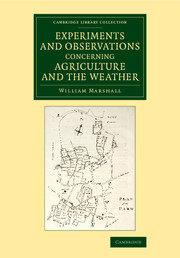
William Marshall (1745–1818), from farming stock, became a farmer and then estate manager and land agent after several years conducting business in the West Indies. This 1779 book (one of his earliest) describes his observations and experiments on his farm in Surrey (which he later had to give up because of his partner's bankruptcy). A description of the size, soil type and aspect of his various fields is followed by a summary of the experiments he carried out - mostly simple ones, such as comparing results if seeded fields were rolled or not. Diary records over two years for each crop are given, with areas sown, soil conditions and weather data. A chapter is devoted to weather prognostications, and another to day-to-day farm management and accounts. Marshall hoped that the systematic reporting of his findings would be of use to others, and the work provides interesting insights into the beginnings of scientifically based agriculture.
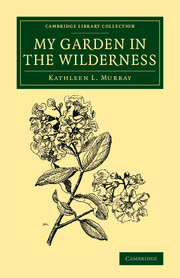
This story of an Indian garden was published in 1915. Its author, Kathleen L. Murray, was living in the remote north-eastern region of Bihar in the home of her brother, an indigo producer, and some of her musings on life and gardening in India had already been published in the periodical The Statesman. She viewed this work not as a guide, but 'merely a rambling record of some years in a garden' which combined European plants such as roses and sweet peas with natives such as cannas and beaumontias. Along with her gardening successes and failures over three years, the book provides insights into the life of the European woman in India - with no employment, and required to be both idle and aloof from the lives of the wider population. Murray's descriptive powers and enthusiasm for her garden make this book both enjoyable and evocative of imperial India.
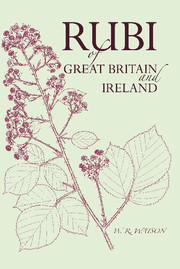
Originally published in 1958, this book describes all the forms of the genus Rubus, which includes blackberries and brambles, found in Britain, Ireland and the Channel Islands. Each species is described in order of frequency, with notations on any special geographical restrictions, and fifty of these species are illustrated at the conclusion of the text. This book will be of value to anyone with an interest in botany and the flora of the British Isles.
There are numerous Earth orbiting satellite sensors that provide observations useful in assessing land cover conditions and landscape dynamics. These orbiting sensors measure spatial patterns of reflected and emitted energy from the land surface that can be used to generate geospatial image products of soil, vegetation, water and biogeochemical features. They measure changes over time through their repeat observations across a range of spatial and temporal scales. Satellite imagery extending back to the 1970s now provides a forty-plus year observation data record of dynamic ecosystem conditions and land surface changes. The synoptic coverage, higher-quality and consistency of satellite imagery have greatly improved the mapping of Earth resources compared with aerial photography.
A basic understanding of the variety of sensor designs and their characteristics is beneficial in correctly applying remote sensing tools to achieve various science and resource management objectives (Fig. 6.1). It is also important to know which sensors yield the appropriate type of remote sensing data to best answer specific ecological questions. Various sensor-dependent properties, such as pixel size, spectral bands, temporal repeat period, radiometric fidelity, polarization and viewing geometry are utilized to measure and characterize the Earth's surface. Each sensor system will have unique measurement strengths and limitations in its ability to characterise and retrieve land cover information.
There are many ways to classify the multitude of orbiting sensors and imagery available for ecosystem landscape studies. Important differentiating criteria may include the region of the electromagnetic spectrum (e.g., microwave, thermal, visible, near-infrared) being sensed, whether the energy source is active versus passive, sensor orbital characteristics (e.g., geostationary), frequency of image acquisition and sensor spatial resolution. In this chapter we introduce basic sensor principles, their design and properties, and discuss their respective capabilities and limitations in assessing land cover status, ecological variables, and landscape processes. Examples of the various types of sensor systems used in landscape studies are also highlighted.
Sensor Resolution
The resolution properties of a sensor define the magnitude and extent to which a sensor is able to discriminate variations and changes in landscape properties. In general, improved surface characterisations are achieved with finer resolution imaging capabilities. However, all sensors are limited by resolution constraints and signal noise limitations.
“Classical” plant physiology is the study of physiological processes of individual plants of a single species growing in pots in glasshouses, growth cabinets and controlled-environment chambers. Single-factor experiments are frequently used to manipulate one variable (e.g. water supply, temperature) in order to establish the response of individual processes (e.g. transpiration rate, phloem loading) or whole plants (e.g. growth rate) to that variable. It has been an immensely powerful science, contributing to increased food productivity and crop genetic selection for many decades.
Ecophysiology takes knowledge gained from plant physiological studies and applies them to plants growing “in the wild”, in real landscapes. This adds several layers of complexity arising from (a) large spatial and temporal variations in multiple variables (e.g. rainfall, temperature, solar radiation); (b) the interactions amongst multiple variables; and (c) complexities arising from the fact that landscapes are composed of multiple species. Although manipulative experiments can be undertaken in ecophysiology (e.g. rainfall exclusion, and rainfall redistribution troughs), the majority of ecophysiological studies do not manipulate environmental variables. Rather, they allow natural seasonal and inter-annual variation to impact on the structure and function of natural vegetation and measure the response of individual leaves, plants (trees, grasses, etc.) and canopies and use statistical inferences and models to analyse these responses.
Modelling of plant function can similarly be undertaken at small (leaves; xylem function), intermediate (trees, canopies) and large scales (stands, regions, sub-continental, global) across a range of temporal scales (typically hours to centuries). These models incorporate plant physiological and ecophysiological data (e.g. light response curves of leaves, eddy covariance tower flux data) to model the function (e.g. gross primary productivity [GPP], net primary productivity [NPP], evapotranspiration [ET]) of landscapes and biomes.
Remote sensing (RS) uses air-borne and satellite platforms for remote surveillance of land and vegetation surfaces (e.g. reflectance of solar radiation across multiple wavebands, land surface temperature). Using these remotely sensed data, plant structural attributes (e.g. LAI) and functional attributes (e.g. NPP, ET) can be calculated. As is the case for modelling, RS as a discipline is increasingly using physiological and ecophysiological (e.g. canopy conductance, canopy gas fluxes, LAI) data to validate/test/compare remotely sensed estimates of landscape processes and vegetation structure. Figure I.1 provides a simplified representation of these three disciplines and their overlap.
The Amazon basin represents a major component of regional and global carbon and water cycles. Understanding seasonal and spatial variations of tropical forest structure and functioning in Amazonia is important for understanding and predicting the fate of Amazon forests under climate change.
Seasonality in productivity of tropical forests is more subtle than that observed in temperate zones that are dominated by an active growing and a dormant season. Field-based studies of tree phenology in the humid tropics show flowering and flushing of new leaves along with increases in leaf area during the dry season when solar radiation availability is larger relative to the more cloudy wet season.
Eddy covariance flux tower measurements show enhanced photosynthesis and larger rates of evapotranspiration in the dry season. Tower measurements are crucial for understanding the mechanisms of functional phenology in tropical forests.
Satellite-based remote sensing data also show forest greening at the basin-scale during the dry season, thereby greatly extending site-based studies. Earth system models have generally represented Amazon forests as water-limited or with year-round constant leaf area and thus predict dry season declines in productivity. However, some models show enhanced productivity in the dry season.
There are many challenges in field, satellite and model assessments of tropical forest phenology, with field methods time consuming and limited to narrow spatial and temporal scales, satellite data subject to cloud contamination and optical artefacts and models subject to uncertainties.
The paradigms of light-limitation or water limitation in tropical forests remain controversial, yet increasingly there is a consensus that basin-wide predictions of modelled carbon and water fluxes can be constrained by incorporation of remote sensing data and local flux measurements.
Biogeography of the Amazon Basin
Knowledge of spatial and seasonal variations in Amazon tropical forests resulting from meteorological drivers, soils, topography, and disturbance (fire, logging, deforestation) is important for understanding their ecological function and future fate with climate change. The Amazon Basin encompasses an area of 7.5 × 10⁶ km2 and is covered mostly of dense tropical evergreen broadleaf rainforests from wet equatorial forests to tropical dry forests. These primary forests are mostly closed canopies with high LAI of 5–7, and are approximately 40 m tall (Goulden et al. 2004).
An understanding of the physical principles of how electromagnetic energy interacts with the Earth's surface is essential for accurate interpretations and effective use of remote sensing images and datasets. In this chapter we highlight the main physical processes of radiant energy interactions with the Earth's surface as they relate to satellite measurements and the generation of remote sensing imagery for use in ecology and environmental sciences.
Fundamentals of the Remote Sensing Signal
Remote sensing is defined as the acquisition of information about the biophysical state and condition of the Earth's surface through non-contact, sensor-based observations. The information is transmitted from the surface to the sensor in the form of electromagnetic radiation, providing us the opportunity to detect or ‘sense’ this signal and derive information about the health, structure, and condition of objects on the land surface from afar.
The electromagnetic signal may be solar energy that is reflected from the Earth's surface or it may be emitted energy coming from the Earth's surface itself, irrespective of the presence or absence (night time) of sunlight (Fig. 5.1). Thermal and microwave radiation are two examples of emitted energy commonly measured by remote sensing. In certain cases, the signal received at a sensor may be a combination of solar-reflected and self-emitted energy, which may be useful, for example, in the detection of fires when portions of the shortwave infrared are detected. Alternatively, an ‘active’ sensor system generates the energy that interacts with the Earth's surface, which is then detected by the same sensor system, as in the case of Radar (Radio Detection and Ranging) and Lidar (Light Detection and Ranging) remote sensing (Fig. 5.1).
Regardless of the type of electromagnetic signal, the energy received and detected by remote sensing provides valuable information that can be used to interpret and characterize the physical, chemical, and biologic state and condition of the surface, along with surface processes involving soils, vegetation, water, and land-use activities. Although, in remote sensing we focus primarily on the measurement and information content of the electromagnetic radiation, this signal may be coupled with other energy terms to yield estimates of evapotranspiration, photosynthesis, and soil moisture content.