To save content items to your account,
please confirm that you agree to abide by our usage policies.
If this is the first time you use this feature, you will be asked to authorise Cambridge Core to connect with your account.
Find out more about saving content to .
To save content items to your Kindle, first ensure no-reply@cambridge.org
is added to your Approved Personal Document E-mail List under your Personal Document Settings
on the Manage Your Content and Devices page of your Amazon account. Then enter the ‘name’ part
of your Kindle email address below.
Find out more about saving to your Kindle.
Note you can select to save to either the @free.kindle.com or @kindle.com variations.
‘@free.kindle.com’ emails are free but can only be saved to your device when it is connected to wi-fi.
‘@kindle.com’ emails can be delivered even when you are not connected to wi-fi, but note that service fees apply.
Frigatebirds have been in taxonomic oblivion for nearly a century. A new genetic study by Martins et al. (2022) provides a stimulus and potential basis for a long-overdue modern review, which might lead to recognition of up to five new species-level taxa, two of which would be “Critically Endangered” globally and may already be effectively extinct. Even some of the more widespread frigatebird taxa are subject to multiple anthropogenic threats and, outside strictly protected and managed areas, may already be in serious decline. Seabird experts and organisations need urgently to review all available data relevant to frigatebird taxonomy and populations, collect additional material for genetic analysis, undertake new assessments of conservation status, and (in collaboration with appropriate regulatory authorities) propose and execute appropriate conservation and management actions.
We present the most recent data on the seasonal and spatial occupation of South American sea lions (Otaria flavescens) and fur seals (Arctocephalus australis) in the Wildlife Refuge of Ilha dos Lobos (WRIL) in southern Brazil throughout the year, based on aerial photographic counts. Thirty-one aerial photographic counts were conducted between July 2019 and November 2020 to assess monthly differences in the abundance of pinnipeds in the WRIL. The results were analysed using a generalized linear model. Spatial analysis was performed using kernel density. Subadult males of South American sea lion were the most abundant pinniped in the WRIL, followed by juveniles of South American fur seal. A juvenile of Southern elephant seal (Mirounga leonina) was also recorded. South American fur seals showed a marked seasonality, occurring only between July and October, while South American sea lions occurred year-round. Among the months analysed, September exhibited the highest mean abundance (mean 113.75; SD: ± 8.58), followed by August (mean 103.00; SD: ± 15.69). The pinnipeds were more often concentrated in the northern and central parts of the island. This study reinforces the importance of the WRIL as a haulout site for pinnipeds. Considering the seasonal occupation of the island by South American pinnipeds, monitoring is recommended prior to the development of activities in the area.
Saving endangered species presents a critical and increasingly pressing challenge for conservation and sustainability movements, and is also matter of survival and livelihoods for the world's poorest and vulnerable communities. In 1973, a global Convention on International Trade in Endangered Species (CITES) was adopted to stem the extinction of many species. In 2015, as part of the Sustainable Development Goals (SDG 15) the United Nations called for urgent action to protect endangered species and their natural habitats. This volume focuses on the legal implementation of CITES to achieve the global SDGs. Activating interdisciplinary analysis and case studies across jurisdictions, the contributors analyse the potential for CITES to promote more sustainable development, proposing international and national regulatory innovations for implementing CITES. They consider recent innovations and key intervention points along flora and fauna value chains, advancing coherent recommendations to strengthen CITES implementation, including through the regulation of trade in endangered species globally and locally.
Accurate demographic data play a critical role in implementing conservation strategies and identifying key areas for species preservation. The population abundance and density of Sotalia guianensis were estimated in the estuarine-lagoon complex of Cananéia, Brazil, using distance sampling. The survey covered 1339.91 km with 83 h 05 min in effort. A half-normal model with cosine adjustments was evaluated as the best fit to estimate an abundance of 193 individuals (95% CI 158–237) and a density of 2.55 ind km−2. The majority of sightings occurred in the Baía de Trapandé (48.72%), followed by the Mar de Cananéia (32.72%) and Mar de Cubatão (18.56%), the three areas surrounding the Ilha de Cananéia. The study confirmed the heterogeneous distribution of the estuary and found that the Mar de Cananéia and the Baía de Trapandé were more densely populated, with 2.76 ind km−2 (95% CI 1.93–3.96) and 2.76 ind km−2 (95% CI 2.07–3.66), respectively, while the Mar de Cubatão was less densely populated, with 1.59 ind km−2 (95% CI 1.04–2.44). The findings support previous research indicating a stable population over the last few decades. The Cananéia estuary is an ecologically diverse region located between protected areas under different categories of environmental protection and harbours a significant population of S. guianensis, providing essential resources for feeding and breeding. Protected areas have proven to be effective tools for preserving both marine and terrestrial environments. Despite the close proximity to humans and constant threats, the study underscores the importance of the area for the conservation of the species.
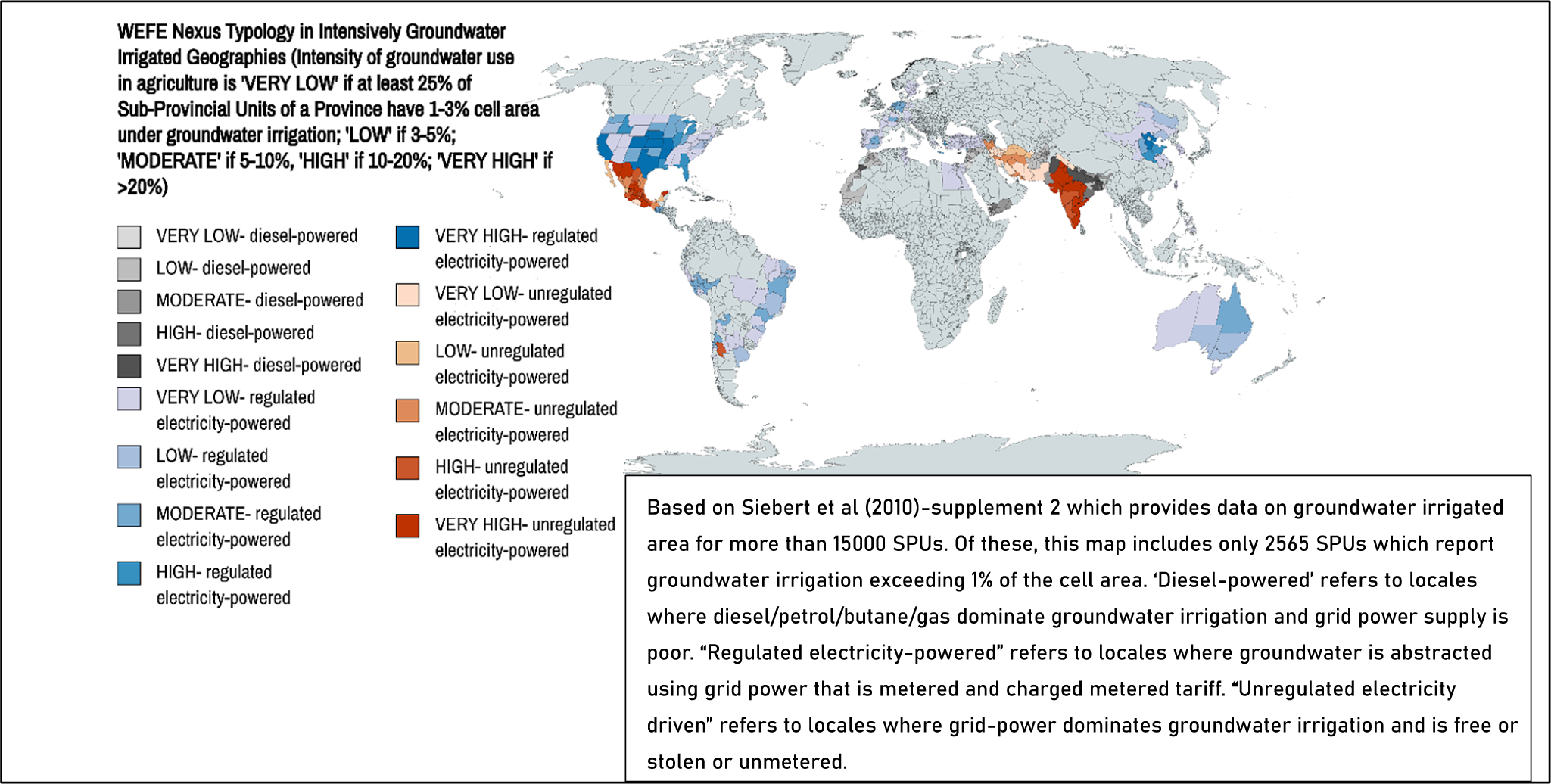
Using water-energy-food-environment (WEFE) nexus as the prism, this review explores evolution of groundwater governance in Iran, Saudi Arabia, Mexico, China, Bangladesh and India – which together account for two-thirds of the global groundwater-irrigated area. Global discourse has blamed widespread water scarcity squarely on supply-side policymaking and advocated a broader template of water governance instruments. Integrated Water Resources Management (IWRM) presented just such a template – with pricing, participation, rights and entitlements, laws, regulations, and river basin organizations – as additional water governance tools. However, the IWRM template faced disillusionment and pushback in many emerging economies. WEFE nexus, the new paradigm, prioritizes system-level optima over sectoral maxima by harnessing synergies and optimizing trade-offs between food, water, energy, soil, and eco-system sustainability within planetary boundaries. Realizing this vision presents a complex challenge in groundwater governance. Global groundwater economy comprises three sub-economies: (a) diesel-powered unregulated, as in Nepal terai, eastern India, Bangladesh, Pakistan Punjab and Sind, and much of Sub-Saharan Africa, where use-specific energy subsidies are impractical; (b) electricity-powered regulated, as in North America and Europe, where tubewells are authorized, metered and subject to consumption-linked energy charges; and (c) electricity-powered unregulated, as in geographies covered by our review – barring China, Bengal and Bangladesh – where unmeasured electricity subsidies have created a bloated groundwater economy. This last sub-economy represents the heartland of global groundwater malgovernance, least equipped to meet the sustainability challenge. It has an estimated 300 million horsepower of grid-connected electric pumps that are either unauthorized and/or unmetered and/or use free or heavily subsidized or pilfered power for irrigating 50–52 million hectares, nearly half of global groundwater-irrigated area. In (a) and (b), groundwater scarcity inspires water-energy saving behavior via increased energy cost of pumping. In sub-economy (c), users are immune to energy costs and impervious to groundwater depletion. Here, the WEFE nexus has remained blind to the irrigation realpolitik that catalyzes or constrains policy action. We explore why the political costs of rationalizing subsidies are prohibitive and exemplify how a smart transition from fossil to solar energy for pumping may offer an opportunity to turn the perverse WEFE nexus into a virtuous one.
Spatial–temporal variability of phytoplankton community and potentially harmful species in the Golden Horn Estuary (Sea of Marmara) was investigated from October 2018 to September 2019 together with some environmental factors. A total of 148 phytoplankton taxa were identified during the study period. Among these, 134 taxa (90.5%) consisted of diatoms (71 taxa, 48%) and dinoflagellates (63 taxa, 42.5%), while 14 taxa (9.5%) were other groups. Seventeen species were recorded for the first time in the study area. Species richness was highest in October, while it was lowest in August. The species diversity (H') varied according to sampling stations. Cell abundances were higher especially in the middle and upper estuary in spring and summer than in autumn and winter. The abundance of diatoms and euglenophyceans was highest in spring, while the abundance of raphidophycean and cryptophycean was highest in summer. Temperature was correlated positively with total abundance (P < 0.01), but negatively with species diversity (H') (P < 0.01). Several dense algal blooms causing discolouration in surface water occurred in spring and summer. A total of 12 microalgae species known as potentially toxic were detected during this study period. Among these, dinoflagellates Alexandrium cf. tamarense and Dinophysis infundibulum were recorded for the first time in the study area. The increase in species diversity and richness in the upper estuary, and the decrease in frequency of bloom events compared with the previous years indicated the changes in environmental conditions in this study period. Findings showed that phytoplankton might be used as an indicator of the changing environmental conditions in such ecosystems.
Edited by
Dan Chamberlain, University of Turin,Aleksi Lehikoinen, Finnish Museum of Natural History, University of Helsinki,Kathy Martin, University of British Columbia, Vancouver
Edited by
Dan Chamberlain, University of Turin,Aleksi Lehikoinen, Finnish Museum of Natural History, University of Helsinki,Kathy Martin, University of British Columbia, Vancouver
This chapter summaries what is known about population trends of mountain birds, especially in Europe and North America. A European mountain bird indicator, which summaries the population trends of 44 alpine species, suggests an overall slightly increasing mountain bird population during 2002–2020. Regional North American indicators, based on up to seven alpine species showed either stable or declining trends during 1968–2020. In European mountains, cold-dwelling species had on average less favourable regional population trends than warm-dwelling species, and long-distance migrants tended to have more negative trends than short-distance migrants and residents. There were also spatial differences in trends of the indicators in Europe: mountain birds in general increased in the Alps but decreased in the UK. A comparison between two European breeding bird atlases showed that the distribution area of mountain birds has generally decreased since the 1980s, and mountain specialists have lost more of their range than mountain generalists. Monitoring alpine species presents many challenges which has led to poor coverage in surveys even in areas with well organised bird monitoring programmes at low elevation. The necessary future improvements needed for successful bird population monitoring in mountain areas will, in many instances, require strong financial support.
Edited by
Dan Chamberlain, University of Turin,Aleksi Lehikoinen, Finnish Museum of Natural History, University of Helsinki,Kathy Martin, University of British Columbia, Vancouver
We review evidence for whether and why mountain birds are potentially more vulnerable to climate change than birds at low elevation, given current knowledge of the avian limits to physiological and environmental conditions. The observed impacts of climate change on bird populations, communities and distributions in mountain environments are limited. We summarise these responses and provide an assessment of the main mechanisms that might underpin those changes, such as changes in climate (temperature, precipitation, snow cover extent), and biotic drivers (phenology/food mismatch, prey/predator populations, shifting treelines). The potential future impacts of climate anticipated in mountain environments, considering the vulnerability of montane species and the likelihood of increasing upslope colonisation by species that currently occupy lower elevations, are considered, including a comparison between the observed and projected impacts where available. Finally, we discuss potential conservation actions for mountain birds in the face of climate change. Are there ways that the management of these habitats can be altered to either help vulnerable species resist negative impacts, or to facilitate more positive changes in response to climate change? We conclude by summarising anticipated avifaunal community composition and function in these mountain environments by the end of the century.
Edited by
Dan Chamberlain, University of Turin,Aleksi Lehikoinen, Finnish Museum of Natural History, University of Helsinki,Kathy Martin, University of British Columbia, Vancouver
Alpine birds face many challenges to live in habitats characterized by low temperatures, high winds, short growing seasons and delayed breeding schedules. Breeding in alpine environments is always a race against time due to the shortened egg laying period and frequent storms that may result in delayed development or reproductive failure. Since daily temperatures in the alpine zone can range from below freezing to >450C, developing embryos may require cooling as well as heating to maintain homeothermy. To cope with such conditions, birds breeding in alpine habitats have developed physiological, morphological and behavioural adaptations, and have adopted a slower lifestyle where they may produce fewer offspring each year compared to populations at low elevations, but may live longer. In the northern hemisphere, only a few birds live exclusively in the alpine zone, with many mountain species breeding in both alpine and lower elevation habitats, while in the Southern Andes, most alpine birds breed exclusively above the treeline. In summary, there may be high ecological costs to living in open habitats at high elevations. However, alpine birds likely experience lower levels of interspecific competition, habitat degradation and parasites and diseases than birds living at lower elevations.
Edited by
Dan Chamberlain, University of Turin,Aleksi Lehikoinen, Finnish Museum of Natural History, University of Helsinki,Kathy Martin, University of British Columbia, Vancouver
Edited by
Dan Chamberlain, University of Turin,Aleksi Lehikoinen, Finnish Museum of Natural History, University of Helsinki,Kathy Martin, University of British Columbia, Vancouver
Edited by
Dan Chamberlain, University of Turin,Aleksi Lehikoinen, Finnish Museum of Natural History, University of Helsinki,Kathy Martin, University of British Columbia, Vancouver
Edited by
Dan Chamberlain, University of Turin,Aleksi Lehikoinen, Finnish Museum of Natural History, University of Helsinki,Kathy Martin, University of British Columbia, Vancouver
High mountains cover an estimated 25% of the global land surface, but harbour almost 50% of terrestrial biodiversity hot-spots and about one-third of terrestrial biodiversity globally. Thus, it is concerning that relatively little research has been conducted on birds in high mountains, especially for tropical mountain birds. We identified 10 major knowledge gaps arising from the reviews in our nine previous chapters, including the urgent need for information on avian diversity and population and community ecology, especially in under-studied mountains of the Global South, avian responses to climate change and other stressors, mountains as refugia from habitat and climate change, and the role of protected areas to function as biodiversity reservoirs. We propose a set of priorities for ecological and conservation research and management that will help to ensure persistence of birds in high mountain ecosystems. Maintaining and restoring mountain biodiversity is important from ecological, evolutionary and cultural points of view. We recommend investing in research to safeguard the critical ecological, social and economic values of mountain systems into the future. Strong support is needed from the scientific community, citizen scientists, policy makers, politicians and local communities to fulfill our priorities for the conservation of mountains and mountain birds.
Edited by
Dan Chamberlain, University of Turin,Aleksi Lehikoinen, Finnish Museum of Natural History, University of Helsinki,Kathy Martin, University of British Columbia, Vancouver
Edited by
Dan Chamberlain, University of Turin,Aleksi Lehikoinen, Finnish Museum of Natural History, University of Helsinki,Kathy Martin, University of British Columbia, Vancouver
There are many definitions of what is a ‘mountain’ and what is a ‘mountain bird’. In this chapter, we first assess these different definitions, and then clearly outline our rationale for choosing to define a mountain bird as bird species where at least some populations of the species somewhere in their distribution spend at least one critical stage of their life cycle above treeline. We then provide an overview of the importance of mountains to biodiversity, and compare knowledge on mountain birds to lowland ecosystems. Zonation is an important aspect of mountain ecology – we review the evidence for consistent patterns in bird richness and diversity across elevation gradients, and consider the different hypotheses that might explain these patterns. Additionally, we consider variation along the elevation gradient in some general species characteristics and the extent to which these trends vary geographically. Furthermore, we give an overview of how mountain bird communities vary seasonally, in particular considering different dispersal and migration strategies, and the extent to which the prevalence of these strategies varies according to different regions. Finally, we summarise the history of human interventions in mountains and their impacts on bird communities from pre-history until the start of the mechanized age.
Edited by
Dan Chamberlain, University of Turin,Aleksi Lehikoinen, Finnish Museum of Natural History, University of Helsinki,Kathy Martin, University of British Columbia, Vancouver
Tropical mountain regions are characterized by complex and mostly resident avifaunas with many small-range species and a high turnover of species across mountain ranges. On a global scale, tropical mountains show an over-representation of both recently-diverged and ancient species, making them both cradles and museums of biodiversity. Tropical mountains are characterized by slight seasonality, and local habitat gradients can be maintained over a long time. The highest levels of diversification and local endemism are found in the tree-line zone. However, a few avian families also diversified in the alpine zone. Here, many species forage by probing for invertebrates in the ground and in matted vegetation, and many species also exploit carbohydrate foods, including nectar. In an environment with few large insects, co-adapted networks of nectarivorous birds and plants play an important role. There is little published evidence of avian population changes that can be related to recent global warming, as the night-time freezing conditions in open landscapes make it difficult for arboreal vegetation to expand upslope. As glaciers melt, we should expect changes in the rich avifauna of the many periglacial Andean wetlands. Re-visits to well-documented study sites in tropical mountains are now needed to evaluate the amount of change.
Edited by
Dan Chamberlain, University of Turin,Aleksi Lehikoinen, Finnish Museum of Natural History, University of Helsinki,Kathy Martin, University of British Columbia, Vancouver
Mountain areas have faced a rapid increase in human activities over recent decades, often leading to habitat loss or degradation. The impacts of these activities can affect bird species both directly (e.g., by altering habitat characteristics, impacting migration or disturbing breeding or wintering grounds), and indirectly by inducing physiological responses. We summarize the human activities that take place at high elevation and provide examples of species that are known to be impacted. Hiking and winter sports in particular are common in many mountain regions and there is growing evidence of a range of impacts on year-round resident mountain birds and their food resources. Increasing evidence also suggests that use of, and dependence on, human-derived foods around human settlements affects the trophic ecology of high-altitude birds. Hunting mountain birds is common place in many areas, and we review the evidence that hunting activity, including illegal persecution, has had impacts at the population level. Finally, we assess how direct disturbance and habitat alteration due to renewable energy developments (i.e. wind turbines and hydropower) are affecting mountain bird communities. There are many unknown impacts of human disturbance and we highlight missing information on specific topics that should be investigated in future research.
Edited by
Dan Chamberlain, University of Turin,Aleksi Lehikoinen, Finnish Museum of Natural History, University of Helsinki,Kathy Martin, University of British Columbia, Vancouver
from
5
-
Population Trends of Mountain Birds in Europe and North America
Edited by
Dan Chamberlain, University of Turin,Aleksi Lehikoinen, Finnish Museum of Natural History, University of Helsinki,Kathy Martin, University of British Columbia, Vancouver