To save content items to your account,
please confirm that you agree to abide by our usage policies.
If this is the first time you use this feature, you will be asked to authorise Cambridge Core to connect with your account.
Find out more about saving content to .
To save content items to your Kindle, first ensure no-reply@cambridge.org
is added to your Approved Personal Document E-mail List under your Personal Document Settings
on the Manage Your Content and Devices page of your Amazon account. Then enter the ‘name’ part
of your Kindle email address below.
Find out more about saving to your Kindle.
Note you can select to save to either the @free.kindle.com or @kindle.com variations.
‘@free.kindle.com’ emails are free but can only be saved to your device when it is connected to wi-fi.
‘@kindle.com’ emails can be delivered even when you are not connected to wi-fi, but note that service fees apply.
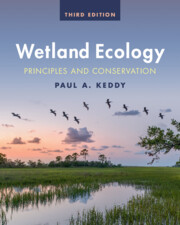
Richly illustrated in full colour and packed with examples from every major continent and wetland type, this third edition has been completely rewritten to provide undergraduates with a thoroughly accessible introduction to the basic principles. It divides the world’s wetlands into six principal types and presents six major causal environmental factors, arranged by importance and illustrated with clear examples, making it easy for instructors to plan tailored lectures and field trips and avoid overwhelming students with unnecessary detail. It retains its rigour for more advanced students, with sections on research methods and experiments, and over a thousand classic and contemporary references. Each chapter ends with questions that review the content covered and encourage further investigation. With expanded sections on topical issues such as sea level rise, eutrophication, facilitation and the latest approaches to restoration and conservation, the new edition of this prize-winning textbook is a vital resource for wetland ecology courses.
The subfamily Polycerinae includes eight genera, from the monospecific Lamellana and Lecithophorus to the diverse Polycera and Gymnodoris, with 33 and 26 valid species, respectively. The monophyly of the subfamily has been tested by molecular data although not all genera were included. To date, relationships within the subfamily are not supported. In the present paper, three new species of polycerid nudibranchs are fully described based on specimens collected in Marshall Islands and Australia: one Palio species (Palio gaeli sp. nov.), one Polycera species (Polycera nimbsi sp. nov.) and a new genus (Paliota galactica gen. and sp. nov.). The new genus is described based on its peculiar radular teeth and genetic divergence.
The internal anatomy was studied by dissections and scanning electron microscope photographs. Partial sequences of mitochondrial cytochrome oxidase c subunit I (COI) and 16S ribosomal RNA (16S) as well as nuclear histone H3 (H3) were also obtained. A phylogenetic framework for two of these three species is proposed, also including for the first time the species Paliolla templadoi and Polycera melanosticta.
The increase in the semi-wild Northern Bald Ibis Geronticus eremita population in Birecik, south-eastern Turkey motivated the Working Group of the Agreement on the Conservation of Africa-Eurasian Migratory Waterbirds (AEWA) to propose the establishment of a second semi-wild Northern Bald Ibis population in Turkey. This paper presents an assessment approach that identifies potential suitable breeding sites and foraging habitats within a large geographical area of approximately 380 × 60 km (23,000 km2) in south-eastern Turkey, which includes former breeding sites. This approach makes use of open-source and easily available geographical information. The structured approach is based on three key parameters, namely: (1) suitable breeding rocks; (2) suitable foraging habitats: (3) available water-bodies. This led to the identification of three potentially suitable areas around Derik and Yesilli in the Mardin province and around Yarbasi in the Sirnak province. The occurrence and spatial distribution of the three key parameters were mostly identified using Google Earth Pro 2021 within a radius of 10–20 km around the three sites. This procedure allowed an initial, cost-effective identification of potentially suitable areas, providing the basis for subsequent geographically focused comprehensive feasibility studies and on-the-ground risk assessment. However, geopolitical and pragmatic constraints may further affect and restrict a final selection of sites.
Hydroinformatics is a technology that combines information and communications technologies together with various disciplinary optimization and simulation models that focus on the management of water. This paper reviews the historical development of hydroinformatics and summarizes the current state of this technology. It describes the range of modeling tools and applications currently described in hydroinformatics literature. The paper concludes with some speculations about possible future developments in hydroinformatics.
The present study investigated the horizontal and vertical distribution of meiofauna community and Nematoda assemblages on two sandy beaches and two muddy tidal flats in a freshwater Amazon estuary governed by mesotides. Meiofauna density was significantly higher in muddy environments, explained by the higher food availability. On the one hand, there was no difference between sediment layers in both sandy environments, which suggests that individuals must have migrated to layers deeper than 10 cm. On the other, the highest densities and richness in muddy environments occurred in the upper layer due to higher food and oxygen availability in the surface sediment layer, which decreases with depth. Muddy environments differed on both beaches; they had the highest nematode genera densities and richness. This might be explained by the high nutrient enrichment in these environments. There was no significant difference in Nematoda density and richness between zones in any environment, likely due to the small mid-littoral extension (<40 m), which did not favour the high spatial variability of genera. Nematoda density was higher at a depth of 0–2 cm in both muddy environments, explained by the availability of oxygen and food. The high abundance of deposit-feeder genera in muddy environments indicates high organic enrichment, whereas the distribution of trophic types was more homogeneous on the beaches where abiotic factors tended to be more structuring than food availability.
Two new species of Microlaimidae: Microlaimus paraaffinis sp. nov. and Pseudomicrolaimus major sp. nov. are described from Yangma Island, the Yellow Sea. M. paraaffinis sp. nov. is characterized by body length 662–785 μm, six inner and six outer labial sensilla papilliform, four short cephalic setae 3–4 μm in length, amphidial fovea cryptocircular at level of buccal cavity, spicules L-shaped with equal thickness, gubernaculum boat shaped, tail conico-cylindrical with short cylindrical portion. P. major sp. nov. is characterized by large body size, six inner labial sensilla papilliform, six outer labial sensilla and four cephalic sensilla setiform, eight subcephalic setae present, amphidial fovea cryptospiral, anterior pharynx region at the buccal cavity widened, posterior pharynx region with oval-shaped bulb, spicules curved with proximal portion enlarged, gubernaculum boat shaped, tail short and conical. Pictorial key to genus Pseudomicrolaimus is given.
Examination of the material collected by Taiwan deep-sea cruises reveals the presence of five species of the deep-sea shrimp genus Glyphocrangon A. Milne-Edwards, 1881, representing new records for Taiwan and Dongsha (Pratas Island; under jurisdiction of Taiwan). These species are Glyphocrangon albatrossae, G. caecescens, G. indonesiensis, G. major and G. proxima, all of which belong to the informal Glyphocrangon spinicauda species group. These findings bring the total number of species in the G. spinicauda species group reported in the waters around Taiwan and Dongsha to 11. The complex ornamentation of the body surface of each species is shown using micro-computed tomography. Diagnosis and illustrations showing diagnostic characters and living colouration are provided for most, if not all, of these species. Glyphocrangon grandis is placed under the synonymy of G. major based on morphology, because it was found that diagnostic characters proposed to distinguish these two taxa are variable within the current series of specimens. The biogeographical distributions of these species are presented, and a key is provided to help identify the 11 known species in this region.
The spatial and seasonal variability of the microphytoplankton and ciliates communities in relation to the environmental factors were studied in the southern coastal area of Sfax. Results revealed a striking difference between seasons regarding pH, with strong acidification in autumn generated by industrial activity. Spatial distribution of pH in autumn impacted the microorganisms in different ways: acidic stations to the south showed significant correlations with Cyanobacteria, dinoflagellates and loricate ciliates whereas higher pH values in spring (pH > 8) were linked to diatoms richness. The high availability of inorganic phosphate is associated with the high release of phosphate due to residue from a phosphate treatment manufacture along the coast; consequently, N/P ratios were low (1.34–13.43) suggesting nitrogen limitation. Microphytoplankton abundance shifted from dinoflagellates dominance in autumn to dominance of diatoms during winter and of Euglenophyceae in summer. Loricate ciliates accounted for the largest proportion of the ciliates community while aloricate ciliates were relatively scarce during all seasons. Variability of ciliate community appeared not directly linked to environmental conditions, but significant positive relationships between abundance of loricate ciliates and microphytoplankton suggest that these ciliates may feed on microphytoplankton.
Polychaetes from tropical ecosystems of the eastern Pacific have been poorly studied; thus, the aim of this study was to analyse their taxonomic composition in the southern Mexican Pacific shelf and to examine their biogeographic affinities. A total of 3741 specimens from 82 species, 52 genera, and 27 families were identified from 38 stations at 42–109 m depth. The Sedentaria group was more diverse (40 species, 48.8%) and abundant (1753 ind., 46.9%) compared to the Errantia (36 species, 43.9%; 346 ind., 9.2%) and the Basal Annelida groups (6 species, 7.3%; 1642 ind., 43.9%). The families Onuphidae (14 spp.), Spionidae (8 spp.), and Paraonidae (8 spp.) were the most diverse. The Amphinomidae and Spionidae accounted for 72.6% of the fauna; the remarkably high abundance of both families together is unusual in the tropical eastern Pacific. The polychaete species had high biogeographic affinities with the Mexican tropical Pacific ecoregion (45.1%), which has tropical conditions, and the Cortezian (29.3%), which has warm-temperate characteristics. Twelve amphiamerican species and ten with worldwide distribution were found. The tropical eastern Pacific is one of the world regions with the lowest number of polychaete records, thus underlining the importance of the taxonomic and biogeographic information provided here. The sampling effort should increase, since the non-parametric estimators indicated that 116–138 species were expected, instead of the 82 species actually found.
The objective of this paper was to characterize bycatch in an experimental fishery for Patagonian toothfish in Ecuador during 2017–2021. Diversity was analysed using Shannon, Margalef, Simpson, and Dominance indices. Bycatch representativity was calculated as the difference percentage between the target catch and non-target, in weight. The bycatch comprised 51 taxa and was composed primarily of fish. In addition, 12 species of pelagic habits (i.e. fishes and sharks) were also captured during the deployment/retrieval of fishing gear. The most frequent species (by number of individuals) were chimaeras (Hydrolagus melanophasma), grenadiers (Antimora rostrata, Coryphaenoides delsolari, and Coryphaenoides armatus), and sharks (Etmopterus granulosus and Centroscymnus owstonii). The diversity was medium low, according to the Shannon indices (0.5–1.8), with a negative trend for dominance and a positive trend for equitability.
Richly illustrated in colour and packed with examples from every major continent and wetland type, this third edition has been completely rewritten to provide undergraduates with a thoroughly accessible introduction to the basic principles. It divides the world's wetlands into six principal types and presents six major causal environmental factors, arranged by importance and illustrated with clear examples, making it easy for instructors to plan tailored lectures and field trips and avoid overwhelming students with unnecessary detail. It retains its rigor for more advanced students with sections on research methods and experiments, and over a thousand classic and contemporary references. Each chapter ends with questions that review the content covered and encourage further investigation. With expanded sections on topical issues such as sea level rise, eutrophication, facilitation and the latest approaches to restoration and conservation, the new edition of this prize-winning textbook is a vital resource for wetland ecology courses.
The Puerto Rican Nightjar Antrostomus noctitherus is an endemic Caprimulgid found in dry coastal and lower montane forests of south-western Puerto Rico. Information on the species (e.g. abundance, nesting biology) has been mostly restricted to forest reserves (i.e. Guánica Forest and Susúa Forest) with limited information available from private lands. We collected stand-level vegetation structure and geographical information from forest reserves and private lands to model habitat suitability and distribution for the Nightjar. Results of the stand-level model indicated forest type and midstorey vegetation density best predicted Nightjar habitat. Our spatial model predicted considerably more Nightjar habitat (17,819.64 ha) located outside protected areas than previously reported. Further, the model highlighted several localities of importance for the species across southern Puerto Rico, all located within private lands. We used a patch occupancy approach to assess regions identified by the landscape-level model as suitable for the Nightjar and documented the presence of the species in 32 of 55 sites, located in 12 of 18 municipalities across southern Puerto Rico. The protection and restoration of forest across the southern coast of Puerto Rico would help to ensure the long-term persistence of the Nightjar across a considerable portion of its range. Addressing habitat needs may be the single most effective mechanism to achieve recovery of the species.
The reproduction of bopyrid isopod parasites is thought to occur immediately following host ecdysis, but direct observations supporting this hypothesis are limited. The aim of this study was to describe the reproductive behaviour of the bopyrid isopod Bopyrus crangorum relative to host ecdysis based on video recordings. Several hours after host ecdysis, biphasic moulting of female parasites was observed. The cuticle of the posterior body was shed before that of the anterior body at an interval of 1 h. Two hours after female moulting, the male repeatedly moved from its initial position between the female pleopods and stopped at the anterior end of the fifth oostegite, immediately above the gonopore. To our knowledge, this repeated visiting behaviour by males has not been previously observed in bopyrid isopods. Oviposition through the female gonopore occurred 33 min later. The male-removal experiment showed that females with their males removed after visits to the gonopore oviposited eggs, whereas females with their males removed before visits did not. We propose that repeated visits by males to the gonopore are attempts to inseminate the female. We hypothesised that sperm are released onto the external surface of each gonopore and that the eggs are fertilised as they pass through the opening, which would explain the synchronous development of fertilised eggs inside the marsupium. The present study provides new information on the life history of bopyrid isopods, which allows for a better understanding of the host–parasite relationship.
The spread of the brown seaweed Sargassum muticum is one of the best documented invasions of a non-native marine species. Observation of a potentially established population of S. muticum in the Orkney Islands archipelago, located off the northern coast of Scotland, was reported by recreational snorkellers in 2019 and 2020. The present study summarises a focussed investigation to confirm its presence and current local distribution, using data from 46 survey sites monitored as a part of the Orkney Islands Council Harbour Authority monitoring programme. Findings in this study represent the most northerly record of an established population of S. muticum in the United Kingdom, extending the latitudinal range in this country by 1.44° (159 km) northwards, and indicate only localised presence of this species. Analysis of a partial cytochrome oxidase I gene sequence confirmed the visual species identification. Possible vectors of introduction, gaps in the geographic range, local ecological and economic impacts, and the potential ameliorating factor of deep rockpools on wave exposed shores for S. muticum are discussed.
To cultivate zooplankton species with highly fragile mucoid structures, a new type of cultivation device was developed, which uses a novel method to gently circulate the water in the culture vessel. Using this device, a species of the fritillarid appendicularia (Fritillaria sp.) collected in Sagami Bay was successfully cultivated. This form resembles Fritillaria haplostoma or Fritillaria formica tuberculata, but some taxonomical characteristics differed from those of the latter forms. A novel device comprising a polycarbonate bucket with a motor-driven rotating cylinder inserted into the water in the bucket was developed and maintained Fritillaria sp. over ten filial generations in the laboratory. The animals reached trunk lengths of 1026 ± 85 μm (mean ± SD) four days after fertilization at 23°C. The instantaneous growth rates were calculated as 1.11–1.72 at 20–26°C, representing a 3.0–5.6-fold daily increase in body weight. The house constructed by this species is extraordinarily fragile, typically has a barrel-like or cylindrical shape, and accommodates its entire body and food-concentrating filter. At 23°C, the species produced houses at a rate of 28 ± 2.8 houses d−1. The new device is useful for the continuous cultivation of the fragile form of fritillarid appendicularia, and even for various other zooplankton. It also shows that Fritillaria sp. could be a significant secondary producer and transporter of organic matter in marine ecosystems due to its high growth and house production rates.