To save content items to your account,
please confirm that you agree to abide by our usage policies.
If this is the first time you use this feature, you will be asked to authorise Cambridge Core to connect with your account.
Find out more about saving content to .
To save content items to your Kindle, first ensure no-reply@cambridge.org
is added to your Approved Personal Document E-mail List under your Personal Document Settings
on the Manage Your Content and Devices page of your Amazon account. Then enter the ‘name’ part
of your Kindle email address below.
Find out more about saving to your Kindle.
Note you can select to save to either the @free.kindle.com or @kindle.com variations.
‘@free.kindle.com’ emails are free but can only be saved to your device when it is connected to wi-fi.
‘@kindle.com’ emails can be delivered even when you are not connected to wi-fi, but note that service fees apply.
Traces of early hominin cultural dynamics are revealed through the spatial and temporal character of the archaeological record. In the European Lower Palaeolithic, biface occurrences provide insights into episodes of cultural loss, persistence and convergence during the Acheulean, the longest known prehistoric cultural phenomenon. Here, the cohesiveness of Europe’s Acheulean record is statistically assessed under multiple spatial scenarios. Repeated cycles of cultural loss are identified in northern Europe, while southern Europe is demonstrated to have a continuous record of Acheulean presence. These data support longstanding hypotheses concerning an absence of Acheulean populations in northern Europe during glacial periods – a result that should increasingly be applied with caution. In southern Europe, Iberia displays the loss of Acheulean cultural information between c. 850 and 500 thousand years ago, with the Italian peninsula potentially acting as a source population for its later reintroduction. When investigated at a continental-level there are no clear episodes of cultural loss. Current evidence therefore suggests that once Acheulean cultural information was introduced to Europe, it never wholly left.
A total of five specimens of sand crab, Jonas kalpakkamensis Barathkumar, Das & Satpathy, 2016 were recorded for the first time from the Western Indian Ocean. The sand crab specimens were collected from the bycatch of the commercial demersal trawler targeting crustaceans at a depth of 15–50 m operated along the western region of the Gujarat coastal waters. The collected specimen consists of 3 males and 2 females and it was identified by comparing with holotype and paratype specimens. Previously, J. kalpakkamensis was reported from the Eastern Indian Ocean in the Bay of Bengal region but there is no report or distribution of this sand crab in the Western Indian Ocean. The detailed taxonomic diagnostic character of the sand crab, J. kalpakkamensis and the key for all species under the genus Jonas reported globally is provided in the current study.
A scruffy piece of paper covered in notes and dated sketches of snowflake segments has been found caught between the pages of a later book in Whitby Museum’s Scoresby archive. The paper had been cut and folded to secure it round the ship Esk’s logbook. Close examination shows pencil drawing beneath the 22 ink sketches, which can be linked to entries for May 1817 in the logbook and matched to completed snowflakes from William Scoresby Junior’s 1820 book An Account of the Arctic Regions. This is almost certainly the first indication of Scoresby’s process for drawing snowflakes at sea.
The paper also contains jottings on many topics that Scoresby was considering including in his book. Comparing these with the published work, his later fact checking was clearly meticulous.
Understanding the movement ecology of threatened species is fundamental to improving management and conservation actions for their protection, mainly during the pre-adult stage and particularly when a species is subject to population reinforcement or reintroduction projects. An example is the case of the Cinereous Vulture Aegypius monachus on the Iberian Peninsula, an endangered species that has been reintroduced in different regions during the last two decades. Here, we explore differences between the spatial ecology of reintroduced pre-adult Cinereous Vultures, according to age-class, sex, and season (breeding and non-breeding). We used GPS-tag data from 51 pre-adult individuals reintroduced into Catalonia (north-east Spain) to describe their use of space, i.e. home-range size, core area, and minimum convex polygon (MCP) and movement patterns, i.e. cumulative distance, maximum displacement, maximum daily dispersal, and maximum annual dispersal. Our study showed significant variation in the use of space and movement patterns among pre-adult birds and the influences of age, sex, and season. Age was the most influential factor, determining range areas and movement patterns. Similar to other vulture species, home range and core areas increase with age, with subadult vultures exhibiting larger ranges than young first year, juveniles, and immature birds, but the MCP measures were larger for juveniles. Movement patterns were also influenced by age-class, with juveniles making longer movements, followed by immatures and subadults (with similar values), and shorter movements for birds during their first year of life. Overall, males made shorter movements and explored smaller foraging areas than females. Season had an important effect on movement patterns, and the daily and dispersal movements were longer during the breeding period (February–August). Our findings fill a knowledge gap regarding the dispersal behaviours of Cinereous Vultures, information that will enable the improvement of management and conservation decisions.
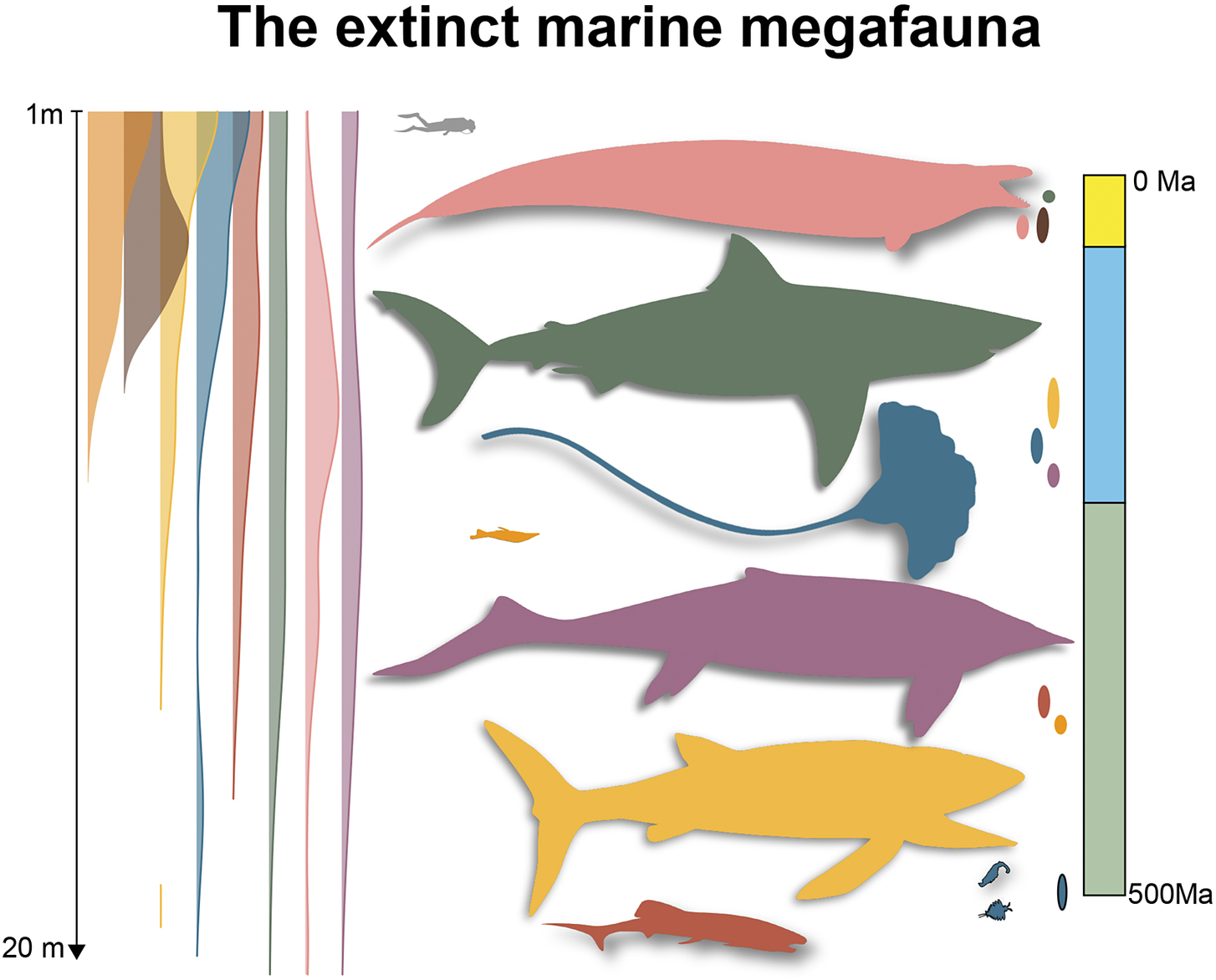
The modern marine megafauna is known to play important ecological roles and includes many charismatic species that have drawn the attention of both the scientific community and the public. However, the extinct marine megafauna has never been assessed as a whole, nor has it been defined in deep time. Here, we review the literature to define and list the species that constitute the extinct marine megafauna, and to explore biological and ecological patterns throughout the Phanerozoic. We propose a size cut-off of 1 m of length to define the extinct marine megafauna. Based on this definition, we list 706 taxa belonging to eight main groups. We found that the extinct marine megafauna was conspicuous over the Phanerozoic and ubiquitous across all geological eras and periods, with the Mesozoic, especially the Cretaceous, having the greatest number of taxa. Marine reptiles include the largest size recorded (21 m; Shonisaurus sikanniensis) and contain the highest number of extinct marine megafaunal taxa. This contrasts with today’s assemblage, where marine animals achieve sizes of >30 m. The extinct marine megafaunal taxa were found to be well-represented in the Paleobiology Database, but not better sampled than their smaller counterparts. Among the extinct marine megafauna, there appears to be an overall increase in body size through time. Most extinct megafaunal taxa were inferred to be macropredators preferentially living in coastal environments. Across the Phanerozoic, megafaunal species had similar extinction risks as smaller species, in stark contrast to modern oceans where the large species are most affected by human perturbations. Our work represents a first step towards a better understanding of the marine megafauna that lived in the geological past. However, more work is required to expand our list of taxa and their traits so that we can obtain a more complete picture of their ecology and evolution.
Statolith growth increments were analysed in the bigfin reef squid, Sepioteuthis lessoniana lineage B, for estimating the age and growth in the Gulf of Mannar Biosphere Reserve (GOM), southeast coast of India. The identification of S. lessoniana lineage B was determined by mitochondrial cytochrome c oxidase I gene sequence. The statolith increment age analysis indicated that the wild-captured squid population of S. lessoniana in the study area undergoes rapid growth. The age of S. lessoniana in males ranged from 61 (95 mm dorsal mantle length (DML)) to 220 d (390 mm DML), while it was 64 (98 mm DML) to 199 d (340 mm DML) in females. The average daily growth rate in males and females was 1.63 and 1.55 mm DML d−1, respectively. The instantaneous growth rate varied from 0.85 (210 d) to 4.1% (110 d) for males and 0.65 (190 d) to 3.7% (110 d) for females. The age at first maturity was 114 and 120 d for males and females, respectively. Back-calculated hatching dates and the attainment of maturity in females suggested that the reproduction of S. lessoniana is year-round, with two distinct spawning peaks during July–August and February months; accordingly, the hatching dates were spread throughout the year, with the presence of two cohorts. Based on the statolith data, it can be concluded that S. lessoniana lineage B in the GOM has a potential lifespan of up to 7 months. This finding contradicts the previous growth estimates based on length-frequency data, which underestimated the true growth potential of this species.
A new species of congrid eel genus, Ariosoma is described here based on two mature female specimens collected from trawl by-catch landings at Thoothukudi fishing harbour, off Thoothukudi, Bay of Bengal. The new species can be easily distinguished from its congeners in having pre-anal length 48.7–49.1% TL; dorsal-fin origin just before pectoral-fin insertion; body bicoloured, pale brown dorsally and silvery white ventrally; preopercular portion dark; pectoral fin reddish with dark spot at the base; SO canal with six pores; pre-dorsal vertebrae 10–11; pre-anal vertebrae 61–64; total vertebrae 162–163. Further, the new species differs from all the congeners of Indian waters in having more total vertebrae, except A. albimaculatum (162–163 vs 129–153 in others; 161–164 in A. albimaculatum). The new species identity was also supported by molecular analyses using the mitochondrial COI gene and the result revealed that the new species is closely related to Ariosoma maurostigma and Ariosoma albimaculatum with a pair-wise genetic distance of 11.4% and 11.6% followed by A. melanospilos with 16.8%.
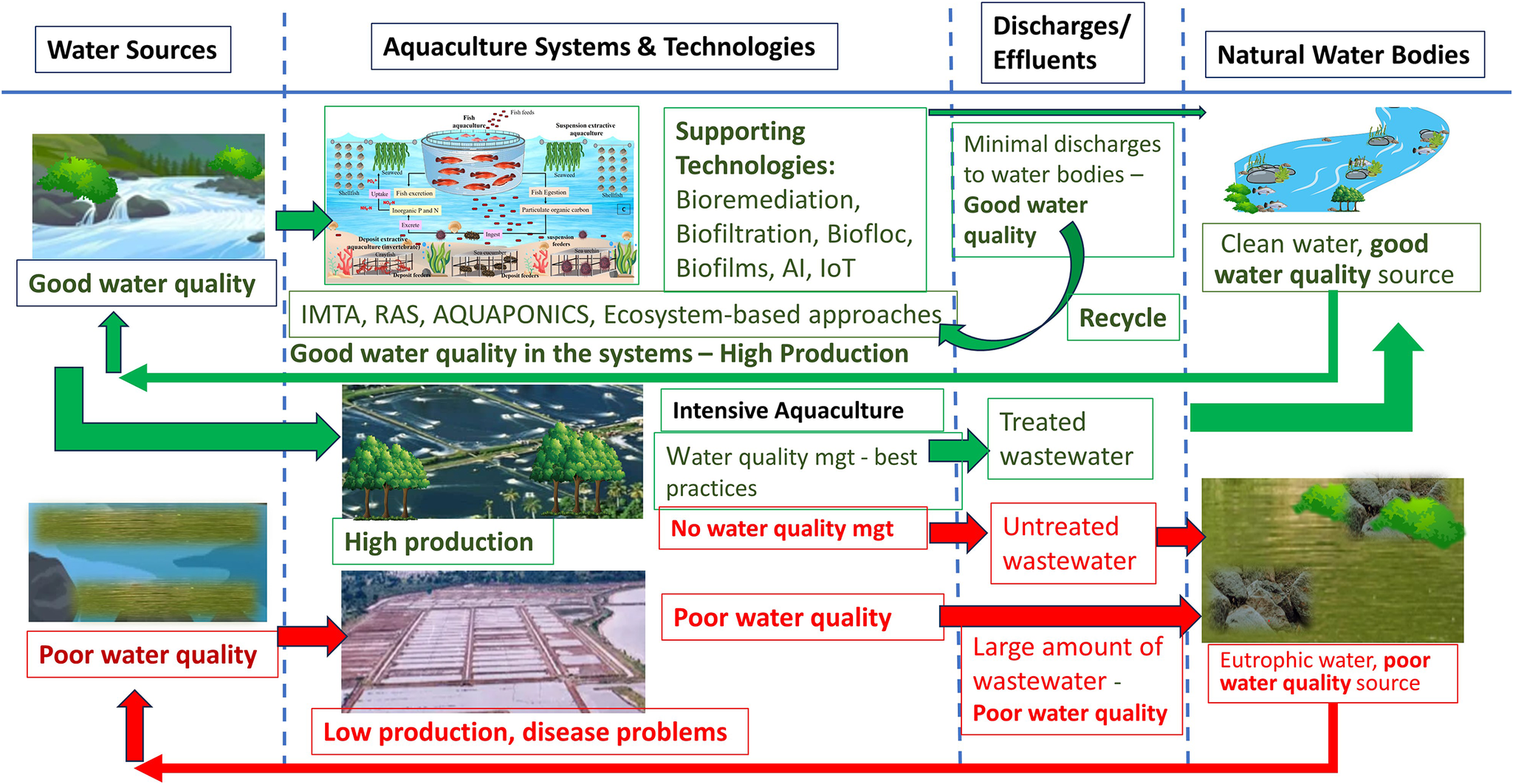
The aquaculture industry requires good water quality for its successful operation but produces wastes that can cause environmental deterioration and pose high risks to the sector. Adequate waste treatment and recycling are necessary to make aquaculture a sustainable and profitable industry and contribute to the circular economy. Polluted water sources, excess feeding, overstocking, use of antibiotics/chemicals and harmful algal blooms are major causes of water quality deterioration and low production in aquaculture systems. Discharges of untreated wastes would have serious impacts on the receiving water bodies, and eventually on the aquaculture industry itself. Possible solutions include technological innovations in environmentally friendly production systems, use of efficient processes in water quality management and improved legislation and governance. Environmentally feasible aquaculture production technologies such as recycling aquaculture system, integrated multi-trophic aquaculture and aquaponics including features of waste recycling are viable options in aquaculture schemes. Best aquaculture practices integrating advanced water quality treatment processes and technologies, supported by automation and sensors, modeling and artificial intelligence-internet of things are necessary for a sustainable aquaculture environment, production and stable value chain. In general, low-cost technologies for aquaculture waste treatment and environmental impact reduction through good governance are crucial for achieving sustainability in the aquaculture industry and natural environmental management.
This fifth volume of State of the Apes brings together original research and analysis with topical case studies and emerging best practice to further the ape conservation agenda around disease and health. It provides an overview of relevant disease and health issues and explores factors such as the ethics of intervening in and managing ape health; the impact of research and tourism on apes; the One Health approach; and disaster management and the protection of apes. It shows how the welfare of apes is interrelated with that of the people who share their habitats, while also demonstrating the benefits of integrating ape conservation in health, socioeconomic activities (such as in the extractive industries, industrial agriculture and infrastructure development), and regulatory policy and practice at all levels, from the local to the international. This title is also available as Open Access via Cambridge Core.