To save content items to your account,
please confirm that you agree to abide by our usage policies.
If this is the first time you use this feature, you will be asked to authorise Cambridge Core to connect with your account.
Find out more about saving content to .
To save content items to your Kindle, first ensure no-reply@cambridge.org
is added to your Approved Personal Document E-mail List under your Personal Document Settings
on the Manage Your Content and Devices page of your Amazon account. Then enter the ‘name’ part
of your Kindle email address below.
Find out more about saving to your Kindle.
Note you can select to save to either the @free.kindle.com or @kindle.com variations.
‘@free.kindle.com’ emails are free but can only be saved to your device when it is connected to wi-fi.
‘@kindle.com’ emails can be delivered even when you are not connected to wi-fi, but note that service fees apply.
This seminal publication began life as a collaborative effort between the Irish botanist William Henry Harvey (1811–66) and his German counterpart Otto Wilhelm Sonder (1812–81). Relying on many contributors of specimens and descriptions from colonial South Africa - and building on the foundations laid by Carl Peter Thunberg, whose Flora Capensis (1823) is also reissued in this series - they published the first three volumes between 1860 and 1865. These were reprinted unchanged in 1894, and from 1896 the project was supervised by William Thiselton-Dyer (1843–1928), director of the Royal Botanic Gardens at Kew. A final supplement appeared in 1933. Reissued now in ten parts, this significant reference work catalogues more than 11,500 species of plant found in South Africa. Volume 4 appeared in two parts, the second comprising sections published in 1904, covering Hydrophyllaceae to Pedalineae.
This seminal publication began life as a collaborative effort between the Irish botanist William Henry Harvey (1811–66) and his German counterpart Otto Wilhelm Sonder (1812–81). Relying on many contributors of specimens and descriptions from colonial South Africa - and building on the foundations laid by Carl Peter Thunberg, whose Flora Capensis (1823) is also reissued in this series - they published the first three volumes between 1860 and 1865. These were reprinted unchanged in 1894, and from 1896 the project was supervised by William Thiselton-Dyer (1843–1928), director of the Royal Botanic Gardens at Kew. A final supplement appeared in 1933. Reissued now in ten parts, this significant reference work catalogues more than 11,500 species of plant found in South Africa. Containing orders of the Calyciflorae with a monopetalous corolla and an inferior ovary, Volume 3 covers Rubiaceae to Campanulaceae.
This seminal publication began life as a collaborative effort between the Irish botanist William Henry Harvey (1811–66) and his German counterpart Otto Wilhelm Sonder (1812–81). Relying on many contributors of specimens and descriptions from colonial South Africa - and building on the foundations laid by Carl Peter Thunberg, whose Flora Capensis (1823) is also reissued in this series - they published the first three volumes between 1860 and 1865. These were reprinted unchanged in 1894, and from 1896 the project was supervised by William Thiselton-Dyer (1843–1928), director of the Royal Botanic Gardens at Kew. A final supplement appeared in 1933. Reissued now in ten parts, this significant reference work catalogues more than 11,500 species of plant found in South Africa. Volume 5 appeared in three parts, the first comprising sections published between 1901 and 1912, covering Acanthaceae to Proteaceae.
This seminal publication began life as a collaborative effort between the Irish botanist William Henry Harvey (1811–66) and his German counterpart Otto Wilhelm Sonder (1812–81). Relying on many contributors of specimens and descriptions from colonial South Africa - and building on the foundations laid by Carl Peter Thunberg, whose Flora Capensis (1823) is also reissued in this series - they published the first three volumes between 1860 and 1865. These were reprinted unchanged in 1894, and from 1896 the project was supervised by William Thiselton-Dyer (1843–1928), director of the Royal Botanic Gardens at Kew. A final supplement appeared in 1933. Reissued now in ten parts, this significant reference work catalogues more than 11,500 species of plant found in South Africa. Volume 5 appeared in three parts, the third comprising sections published between 1912 and 1913, covering Hydrocharideae to Scitamineae.
This seminal publication began life as a collaborative effort between the Irish botanist William Henry Harvey (1811–66) and his German counterpart Otto Wilhelm Sonder (1812–81). Relying on many contributors of specimens and descriptions from colonial South Africa - and building on the foundations laid by Carl Peter Thunberg, whose Flora Capensis (1823) is also reissued in this series - they published the first three volumes between 1860 and 1865. These were reprinted unchanged in 1894, and from 1896 the project was supervised by William Thiselton-Dyer (1843–1928), director of the Royal Botanic Gardens at Kew. A final supplement appeared in 1933. Reissued now in ten parts, this significant reference work catalogues more than 11,500 species of plant found in South Africa. Volume 5 appeared in three parts, the second comprising sections published between 1915 and 1925, covering Thymelaeaceae to Ceratophylleae. The 1933 supplement on Gymnospermae is also incorporated in this reissue.
This seminal publication began life as a collaborative effort between the Irish botanist William Henry Harvey (1811–66) and his German counterpart Otto Wilhelm Sonder (1812–81). Relying on many contributors of specimens and descriptions from colonial South Africa - and building on the foundations laid by Carl Peter Thunberg, whose Flora Capensis (1823) is also reissued in this series - they published the first three volumes between 1860 and 1865. These were reprinted unchanged in 1894, and from 1896 the project was supervised by William Thiselton-Dyer (1843–1928), director of the Royal Botanic Gardens at Kew. A final supplement appeared in 1933. Reissued now in ten parts, this significant reference work catalogues more than 11,500 species of plant found in South Africa. Opening with a preface which clarifies the project's original scope, Volume 1 covers Ranunculaceae to Connaraceae.
The plant geneticist Sir Rowland Biffen (1874–1949), who is best remembered for his work on the improvement of English wheat varieties using Mendelian principles, was also a keen botanist and gardener. This short work on the auricula, published posthumously in 1951, contains a full botanical account of the species, but also a social history of this most popular of 'florist's flowers'. Probably introduced to England by refugees from the continent in the late sixteenth century, the auricula, though delicate-looking, is extremely hardy, can be grown in pots, and hybridizes freely, and so it was an ideal plant for competitive growers, especially in the north of England, who in the eighteenth and nineteenth centuries vied with each other to breed ever more spectacular varieties, while adhering to strict guidelines on form and proportion. This work, illustrated with seven black-and-white plates, will be of interest to botanists and garden historians alike.
The Swedish botanist Carl Peter Thunberg (1743–1828), a physician and pupil of Linnaeus, carried out his most important work in South Africa and Japan. Having studied in Amsterdam and Leiden, he was asked to go plant-hunting in areas where the Dutch East India Company's trading activities were opening up territory for scientific exploration. In 1771 he travelled to South Africa as a ship's doctor, spending three years searching for, classifying and propagating plants, while at the same time becoming fluent in Dutch, as only the Dutch were allowed to enter Japan, his ultimate destination. Having acquired many Japanese specimens, he continued his travels and returned to Sweden in 1779. Three fascicles of this influential reference work in Latin on the South African flora were issued between 1807 and 1813. Reissued here is the full version edited by the Austrian botanist Josef August Schultes (1773–1831) and published in 1823.
This seminal publication began life as a collaborative effort between the Irish botanist William Henry Harvey (1811–66) and his German counterpart Otto Wilhelm Sonder (1812–81). Relying on many contributors of specimens and descriptions from colonial South Africa - and building on the foundations laid by Carl Peter Thunberg, whose Flora Capensis (1823) is also reissued in this series - they published the first three volumes between 1860 and 1865. These were reprinted unchanged in 1894, and from 1896 the project was supervised by William Thiselton-Dyer (1843–1928), director of the Royal Botanic Gardens at Kew. A final supplement appeared in 1933. Reissued now in ten parts, this significant reference work catalogues more than 11,500 species of plant found in South Africa. Volume 6 comprises sections that were published individually between 1896 and 1897, covering Haemodoraceae to Liliaceae.
This seminal publication began life as a collaborative effort between the Irish botanist William Henry Harvey (1811–66) and his German counterpart Otto Wilhelm Sonder (1812–81). Relying on many contributors of specimens and descriptions from colonial South Africa - and building on the foundations laid by Carl Peter Thunberg, whose Flora Capensis (1823) is also reissued in this series - they published the first three volumes between 1860 and 1865. These were reprinted unchanged in 1894, and from 1896 the project was supervised by William Thiselton-Dyer (1843–1928), director of the Royal Botanic Gardens at Kew. A final supplement appeared in 1933. Reissued now in ten parts, this significant reference work catalogues more than 11,500 species of plant found in South Africa. Containing the remaining polypetalous orders of the Calyciflorae, Volume 2 covers Leguminosae to Loranthaceae.
This seminal publication began life as a collaborative effort between the Irish botanist William Henry Harvey (1811–66) and his German counterpart Otto Wilhelm Sonder (1812–81). Relying on many contributors of specimens and descriptions from colonial South Africa - and building on the foundations laid by Carl Peter Thunberg, whose Flora Capensis (1823) is also reissued in this series - they published the first three volumes between 1860 and 1865. These were reprinted unchanged in 1894, and from 1896 the project was supervised by William Thiselton-Dyer (1843–1928), director of the Royal Botanic Gardens at Kew. A final supplement appeared in 1933. Reissued now in ten parts, this significant reference work catalogues more than 11,500 species of plant found in South Africa. Volume 4 appeared in two parts, the first comprising sections published between 1905 and 1909, covering Vacciniaceae to Gentianeae.
A keen collector and sketcher of plant specimens from an early age, the author, educator and clergyman Charles Alexander Johns (1811–74) gained recognition for his popular books on British plants, trees, birds and countryside walks. Flowers of the Field (1851), one of several works originally published by the Society for Promoting Christian Knowledge, is also reissued in this series. First published by the Society between 1847 and 1849, this two-volume botanical guide for amateur enthusiasts focuses on the trees found in British woodland. Johns describes each species, noting also pests and diseases, uses for the wood, and associated myths and legends. The work is noteworthy for its meticulous engravings of leaves, seeds and blossom, and of the trees in natural settings. Volume 2 (1849) covers such species as chestnut, birch, elm, willow, ivy, yew and cedar. An index to the whole work is also provided.
A Scottish doctor and botanist, George Watt (1851–1930) had studied the flora of India for more than a decade before he took on the task of compiling this monumental work. Assisted by numerous contributors, he set about organising vast amounts of information on India's commercial plants and produce, including scientific and vernacular names, properties, domestic and medical uses, trade statistics, and published sources. Watt hoped that the dictionary, 'though not a strictly scientific publication', would be found 'sufficiently accurate in its scientific details for all practical and commercial purposes'. First published in six volumes between 1889 and 1893, with an index volume completed in 1896, the whole work is now reissued in nine separate parts. Volume 5 (1891) contains entries from Linum (the flax genus) to oyster (the subcontinent's best oyster beds were to be found 'on the coast near Karachi, Bombay and Madras').
A Scottish doctor and botanist, George Watt (1851–1930) had studied the flora of India for more than a decade before he took on the task of compiling this monumental work. Assisted by numerous contributors, he set about organising vast amounts of information on India's commercial plants and produce, including scientific and vernacular names, properties, domestic and medical uses, trade statistics, and published sources. Watt hoped that the dictionary, 'though not a strictly scientific publication', would be found 'sufficiently accurate in its scientific details for all practical and commercial purposes'. First published in six volumes between 1889 and 1893, with an index volume completed in 1896, the whole work is now reissued in nine separate parts. Volume 3 (1890) contains entries from Dacrydium (a genus of coniferous trees) to Gordonia obtusa (a species of evergreen tree).
This practical guide was first published in 1776: in this reissue of the two-volume 1777 second edition, the two volumes have been bound in one book. John Kennedy (d.1790) was the gardener to Sir Thomas Gascoigne, the owner of Parlington Hall in Yorkshire, and his book is addressed to landowners and their head gardeners. His concern is with 'the planting of poor wastes, moorlands, and apparent mountains', as well as with hothouse plants such as pineapples and vines, and delicacies including asparagus and cultivated mushrooms. At the other end of the scale, he also provides sections on field-cabbages, carrots and turnips as feed for cattle. In each of these areas, he gives detailed descriptions of the preparation of the ground, the tools needed, propagation techniques, and the subsequent management of pests and diseases. This is a fascinating treatise on the gardening skills needed on a grand eighteenth-century agricultural estate.
Written and richly illustrated by the Derby-born artist Ernest Ellis Clark (1869–1932), this guide was originally published in 1904 to demonstrate the decorative possibilities of certain plants, mainly English wild flowers, to art students sitting examinations in plant drawing and design. Clark emphasises the importance of retaining a certain amount of botanical accuracy and provides examples of the ornamental possibilities of selected plants in various stages of their development. The language employed in describing the plants is not rigorously scientific and may be understood by those with little familiarity with botanical terms (a brief glossary is also provided). By focusing primarily on accurate renderings of the plants, rather than decorative applications, Clark allows the student's originality to remain unaffected by his personal preferences, and in so doing he allows students to adapt his teachings to their particular tastes and styles.
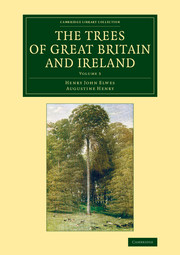
Although without formal scientific training, Henry John Elwes (1846–1922) devoted his life to natural history. He had studied birds, butterflies and moths, but later turned his attention to collecting and growing plants. Embarking on his most ambitious project in 1903, he recruited the Irish dendrologist Augustine Henry (1857–1930) to collaborate with him on this well-illustrated work. Privately printed in seven volumes between 1906 and 1913, it covers the varieties, distribution, history and cultivation of tree species in the British Isles. The strictly botanical parts were written by Henry, while Elwes drew on his extensive knowledge of native and non-native species to give details of where remarkable examples could be found. Each volume contains photographic plates as well as drawings of leaves and buds to aid identification. The species covered in Volume 3 (1908) include cedar, hornbeam, southern beech, hickory, maple and redwood.
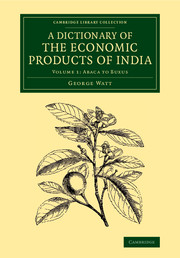
A Scottish doctor and botanist, George Watt (1851–1930) had studied the flora of India for more than a decade before he took on the task of compiling this monumental work. Assisted by numerous contributors, he set about organising vast amounts of information on India's commercial plants and produce, including scientific and vernacular names, properties, domestic and medical uses, trade statistics, and published sources. Watt hoped that the dictionary, 'though not a strictly scientific publication', would be found 'sufficiently accurate in its scientific details for all practical and commercial purposes'. First published in six volumes between 1889 and 1893, with an index volume completed in 1896, the whole work is now reissued in nine separate parts. Volume 1 (1889) opens with the prefatory matter, along with lists of works consulted, contributors and abbreviations. It contains entries from Abaca (a name in the Philippines for Manila hemp) to Buxus (a genus of evergreen shrubs).
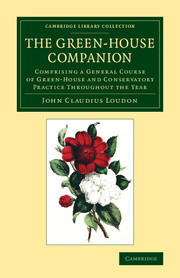
The Scottish landscape gardener and prolific horticultural writer John Claudius Loudon (1783–1843) published this manual on the practice of greenhouse or conservatory gardening in 1824. In his preface he remarks on the rise of greenhouses, which have 'now become an appendage to every villa, and to many town residences'. The work is directed at professional gardeners (and their employers) who may not have the requisite knowledge and skills to make the best use of this exciting new space. The first part of the work describes the practicalities of siting and constructing the greenhouse, how it should be heated, with what plants it should be stocked and how these should be cultivated. The second part consists of a catalogue of 'all the green-house and frame plants hitherto in cultivation'. Still valuable, this substantial guide offers modern readers a record of the plants that were then available to the enthusiast.
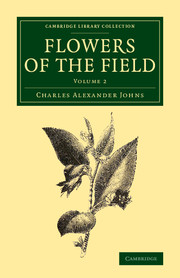
A keen collector and sketcher of plant specimens from an early age, the author, educator and clergyman Charles Alexander Johns (1811–74) gained recognition for his popular books on British plants, trees, birds and countryside walks. The Forest Trees of Britain (1847–9), one of several works originally published by the Society for Promoting Christian Knowledge, is also reissued in this series. First published by the Society in 1851, Johns' best-known work is this two-volume botanical guide to common British flowering plants. Following the Linnaean system of classification, Johns describes the various plant families, providing the common and Latin names for each species. The work is especially noteworthy for its delicate and meticulous line drawings, based on watercolours by the botanical artist Emily Stackhouse and the author's sisters Julia and Emily. Volume 2 completes the botanical descriptions and includes indexes of English and Latin plant names.