To save content items to your account,
please confirm that you agree to abide by our usage policies.
If this is the first time you use this feature, you will be asked to authorise Cambridge Core to connect with your account.
Find out more about saving content to .
To save content items to your Kindle, first ensure no-reply@cambridge.org
is added to your Approved Personal Document E-mail List under your Personal Document Settings
on the Manage Your Content and Devices page of your Amazon account. Then enter the ‘name’ part
of your Kindle email address below.
Find out more about saving to your Kindle.
Note you can select to save to either the @free.kindle.com or @kindle.com variations.
‘@free.kindle.com’ emails are free but can only be saved to your device when it is connected to wi-fi.
‘@kindle.com’ emails can be delivered even when you are not connected to wi-fi, but note that service fees apply.
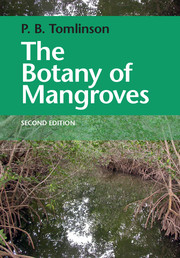
Mangroves are distinctive tropical plant communities that occupy the intertidal zone between sea and land. They are of major ecological importance, have economic value as a source of food and raw materials, and serve as a buffer from flooding and climate change-induced sea level rise. Mangroves are under threat from pollution, clearance and over-exploitation, and increasing concern has driven demand for an improved understanding of mangrove species. This book provides an introduction to mangroves, including their taxonomy, habitat-specific features, reproduction and socio-economic value. Fully updated to reflect the last two decades of research, this new edition of a key text includes newly documented taxa, new understandings of vivipary and the evolution of mangrove species, and a rich set of colour illustrations. It will appeal to researchers and students across a range of disciplines, including botany, ecology and zoology.
James Backhouse (1794–1869) came from a family of accomplished naturalists and horticulturalists. As a Quaker, he spent several years in Australia engaged in missionary and humanitarian work, after which he returned to England via Mauritius and South Africa. The present work, first published in 1844, is adapted from his journals of that journey, providing a rich and personal account. It contains vivid descriptions of the people he encountered, particularly the indigenous communities and those involved in the slave trade, which he found revolting and unchristian. Backhouse's horticultural interests are evident in the detailed botanical observations he made, the value of which led to a genus of shrub being named after him: Backhousia. This work contains illustrations based on original sketches made by Backhouse during the trip, and appendices which include letters and texts relating to the mission, as well as a map of South Africa.
Coming from a prosperous London Quaker family, the author Priscilla Wakefield (1751–1832) wrote educational books for children, and one work for adults, Reflections on the Present Condition of the Female Sex (1798), also reissued in this series. This 1796 book on botany, a science which 'contributes to health of body and cheerfulness of disposition' but is difficult to study because of its Latin nomenclature and the cost of textbooks, offers a simple introduction for children through the medium of letters between sisters, as 'Felicia' shares with 'Constance' her growing understanding of plant science. Felicia's governess is a follower of Linnaeus, whose classificatory system is described as 'the one universally adopted', and by the twenty-eighth and final letter, Felicia is describing the class Cryptogamia. This illustrated account in simple language gives an insight into the level of education thought appropriate for young girls at the end of the eighteenth century.
Employed early in his career by Sir Joseph Banks, the botanist John Lindley (1799–1865) is best known for his recommendation that Kew Gardens should become a national botanical institution, and for saving the Royal Horticultural Society from financial disaster. As an author, he is best remembered for his various works on taxonomy and classification. This work, one of his most famous, was first published in 1846; reissued here is the revised third edition of 1847. Lindley describes his motive as being 'to make his countrymen acquainted with the progress of Systematic Botany abroad' given that the 'superficial and useless system of Linnaeus' was now consigned to history. The work, nonetheless an important milestone in the development of plant taxonomy, gives an overview of the various classification systems used since that of John Ray, and goes on to define the vegetable kingdom in terms of classes and 'alliances' of plants.
The botanist Robert Brown (1773–1858) is regarded as one of the most significant figures in the advancement of plant science in the nineteenth century. After studying at Aberdeen and Edinburgh, he made the acquaintance of Sir Joseph Banks via William Withering, and in 1801 was appointed as naturalist on Matthew Flinders' expedition to Australia. Brown made extensive collections of animals and minerals, but his 3,400 plant specimens from Australia, Tasmania and Timor were the foundation of his work for the rest of his life, as an active member of the Linnean Society, as Banks's librarian, and as an under-librarian in the British Museum. This two-volume collection of his 'miscellaneous botanical works', edited by John J. Bennett, Brown's assistant at the British Museum, was published in 1866–7. It has not been possible to reissue the accompanying quarto volume of plates. Volume 2 contains 'Systematic Memoirs' and 'Contributions to Systematic Works'.
Jane Loudon (1807–58), the Mrs Beeton of the Victorian gardening world, wrote several popular books on horticulture and botany specifically for women. Her enthusiasm for plants and gardening was encouraged by her husband, the landscape designer John Claudius Loudon, whom she married in 1830. Her Instructions in Gardening for Ladies (also reissued in this series) was enormously successful, and she followed it up in 1842 with this volume on botany, in which she uses the natural system of classification. The 'grand object' of the work is 'to enable my readers to find out the name of a plant when they see it … or, if they hear or read the name … to make that name intelligible to them'. She takes her readers through the botanical orders, using a familiar plant as an exemplar for each, and then presents de Candolle's systematic description of plant species.
The innovative gardener and writer William Robinson (1838–1935), many of whose other works are reissued in this series, was sent by The Times as its horticultural correspondent to the Paris International Exposition of 1867. As a result of his visit, he produced two books, one on gardening trends in France, and this work of 1869 on the parks and gardens of Paris and its environs (including Versailles), and on the fruit and vegetable farming which fed the famous Parisian food markets such as Les Halles. Robinson admired especially the small planted open spaces, squares and courtyards in Paris, which had no equivalent in London, and which he claimed were 'saving [its inhabitants] from pestilential overcrowding, and making their city something besides a place for all to live out of who can afford it'. This highly illustrated work will interest not only historians of horticulture but also lovers of Paris.
The horticulturalist John Lindley (1799–1865) worked for Sir Joseph Banks, and was later instrumental in saving the Royal Horticultural Society from financial disaster. He was a prolific author of works for gardening practitioners but also for a non-specialist readership, and many of his books have been reissued in this series. The first volume of this two-volume work was published in 1834, and the second in 1837. At a time when botany was regarded as the only science suitable for study by women and girls, Lindley felt that there was a lack of books for 'those who would become acquainted with Botany as an amusement and a relaxation', and attempted to meet this need. The first volume, in the form of engaging letters to a lady, was originally intended to stand alone. Illustrated with detailed botanical drawings, it schools the student in botanical form and taxonomy as well as nomenclature.
The botanist Robert Brown (1773–1858) is regarded as one of the most significant figures in the advancement of plant science in the nineteenth century. After studying at Aberdeen and Edinburgh, he made the acquaintance of Sir Joseph Banks via William Withering, and in 1801 was appointed as naturalist on Matthew Flinders' expedition to Australia. Brown made extensive collections of animals and minerals, but his 3,400 plant specimens from Australia, Tasmania and Timor were the foundation of his work for the rest of his life, as an active member of the Linnean Society, as Banks's librarian, and as an under-librarian in the British Museum. This two-volume collection of his 'miscellaneous botanical works', edited by John J. Bennett, Brown's assistant at the British Museum, was published in 1866–7. It has not been possible to reissue the accompanying quarto volume of plates. Volume 1 contains 'Geographico-Botanical Memoirs' and 'Structural and Physiological Memoirs'.
Employed early in his career by Sir Joseph Banks, the botanist John Lindley (1799–1865) is best known for his recommendation that Kew Gardens should become a national botanical institution, and for saving the Royal Horticultural Society from financial disaster. As an author, he is best remembered for his works on taxonomy and classification. A partisan of the 'natural' system rather than the Linnaean, Lindley published this 1841 work, the fourth edition of his Outline of the First Principles of Botany, under a new title to emphasise not only that it was 'much extended, and, it is hoped, improved', but also that it was a textbook for students of 'structural, physiological, systematical, and medical' botany. He defines the different elements of a plant, and provides a checklist for identification of plant families, before discussing the various 'natural' systems of classification, including his own, and the different practical uses of plants.
This two-volume milestone work, published in 1776, was the first major publication of William Withering (1741–99), a physician who had also trained as an apothecary (his Account of the Foxglove, and Some of its Medical Uses is also reissued in this series). The first systematic botanical guide to British native plants, the present work uses and extends the Linnaean system of classification, but renders the genera and species 'familiar to those who are unacquainted with the Learned Languages'. Withering offers 'an easy introduction to the study of botany', explaining the markers by which the plants are classified in a particular genus, and giving advice on preserving specimens, but the bulk of the work consists of botanical descriptions (in English) of the appearance, qualities, varieties, common English names, and uses of hundreds of plants. The book continued to be revised and reissued for almost a century after Withering's death.
Employed early in his career by Sir Joseph Banks, the botanist John Lindley (1799–1865) is best known for his recommendation that Kew Gardens should become a national botanical institution, and for saving the Royal Horticultural Society from financial disaster. As an author, he is best remembered for his works on taxonomy and classification. A partisan of the 'natural' system of Jussieu rather than the Linnaean, Lindley writes, in his preface to this 1830 work, that it was originally created for his own use, to avoid having recourse to 'rare, costly and expensive publications' available only in the libraries of the wealthy. His intention is to give a 'systematic view of the organisation, natural affinities, and geographical distribution of the whole vegetable kingdom', as well as of the uses of plants 'in medicine, the arts, and rural or domestic economy'. The work is important in the history of taxonomy.
The horticulturalist John Lindley (1799–1865) worked for Sir Joseph Banks, and was later instrumental in saving the Royal Horticultural Society from financial disaster. He was a prolific author of works for gardening practitioners but also for a non-specialist readership, and many of his books have been reissued in this series. The first volume of this two-volume work was published in 1834, and the second in 1837. At a time when botany was regarded as the only science suitable for study by women and girls, Lindley felt that there was a lack of books for 'those who would become acquainted with Botany as an amusement and a relaxation', and attempted to meet this need. In the second volume of 'this little work', Lindley continues to introduce new 'tribes' of plants, including exotica such as mangoes and Venus fly traps, to his lady correspondent and her children.
This two-volume milestone work, published in 1776, was the first major publication of William Withering (1741–99), a physician who had also trained as an apothecary (his Account of the Foxglove, and Some of its Medical Uses is also reissued in this series). The first systematic botanical guide to British native plants, the present work uses and extends the Linnaean system of classification, but renders the genera and species 'familiar to those who are unacquainted with the Learned Languages'. Withering offers 'an easy introduction to the study of botany', explaining the markers by which the plants are classified in a particular genus, and giving advice on preserving specimens, but the bulk of the work consists of botanical descriptions (in English) of the appearance, qualities, varieties, common English names, and uses of hundreds of plants. The book continued to be revised and reissued for almost a century after Withering's death.
The botanist and horticulturalist John Lindley (1799–1865) worked for Sir Joseph Banks, and was later instrumental in saving the Royal Horticultural Society from financial disaster. He was a prolific author of works for gardening practitioners but also for a non-specialist readership, and many of his books have been reissued in this series. This 1829 work is a classification of British plants using the 'natural' system of the French botanist Antoine Laurent de Jussieu, which Lindley firmly supported, believing that the Linnaean system was both inaccurate and had 'almost disappeared from every country but our own'. Lindley describes genera and species in English, but using a uniform, standard vocabulary, and gives the alternative Latin names proposed by taxonomists including Smith, Curtis, Linnaeus, and the Hortus Kewensis. He also offers tables showing the components of each genus, and substantial indexes giving both Latin and English common names of the plants discussed.
A keen collector and sketcher of plant specimens from an early age, the author, educator and clergyman Charles Alexander Johns (1811–74) gained recognition for his popular books on British plants, trees, birds and countryside walks. Flowers of the Field (1851), one of several works originally published by the Society for Promoting Christian Knowledge, is also reissued in this series. First published by the Society between 1847 and 1849, this two-volume botanical guide for amateur enthusiasts focuses on the trees found in British woodland. Johns describes each species, noting also pests and diseases, uses for the wood, and associated myths and legends. The work is noteworthy for its meticulous engravings of leaves, seeds and blossom, and of the trees in natural settings. Volume 1 (1847) provides an introduction to the botanical terms used. The species covered in this volume include oak, ash, beech and poplar.
George Bentham (1800–84) was one of Britain's most influential botanists, whose own collection of plant specimens numbered more than 100,000. Although he donated his herbarium to the Royal Botanic Gardens, Kew in 1854, he continued to make significant contributions to the field, including this exhaustive, seven-volume work detailing the plant life of Australia, which was published from 1863 to 1878. It was part of a series of works commissioned by the British government to document the flora in its colonies. Using the extensive numbers of specimens at Kew - and with the help of Ferdinand Mueller (1825–96), a German botanist in Australia - Bentham was able to compile descriptions of more than 8,000 species of Australian plants, making these volumes the first completed compendium of the flora of any large continental area. Volume 3, published in 1866, describes 14 orders of dicotyledon flora in the subclasses polypetalae and monopetalae.
This world-famous work was begun by Sir William Jackson Hooker (1785–1865) in 1837, and the ten volumes reissued here were produced under his authorship until 1854, at which point his son, Joseph Dalton Hooker (1817–1911) continued the work of publication. Hooker's own herbarium, or collection of preserved plant specimens, was so extensive that at one point he stored it in one house and lived in another; it was left to the nation on his death. Each volume contains 100 line drawings of plants, and each is accompanied by a full Latin description, with notes in English on habitat and significant features. The order of the plants in each volume is not systematic, but two 'indexes' at the beginning provide plant lists, in alphabetical order and 'arranged according to the natural orders'.
This seminal publication began life as a collaborative effort between the Irish botanist William Henry Harvey (1811–66) and his German counterpart Otto Wilhelm Sonder (1812–81). Relying on many contributors of specimens and descriptions from colonial South Africa - and building on the foundations laid by Carl Peter Thunberg, whose Flora Capensis (1823) is also reissued in this series - they published the first three volumes between 1860 and 1865. These were reprinted unchanged in 1894, and from 1896 the project was supervised by William Thiselton-Dyer (1843–1928), director of the Royal Botanic Gardens at Kew. A final supplement appeared in 1933. Reissued now in ten parts, this significant reference work catalogues more than 11,500 species of plant found in South Africa. Volume 7 comprises sections that were published individually between 1897 and 1900, covering Pontederiaceae to Gramineae.