To save content items to your account,
please confirm that you agree to abide by our usage policies.
If this is the first time you use this feature, you will be asked to authorise Cambridge Core to connect with your account.
Find out more about saving content to .
To save content items to your Kindle, first ensure no-reply@cambridge.org
is added to your Approved Personal Document E-mail List under your Personal Document Settings
on the Manage Your Content and Devices page of your Amazon account. Then enter the ‘name’ part
of your Kindle email address below.
Find out more about saving to your Kindle.
Note you can select to save to either the @free.kindle.com or @kindle.com variations.
‘@free.kindle.com’ emails are free but can only be saved to your device when it is connected to wi-fi.
‘@kindle.com’ emails can be delivered even when you are not connected to wi-fi, but note that service fees apply.
Julianne House, Universität Hamburg/Hun-Ren Hungarian Research Centre for Linguistics /Hellenic American University,Dániel Z. Kádár, Dalian University of Foreign Languages/Hun-Ren Hungarian Research Centre for Linguistics/University of Maribor
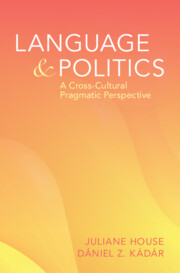
The research and teaching of language and politics has mainly been carried out in the fields of critical discourse analysis and sociolinguistics. This groundbreaking book provides a concise introduction to the field from the perspective of cross-cultural pragmatics. It introduces a strictly language-based, bottom-up and comprehensive model for analysing political data, which allows the reader to examine political and socio-political data without pre-held convictions and prejudices, avoiding many pitfalls that have lurked for a long time in the study of political language use. It is illustrated with a wealth of data and case studies drawn from many linguacultures, including Anglophone ones, China, Japan, Germany and the former Yugoslavia, and from different contexts of political language use, such as diplomacy, activism, public communication and news articles. It includes handy further reading lists, discussion points and a comprehensive glossary, making it ideal for anyone keen to know how language interacts with politics.
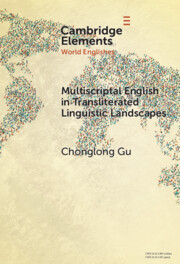
In this monograph, 'multiscriptal English' is theorised. Unorthodox and unconventional this may sound, a salient sociolinguistic reality is emerging globally. That is, while standardised English (Roman script) is routinely taught and used, English in superdiverse, multilingual, and/or (post)colonial societies is often camouflaged in local scripts and 'passes off' as local languages in these places' linguistic landscapes through transliteration (at lexical, phrasal and sentential levels). To illustrate, documentary evidence from Arabic, Malay (Jawi), Nepali, Urdu, Tamil, Korean, Japanese, Russian, Thai, etc. is presented. Through inter-scriptal rendition, English is glocalised and enshrined in seemingly 'exotic' scripts that embody different socio-political and religious worldviews. In the (re)contextualisation process, English inevitably undergoes transformations and adopts new flavours. This gives English a second life with multiple manifestations/incarnations in new contexts. This points to the juggernaut of English in our globalised/neoliberal world. The existence of multiscriptal English necessitates more coordinated and interdisciplinary research efforts going forward.
This Element aims to address a gap in the literature at the intersection of linguistics, particularly pragmatics, and health sciences, such as speech and language pathology. The first section introduces the application of pragmatics concepts in healthcare and neuroscience. Section 2 discusses the development of pragmatic abilities in childhood, focusing on pragmatic communication disorder. Section 3 reviews studies on pragmatic abilities in adolescents, adults, and clinical populations, including assessments of pragmatic skills in ageing. Section 4 broadens the scope by exploring pragmatic impairments in new populations. The final section reflects on the importance of pragmatics in healthcare practice, introducing studies on mental health and intercultural pragmatics. Each section proposes discussion points to contextualise the research within debates on health pragmatics. The Element also includes a glossary (available as online supplementary material) to assist interdisciplinary audiences in understanding clinical pragmatics terminology.
Transnational Korean Englishes presents the many faces of English in South Korea (henceforth also Korea) – from Korean English forms and functions to English loanwords in Korean, and from the influences of Korean on the English language to Korean cultural exports. Drawing on specialized and purpose-built spoken and written corpora and other empirical data as well as previous studies, the Element illuminates the Korean-English language contact setting from a range of perspectives, shining light on various transnational Korean English phenomena. Guided by questions of legitimization and codification, this Element shows Koreans as productive and creative users of localized English forms, with hallyu (the Korean Wave) promoting not only Korean pop cultural products around the world but also contributing to influences of Korean on English worldwide.
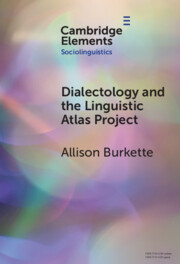
People from different places use different words for things, even everyday things such as carbonated beverages (e.g. soda, coke, pop) or bread roll-based sandwiches (e.g. hoagie, grinder, sub). Regional variation in vocabulary is one of the foci of dialectology, a subfield of linguistics that examines the geographic distribution of specific words, along with distributions of different pronunciations and grammatical constructions. This Element will provide readers with a basic understanding of traditional dialectological study and will demonstrate through examples (audio, text, maps) how Linguistic Atlas Project research has changed and expanded over time. Readers will be introduced to the key concepts of dialectology with a focus on the North American Linguistic Atlas Project (LAP) and its materials. This Element will also discuss today's LAP with reference to third-wave sociolinguistics, outlining the ways in which the LAP has changed over time to meet the needs and goals of contemporary sociolinguistic study.
This chapter describes historical and contemporary advocacy and activism movements in Israel. The first of these movements was the push to revive the Hebrew language, transform it from a literate language into a vernacular, and make it a dominant and ideologically unifying tool for Jewish immigrants to Palestine (later Israel) throughout the twentieth century. Strong advocacy movements mobilized to achieve this goal, which eventually succeeded in achieving official status for the language from the British Mandate and forcing individuals to switch their home languages to Hebrew. While Hebrew is indeed a strong, vital and powerful force in Israel today, a new movement is taking place today whereby the language repertoires of individuals are being expanded, the home languages of immigrants are maintained and used, and a new multilingual educational policy is being developed and implemented. Descriptions of these advocacy movements and their activist workings will be analyzed in the context of the history of the nation.
The introduction provides an overview of the state-of-the-art and situates the diverse research experiences and theoretical perspectives discussed by the volume contributors. Moreover, it presents different ways to define language activism based on various theoretical perspectives, research experiences and socio-political contexts. In order to present a nuanced and comprehensive view of activism, the introduction includes a special focus on the different forms it takes, the various stakeholders who may be involved, the unpredictability of who is included and excluded, and the inescapably ideological nature of language and language research. The introduction also addresses the kinds of questions scholars ask depending on the nature of their scholarly and political agendas and lays out a rationale for the four-part organization of the volume. The volume contributions deal with varied social settings ranging from contexts marked by great socio-economic and political inequality with sharply defined power hierarchies, to more egalitarian contexts with more dispersed power and subtle and diverse power hierarchies. Language struggles, whether they involve endangered language revitalization, language standardization, spelling reform or other efforts, involve numerous stakeholders and lead to tensions and battles among as well as within groups.
The European Commission against Racism and Intolerance states that hate speech ‘poses grave dangers for the cohesion of a democratic society, the protection of human rights and the rule of law’. In hate speech, human dignity is violated through the use of dehumanising communicative means and through the tendency to rank people in hierarchies, in which some groups are considered more and others less worthy. In this chapter, I shall argue that critical linguistic awareness is a useful tool in combatting hate speech. The theoretical contribution is a linguistically based definition of hate speech, drawing on concepts from speech act theory, social semiotics and multimodality. The aim of this chapter is twofold: to enhance language activists’ and the general public’s understanding of the way hate speech is performed through communicative means and to provide activists with an analytic tool to cultivate critical linguistic awareness about hate speech.
Recent work in sociolinguistics criticizes labeling sets of linguistic practices as languages and varieties. A focal concept is translanguaging – while opening productive perspectives on linguistic behavior, this approach often claims that, linguistically speaking, there is no such thing as a language. In this chapter we argue that this ontological claim is too strong, and that bottom-up approach to activism that follows in its trail, is insufficient as a response to linguistically embedded social hierarchies and power inequalities. Linguistics has a checkered history; labeling of varieties and construction of language standards has served dubious ends. However, using Norway as a case in point and alluding to other cases of standardization and norm regulation, we argue that effective linguistic activism aimed at social justice sometimes requires the identification of varieties as linguistic objects. We reject a generalized language suspicion, because the anti-language approach to activism pushes out of theoretical reach a level of organization where social and political hierarchies are instituted and maintained – but where such hierarchies may also be challenged and altered. We conclude that socially engaged language scholars must struggle with the concrete contextual assessments that languages and varieties confront us with, and face the normative dilemmas that top-down political intervention on languages allegedly faces. Otherwise, important means of social justice are lost.
This paper explores what is at stake when we talk of language activism, and what normative values often underlie such discussions. Language activism can generally be understood to involve some work in, on or through language (broadly understood), to include some kind of social action (pedagogy, policy, research), and to operate towards some vision of equitable change (social justice). None of these terms, however, is uncontested. If language itself remains an unchallenged ideal, without asking more fundamental questions about whose version of language is involved, language activism may have undesirable effects; if social action remains at the level of institutional advocacy, communities may be poorly served by inappropriate support; and if social justice defines the extent of the political philosophy, language activism may be as reactionary as it is progressive. This paper makes a case for activist applied linguistics – there is little point in applied linguistics otherwise – that by necessity bases its language and politics on emergent rather than extractivist approaches to communities, and on a decolonial agenda for both language and change. A materialist decolonial approach to language activism aims towards collaborative and emergent knowledge and politics.
This paper is about how emotion generates sociolinguistic advocacy for dairy cows, and activism for nonhuman animals. It discusses my case for an animal turn in sociolinguistics that came about as I was carrying out ethnographic fieldwork among dairy cows in an industrial farming context in which the routinized separation of newborn calves can be considered as an act of normalized violence, confronting me with numerous emotions when relating to these calves, their mothers and other dairy cows. The aim of the paper is to show what research into animal others can contribute beyond the assumptions of human exceptionalism and species hierarchy. It shows that emotion, although historically gendered, should have a place in sociolinguistics since it performs an important role in the various streams producing reflexive researchers, scientific knowledge and motivating action i.e. animal advocacy and activism. Advocacy of animal welfare rests on three public mainstays: (i) the researcher who makes a case for an inclusive sociolinguistics in which nonhuman animals are no longer silenced and muted; (ii) sociolinguistic knowledge in which bodies are part of the semiotic landscape, and (iii) the voice of the calves, although portrayed as victims can be heard when we as humans decentre ourselves.
Researchers investigating minoritized languages have engaged in the promotion and defense of these languages in a variety of ways. While not all researchers consider themselves to be activists, their actions are nonetheless a part of language politics in the contexts where they work. All research is political and all researchers are political actors, as members of colonized groups know all too well. In this chapter, I discuss language activism as a social project where multiple actors have meaningful roles to play, scholars among them. I begin by positioning myself as a scholar activist and then discuss the broad aims of language activism, including the potentially conflicting nature of activism goals. Turning to consider activism strategies, I draw on a framework developed through ethnographic study of language activists in the Isthmus of Tehuantepec, Mexico, which represents a repertoire of strategies available to actors dependent on their positionality. Throughout, I reflect on the affordances and constraints of scholars as social actors within the wider project of language activism, drawing on my own experiences as a European-American scholar engaged in primarily Indigenous language initiatives. I highlight approaches that I have found helpful, including working across disciplines and a constructivist understanding of activism aims and strategies.