To save content items to your account,
please confirm that you agree to abide by our usage policies.
If this is the first time you use this feature, you will be asked to authorise Cambridge Core to connect with your account.
Find out more about saving content to .
To save content items to your Kindle, first ensure no-reply@cambridge.org
is added to your Approved Personal Document E-mail List under your Personal Document Settings
on the Manage Your Content and Devices page of your Amazon account. Then enter the ‘name’ part
of your Kindle email address below.
Find out more about saving to your Kindle.
Note you can select to save to either the @free.kindle.com or @kindle.com variations.
‘@free.kindle.com’ emails are free but can only be saved to your device when it is connected to wi-fi.
‘@kindle.com’ emails can be delivered even when you are not connected to wi-fi, but note that service fees apply.
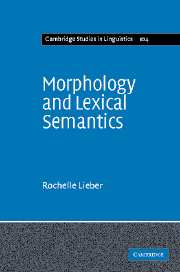
Morphology and Lexical Semantics explores the meanings of morphemes and how they combine to form the meanings of complex words, including derived words (writer, unionise), compounds (dog bed, truck driver) and words formed by conversion. Rochelle Lieber discusses the lexical semantics of word formation in a systematic way, allowing the reader to explore the nature of affixal polysemy, the reasons why there are multiple affixes with the same function and the issues of mismatch between form and meaning in word formation. Using a series of case studies from English, this book develops and justifies the theoretical apparatus necessary for raising and answering many questions about the semantics of word formation. Distinguishing between a lexical semantic skeleton that is featural and hierarchically organised and a lexical semantic body that is holistic, it shows how the semantics of word formation has a paradigmatic character.
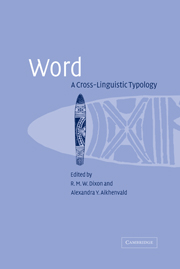
In some languages words tend to be rather short but in others they may be dauntingly long. In this book, a distinguished international group of scholars discuss the concept 'word' and its applicability in a range of typologically diverse languages. An introductory chapter sets the parameters of variation for 'word'. The nine chapters that follow then study the character of 'word' in individual languages, including Amazonian, Australian Aboriginal, Eskimo, Native North American, West African, Balkan and Caucasian languages, and Indo-Pakistani Sign Language. These languages exhibit a huge range of phonological and grammatical characteristics, the close study of which enables the contributors to refine our understanding of what can constitute a 'word'. An epilogue explores the status and cross-linguistic properties of 'word'. The book will be an invaluable resource for scholars of linguistic typology and of morphology and phonology.
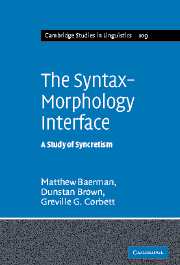
Syncretism - where a single form serves two or more morphosyntactic functions - is a persistent problem at the syntax-morphology interface. It results from a 'mismatch' whereby the syntax of a language makes a particular distinction but the morphology does not. This pioneering book provides a full-length study of inflectional syncretism, presenting a typology of its occurrence across a wide range of languages. The implications of syncretism for the syntax-morphology interface have long been recognised: it argues either for an enriched model of feature structure (thereby preserving a direct link between function and form), or for the independence of morphological structure from syntactic structure. This book presents a compelling argument for the autonomy of morphology and the resulting analysis is illustrated in a series of formal case studies within Network Morphology. It will be welcomed by all linguists interested in the relation between words and the larger units of which they are a part.
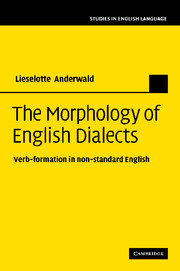
Where do dialects differ from Standard English, and why are they so remarkably resilient? This study argues that commonly used verbs that deviate from Standard English for the most part have a long pedigree. Analysing the language use of over 120 dialect speakers, Lieselotte Anderwald demonstrates that not only are speakers justified historically in using these verbs, systematically these non-standard forms actually make more sense. By constituting a simpler system, they are generally more economical than their Standard English counterparts. Drawing on data collected from the Freiburg English Dialect Corpus (FRED), this innovative and engaging study will be of great interest to students and researchers of English language and linguistics, morphology and syntax.
Much regional variation is being lost as the large number of traditional dialects covering small geographical areas gradually disappear from most, though by no means all, parts of the country. These, however, are being replaced by a much smaller number of new modern dialect areas covering much larger areas. The dialects and accents associated with these areas are much less different from one another, and much less different from RP and Standard English, than the traditional dialects were.
(Trudgill 2001: 179)
Summary of findings
The most striking result of this investigation is the fact that processes predicted by universal morphological naturalness (Mayerthaler) play only a minor role. If anything, universal natural morphology predicts in the realm of the verb a continuous shift of strong verbs into the weak verb class (‘weakification’). However, the investigation in Chapter 4 has shown that while weakification does take place, it is by no means frequent and, in the majority of cases, can be explained by the retention of historically attested forms. Weakification, contrary to Mayerthaler's predictions, thus constitutes only a minor strategy. In the comparison with more modern data especially (e.g. from COLT, representing London teenage speech in the 1990s), we can see that strong verbs are remarkably resilient and resist the trend towards weakification on a grand scale.
Jedes Wort has seine Geschichte und lebt sein eigenes Leben. (Every word has its own history and lives its own life.)
(Grimm 1819: xiv, my translation)
Introduction
As already mentioned in section 1.1, weak verbs can very generally be considered a common Germanic innovation, although perhaps as many as 2 per cent may have come down from Indo-European, as West (2001: 54) points out. It is generally agreed that the class of strong verbs inherited from Indo-European, mainly characterized by ablaut in the Germanic languages, has been steadily diminishing in all Germanic languages, as verbs have been switching verb classes from strong to weak.
In terms of universal natural morphology, a switch of verbs from strong to weak constitutes a natural development (see section 2.9.1), and is one of the few predictions on verb classes that can be derived from Mayerthaler (1981, 1988). Strong verbs are either minimally iconic, if the meaning ‘Past’ is indicated solely through modulation (e.g. sing — sang), or they are less than maximally iconic, if the meaning ‘Past’ is indicated by the addition of a segment, but through modulation as well (e.g. keep — kept). Weak verbs on the other hand are always maximally iconic (the semantically marked meaning ‘Past’ corresponds to the formal addition of the segment <-ed>, e.g. hunt — hunted).
But it was in the verbal conjugation that the Ablaut found its peculiar home, and there it took formal and methodical possession.
(Earle 1892: §124)
The past tense — a descriptive approach
PAST is the most frequently marked verbal category by far (e.g. according to Sampson 2002, based on figures from the British National Corpus), accounting for around 25 per cent of all verb forms in contemporary spoken British English. In comparison, the two next categories, negation or modals, both only account for roughly 12 per cent of verb forms, the perfect for around 8 per cent, and the progressive for under 6 per cent. The passive finally is at best marginal with a text probability of under 1 per cent.
Past tense formation in English appears to be a very simple matter. Nevertheless — or perhaps because of this simplicity — great theoretical significance has been attached to an analysis of the past tense because it is used as the prime example in a long-standing debate in morphological theory (more on which in Chapter 2).
Putting it in simple descriptive terms (although no description is of course theory-free, or truly pre-theoretical), the majority of English verbs today have past tense forms that consist of the present tense stem plus <-ed>.
There are not in English so many as a Hundred Verbs … which have a distinct and different form for the Past Time Active and the Participle Perfect or Passive. The General bent and turn of the language is towards the other form, which makes the Past Time and Participle the same. This general inclination and tendency of the language, seems to have given occasion to the introducing of a very great Corruption; by which the Form of the Past Time is confounded with that of the Participle in these Verbs, few in proportion, which have them quite different from another. This confusion prevails greatly in common discourse.
(Lowth 1762: 85–6)
Introduction
In this chapter, a range of seemingly quite different verbs will be discussed. They have in common that they are non-standard strong verbs with paradigms consisting of just two forms, while their standard English counterparts consists of three forms, e.g. drink — drunk — drunk vs. StE drink — drank — drunk; see — seen — seen vs. StE see — saw — seen; do — done — done vs. StE do — did — done and eat — eat — eaten vs. StE eat — ate — eaten. Two of these example paradigms are part of larger patterns: drink — drunk — drunk is what I will term a ‘Bybee’ verb, and there are a host of other verbs behaving like drunk, as section 5.2 will show.
Like fruit flies, regular and irregular verbs are small and easy to breed, and they contain, in an easily visible form, the machinery that powers larger phenomena in all their glorious complexity.
(Pinker 1999: ix)
No-one has ever dreamed of a universal morphology, for it is clear that actually found formatives, as well as their functions and importance, vary from language to language to such an extent that everything about them must be reserved for special grammars.
(Jespersen 1924: 52)
Introduction
After the short descriptive overview in the previous chapter, this chapter will concentrate on the role of weak vs. strong past tense formation in various theoretical frameworks. Indeed, past tense formation has served and is serving as the test case for or against individual theoretical constructions, and this fact already merits a closer look at the various theories. In turn, different theories may make different predictions about what to expect in non-standard tense paradigms, and new observations from non-standard past tense paradigms in the remainder of the book may support or revise specific theories.
Although the systematic study of morphology goes back at least to Indian linguists like Panini (ca. fifth or sixth century BC), this tradition has not had a great impact on Western theorizing (although, as we shall see, some ideas have — without acknowledgement — found their way into generative theories).
Run (rΛn), v. […] A verb of complicated history in Eng[lish] …
(OED: s.v. run v.)
Past tensecome
Introduction
He was at sea f' Christmas and she come in — there was just the wheel there. (FRED SFK 033) (Suffolk, South East)
We had to stop it when he come from the war. (FRED NTT 006) (Nottinghamshire, Midlands)
She wouldn't cut the bread when it come out the bakehouse, it was too hot. (FRED LAN 002) (Lancashire, North)
The non-standard use of come in the past tense is generally well known and seems to be a feature of enormous geographical spread — indeed Chambers includes it under his vernacular universals as one of ‘the most ubiquitous’ ‘markers of W[orking] C[lass] speech in widely scattered areas of the English-speaking world’ (Chambers 1995: 240). Chambers' inclusion of past tense come as a general indicator of ‘mainstream non-standard’ English (Chambers 1995: 241) equally means that this feature is so frequent it would qualify not as a dialect feature in the strict sense, but as a general non-standard feature. Past tense come is also mentioned by Wolfram and Schilling-Estes (1998: 332) for the majority of vernaculars in the US North and South, and is one of the most frequent non-standard past tense forms in Poplack and Tagliamonte's study of diaspora varieties of African American English (Poplack and Tagliamonte 2001).
While tense and aspect in general have always interested me since my days as a student at the Free University Berlin and a class on the topic by Ekkehartd König, my interest in the non-standard past tense arose purely coincidentally. I was asked to write an overview of the morphology and syntax of the South East of England (Anderwald 2004), when — in the pursuit of some little-documented feature — I fell to reading whole texts from our corpus FRED from this area, especially those from London, noting down rather informally all non-standard features I came across. Many questions that this article raised could not be answered immediately, but I thought they deserved a more thorough investigation. In particular, the many and varied non-standard past tense forms had never been investigated in their regional extension, and I had the feeling that this would make a satisfying research topic.