To save content items to your account,
please confirm that you agree to abide by our usage policies.
If this is the first time you use this feature, you will be asked to authorise Cambridge Core to connect with your account.
Find out more about saving content to .
To save content items to your Kindle, first ensure no-reply@cambridge.org
is added to your Approved Personal Document E-mail List under your Personal Document Settings
on the Manage Your Content and Devices page of your Amazon account. Then enter the ‘name’ part
of your Kindle email address below.
Find out more about saving to your Kindle.
Note you can select to save to either the @free.kindle.com or @kindle.com variations.
‘@free.kindle.com’ emails are free but can only be saved to your device when it is connected to wi-fi.
‘@kindle.com’ emails can be delivered even when you are not connected to wi-fi, but note that service fees apply.
This chapter sets out the basic structure of premodifier order, which the rest of the book will explain and discuss. It argues for three main points. First, premodifier order is a matter of zones (each containing one word, or several, or none), rather than of individual words. Second, there are four zones. Finally, there are three types of order: (a) ‘unmarked’ order, across zones, in which words occur in the grammatically set order of the zones; (b) ‘marked’ order, across zones, in which a user may flout the unmarked order for certain stylistic purposes; (c) ‘free’ order, within one zone, in which words may grammatically occur in any order. Those points will be asserted as empirical facts evident from the examples given; but the reader may prefer to treat them as working hypotheses, since the chapters to follow will substantiate them by explaining the nature of the zones and their order.
The concept of premodification zone will be introduced, the nature of each zone will be outlined, and each of the zones will be named. The concepts will be developed through much of the chapter. The rest of the chapter sets out the nature of the zones (§2.2), and the types of order (§2.3). The conclusion (§2.4) sums up, and looks forward to later chapters.
The purpose of the chapter is to explain English premodifier order semantically. Starting from the last chapter’s analysis of nominal phrase order as one of zones, it argues that the zone order is an order of ‘semantic structure’, as follows. The first words (those in the Reinforcer zone) are those with a purely ‘grammatical’ meaning. Those that come in the next zone (Epithets) are words with conceptual ‘descriptive’ meaning that is scalar. Words in the Descriptor zone have perceptual ‘descriptive’ meaning that is not scalar. Classifier words have ‘naming’ or ‘referential’ meaning. (The terms in quotation marks are explained in the next section.)
In this chapter, the terms ‘semantics’ and ‘meaning’ relate to the significance of words individually. They exclude the compositional significance of phrases (that is, the meaning of a phrase as a combination of words), which is treated in the following chapter, on syntax. They also exclude what might be called ‘sentence meaning’ and ‘discourse meaning’; the latter is treated in §9.3. ‘Semantic structure’ is the combination of types and dimensions of meaning that makes up the meaning of a word (such as ‘descriptive’ and ‘social’ meaning). The concept is crucial to the book. Those concepts will be developed in the next section, along with others.
The purpose of this chapter is to provide a syntactic explanation of the zone structure set out in chapter 2, parallel to the semantic explanation set out in the last chapter. The starting point is the basic syntactic fact, set out in chapter 2, that premodifiers modify the following part of the phrase. For example, in ‘the [large [public [nature reserves]]]’, nature modifies ‘reserves’, public modifies ‘nature reserves’, and large modifies the still larger unit, ‘public nature reserves’. The chapter explores what is entailed in the relation of modifying.
The argument is that premodifiers do more than modify the following part of the phrase. In general, the further from the head a premodifier is: (a) the wider is its scope of modification– for example, it can relate to other modifiers individually, and to participants in the discourse situation other than the entity denoted by the head; (b) the more types of modification it has; (c) the looser is its bond to the head. Those generalisations, and the exceptions to them, are explained by the semantic structure of the modifiers concerned. These facts lead to the conclusion that syntactic structure makes a partial explanation of premodifier order, but that semantic structure explains the syntactic structure.
This section summarises the book in one paragraph and in order of importance to the argument developed, and then offers a summary chapter by chapter.
There is a normal, grammatically required unmarked order in English nominal premodifiers which consists of the order of the zones in which the words occur. There are four zones, each of which may have one word, many words (co-ordinated with each other), or none. The order of zones is at once semantic (that is, of words’ constituent types and dimensions of meaning– their ‘semantic structure’), and syntactic (that is, earlier words modify all the later words as a group and are subordinated to them). The normal order can be varied, in marked order: moving a word into a zone for which it has no conventionalised use gives the word emphasis, and requires the reader to interpret it with a new meaning of the type appropriate to its zone. When there are two or more words in a zone, speakers may grammatically put them in any order, but sometimes speakers choose to follow a stylistic principle for the order. Premodifier order has evolved historically, with the syntactic order developing in Middle English and the semantic order developing as an extra dimension by early in the Modern English period. The principles given just above are confirmed by information structure in the phrase, by the processes of grammaticalisation, and by what we know of psycholinguistic processing and of children’s acquisition of nominal phrase structure.
In the previous chapters, I have generally treated the Classifier zone as if it always contained only a single word; but, as I noted in the chapter on zones, that is a simplification: the Classifier zone not only often has several words, but it has a structure of its own. This chapter sets out and explains that internal structure, which is complex and quite different from the structure of the other zones; its discussion of semantics parallels chapter 3, expanding §3.2 in particular, and its discussion of syntax parallels chapter 4.
The chapter starts afresh from the discussion of zones in chapter 2, because there are fresh facts to be explained, as follows. First, there are subzones within the Classifier zone, which show coordination within the subzone and subordination of the subzones to following ones, as in examples (1) and (2).
This chapter explains free order (order within one zone), complementing the previous three chapters, which explain unmarked order (grammatically set order across zones). It starts from two points made in chapter 2: order within a zone is not bound by grammatical rule, and multiple premodifiers within one zone are co-ordinated (phonologically, or by commas or conjunctions such as and and but).
Premodifiers within the same zone are sequential in utterance, but not sequential in syntactic structure: they modify the group made up of words in later zones and the head; they do not modify later words in the same zone (§2.2.1.2). They are structured paratactically, not hypotactically. The phrase, ‘its full-bodied, soft, sweet lingering dark cherry flavours’, can be represented in Figure 6.1, which has arrows added to the bracketed analysis of constituency, to make the modification structure more explicit.The lack of structural sequence gives the speaker freedom to vary ‘full-bodied, soft, sweet…’ to ‘soft, sweet, full-bodied…’, or ‘sweet, soft, full-bodied…’. This chapter examines that freedom.
This chapter sets out to explain premodifier order generally, and to explain specific features which have not been explained previously. It complements the previous chapters: they explained premodifier order synchronically; this chapter explains diachronically both the basic structure of zones (chapter 2) and the types of order (chapters 3 to 7).
Taking in turn the periods in the development of English (taken from Hogg 1992–1999), the chapter argues as follows. The unmarked order of premodifiers has evolved (from Old English times onward) gradually, and in stages. In Old English, the order was by part of speech: [adjective] [participle] [genitive noun] [head]. By late Middle English, the part-of-speech order had been reinterpreted as a syntactic one: premodifier [premodifier [premodifier [head]]]. By the sixteenth century, the order had its present structure, by the reanalysis of the syntactic pattern as embodying a semantic pattern: Epithet [Descriptor [Classifier [head]]]. Free order has always existed, but has changed in use. Marked order has evolved in the last century or so. The later changes depended on changes in what semantic structure was possible for premodifiers, and involved individual words changing in zone membership (as they developed new senses). That evolution helps explain general features of premodifier order that also have a synchronic explanation, and explains some specific features that have no good synchronic explanation at all.
The argument in the book so far, from synchronic and diachronic semantics and syntax, leaves several areas of language not discussed. This chapter argues that scholars’ knowledge of those areas supports the explanations given previously, completing and integrating the argument of the book as a whole.
Section 9.2 deals with psycholinguistics, §9.3 with discourse structure, §9.4 with language acquisition, and §9.5 with morphology and phonology.
This book sets out to explain the nature and arrangement of premodifiers in English nominal phrases by relating their order to their meaning and syntax and to other areas of language, and to show the significance of that structure for other work in linguistics. (‘Premodifiers’ covers uses like ‘the nearby house’; ‘a house nearby’ has a postmodifier; the words the and a are excluded, as determiners.)
The book starts from three facts about English that call for explanation. A music reviewer (cited in the British National Corpus) once described the tambourine as ‘your actual tinny round percussion instrument’. It is generally agreed among linguists and nonspecialist users of language that the order of modifiers in such a phrase cannot be varied freely: we cannot grammatically say *‘your percussion actual round tinny instrument’ or *‘your tinny round percussion actual instrument’, for example. There are evidently rules of some sort for the order; so the fundamental thing to be explained about the order of premodifiers in English nominal phrases is the nature of the rules.
The previous chapters have set out the structure of premodifiers in English, from both synchronic and diachronic points of view. This chapter is broader, discussing the zones themselves, grammaticalisation in the premodifiers, and – more broadly still – other theories of the order. The purpose is to complement the analysis of their structure with discussion of their significance for other areas of linguistics, including particular points of understanding, approaches taken and methodology.
Introduction
In chapter 2, zones were presented in little more than assertion – that premodification in English nominal phrases is a structure of zones. This section draws on chapters 3 to 9 to vindicate that assertion, and to show their full significance.
This chapter completes the exposition of the three types of order: chapters 3, 4 and 5 presented unmarked order; chapter 6 presented free order; this presents the last type, marked order.
Like the last four, the chapter starts from the outline of zones and types of order given in chapter 2. Specifically, it starts from the assertion there that premodifiers are sometimes used in an apparently ungrammatical order (but one established by usage), in which the unmarked order is changed for a special purpose. For example, ruby has a Classifier sense, as in ‘sweet-tasting [E] [old] [D] ruby [C] port’, and it has a Descriptor sense, as in ‘[beautiful] [E] ruby [D] lustre [C] tiles’. (Here, and often in this chapter, the zones are abbreviated to their initials.) But it is used in Epithet position in example (1).
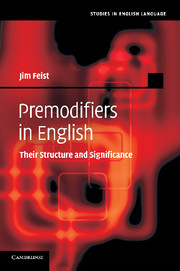
The order and behaviour of the premodifier (an adjective, or other modifying word that appears before a noun) has long been a puzzle to syntacticians and semanticists. Why can we say 'the actual red ball', but not 'the red actual ball'? And why, conversely, do some other premodifiers have free variation in sentences; for example we can say both 'German and English speakers' and 'English and German speakers'? Why do some premodifiers change the meaning of a phrase in some contexts; for example 'young man', can mean 'boyfriend', rather than 'man who is young'? Drawing on a corpus of over 4,000 examples of English premodifiers from a range of genres such as advertising, fiction and scientific texts, and across several varieties of English, this book synthesises research into premodifiers and provides a new explanation of their behaviour, order and use.
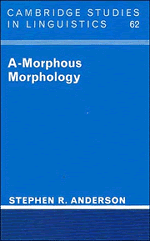
In A-Morphous Morphology, Stephen Anderson presents a theory of word structure which relates to a full generative grammar of language. He holds word structure to be the result of interacting principles from a number of grammatical areas, and thus not localized in a single morphological component. Dispensing with classical morphemes, the theory instead treats morphology as a matter of rule-governed relations, minimizing the non-phonological internal structure assigned to words and eliminating morphologically motivated boundary elements. Professor Anderson makes the further claim that the properties of individual lexical items are not visible to, or manipulated by, the rules of the syntax, and assimilates to morphology special clitic phenomena. A-Morphous Morphology maintains significant distinctions between inflection, derivation, and compounding, in terms of their place ina grammar. It also contains discussion of the implications of this new A-Morphous position analysis of word structure.
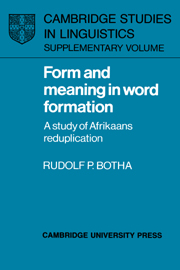
This study of reduplication in Afrikaans provides a unified and principled analysis of an unusual and highly complex word formation process, shedding new light on the scope and content of various fundamental lexicalist principles of word formation. Surprisingly, Rudolf Botha concludes that the principles involved in Afrikaans reduplication are not unique to Afrikaans, as has often been thought, and are used by many other languages. Moreover, the interpretation of Afrikaans reduplications depends on principles of conceptual structure that are restricted neither to Afrikaans nor to the interpretation of reduplications, thus supporting recent work on cognition and meaning undertaken by Ray Jackendoff and other scholars. In analysing the data, Professor Botha has also provided a concrete illustration of how the Galilean style of linguistic inquiry can fruitfully be applied in the study of word formation and meaning. The study thus represents an important theoretical and methodological advance which will be of as much interest for its method of inquiry and argumentation as for the fresh insights it provides for scholars and researchers in the fields of morphology, word formation and semantics.