To save content items to your account,
please confirm that you agree to abide by our usage policies.
If this is the first time you use this feature, you will be asked to authorise Cambridge Core to connect with your account.
Find out more about saving content to .
To save content items to your Kindle, first ensure no-reply@cambridge.org
is added to your Approved Personal Document E-mail List under your Personal Document Settings
on the Manage Your Content and Devices page of your Amazon account. Then enter the ‘name’ part
of your Kindle email address below.
Find out more about saving to your Kindle.
Note you can select to save to either the @free.kindle.com or @kindle.com variations.
‘@free.kindle.com’ emails are free but can only be saved to your device when it is connected to wi-fi.
‘@kindle.com’ emails can be delivered even when you are not connected to wi-fi, but note that service fees apply.
This chapter concludes the monograph by summarising its main findings. The chapter aims to explain the dominance of certain patterns as well as the relative minority status of others. This chapter also offers methodological reflections on the study and asks how representations which challenge the types of stigmatising and shaming discourses observed might be challenged in future.
This chapter explores how representations of obesity intersect with discourses relating to other aspects of identity, focusing in particular on gender. The analysis is divided into two halves. The first half of the chapter examines the representation of men and women with obesity using collocation and compares the representations against each other, relating these to wider gendered discourses in society. The second half analyses a particular type of article where a focus on gender is foregrounded – weight loss narratives. Specifically, this part of the analysis compares the ways in which men’s and women’s weight loss is reported in the press. Overall the analysis reported in this chapter points to the ways in which representations of obesity can depend on the gender and sex identity of the person or group in question. While men’s obesity is represented as exceptional and their weight loss methods as unusual or extreme, obesity in women is depicted as something that is more widespread but also more harmful, including to their children and other relatives.
This chapter analyses the discourse surrounding four words that are frequent and statistically salient across all sections of the press: healthy, body, diet and exercise. Through these foci, the analysis explores how the press constructs a link between health and not having obesity, as well as how individuals are implored to eradicate their obesity and reduce their risk of obesity by regarding their bodies as entities that are separate to their selves and subjecting their bodies to gruelling treatment, including through extreme diets and intense exercise regimes. This chapter questions which of the weight loss methods widely reported across the press are likely to engender weight loss in readers and, more importantly, whether or not they are likely to encourage healthy attitudes towards the body and the self.
In this chapter, obesity representations are analysed in terms of the ways they intersect with discourses around social class. Specifically, the analysis focuses on the representation of four social class groups: i) upper class, ii) middle class, iii) working class and iv) underclass. The analysis points to a range of ways in which representations of these specific social class groups intersect with and contribute towards the broader representation of obesity. These representations are complex, with few straightforward patterns. However, generally, there are telling differences between newspapers with different political leanings. While those on the left of the political spectrum argue for the role of social inequality as a contributing factor in the development of obesity, those on the right argue that obesity is something that is not influenced by social class, as it exists at all class levels. Instead, newspapers to the political right argue that obesity results from individual factors, such as lack of self-control and over-dependence on the ‘nanny state’.
This chapter builds on the previous chapter by examining the corpus in terms of the same four sections that were analysed previously (i.e. left-leaning broadsheets, left-leaning tabloids, right-leaning broadsheets and right-leaning tabloids). Where the previous chapter focused on language and representations that were shared by these sections, and so are characteristic of the press as a whole, this chapter instead focuses on differences between them. Specifically, the analysis uses the keywords approach to compare these different parts of the press against each other, with the resulting keywords signposting discourses and representations of obesity that are characteristic of each section of the press relative to the others.
This chapter explores trends in obesity coverage over time, both in terms of areas of stability and change. Two perspectives on time are adopted. First, changes to keywords are studied on a year-by-year basis, spanning the duration of the corpus (i.e. 2008 to 2017). Second, change is studied in terms of the annual press cycle, with keywords obtained by comparing articles in terms of the particular month in which they are published (e.g. comparing articles published in January against those published in all other months combined, and so on). The first part of the analysis shows how certain discourses, namely those which represent obesity as a matter of personal responsibility, are increasing in relative frequency over time, while those which represent obesity as something resulting from social and political factors are in decline. The second part of the analysis shows how obesity representations can be driven by the news values associated with particular events in the annual (press) cycle, such as Christmas, Easter, summer holidays and the timing of children’s school terms.
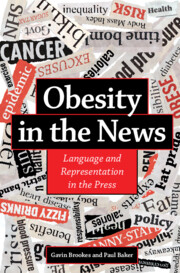
Obesity is a pressing social issue and a persistently newsworthy topic for the media. This book examines the linguistic representation of obesity in the British press. It combines techniques from corpus linguistics with critical discourse studies to analyse a large corpus of newspaper articles (36 million words) representing ten years of obesity coverage. These articles are studied from a range of methodological perspectives, and analytical themes include variation between newspapers, change over time, diet and exercise, gender and social class. The volume also investigates the language that readers use when responding to obesity representations in the context of online comments. The authors reveal the power of linguistic choices to shame and stigmatise people with obesity, presenting them as irresponsible and morally deviant. Yet the analysis also demonstrates the potential for alternative representations which place greater focus on the role that social and political forces play in this topical health issue.
This chapter analyses a set of keywords which were used to refer to ‘Us’, that is the author of the text and the social group that they belong to, which includes the reader as a potential member of that group. The keywords examined in this chapter are Islam, Allah, Muslim, brothers, believers, Ummah and you. The chapter introduces the reader to the main method of analysis which involves identification of representation surrounding each keyword via grammatical patterns through the corpus analysis tool Sketch Engine.
This chapter functions as a literature review, beginning with a summary of some of the terminological issues surrounding the study of terrorism. This is followed by an overview of theorisations of terrorism as communication, that is, the theory that violent acts are communicative. We then discuss not the practices and (verbal) expressions related to clandestine violence undertaken by terrorist individuals or groups. We explore some of the findings from previous research relating to the patterns in terrorists’ words and communicative strategies. We then turn to violent jihadist discourse specifically considering issues around polarised language and its relation to grievance-based discourse, the creation of shared identity, intertextual use of historical and theoretical texts and evocation of authority. We conclude by suggesting why the dearth of research on terrorist discourse poses problems for the creation of viable counter-terrorism measures.
In this chapter, the focus remains on language but moves away from representations around particular words to instead consider the ways in which specific types of language are used as persuasive devices in themselves. Here, we take another meaning of discourse, one which relates to the concept of register, text-type or genre and involves issues relating to stylistic choice. We thus explore some of the specific linguistic strategies that authors use in the data in order to highlight how these might contribute to the legitimacy or persuasiveness of the extremist discourse. We examine keywords that index formal register, as well as those connected to the concepts of truth and quotation. This is followed by a consideration of how code-switching into Arabic is employed in the texts.
This chapter examines the language around harm, focussing on keywords related to the category of violence: jihad, kill, martrydom and paradise. We identify the frequent use of a religious journey metaphor which extremist writers have taken from the Qur’an and reworked to justify killing. A key stage on this path then, is the conceptualisation of jihad as literal fighting and as obligatory, desired by Allah and in is his name. Three representations around killing help to position Muslims as victims, giving a justification for killing civilians, and helping to assuage fears around losing one’s own life as the result of engaging in violent attacks, again by invoking Allah’s authority and approval. Violence is cast as heroic martyrdom and justified as occurring within the context of a war.
This chapter gives an account of our data and method, specifically outlining how we collected and prepared the texts containing extremist language that are the subject of this book, along with the different tools and techniques that were used for analysis. The chapter then carries out preliminary analyses of the data, using Biber’s multidimensional approach before moving on to describe a methodology called Corpus Assisted Discourse Studies (CADS) which involves a collection of approaches that are united by their use of software to identify linguistic patterns in large, electronically-encoded sets of data. We also describe how we obtained and classified keywords across the three sub-corpora which were used as the basis of focussing our analysis on a manageable set of lexical items.
This chapter acts as a counter-point to the previous one, in that it also deals with how social actors are represented, but this time we look at those who are viewed as part of the out-group as opposed to the in-group, considering how the in-group use language to carry out ‘othering’ of the out-group. We examine how strategies of collectivisation, stereotyping, dehumanisation and separation are linguistically realised by examining the following keywords: kufr, disbelief, kuffar, disbeliever, America and evil.