To save content items to your account,
please confirm that you agree to abide by our usage policies.
If this is the first time you use this feature, you will be asked to authorise Cambridge Core to connect with your account.
Find out more about saving content to .
To save content items to your Kindle, first ensure no-reply@cambridge.org
is added to your Approved Personal Document E-mail List under your Personal Document Settings
on the Manage Your Content and Devices page of your Amazon account. Then enter the ‘name’ part
of your Kindle email address below.
Find out more about saving to your Kindle.
Note you can select to save to either the @free.kindle.com or @kindle.com variations.
‘@free.kindle.com’ emails are free but can only be saved to your device when it is connected to wi-fi.
‘@kindle.com’ emails can be delivered even when you are not connected to wi-fi, but note that service fees apply.
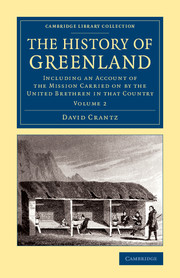
In 1759, David Crantz (or Cranz) was sent to Greenland for a year by the Moravian Church. Writing in German, Crantz (1723–77) published in 1765 his detailed observations on the country, its people and their way of life, including a history of the Moravian mission there. This English translation appeared in two volumes in 1820, prepared by staff at the Fulneck School in West Yorkshire, where a Moravian community existed. The text is illustrated with several engravings that depict landscapes as well as kayaks, weapons and tools used by the Greenlanders, providing a valuable visual record of eighteenth-century life among the native population. Volume 2 contains an account of Moravian missionary activity in Greenland since 1733, tracing how the Moravians managed to brave the conditions while spreading the Gospel among the people. An appendix looks at the Moravian settlement established on the coast of Labrador.
This short work, featuring a number of attractive engravings, traces an abortive expedition to the Canadian Arctic. George Francis Lyon (1795–1832), naval officer and explorer, had accompanied William Parry on a previous expedition in search of the North-West Passage. In 1824 Lyon was instructed to return to Repulse Bay and to explore the mainland. Unfavourable weather conditions forced Lyon to turn back after a few months, and he published this account of the experience the following year. Lyon's text is notable for his descriptions of encounters with Inuit, with whom he spent a great deal of time. The book also includes the text of the official instructions issued by the Admiralty. Chronicling the 1821–3 expedition with Parry, The Private Journal of Captain G. F. Lyon (1824) is also reissued in the Cambridge Library Collection, along with his Journal of a Residence and Tour in the Republic of Mexico (1828).
John Irving (1815–1847?) was a lieutenant on board H.M.S. Terror during Sir John Franklin's fateful expedition, and had the melancholy distinction of being the first identifiable body to be found by a subsequent search party - that of the US officer Frederick Schwatka - in 1878. Irving was identified by a silver medal, won for mathematics in 1830. His remains were brought back to Britain and reburied in his home town, Edinburgh, and at the request of Irving's father this 'memorial sketch', including some of the young lieutenant's letters to his family, was published in 1881 by Benjamin Bell (1810–83), great-grandfather of the surgeon Joseph Bell, Conan Doyle's model for Sherlock Holmes. As well as the touching memoir, the work includes details of the various search and rescue attempts, and a reconstructed chronology by Clements Markham of the Franklin expedition up to its disastrous end.
The British naval officer George Francis Lyon (1795–1832) survived extremes of African heat and Arctic cold during his colourful career. Remembered chiefly for the engaging journals he kept, and for his watercolours of the Arctic, he was fascinated by the indigenous peoples of the lands he explored, notably being tattooed by Inuit and eating raw caribou and seal meat with them. In 1826 he sailed to Mexico, then recovering from its war of independence, to serve as a commissioner for an English mining company. His vivid and often entertaining two-volume account of his experiences was published in 1828. In Volume 2, Lyon encounters notorious bandits outside Guadalajara, ponders the potential navigation of rivers for commercial shipping, and writes of a visit to the Guadalajara theatre: 'had it not been for the universal smoking, and the silence and good manners of the audience, I might have almost fancied myself in England'.
In 1871 the British government agreed to support an expedition to collect physical and chemical data and biological specimens from the world's oceans. Led by Charles Wyville Thomson (1830–82), the expedition used HMS Challenger, refitted with laboratories. They sailed nearly 70,000 nautical miles around the world, took soundings and water samples at hundreds of stops along the way, and discovered more than 4,000 new marine species. Noted for the discovery of the Mid-Atlantic Ridge and the Pacific's deepest trench, the expedition laid the foundations for modern oceanography. This acclaimed two-volume account, first published in 1877, summarises the major discoveries for the Atlantic legs of this pioneering voyage. Illustrated with plates and woodcuts, Volume 1 describes the laboratories and equipment, the observations from Portsmouth via Tenerife to the Caribbean, and the detailed studies on the Gulf Stream.
After qualifying as a physician, Robert Richardson (1779–1847) joined the household of the earl of Belmore, and accompanied him and his family on a tour of the eastern Mediterranean in his yacht the Osprey, converted from a captured American schooner. Richardson dedicated this two-volume work to his patron in 1822. Having spent several months in Naples, the party travelled through the Greek islands to Constantinople, arriving in Alexandria in September 1817. Volume 2 describes further exploration in Egypt, before the party travelled into Palestine, where they visited Jerusalem and the Holy Places, and the cities of the Old Testament, continuing through Syria and Lebanon. Their intention of revisiting Greece on their return was thwarted by reports of the plague, and they arrived back in Malta in July 1818. Richardson's account is full of detail, both of the archaeological remains and of everyday life in the Middle East.
After qualifying as a physician, Robert Richardson (1779–1847) joined the household of the earl of Belmore, and accompanied him and his family on a tour of the eastern Mediterranean in his yacht the Osprey, converted from a captured American schooner. Richardson dedicated this two-volume work to his patron in 1822. Having spent several months in Naples, the party travelled through the Greek islands to Constantinople, arriving in Alexandria in September 1817. Volume 1 recounts their journey up the Nile, exploring both the antiquities of Egypt and the modern cities, especially Cairo, where Richardson made the acquaintance of Burckhardt (whose death he witnessed), Belzoni, Henry Salt and other early explorers of Egypt's past. Having reached the Nile's second cataract, they returned to Thebes, where they were greeted with news of Princess Charlotte's death. Richardson's account is full of detail, both of the archaeological remains and of everyday life in modern Egypt.
Educated at King's College, London, the naturalist and marine biologist William Saville-Kent (1845–1908) went on to work at the British Museum and in aquariums at Brighton, Manchester and Westminster. He spent many years in Australia as a fisheries expert, and during this time he made extensive surveys of the natural world. The present work, first published in 1897, was intended to give a non-scientific audience a glimpse of the fantastic array of wildlife in Australia. The author discusses the many varieties of birds, lizards, fish and other sea life, insects (an entire chapter is devoted to termites), and vegetation. He was also able to take advantage of the photographic technology of the time and include around fifty collotype images, which complement the many other illustrations of the plants and animals he writes about, providing a vivid overview of the natural world in late nineteenth-century Australia.
In 1759, David Crantz (or Cranz) was sent to Greenland for a year by the Moravian Church. Writing in German, Crantz (1723–77) published in 1765 his detailed observations on the country, its people and their way of life, including a history of the Moravian mission there. This English translation appeared in two volumes in 1820, prepared by staff at the Fulneck School in West Yorkshire, where a Moravian community existed. The text is illustrated with several engravings that depict landscapes as well as kayaks, weapons and tools used by the Greenlanders, providing a valuable visual record of eighteenth-century life among the native population. Volume 1 is primarily concerned with the geography of Greenland, the local weather patterns, and flora and fauna, as well as the attitudes, traditions, social habits and hierarchies of the people of Greenland.
Impressed by the discoveries of Captain Cook, and conscious that Russia was lagging behind other countries in terms of navigation and exploration, Catherine the Great commissioned an expedition in 1785 to chart the coastline in the far north-east of her empire. Born in Middlesex, Joseph Billings (1758–1806) had sailed under Cook but entered Russian service in 1783. He was chosen to lead the expedition, which would last for nine years. Written up by Martin Sauer, secretary and translator to the expedition, this illustrated account was first published in English in 1802, documenting the sheer scale of the task and the range of scientific activities carried out. Notable for producing the first accurate maps of the shoreline and islands of east Siberia, the expedition also contributed to the ethnographic and zoological knowledge of this most inhospitable of environments.
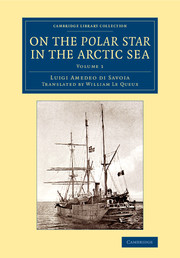
Prince Luigi Amedeo of Savoy, a grandson of King Vittorio Emanuele II of Italy, was well known as a mountaineer and traveller when, in 1899, he organised an expedition to the Arctic, obtaining a steam whaling ship in Oslo which he renamed the Stella Polare. His ambition was to reach the highest possible latitude (and possibly the North Pole itself) by careful logistical arrangements, wintering on the ice in Franz Josef Land and using dog-sledges to travel further north. He also intended a scientific survey of the area in which the team passed the winter. His account of the expedition was published in Italian in 1902 and this two-volume English translation by William Le Queux (better known as the author of sensationalist spy and crime novels) appeared in 1903. Volume 1 recounts the genesis and progress of the expedition, including the crew's efforts to free the ice-bound ship using explosives.
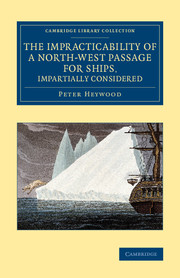
Peter Heywood (1772–1831) became known for his involvement in the 1789 mutiny aboard the Bounty. After evading a death sentence thanks to a royal pardon, he was able to advance himself in a distinguished naval career, achieving the rank of post-captain. The question of the North-West Passage, a sea route through the Arctic that would connect the Atlantic and Pacific oceans, remained an obsession for the British for much of the nineteenth century. Drawing on his experience as a naval hydrographer and writing under the pseudonym 'Scrutator', Heywood considers the question of the North-West Passage in this 1824 publication by surveying accounts of recent expeditions to the Arctic. While he does not dispute the existence of the much-sought route, he argues that the icy waters would not be navigable for ships. It was not until the early twentieth century that Roald Amundsen and his crew achieved the seemingly impossible.
John Bell (1691–1780) trained as a physician, but preferred a life of travel and diplomacy. He entered the service of Tsar Peter the Great of Russia, and had already taken part (as the expedition's doctor) in a government mission to Persia in 1715–18 when he was asked to join a further embassy to China. This two-volume work, published in 1763, describes both these journeys. Volume 2 takes up the story with the embassy's reception in Beijing, with accounts of the Chinese emperor and his court, and the return journey. It also includes the journal of Lorenz Lange (c.1690–1752), a Swede in Russian service who was an agent at the court of Beijing at the time of Bell's own mission, and short accounts of Bell's later visits to Derbent on the Caspian Sea, and to Constantinople. This is a delightful account of an area then hardly known in the west.
An Irish officer in the British army, William Francis Butler (1838–1910) travelled widely during a career which took him from India to Africa. In 1867 he made for Canada with his regiment, and he recalls his adventures in this lively account, first published in 1872 to immediate success, and followed by this second edition in the same year. The book covers Butler's risky reconnaissance mission during the Red River Rebellion, during which he met the Métis leader Louis Riel. Later chapters describe subsequent journeys into the sparsely populated Manitoba and Saskatchewan territories, as well as the US states of Illinois, Minnesota and North Dakota. In vivid detail, Butler describes the landscapes and peoples he encountered, including many Native American tribes. This region of North America was later transformed by an influx of settlers, and Butler's work captures the final days of what was then an underexplored wilderness.