To save content items to your account,
please confirm that you agree to abide by our usage policies.
If this is the first time you use this feature, you will be asked to authorise Cambridge Core to connect with your account.
Find out more about saving content to .
To save content items to your Kindle, first ensure no-reply@cambridge.org
is added to your Approved Personal Document E-mail List under your Personal Document Settings
on the Manage Your Content and Devices page of your Amazon account. Then enter the ‘name’ part
of your Kindle email address below.
Find out more about saving to your Kindle.
Note you can select to save to either the @free.kindle.com or @kindle.com variations.
‘@free.kindle.com’ emails are free but can only be saved to your device when it is connected to wi-fi.
‘@kindle.com’ emails can be delivered even when you are not connected to wi-fi, but note that service fees apply.
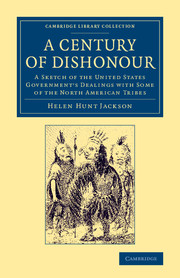
Author and activist Helen Hunt Jackson (1830–85) is remembered for her work in support of Native American rights. She was also a friend and correspondent of the poet Emily Dickinson, and her own verse was praised by Ralph Waldo Emerson. Her highly popular novel Ramona (1884) addressed discrimination against Native Americans, raising public consciousness as Harriet Beecher Stowe had done for slavery in Uncle Tom's Cabin (1852). Jackson's novel emerged out of her passionate seeking of justice for her country's indigenous peoples. She describes decades of government-sanctioned mistreatment of Native Americans in this 1881 publication. The work introduces seven major tribes, their claims to ancestral lands, and the history of broken treaties and massacres they had endured. Alongside this, Jackson also presents details of Native American culture, resilience and creativity. This remains a vital and substantial account of minority persecution in North American history.
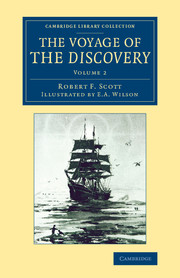
At the outset of the twentieth century, Antarctica was scarcely explored or understood. Penetrating the pack ice in the purpose-built Discovery, the British National Antarctic Expedition (1901–4) established a base in McMurdo Sound, enabling scientists and sledging parties to significantly push back the boundaries of the unknown. Published in 1905, this acclaimed two-volume work by the naval officer and expedition leader Robert Falcon Scott (1868–1912) recounts the trials, errors and achievements of an undertaking which laid the foundations for future research and Scott's later journey to the South Pole. The work is greatly enhanced by many photographs as well as illustrations by the doctor, zoologist and artist Edward A. Wilson (1872–1912). Volume 2 opens with the sledging journey made by Scott, Wilson and Ernest Shackleton which reached an unprecedented southern latitude. A second polar winter and further sledging exploits are also described. The appendices contain geological and zoological findings.
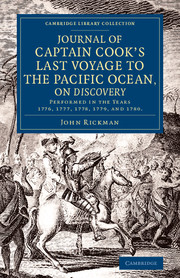
John Rickman, second lieutenant on one of the two ships commanded by James Cook on his last expedition, wrote this journal during the voyage. It was first published anonymously in 1781, because the Admiralty embargoed all personal accounts until an official report of the voyage was released. Rickman apparently wanted to anticipate any attempt to blame him (a party under his command had killed a Hawaiian chief) for precipitating Cook's death. This revised edition, 'compared with, and corrected from, the voyage published by authority' was published - again anonymously - in 1785. After an editorial preface and an introductory account of earlier voyages to the South Seas, the journal itself offers a detailed first-hand narrative of the four-year voyage, including the deaths of Cook and of Captain Clerke, who took over command of the expedition but died of tuberculosis while searching for the western entrance to the North-West Passage.
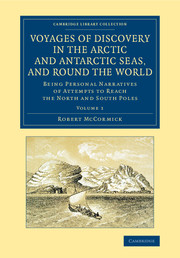
Published in 1884 and illustrated with over 100 of his own drawings and maps, this two-volume work by the doctor and naturalist Robert McCormick (1800–90) provides an account of his voyages in the Arctic with William Parry and in the Antarctic with James Clark Ross, noting also his part in the search for Sir John Franklin. Incorporating a very detailed autobiography, McCormick's work also provides many details relating to natural history and geology. Volume 1 is mainly devoted to his Antarctic voyage (1839–43), during which he also visited St Helena, the Kerguelen Islands, Australia, New Zealand, the Falkland Islands and Tierra del Fuego. During three attempts to reach the South Pole the expedition explored the Ross Sea, described the ice barrier, and raised the British flag to claim possession. The volume ends with the abortive attempt in 1827 to reach the North Pole via Spitsbergen.
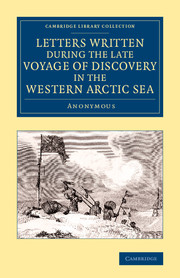
Sir Edward Parry (1790–1855) wrote accounts of his three Arctic expeditions, which have also been reissued in this series. This book takes the form of letters written to a sibling by an anonymous member of the crew on Parry's 1819–20 voyage. It was brought out in 1821 by the enterprising publisher Richard Phillips ahead of any other narrative, as all accounts and journals had first to be handed to the Admiralty Board for the extraction of any important details. It seems likely that the work, which is carefully constructed and elegant in style, was elaborated either from notes or from a genuine series of letters, to get round the restriction on publication. This is a fascinating narrative, full of striking details, such as entertainments on board to help morale, the reappearance of the sun at the end of the Arctic winter, and the sight of the aurora borealis.
After a six-month voyage, the Carmelite missionary Paolino da San Bartolomeo (1748–1806) arrived in Malabar in India towards the end of July 1776. Later acclaimed as an orientalist, he was among the first to note the relationship between Sanskrit and European languages, and the present work gives a valuable account of the geography and culture he observed over the course of thirteen years. Returning to Rome in 1789, he wrote many books under the patronage of Cardinal Stefano Borgia, including one of the first works on Sanskrit grammar. Here he uses his impressive knowledge of Indian dialects to revise the accepted spelling and pronunciation of a number of cities and natural features. The book also contains observations on the religion, history, botany and laws of eighteenth-century India. First published in Italian in 1796, the work was soon translated into German, from which William Johnston produced this English translation in 1800.
This biography of the naval officer and explorer Sir Albert Hastings Markham (1841–1918) was published in 1927 by two relatives (both professional authors), using the detailed journals which he kept from 1862. Markham was the cousin of Sir Clements Markham, the historian and geographer, and was greatly influenced by him. Having volunteered for Arctic service, he was rejected by the Admiralty, but took a period of leave in which he went to Baffin Bay as second mate on a whaler. (His account of this voyage, and several other works, are also reissued in this series.) Though best remembered for his Arctic exploration, Markham was involved in active service in China, the Mediterranean and Australian waters, and in the training of naval recruits. He continued in the Royal Navy until 1906, and in his retirement continued to encourage polar exploration, serving for many years on the Council of the Royal Geographical Society.
An eminent geographer, Clements Markham (1830–1916) had searched for Sir John Franklin in the Arctic as a young man in the Royal Navy. This stimulated his lifelong passion for the polar regions. Published in 1873, this historical review of Arctic exploration was based on extensive research at the Royal Geographical Society, of which Markham was then secretary and later president. The chapters include coverage of early explorers from the sixteenth century, the voyages of Barents and Hudson, Dutch and English whaling voyages around Spitsbergen, exploration of Greenland's east coast, expeditions into Baffin Bay and Smith Sound, Russian discoveries, and possibilities for scientific progress. A discussion of the best route for future British exploration is provided, with an appendix setting out the case for the expedition of 1875–6. Illustrated with a number of maps, Markham's book keenly sought to stimulate further polar exploration by his countrymen.
In 1867, Prince Alfred, Queen Victoria's second son, commissioned the Galatea for a voyage around the world which would include the first royal visit to Australia. Stopping along the way in Rio de Janeiro and Cape Town, Alfred was received with great ceremony at each port of call. These visits provided the ship's chaplain John Milner (1822–97) and the artist Oswald Brierly (1817–94) with ample material for this chronicle, published in 1869, which gives background details of each region alongside scenes from the tour, enhanced by illustrations based on Brierly's sketches. The authors drew on various recollections and writings, including a letter from Alfred to his brother describing an elephant hunt in South Africa. The tour was abruptly curtailed in Sydney when a Fenian sympathiser attempted to assassinate the prince, an act which boosted support for the British royal family.
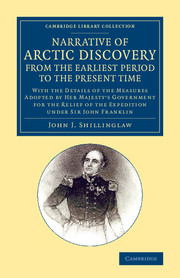
This 1850 account of the history of Arctic exploration was dedicated to Lady Franklin, whose energy in spurring on expeditions in search of her husband and his two ships, by then missing for five years, was widely admired. John Shillinglaw (d.1862), a fellow of the Royal Geographical Society, was able both to give a historical perspective and to describe the most recent efforts being made to discover Franklin's fate. The narrative begins with the Viking exploration and settlement of Iceland and Greenland, and possible landings in North America. While focusing on British voyages in more recent history, Shillinglaw also includes Russian and Danish activities, as well as the founding of trading firms like the Hudson's Bay Company. But the greater part of the book describes, in considerable detail, voyages from the late eighteenth century up to 1850, and offers a useful synthesis of the first-hand accounts published in this period.
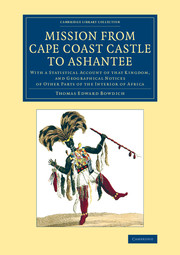
This work by Thomas Edward Bowdich (1791?–1824) describes the journey he made on behalf of the Royal African Company from Cape Coast Castle in West Africa into the territory of the Ashanti, a warlike tribe which had legendary resources of gold and which had been attacking European settlements along the Gold Coast. The intention was to make a peace and trade treaty with the Ashanti, and also to learn more about their culture and customs. Bowdich, not the original leader of the expedition, took control, and negotiated a treaty of mutual co-operation and trade. He returned to Europe in 1818, publishing this fascinating account in 1819, but he felt that his own efforts, and his book, did not receive the rewards they merited. He died on a second, scientific expedition to West Africa, leaving his widow, naturalist and artist Sarah (later Lee), to edit and publish his last work.
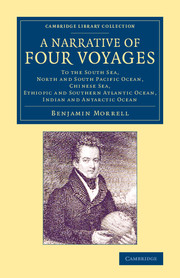
Based on his journals, with literary assistance provided by a ghostwriter, this 1832 publication gives an account of the early life and later voyages of the American sealer and explorer Benjamin Morrell (1795–1839). The titular adventures consisted of explorations of the Pacific and Antarctic between 1822 and 1831. The text describes unfamiliar bodies of land, sometimes violent interactions with native populations (several of Morrell's crew were killed in the Carteret Islands), and encounters with the slave trade. Morrell also claimed to have been the first American captain to cross the Antarctic Circle. However, there are doubts about the veracity of his narrative, as reported distances, times and locations, particularly in the Antarctic, have proven to be inaccurate. This has been attributed variously to error, exaggeration or outright deception. Morrell himself admits to enhancing his narrative by drawing on information furnished by other navigators.
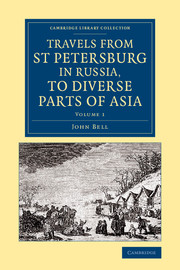
John Bell (1691–1780) trained as a physician, but preferred a life of travel and diplomacy. He entered the service of Tsar Peter the Great of Russia, and had already taken part (as the expedition's doctor) in a government mission to Persia in 1715–18 when he was asked to join a further embassy to China. This two-volume work, published in 1763, describes both these journeys. The first part of Volume 1 contains an account of the Persian expedition, and the second a narrative of the journey across Siberia to the walls of Beijing. It includes fascinating anecdotes of the peoples encountered, and their environment, beliefs and customs, including a female Siberian shaman, the pet musk deer of an exiled Swedish general, and the interdependence of marmots and rhubarb (at this time a valuable medicinal drug). This is a delightful account of an area then hardly known in the west.
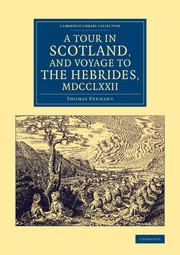
The naturalist and traveller Thomas Pennant (several of whose other works are reissued in the Cambridge Library Collection) published this account of a journey through Scotland and its islands in 1774. Pennant (1726–98) had already written one account of Scotland, in 1771. (He later claimed that by 'shewing that it might be visited with safety' he had created a tourist boom.) His great enthusiasm was for the Hebrides, and more than half of the book describes his voyage around the islands, though he was frustrated by bad weather in getting to Staffa. He transcribes instead an account by Sir Joseph Banks, who had visited in the same year, and in his preface he acknowledges the researches and notes on particular places which had been provided by friends and correspondents. This is a genial account of the history, environment and people of a region still exotic to many Britons.
The disappearance of Sir John Franklin's Arctic expedition of 1845 led to many rescue attempts, some by the British government and some by private individuals, as well as a large number of works recounting these expeditions and reflecting on the mystery. Little is known about the author of this 1857 work, James Parsons. He begins this dramatic account by noting that the disappearance of a large and well-equipped party is almost unprecedented in the Arctic: nothing certain was known about Franklin's fate twelve years after the last recorded sighting. Parsons' speculations derive from a knowledge of naval practice, and familiarity with the seas and climate of the Arctic region and the records of earlier expeditions. He offers practical suggestions about a new attempt using steam-boats, but knows that this will be to find out what actually happened, because there could now be no possibility of finding survivors.
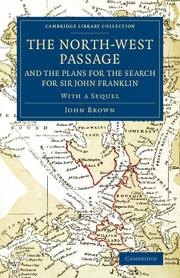
When John Brown (1797–1861) developed a defect in his eyesight, he could no longer embark on extended voyages for the East India Company. After making a fortune selling gold and diamonds, he cultivated his geographical interests, and was elected to the Royal Geographical Society in 1837. Brown was especially interested in the Arctic, and he became concerned about the missing Franklin expedition to find the North-West Passage. In this substantial work, first published in 1858 and reissued here in one volume with its 1860 sequel, Brown provides a detailed account of previous polar expeditions before turning to the efforts to find Franklin and his men. The sequel is devoted to the 1857–9 search expedition arranged by Lady Franklin and led by Leopold McClintock. A number of other works on Franklin's last expedition and the subsequent searches have also been reissued in this series.
Antiquary, zoologist and traveller, Thomas Pennant (1726–98) is remembered for his work in bringing natural history to popular attention and for his engaging writing about the journeys he made. Lavishly illustrated by Moses Griffith with fine engravings of the stunning scenery, buildings and artefacts, this work appeared in two volumes between 1778 and 1781. More than a mere travelogue, this tour of his native country is full of delightful vignettes and historical background. The descriptions of locations and buildings reveal Pennant's thorough mind and tireless capacity for observation. Several of Pennant's other works, including his Tour in Scotland (second edition, 1772), are also reissued in the Cambridge Library Collection. Volume 1 begins in Pennant's birthplace, Downing in Flintshire, and follows a route around North Wales, making 'a complete tour of the tamer parts of our country'. The places visited include Chester, Oswestry, Llangollen, Mold and Caerwys.
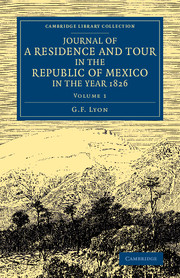
The British naval officer George Francis Lyon (1795–1832) survived extremes of African heat and Arctic cold during his colourful career. Remembered chiefly for the engaging journals he kept, and for his watercolours of the Arctic, he was fascinated by the indigenous peoples of the lands he explored, notably being tattooed by Inuit and eating raw caribou and seal meat with them. In 1826 he sailed to Mexico, then recovering from its war of independence, to serve as a commissioner for an English mining company. His vivid and often entertaining two-volume account of his experiences was published in 1828. In Volume 1, Lyon complains of his first nights being disturbed by 'dogs, pigs and restless cocks', and on his way to the mining area of Zacatecas he visits a church where a figure of Christ made him recall a 'creation of Frankenstein'.
On 14 December 1911, Roald Amundsen (1872–1928) and his Norwegian team became the first humans to reach the South Pole, a month before their ill-fated British rivals under the leadership of Robert Falcon Scott. Reissued here is the 1912 English translation of Amundsen's two-volume account of how this extraordinary and perilous feat was achieved. Illustrated throughout with illuminating maps and photographs, the text contains important details relating to matters of climate, equipment, diet, sledging and survival in forbiddingly cold conditions over uncertain terrain. Underpinning Amundsen's success, the use of dogs, skis and fur clothing made possible the dash to the pole and back without the loss of human life. While careful to present the expedition in the best light, Amundsen's work remains essential reading in the history of Antarctic exploration. Volume 1 covers the early stages of the expedition prior to the start for the pole in October 1911.
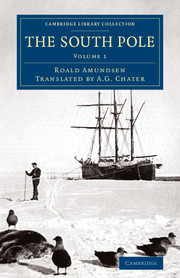
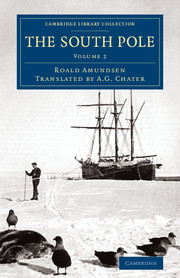
On 14 December 1911, Roald Amundsen (1872–1928) and his Norwegian team became the first humans to reach the South Pole, a month before their ill-fated British rivals under the leadership of Robert Falcon Scott. Reissued here is the 1912 English translation of Amundsen's two-volume account of how this extraordinary and perilous feat was achieved. Illustrated throughout with illuminating maps and photographs, the text contains important details relating to matters of climate, equipment, diet, sledging and survival in forbiddingly cold conditions over uncertain terrain. Underpinning Amundsen's success, the use of dogs, skis and fur clothing made possible the dash to the pole and back without the loss of human life. While careful to present the expedition in the best light, Amundsen's work remains essential reading in the history of Antarctic exploration. Volume 2 covers the momentous journey to the pole and back, closing with chapters and appendices on nautical and scientific topics.