To save content items to your account,
please confirm that you agree to abide by our usage policies.
If this is the first time you use this feature, you will be asked to authorise Cambridge Core to connect with your account.
Find out more about saving content to .
To save content items to your Kindle, first ensure no-reply@cambridge.org
is added to your Approved Personal Document E-mail List under your Personal Document Settings
on the Manage Your Content and Devices page of your Amazon account. Then enter the ‘name’ part
of your Kindle email address below.
Find out more about saving to your Kindle.
Note you can select to save to either the @free.kindle.com or @kindle.com variations.
‘@free.kindle.com’ emails are free but can only be saved to your device when it is connected to wi-fi.
‘@kindle.com’ emails can be delivered even when you are not connected to wi-fi, but note that service fees apply.
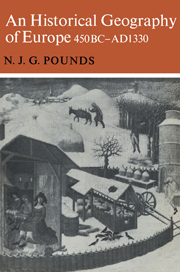
Every age has its own geography, separate and distinct from the geographies of earlier and succeeding ages. This 1973 book seeks to examine the complex of natural and man-made features which have provided the background of history, influencing its course and themselves modified by human action. Professor Pounds examines five short periods, each of which is not only relatively well documented, but also important in the climax of a civilisation. In a sense, each represents the climax of a longer period of historical development. The aim is to survey the whole of Europe for each of the chosen periods, not merely those areas which have been highlighted by documents and events. Northern Europe in the age of Pericles and eastern Europe in all periods are, for example, examined, alongside the better-known Mediterranean region, France and the Rhineland. Considerable use is made of maps, all specially prepared for this book.
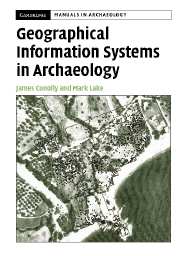
Geographical Information Systems has moved from the domain of the computer specialist into the wider archaeological community, providing it with an exciting new research method. This clearly written but rigorous book provides a comprehensive guide to that use. Topics covered include: the theoretical context and the basics of GIS; data acquisition including database design; interpolation of elevation models; exploratory data analysis including spatial queries; statistical spatial analysis; map algebra; spatial operations including the calculation of slope and aspect, filtering and erosion modeling; methods for analysing regions; visibility analysis; network analysis including hydrological modeling; the production of high quality output for paper and electronic publication; and the use and production of metadata. Offering an extensive range of archaeological examples, it is an invaluable source of practical information for all archaeologists, whether engaged in cultural resource management or academic research. This is essential reading for both the novice and the advanced user.
The need for a better understanding of the role location plays in economic life was first and most famously made explicit by Bertil Ohlin in 1933. However it is only recently, with the development of computer packages able to handle complex systems, as well as advances in economic theory (in particular an increased understanding of returns to scale and imperfect competition), that Ohlin's vision has been met and a framework developed which explains the distribution of economic activity across space. This book is an integrated, non-mathematical, first-principles textbook presenting geographical economics to advanced students. Never avoiding advanced concepts, its emphasis is on examples, diagrams, and empirical evidence, making it the ideal starting point prior to monographic and journal material. Contains copious computer simulation exercises, available in book and electronic format to encourage learning and understanding through application. Uses case study material from North America, Europe, Africa and Australasia.
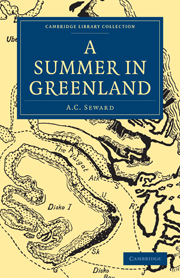
The author of the standard early twentieth-century textbook on fossil plants, A. C. Seward (1863–1941) was Professor of Botany at Cambridge, Master of Downing College and Vice-Chancellor of Cambridge University. This account of his first research trip to Greenland is an evocative portrait of the country, its immense and sublime landscape, its people, and life on the Danish scientific station. This little book, written in an engaging conversational tone, conveys Seward's enthusiasm for Greenland. It includes an explanation for non-specialists of some of Seward's findings relating to fossil plants found there, which provide evidence that the country had a much milder climate in previous geological periods. Seward's own photographs are a fascinating record of the traditional life of the Inuit population as it then survived, as well as the rugged scenery of icebergs and glaciers.
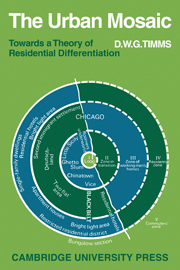
The concept of the city as a mosaic of social worlds has achieved wide currency: the residential differentiation of the urban population provides the matrix for much human activity. In this detailed study, the author demonstrates that much of the manifold variation in the social characteristics of populations living in different parts of the city may be summarized in terms of a small number of factors relating to social rank, style of life preferences and ethnicity. Residential and social differentiation are seen as intimately connected. At the individual level, it is suggested that questions relating to social rank, style of life, and ethnicity provide the main framework for the choice of residential location. At the societal level, it is suggested that the variations in the inter-relationship of the basic differentiating factors are a function of modernization. Empirical material is drawn from an number of Australian cities.
The publications of the Hakluyt Society (founded in 1846) made available edited (and sometimes translated) early accounts of exploration. The first series, which ran from 1847 to 1899, consists of 100 books containing published or previously unpublished works by authors from Christopher Columbus to Sir Francis Drake, and covering voyages to the New World, to China and Japan, to Russia and to Africa and India. Three volumes, published in 1887, are devoted to the diary of William Hedges (1632–1701) who in 1681 became the first Agent of the East India Company at its new base in Bengal. The first volume contains a transcription of the diary itself; Volume 2 contains a collection of documents relevant to Hedges' time in India; and Volume 3 is a documentary history of Thomas Pitt, grandfather of Pitt the Elder and Governor of Fort St George, who appears frequently in Hedges' diary.
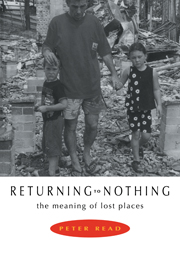
Feelings about lost or destroyed places rouse our deepest emotions. Losing a home or a suburb or leaving a homeland can be like losing a loved one. This book examines what it means to lose a place forever and why we return, and keep on returning, to these places so large in our memories. It considers many lost towns, suburbs, and homes: Darwin after Cyclone Tracy, the flooding of the town of Adaminaby in New South Wales, the inundation of Lake Pedder in Tasmania, bushfire at Macedon in Victoria, migration from other countries, the clearing of neighbourhoods for freeways and the everyday circumstances which force people from their land. Peter Read establishes how important the places we live in are, and how much we grieve when we lose them. It tells a human story, which is disturbing, poetic, and often inspiring. Everyone who has lost a place of importance to them will find it unforgettable.
On Disasters in India is a comprehensive compilation of extensive research on disasters in India. It unfolds the pitfalls in research so far and insists on a fresh paradigm in the methodology for accessing research on disasters. The book reconstructs a researchscape and examines the three time periods of study of disasters, namely, the phase of awareness, indifference and recognition. The narrative is built across the colonial, independence and post-globalisation years. The 4004 references, located, classified and collated figuratively and categorically in the book, form the groundwork for any research pertaining to disasters in India. The collection is indispensable to postgraduate students, researchers, disaster managers and policy-makers who are keenly involved in research or in providing solutions to disasters.
Western exploration of the Arabian Desert began in the mid-eighteenth century, but it was not until the nineteenth century that the British officers of the Indian colonial government undertook surveys of the areas remote from the major pilgrimage routes. Charles Doughty (1843–1926) spent two years among various nomad tribes and wrote in 1888 what would be the first comprehensive Western work on the geography of Arabia, in an attempt, as he says in the preface, to 'set forth faithfully some parcel of the soil of Arabia smelling of sàmn and camels'. His classic and justly famous account is a fantastic piece of travel writing that shows full understanding of the area, the people and all aspects of nomadic life in the desert.
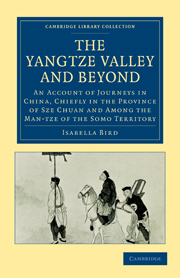
The Yangtze Valley and Beyond, first published in 1899, contains the account by the redoubtable Isabella Bird (now Mrs J. F. Bishop) of a journey through central China in 1896–1897. The volume focuses on her travels though the province of Szechuan and among the Man-tze of the Somo territory. Many of the areas she explored and carefully described were almost unknown to European visitors and had not been mentioned in any earlier English publications. The volume is based on journal letters and the diary written during her journey, and it is generously illustrated with photographs and Chinese drawings. Bishop's work was warmly received in England and praised especially for the information included on agriculture and industry. The Geographical Journal heralded the work as 'undoubtedly one of the most important contributions to English literature on that country'. It remains a key source for late nineteenth-century British perceptions of China.
The publications of the Hakluyt Society (founded in 1846) made available edited (and sometimes translated) early accounts of exploration. The first series, which ran from 1847 to 1899, consists of 100 books containing published or previously unpublished works by authors from Christopher Columbus to Sir Francis Drake, and covering voyages to the New World, to China and Japan, to Russia and to Africa and India. Three volumes, published in 1887, are devoted to the diary of William Hedges (1632–1701) who in 1681 became the first Agent of the East India Company at its new base in Bengal. The first volume contains a transcription of the diary itself; Volume 2 contains a collection of documents relevant to Hedges' time in India; and Volume 3 is a documentary history of Thomas Pitt, grandfather of Pitt the Elder and Governor of Fort St George, who appears frequently in Hedges' diary.
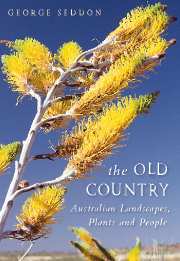
We are a nation of gardeners, and we take pleasure in tending our backyards. But this pleasure sits uneasily with our knowledge that the places where most of us live are running out of water. We suspect that our lawns and many of our plants from the damp climates of northern European gardens are too demanding of scarce supplies, but can't imagine our streets and gardens without them. The Old Country opens our eyes, and minds, to other possibilities. It does so by telling us stories about our natural landscape. George Seddon believes that the better we understand the delicacy and beauty of our natural environment, the more 'at home' we will feel as Australians. This passionate, wise and witty book, enriched with breathtakingly beautiful illustrations, suggests that the answers to our water problems lie here, at home.
Western exploration of the Arabian Desert began in the mid-eighteenth century, but it was not until the nineteenth century that the British officers of the Indian colonial government undertook surveys of the areas remote from the major pilgrimage routes. Charles Doughty (1843–1926) spent two years among various nomad tribes and wrote in 1888 what would be the first comprehensive Western work on the geography of Arabia, in an attempt, as he says in the preface, to 'set forth faithfully some parcel of the soil of Arabia smelling of sàmn and camels'. His classic and justly famous account is a fantastic piece of travel writing that shows full understanding of the area, the people and all aspects of nomadic life in the desert.