To save content items to your account,
please confirm that you agree to abide by our usage policies.
If this is the first time you use this feature, you will be asked to authorise Cambridge Core to connect with your account.
Find out more about saving content to .
To save content items to your Kindle, first ensure no-reply@cambridge.org
is added to your Approved Personal Document E-mail List under your Personal Document Settings
on the Manage Your Content and Devices page of your Amazon account. Then enter the ‘name’ part
of your Kindle email address below.
Find out more about saving to your Kindle.
Note you can select to save to either the @free.kindle.com or @kindle.com variations.
‘@free.kindle.com’ emails are free but can only be saved to your device when it is connected to wi-fi.
‘@kindle.com’ emails can be delivered even when you are not connected to wi-fi, but note that service fees apply.
Coherent anti-Stokes Raman scattering (CARS) spectroscopy is a technique that has been widely applied for temperature measurements in combustion and for microscopic imaging of cell structures. CARS spectroscopy is discussed in detail in this chapter as an example of a nonlinear optical technique. The concept of the nonlinear susceptibility is introduced, and the derivation of the susceptibility tensor appropriate for CARS spectroscopy is described in detail. A key aspect of this derivation is the incorporation of the electric dipole transition matrix elements for the Raman scattering process into the susceptibility tensor. CARS spectral modeling and collisional narrowing of CARS spectral features are discussed in detail. The emerging field of femtosecond CARS is discussed. The chapter concludes with detailed examples of CARS intensity calculations.
The structure of diatomic molecules is discussed in this chapter. The electronic structure of diatomic molecules is then discussed in detail. The coupling of the orbital and spin angular momenta of electrons and the angular momentum associated with nuclear rotation are discussed, with an emphasis on Hund’s cases (a) and (b). The rotational wavefunctions for diatomic molecules in the limits of Hund’s cases (a) and (b) and in the case intermediate between Hund’s cases (a) and (b) are then discussed in detail. For molecules that are of importance in combustion diagnostics, such as OH, CH, CN, and NO, the electronic levels are intermediate between Hund’s cases (a) and (b). We use Hund’s case (a) as the basis wavefunctions, and linear combinations of these wavefunctions are used to represent wavefunctions for electronic levels intermediate between cases (a) and (b). The choice of case (a) wavefunctions as the basis set is typical in the literature although case (b) wavefunctions can also be used as a basis set.
Raman scattering spectroscopy is widely used in analytical chemistry, for structural analysis of materials and molecules and, most importantly for our purposes, as a gas-phase diagnostic technique. Raman scattering is a two-photon scattering process, and the mathematical treatment of Raman scattering is very similar to the mathematical treatment of two-photon absorption. Many of the molecules of interest for quantitative gas-phase spectroscopy are diatomic molecules with non-degenerate 1Σ ground electronic levels, including N2, CO, and H2. In this chapter, the theory of Raman scattering is developed based on Placzek polarizability theory and using irreducible spherical tensor analysis. Herman–Wallis effects are discussed in detail. The chapter concludes with detailed examples of Raman scattering signal calculations.
We present a practical verification method for safety analysis of the autonomous driving system (ADS). The main idea is to build a surrogate model that quantitatively depicts the behavior of an ADS in the specified traffic scenario. The safety properties proved in the resulting surrogate model apply to the original ADS with a probabilistic guarantee. Given the complexity of a traffic scenario in autonomous driving, our approach further partitions the parameter space of a traffic scenario for the ADS into safe sub-spaces with varying levels of guarantees and unsafe sub-spaces with confirmed counter-examples. Innovatively, the partitioning is based on a branching algorithm that features explainable AI methods. We demonstrate the utility of the proposed approach by evaluating safety properties on the state-of-the-art ADS Interfuser, with a variety of simulated traffic scenarios, and we show that our approach and existing ADS testing work complement each other. We certify five safe scenarios from the verification results and find out three sneaky behavior discrepancies in Interfuser which can hardly be detected by safety testing approaches.
For the engineer or scientist using spectroscopic laser diagnostics to investigate gas-phase media or plasmas, this book is an excellent resource for gaining a deeper understanding of the physics of radiative transitions. While a background in quantum mechanics is beneficial, the book presents a comprehensive review of the relevant aspects, extensively covering atomic and molecular structure alongside radiative transitions. The author employs effective Hamiltonians and Hund's case (a) basis wavefunctions to develop the energy level structure of diatomic molecules. These techniques also form the basis for treating radiative transitions in diatomic molecules. Recent advancements in quantum chemistry, enabling readers to calculate absolute single-photon and Raman transition strengths, are also presented. Illustrated with detailed example calculations of molecular structure and transition rates, this self-contained reference for spectroscopic data analysis will appeal to professionals in mechanical, aerospace, and chemical engineering, and in applied physics and chemistry.
We present a versatile method to generate asymmetric profiles and use it to create Gaussian-like, Cauchy-like, and Pseudo-Voigt-like profiles in terms of elementary functions. Furthermore, this method guarantees that the position and magnitude of the global maximum are independent of the asymmetry parameter, which substantially facilitates the convergence of an optimizer when fitting the peaks to real data. This investigation shows that the method developed here exhibits favorable practical properties and is particularly well suited for various applications where asymmetric peak profiles are observed. For example, in X-ray diffraction (XRD) measurements, the use of asymmetric profiles is essential for obtaining accurate outcomes. This is because diffractometers can introduce asymmetry into the diffraction peaks due to factors such as axial divergence in the beam path. By taking this asymmetry into account during the modeling process, the resulting data obtained can be corrected for instrumental effects. The results of the study show that the evaluation of XRD using nearly defect-free LaB6 allows a precise characterization of the peak broadening caused by the diffractometer itself. Additional size-strain effects of ZnO are determined by considering the asymmetric peak profile of the diffractometer.
Community biology labs are locally organized spaces for research, tinkering and innovation, which are important for improving the accessibility of biological research and the transferability of scientific knowledge. These labs promote citizen science by providing resources and education to community members. For community labs to deliver consistent and reliable results, they would ideally be based on an adaptive and robust foundation: an Enterprise Systems Thinking (EST) framework. This paper follows a descriptive methodology to apply EST to conceptualize the optimal functioning of community biology labs. EST approaches can increase the overall understanding of the community lab system’s context and performance. This supportive tool can aid in successful stakeholder engagement and communications within the lab’s complex structure. It is also adaptive and can be adjusted as Community Bio labs expand in scale and are newly introduced to local communities. The result of this paper is the development of a framework that may help enhance existing community laboratory organizational approaches so that they may provide consistent accessibility, innovation and education to local communities.
Biodesign, an innovative multidisciplinary approach to design, addresses anthropocentric challenges by minimizing ecological footprints in product and system creation. It incorporates living organisms such as bacteria, fungi, plants and algae into products and manufacturing processes. This approach harnesses the organisms’ potential, including their metabolic activities, growth, stimuli responses, reproductive capabilities, and relationships with other life forms, to create living-like design outcomes. Indigenous communities have a historical connection to living systems in agriculture, wine making and traditional crafts, offering valuable insights.
This paper presents a real-life case study of the Kotpad craft community in Odisha, India, highlighting their challenges. As indigenous communities like the Mirigan craftsmen face pressure to integrate into the mainstream economy, there is a risk of losing their connection with nature, traditional knowledge, and unique identity. The paper envisions the possibility of Biodesign applications in indigenous craft practices and explores hypothetical approaches to problem-solving by application of Synthetic Biology to indigenous crafts preservation. It critically analyzes the advantages, disadvantages, ethical considerations and socio-economic-cultural implications for the community.
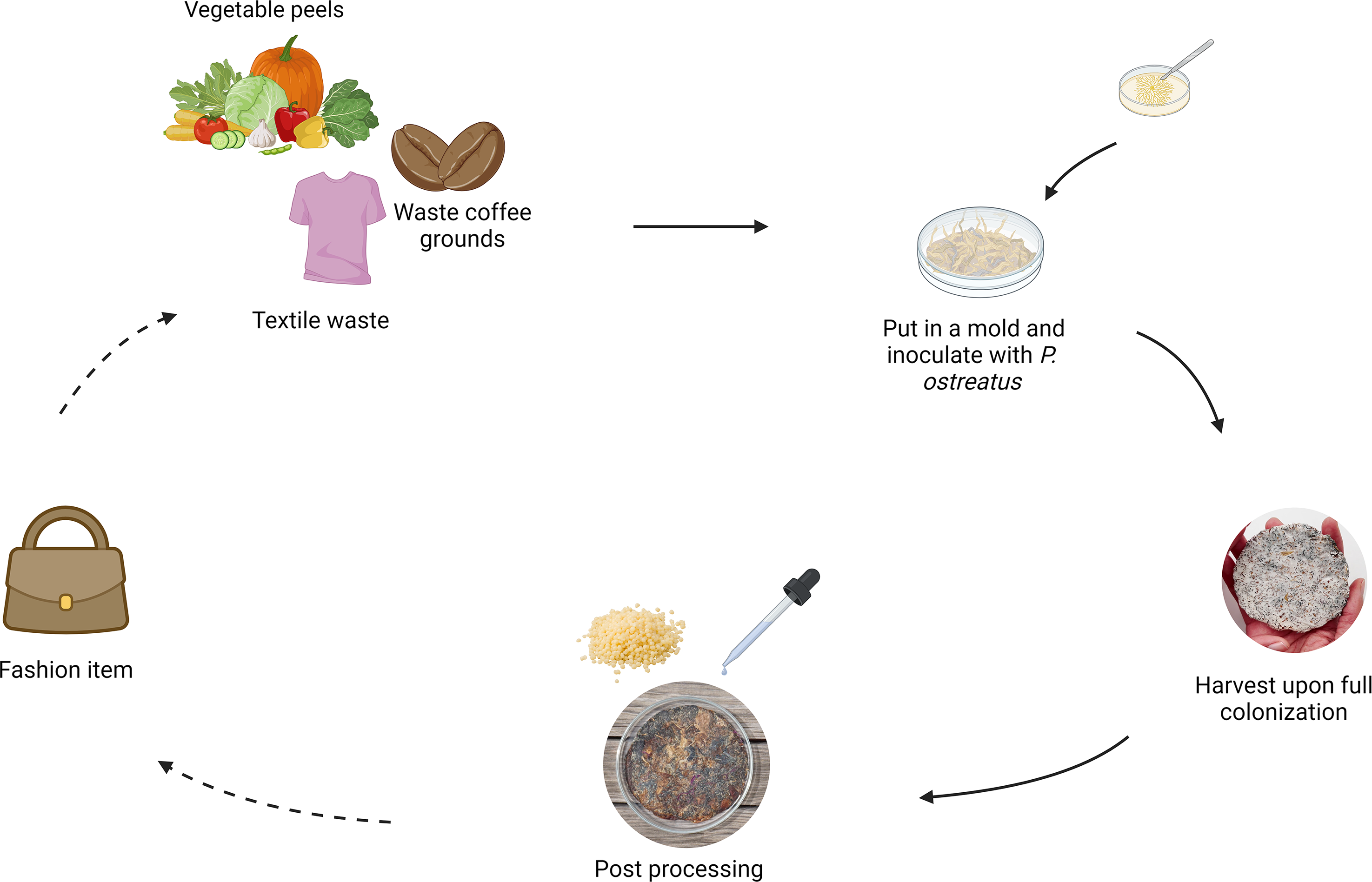
The fashion industry produces over 100 billion garments per year, of which 85% end up in landfill before the end of the year. Considering filamentous fungi are capable of biodegrading cellulose and complex molecules and of producing a wide range of biomaterials, an opportunity to rethink the linearity of the textile industry emerges. Biodegradation of various combinations of denim textile waste, synthetic textile waste, food waste and spent coffee grounds was investigated using Pleurotus ostreatus mycelium. The resulting composite material was tested for its use in material production. The outcomes of the study showed that Pleurotus ostreatus mycelium could successfully grow on all the combinations of food waste (vegetable peels and coffee grounds) with textile waste (synthetic textile and denim textile) and even on denim textile waste only. Provided the soft nature of the substrate, the textile and food waste mycelium composite is also malleable and therefore interesting for applications in the textile industry. A protocol for post-processing of the flexible composite material using low energy and natural components (heat, water, glycerol and wax) was created to transform the composite into a leather-like fungal material.
The design field encompasses aspects of culture and thought and, ultimately, can integrate other disciplines like biology and engineering. One of the potentials of biodesign is the replacement of current materials with more sustainable ones. Bacterial cellulose (BC) is a biopolymer that is produced by microorganisms such as Komagataeibacter spp. and has been recently explored for applications in fashion, architecture and material science receiving global media attention. In this impact paper, it is assessed the challenges of producing BC through an analysis of its production and chemistry. Through a critical analysis of applied case studies, it is argued that there is yet work to be done to allow the widespread use of BC. In conclusion, the increased understanding of the acetic acid bacteria genetic landscape and biochemistry will potentiate the education, research, development, manufacture and market implementation of more feasible and sustainable cellulose-based products.
The rediscovered potential of ‘growing’ instead of ‘making’ drives the emergence of new materialities. This is leading to innovative developments in biotechnologies and Biodesign, both of which are intricately connected and seen as transformative elements in the discourse on sustainability. Biofabricated materials are starting to be evaluated using established sustainability metrics such as life cycle assessment, highlighting their essential role in the circular economy and shedding light on some overlooked process-dependent environmental burdens. At the same time, some biodesigned materials and artefacts are characterised by their ability to transcend the conventional concept of sustainability, embracing the principles of Regenerative Design thanks to the restorative and regenerative potential of living and bioreceptive materials. The study explores the main Biodesign variables, presenting a taxonomy created to comprehensively understand the phenomenon. The resulting findings highlighted the dual nature of Biodesign, which promotes both inner and outer sustainability. These findings gave rise to a conceptual framework defined as ‘Healing Materialities’, developed by the authors to highlight the main Biodesign variables discussed while addressing a broad spectrum of ecological potentials, from conventional to regenerative sustainability. The article discusses the concept of ‘Healing Materialities’, emphasising the role of Biodesign in supporting a profound ecological turn and advocating the adoption of regenerative materials and processes capable of harmonising the long-term needs of both human and non-human entities.