To save content items to your account,
please confirm that you agree to abide by our usage policies.
If this is the first time you use this feature, you will be asked to authorise Cambridge Core to connect with your account.
Find out more about saving content to .
To save content items to your Kindle, first ensure no-reply@cambridge.org
is added to your Approved Personal Document E-mail List under your Personal Document Settings
on the Manage Your Content and Devices page of your Amazon account. Then enter the ‘name’ part
of your Kindle email address below.
Find out more about saving to your Kindle.
Note you can select to save to either the @free.kindle.com or @kindle.com variations.
‘@free.kindle.com’ emails are free but can only be saved to your device when it is connected to wi-fi.
‘@kindle.com’ emails can be delivered even when you are not connected to wi-fi, but note that service fees apply.
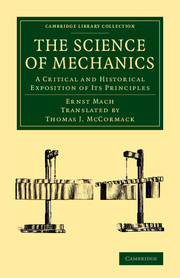
Ernst Mach (1838–1916), the first scientist to study objects moving faster than the speed of sound, propounded a scientific philosophy which called for a strict adherence to observable data. He maintained that the sole purpose of scientific study is to provide the simplest possible description of detectable phenomena. In this work, first published in German in 1883 and here translated in 1893 by Thomas J. McCormack (1865–1932) from the 1888 second edition, Mach begins with a historical discussion of mechanical principles. He then proceeds to a critique of Newton's concept of 'absolute' space and time, reflecting Mach's rejection of theoretical concepts in the absence of definitive evidence. Although historically controversial, Mach's ideas and attitudes informed philosophers as influential as Russell and Wittgenstein, and his insistence upon a 'relative' idea of space and time provided much of the philosophical basis for Einstein's theory of general relativity decades later.
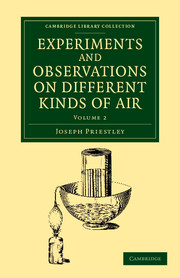
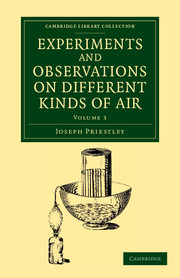
By the late eighteenth century, scientists had discovered certain types of gas, such as 'fixed air' (carbon dioxide), but their composition was little understood. Relatively few investigations into gases had taken place, and so the polymath Joseph Priestley (1733–1804) was able to make major breakthroughs in the field using a range of experimental techniques. While living near a brewery, he found that it was possible to outline the shape of the gas above fermenting beer with smoke, and that fire would burn with varying strength depending on the composition of the air. This three-volume collection first appeared between 1774 and 1777. Following the international interest and new discoveries prompted by the publication of its predecessor, Volume 2 - reissued here in its corrected 1776 second edition - includes accounts of further experiments, Priestley's paper on the conducting power of charcoal, and, most significantly, notes on what he calls 'dephlogisticated air' (oxygen).
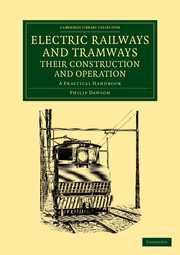
One of the world's leading electrical engineers and involved in projects across the globe, Sir Philip Dawson (1866–1938) was at the forefront of the new technology of electric locomotion. Published in 1897, less than twenty years after the first successful demonstration of an electric passenger locomotive and just seven years after the opening of London's first electrified underground line, this handbook covers all aspects of the building and running of a successful electric railway, ranging from the construction of the permanent way and different means of delivering current through to financial accounting, staff organisation and discipline. Impressed by the speed of American progress, Dawson is keen to impress upon his reader the need for Europe to keep up. With some 500 illustrations, this work offers a uniquely revealing picture of the earliest days of a technology that is now taken for granted.
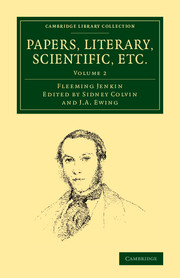
An electrical engineer, university teacher and wide-ranging writer, Fleeming Jenkin (1833–85) filed thirty-five British patents in the course of his career. Edited by Sidney Colvin (1845–1927) and J. A. Ewing (1855–1935) and first published in 1887, this two-volume work brings together a selection of Jenkin's varied and engaging papers. The collection ranges from notes on his voyages as a marine telegraph engineer, to a critical review of Darwin's On the Origin of Species, essays on literature, and thoughts on technical education. A memoir written by Robert Louis Stevenson, his former student, provides biographical context and attests to Jenkin's many interests and talents across the arts and sciences. Volume 2 includes Jenkin's papers on political economy, scientific education, and applied science, notably marine telegraphy. Abstracts of his scientific papers, along with a list of his patents, form an appendix to the volume.
By the late eighteenth century, scientists had discovered certain types of gas, such as 'fixed air' (carbon dioxide), but their composition was little understood. Relatively few investigations into gases had taken place, and so the polymath Joseph Priestley (1733–1804) was able to make major breakthroughs in the field using a range of experimental techniques. While living near a brewery, he found that it was possible to outline the shape of the gas above fermenting beer with smoke, and that fire would burn with varying strength depending on the composition of the air. This three-volume collection first appeared between 1774 and 1777. Primarily an account of Priestley's early experiments, with details of apparatus including candles and live mice, Volume 1 is reissued here in its corrected 1775 second edition and also incorporates a brief history of the field of inquiry.
Joseph Yelloly Watson (1817–88) produced this short work for private circulation in 1843. For many years a mining agent with the London firm of Watson and Cuell, he became a fellow of the Geological Society and wrote on mining and historical subjects. Drawing chiefly on data from Cornwall, the present work gives details of mining processes, the layout of mines, the working conditions of miners (including figures for wages and working hours), and the typical management structure of a mine, with information on shareholders, profits and accounting. The work includes coverage of individual mining districts, including Gwennap, Camborne, Illogan, St Just, St Ives and Marazion in Cornwall, along with discussion of mines in Devon, Cumberland and elsewhere. Concluding with notes on the history of metal mining, followed by a useful glossary of mining terms, this remains a concise and instructive resource on a significant economic sector in the nineteenth century.
The Austrian scientist Ernst Mach (1838–1916) carried out work of importance in many fields of enquiry, including physics, physiology, psychology and philosophy. Published in this English translation of 1906, these essays examine geometry from three different perspectives. Mach argues that, as our ideas about space are created by the senses and how we experience our environment, researchers must not consider the subject from a mathematical standpoint alone. In the first essay, he explains how humans generate spatial concepts. Next, he discusses the psychology of geometry, its empirical origins, and its development. In the final piece, he writes from the viewpoint of a physicist, outlining how various mathematicians, such as Carl Friedrich Gauss and Bernhard Riemann, have contributed to our geometrical understanding. Also reissued in this series in English translation are Mach's The Science of Mechanics (1893) and Popular Scientific Lectures (1895).
The mining engineer and petrologist Frederick Henry Hatch (1864–1932) left the Geological Survey of Great Britain in 1892, relocating to South Africa. He worked for De Beers and with John Hays Hammond for Cecil Rhodes, finding important new gold fields in Matabeleland and Mashonaland. Control of the gold mines was a significant factor in the tension between Dutch and English settlers that would result in the Second Boer War in 1899. Prior to this, Rhodes and Hammond were behind the abortive Jameson Raid, but Hatch had returned to England briefly and was not implicated. This 1895 work, written with South African mining engineer J. A. Chalmers, reveals the extent of gold reserves in the Transvaal, and the engineering skills needed to exploit them. It deals with geological, economic and legal aspects of the mining industry, remaining of interest to historians of South Africa and the British Empire.
Professor of natural philosophy at the Royal Institution between 1853 and 1887, the British physicist and mountaineer John Tyndall (1820–93) passionately sought to share scientific understanding with the Victorian public. A lucid and highly regarded communicator, he lectured on such topics as heat, light, magnetism and electricity. In this collection of eight lectures, first published in 1867, Tyndall explains numerous acoustic phenomena for a non-specialist audience. Emphasising the practical nature of scientific enquiry, he describes experiments throughout and includes many illustrations of laboratory equipment. The lectures discuss the general properties of sound, how it travels, how noise and music differ, how gas flames can produce musical notes, and much more. Several of Tyndall's other publications, from his work on radiant heat to his exploration of alpine glaciers, are also reissued in this series.
As early as the seventeenth century, scientists realised that a pendulum swings more slowly at the equator than it would at the North Pole. Newton predicted that gravity increased with latitude, and that the Earth could not be perfectly spherical. Although various experiments were undertaken to determine the exact degree of this ellipticity, none proved successful until physicist Edward Sabine (1788–1883) embarked on a series of expeditions across the world. Based on pendulum measurements from a wide range of latitudes, from Jamaica to Spitsbergen, his results were very different to mathematical predictions, and far more accurate; Charles Babbage would even complain that they were too good to be true. In this account, which first appeared in 1825, Sabine explains his methodology and presents his findings. His book opens a fascinating window into nineteenth-century geodesy for students in the history of science.
A respected hydraulic engineer, William Henry Wheeler (1832–1915) established himself as an authority in the fields of low-lying land reclamation and drainage, embanking, and the improvement of tidal rivers and harbours. Based on articles written for The Engineer in 1887, he published this more substantial work in 1888 to provide a practical point of reference for those working on existing drainage systems or designing and implementing new schemes. Drawing on first-hand knowledge of the low-lying fens of England and the polders of Holland, Wheeler describes the processes of drainage by gravitation and steam power. The book also includes chapters on lifting and draining water using the scoop wheel, the Archimedean screw pump and the centrifugal pump. Providing also a wealth of operational facts relating to pumping stations in England and abroad, this remains a rich source of information for those interested in the history of civil engineering.
Costing at the time £1.8 million to complete, the Severn Tunnel was a Victorian engineering triumph, and for over a century it remained the longest rail tunnel in Britain. Construction had begun in 1873 but came to a standstill after the workings were inundated by water in 1879. An accomplished civil engineering contractor, Thomas Andrew Walker (1828–89) had worked on railways in Canada, Russia and Africa as well as on London's new underground lines; he was therefore well qualified to complete the Severn Tunnel, which was achieved in 1886. First published in 1888, Walker's first-hand account of the problematic project remains an engaging source for railway and engineering historians, and its detailed account of the ground encountered will also interest geologists. Replete with plans and maps, reissued here is the second edition of 1890, the year following Walker's death, which is likely to have been hastened by overwork.
By the late eighteenth century, scientists had discovered certain types of gas, such as 'fixed air' (carbon dioxide), but their composition was little understood. Relatively few investigations into gases had taken place, and so the polymath Joseph Priestley (1733–1804) was able to make major breakthroughs in the field using a range of experimental techniques. While living near a brewery, he found that it was possible to outline the shape of the gas above fermenting beer with smoke, and that fire would burn with varying strength depending on the composition of the air. This three-volume collection first appeared between 1774 and 1777. Priestley acknowledges that Volume 3 (1777) would more greatly interest those with technical training in the physical sciences as compared with general scholars. It also highlights some new and important inferences, notably on the function of blood in respiration.
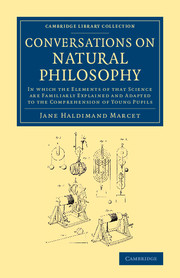
An author of educational works intended especially for young women, Jane Haldimand Marcet (1769–1858) sought to combat the notion that technical topics were unsuitable for female students. Inspired by conversations with the famous scientists she entertained, she wrote textbooks in the lively form of discussions between a teacher and her two female pupils. Published anonymously at first, they found broad popularity: Michael Faraday, as a young bookbinder's apprentice, credited Marcet with introducing him to electrochemistry. The present work, an introduction to physics, astronomy and the properties of matter, sound and light, was Marcet's first, though it remained unpublished until 1819. Her other works include Conversations on Chemistry (1805), Conversations on Political Economy (1816) and Conversations on Vegetable Physiology (1829), all of which are reissued in this series. Never professing to be original, Marcet's work is noted nonetheless for its thoroughness and clear presentation of concepts.
The American social historian and antiquarian Alice Morse Earle (1851–1911) published this lavishly illustrated book, among the last of her works, in 1902. By this time she had developed a distinctive style of historical writing which made innovative use of material evidence in its focus on the details of everyday life. She was particularly interested in family and society in colonial America, and her views about the importance of ancestry were reflected in her membership of the National Society of the Daughters of the American Revolution. Her fascination for beautiful things found lively expression in this learned and charming exploration of two 'garden delights'. Drawing readily on folklore, literature and anecdote, Earle brings to life her history of sundials and roses in Europe and America, touching on practical, aesthetic and symbolic aspects.
Being a Description of the Rivers Witham and Welland and their Estuary, and an Account of the Reclamation, Drainage, and Enclosure of the Fens Adjacent Thereto
A respected hydraulic engineer, William Henry Wheeler (1832–1915) established himself as an authority in the fields of low-lying land reclamation and drainage, embanking, and the improvement of tidal rivers and harbours. First published in 1868, Wheeler's historical work on the Fens of South Lincolnshire is reissued here in its much expanded second edition of 1896. It discusses in detail the reclamation of the fenland in the late eighteenth and early nineteenth centuries. The coverage includes a history of each of the districts, the Acts of Parliament involved, the pumping machinery used, the management of the highways and waterways, the agriculture and geology of the area, and the costs associated with the whole reclamation project. Another of Wheeler's works, The Drainage of Fens and Low Lands (1888), is also reissued in this series. The books remain a rich source of information for local historians and civil engineers.
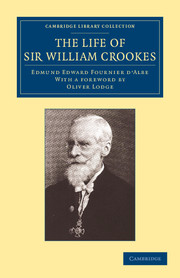
In 1870, Sir William Crookes (1832–1919) travelled to Gibraltar to observe the solar eclipse. He kept a diary and produced beautiful accounts of the expedition - alongside altogether more specific observations, including the 656 steps down a local cliff face, and every item in his luggage. It is with the same meticulous approach and cheerful prose that he records, in letters, journal articles and reports, the successes and failures of the vast range of projects in which he was involved. Although initially trained as a chemist, Crookes worked across the spectrum of the sciences, from consulting on preventative measures against cattle plague through to investigating spiritualism. Opening with a foreword by the physicist Sir Oliver Lodge, this biography by Edmund Edward Fournier d'Albe (1868–1933), first published in 1923, explores a remarkable life of enquiry through a host of first-hand sources.
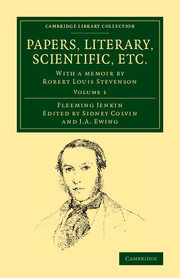
An electrical engineer, university teacher and wide-ranging writer, Fleeming Jenkin (1833–85) filed thirty-five British patents in the course of his career. Edited by Sidney Colvin (1845–1927) and J. A. Ewing (1855–1935) and first published in 1887, this two-volume work brings together a selection of Jenkin's varied and engaging papers. The collection ranges from notes on his voyages as a marine telegraph engineer, to a critical review of Darwin's On the Origin of Species, essays on literature, and thoughts on technical education. A memoir written by Robert Louis Stevenson, his former student, provides biographical context and attests to Jenkin's many interests and talents across the arts and sciences. Volume 1 begins with Stevenson's memoir, incorporating Jenkin's records of his voyages. This is followed by writings on literature and drama. Three pieces on scientific subjects, including the review of Darwin, conclude the volume.
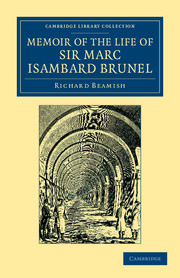
Abandoning a military career, Richard Beamish (1798–1873) decided to become a civil engineer. His suitability as a biographer of Sir Marc Isambard Brunel (1769–1849) stems from the period he spent working closely with the Brunels on the Thames Tunnel. Published in 1862, this memoir recounts the elder Brunel's eventful life and work, including his youth in France, his flight to America in the aftermath of the French Revolution, his lesser-known ventures in the early nineteenth century, and the tunnelling project which would consume much of the second half of his life. An informed portrait of a figure who has since been outshone by his more famous son, this book includes first-hand accounts of the ill-fated early attempt to build the Thames Tunnel, which was abandoned in 1828 due to flooding and lack of funds, and of Brunel's vindication upon its eventual completion in 1843.
Professor of natural philosophy at the Royal Institution between 1853 and 1887, the physicist and mountaineer John Tyndall (1820–93) passionately sought to share scientific understanding with the Victorian public. A lucid and highly regarded communicator, he lectured on such topics as heat, light, magnetism and electricity. In this collection of twelve lectures, first published in 1863, Tyndall discusses the general properties of heat and its associated physical processes, such as convection, conduction and radiation. He presents concepts so that they are intelligible to non-specialists, and helpful illustrations of laboratory equipment accompany his descriptions of experiments and phenomena. Throughout, he explains the research and discoveries of renowned scientists, including Sir Humphry Davy, Julius von Mayer, James Prescott Joule, and Hermann von Helmholtz. Several of Tyndall's other publications, from his lectures on sound to his exploration of alpine glaciers, are also reissued in this series.