To save content items to your account,
please confirm that you agree to abide by our usage policies.
If this is the first time you use this feature, you will be asked to authorise Cambridge Core to connect with your account.
Find out more about saving content to .
To save content items to your Kindle, first ensure no-reply@cambridge.org
is added to your Approved Personal Document E-mail List under your Personal Document Settings
on the Manage Your Content and Devices page of your Amazon account. Then enter the ‘name’ part
of your Kindle email address below.
Find out more about saving to your Kindle.
Note you can select to save to either the @free.kindle.com or @kindle.com variations.
‘@free.kindle.com’ emails are free but can only be saved to your device when it is connected to wi-fi.
‘@kindle.com’ emails can be delivered even when you are not connected to wi-fi, but note that service fees apply.
One of the great Victorian engineers, Sir William Fairbairn (1789–1874) had started his career as a millwright's apprentice, going on to become a civil engineer, a designer of industrial machinery and an expert on the failure of materials and structures. The present work distils a lifetime's experience of mechanical design into two highly illustrated parts. First published in 1861 and 1863, they are here reissued in a single volume. Part 1 gives a general overview of mechanisms such as gears, cranks and cams, and then moves on to the design of prime movers: waterwheels and turbines, steam engines and boilers, and windmills. Part 2 covers the design of mechanisms in more detail, and discusses power transmissions and their components: shafts, gears, bearings, couplings and so on. Lastly, Fairbairn gives overviews of the most important types of industrial mill - including cotton, wool, paper, iron and gunpowder - and their machinery.
After a brief career at sea, during which he tested Harrison's chronometer for the Board of Longitude, John Robison (1739–1805) became lecturer in chemistry at the University of Glasgow. In 1774, having spent a period teaching mathematics in Russia, he returned to Scotland as professor of natural philosophy at Edinburgh. Despite his busy schedule, he contributed major articles on the sciences to the Encyclopaedia Britannica, giving an overview of contemporary scientific knowledge for the educated layperson. After his death, these and other pieces of his scientific writing were edited by his former pupil David Brewster (1781–1868) and were finally published in four volumes in 1822, with a separate volume of illustrative plates. This reissue incorporates those plates in the relevant volumes of text. Volume 1 contains articles on dynamics and on the construction of roofs, arches and bridges, as well as a previously unpublished manuscript on projectile motion.
Two years after Thomas Edison patented his electric light bulb, the 1881 International Exposition of Electricity in Paris, featuring many spectacular lighting displays, showcased the potential of this technology for commercial and domestic use. The accompanying International Congress of Electricians also agreed on international standards for units of electrical resistance, potential and current. In its wake, James Dredge (1840–1906), editor of the British periodical Engineering, compiled this illustrated overview of electrical technology and its application to lighting. First published in two volumes between 1882 and 1885, and using material that had previously appeared in Engineering, as well as new articles by various contributors, this substantial work reflects the complexities and possibilities of a propitious technological development. Among other topics, Volume 1 covers electrical units, methods of generation, conductors, and various kinds of lamp. The appendices give abstracts of British electrical patents from 1837 to 1872.
Much of eastern England is below sea level, resulting in wide swathes of marshland that are easily flooded. In the seventeenth century, the Bedford Level Corporation was set up by Francis Russell, fourth earl of Bedford, in order to manage the drainage of the Great Level of the Fens, which became known as the Bedford Level and is the largest region of fenland in eastern England. Between 1828 and 1830, Samuel Wells, the corporation's registrar, published his well-documented history of the Bedford Level and the attempts made at various points to clear it of water using a variety of methods, from earthworks raised by the Romans to the strategies of Sir Cornelius Vermuyden and the eventual introduction of steam-powered technology. Volume 1, published in 1830, contains a historical account of the area and of the commission set up to address the perennial problem of flooding.
Born in Marseilles, Louis Simonin (1830–86) became a leading mining engineer of his age. He travelled widely on government and private commissions, particularly around the United States, where he was held in very high esteem. His posthumous renown rests primarily on this substantial work on mining, first published in 1867. The book is divided into three parts, dealing with coal mining, metal mining, and the mining of precious stones. It covers metallurgy and mineralogy, the history of mining, and techniques, methods and equipment. Bringing the struggles of miners to life, and enhanced by numerous illustrations by some of the leading engravers of the day, the book is regarded as having inspired and informed Émile Zola, whose great novel Germinal (1885) depicts coal miners' lives during a strike. Simonin's work reached a wide readership in his native France, and this English translation appeared in 1869.
As a Reference to Nichols, Priestley and Walker's New Map of Inland Navigation, Derived from Original and Parliamentary Documents in the Possession of Joseph Priestley, Esq.
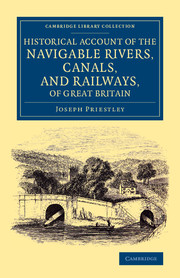
This account of the waterways and railways of Great Britain covers those transport routes and systems of inland navigation that had been completed or were in construction at the time of publication in 1831. Not to be confused with his polymath namesake, Joseph Priestley (1766–1852) entrenched his expertise as manager of the Aire and Calder Navigation. Here he provides alphabetical entries ranging from the Aberdare Canal in Glamorganshire to the Wyrley and Essington Canal in the Midlands. Details are given regarding location, construction, relevant Acts of Parliament, and even tonnage rates. Published to accompany a huge map of British inland navigation (a smaller version is featured here as the frontispiece), the book became a standard reference work in its day. Shedding light on the development of commercially crucial infrastructure, it remains valuable to readers and researchers interested in the history of British transport and technology.
Much of eastern England is below sea level, resulting in wide swathes of marshland that are easily flooded. In the seventeenth century, the Bedford Level Corporation was set up by Francis Russell, fourth earl of Bedford, in order to manage the drainage of the Great Level of the Fens, which became known as the Bedford Level and is the largest region of fenland in eastern England. Between 1828 and 1830, Samuel Wells, the corporation's registrar, published his well-documented history of the Bedford Level and the attempts made at various points to clear it of water using a variety of methods, from earthworks raised by the Romans to the strategies of Sir Cornelius Vermuyden and the eventual introduction of steam-powered technology. Volume 2, published in 1828, contains the necessary documents and appendices for the proper understanding of Volume 1, which appeared two years later.
Wherein the Principles on Which Roads Should Be Made Are Explained and Illustrated, by the Plans, Specifications, and Contracts Made Use of by Thomas Telford, Esq., on the Holyhead Road
The politician Sir Henry Parnell (1776–1842) was instrumental in drafting legislation to improve the important road linking London with Holyhead in Anglesey, a major port for communication with Dublin. He was aided by the pioneering civil engineer Thomas Telford, and in 1833 Parnell published the first edition of this thorough work on road construction and maintenance. Reissued here is the second edition of 1838. Drawing on his experiences with Telford, who called the work 'the most valuable Treatise which has appeared in England' on the subject, Parnell outlines not only the rules governing the planning of a new road, but also addresses the practical aspects of building and repairing roads, noting the various tools and materials needed. Parnell, later Baron Congleton, also highlights the connection between road construction and national development, and includes a number of appendices relating to contemporary legislation on the subject of roads.
Published in 1832, this was the first English textbook dedicated to the topic of suspension bridges in Britain and continental Europe. Having assisted the naval officer and civil engineer Samuel Brown in preparing plans for the Clifton Suspension Bridge, Charles Stewart Drewry (1805–81) used information supplied directly by his engineering contemporaries to give an overview of the principles and challenges involved in the construction of suspension bridges. A key reference for the early history of this type of structure, the book discusses various methods and materials, ranging across rope, wood, chain and wire. Details regarding experiments on the strength of iron bars and wires are also given. Enhanced by lithographic plates and woodcut illustrations, the work is notable for its discussion of many examples of important bridges, such as Thomas Telford's Menai Suspension Bridge and the first such construction over the Thames at Hammersmith, as well as designs from overseas.
This concise, plain-language guide for senior undergraduates and graduate students aims to develop intuition, practical skills and an understanding of the framework of numerical methods for the physical sciences and engineering. It provides accessible self-contained explanations of mathematical principles, avoiding intimidating formal proofs. Worked examples and targeted exercises enable the student to master the realities of using numerical techniques for common needs such as solution of ordinary and partial differential equations, fitting experimental data, and simulation using particle and Monte Carlo methods. Topics are carefully selected and structured to build understanding, and illustrate key principles such as: accuracy, stability, order of convergence, iterative refinement, and computational effort estimation. Enrichment sections and in-depth footnotes form a springboard to more advanced material and provide additional background. Whether used for self-study, or as the basis of an accelerated introductory class, this compact textbook provides a thorough grounding in computational physics and engineering.
So far in our discussion of multidimensional problems we have been focussing on continuum fluids governed by partial differential equations. Despite the fact that treating fluids as continua seems entirely natural, and gives remarkably accurate representation in many cases, we know that fluids in nature are not continuous. They are made up of individual molecules. A continuum representation is expected to work well only when the molecules experience collisions on a time and space scale much shorter than those of interest to our situation. By contrast, when the collision mean-free-path is either an important part of the problem, as it is, for example, when calculating the viscosity of a fluid, or when the collision mean-free-path (or time) is long compared with the typical scales of the problem, as it is for very dilute gases and for many plasmas, a fluid treatment cannot cope. We then need to represent the discrete molecular nature of the substance as well as its collective behavior.
Even so, it is unrealistic in most problems to suppose that we can follow the detailed dynamics of each individual molecule. There are p/kT = 105 (Pa)/ [1.38 × 10⁻²³ (J/K) × 273(K)] = 2.65 × 1025 molecules, for example, in a cubic meter of gas at atmospheric pressure and 0°C temperature (STP). Even computers of the distant future are not going to track every particle in such an assembly. Instead, a statistical description is used. The treatment is common to many different types of particles. The particles under consideration might be neutrons in a fission reactor, neutral molecules of a gas, electrons of a plasma, and so on.
The distribution function
Consider a volume element, small compared with the size of the problem but still large enough to contain very many particles. The element is cuboidal d3x = dx.dy.dz with sides dx, see Fig. 8.1. It is located at the position x. We want a sufficient description of the average properties of the particles in this element.
So far we have been focussing on how particle codes work once the particles are launched. We've talked about how they are moved, and how self-consistent forces on them are calculated. What we have not addressed is how they are launched in an appropriate way in the first place, and how particles are reinjected into a simulation. We've also not explained how one decides statistically whether a collision has taken place to any particle and how one would then decide what scattering angle the collision corresponds to. All of this must be determined in computational physics and engineering by the use of random numbers and statistical distributions. Techniques based on random numbers are called by the name of the famous casino at Monte Carlo.
Probability and statistics
11.1.1 Probability and probability distribution
Probability, in the mathematically precise sense, is an idealization of the repetition of a measurement, or a sample, or some other test. The result in each individual case is supposed to be unpredictable to some extent, but the repeated tests show some average trends that it is the job of probability to represent. So, for example, the single toss of a coin gives an unpredictable result: heads or tails; but the repeated toss of a (fair) coin gives on average equal numbers of heads and tails. Probability theory describes that regularity by saying the probability of heads and tails is equal. Generally, the probability of a particular class of outcomes (e.g. heads) is defined as the fraction of the outcomes, in a very large number of tests, that are in the particular class. For a fair coin toss, the probability of heads is the fraction of outcomes of a large number of tosses that is heads, 0.5. For a six-sided die, the probability of getting any particular value, say 1, is the fraction of rolls that come up 1, in a very large number of tests.