To save content items to your account,
please confirm that you agree to abide by our usage policies.
If this is the first time you use this feature, you will be asked to authorise Cambridge Core to connect with your account.
Find out more about saving content to .
To save content items to your Kindle, first ensure no-reply@cambridge.org
is added to your Approved Personal Document E-mail List under your Personal Document Settings
on the Manage Your Content and Devices page of your Amazon account. Then enter the ‘name’ part
of your Kindle email address below.
Find out more about saving to your Kindle.
Note you can select to save to either the @free.kindle.com or @kindle.com variations.
‘@free.kindle.com’ emails are free but can only be saved to your device when it is connected to wi-fi.
‘@kindle.com’ emails can be delivered even when you are not connected to wi-fi, but note that service fees apply.
After a brief career at sea, during which he tested Harrison's chronometer for the Board of Longitude, John Robison (1739–1805) became lecturer in chemistry at the University of Glasgow. In 1774, having spent a period teaching mathematics in Russia, he returned to Scotland as professor of natural philosophy at Edinburgh. Despite his busy schedule, he contributed major articles on the sciences to the Encyclopaedia Britannica, giving an overview of contemporary scientific knowledge for the educated layperson. After his death, these and other pieces of his scientific writing were edited by his former pupil David Brewster (1781–1868) and were finally published in four volumes in 1822, with a separate volume of illustrative plates. This reissue incorporates those plates in the relevant volumes of text. Volume 3 reprints Robison's large treatise on astronomy, based on his university lectures, as well as his articles on telescopes and pneumatics.
From the 1770s onwards, John Banks (1740–1805) taught natural philosophy and gave courses of public lectures across the north west of England. Much of his work aimed to show engineers, mechanics and artisans how they could benefit from expanding their practical and theoretical knowledge. In this 1803 publication, Banks ranges across mechanics, hydraulics and the strength of materials. He considers various designs for important industrial machines, such as watermills, pumps and steam engines, offering calculations of their power. Drawing on his own experiments, as well as those of others, he shows readers how to estimate the strength of wooden and iron beams, and how to calculate the airflow from a pair of bellows. Diverse in its topics, the book sheds light on how rational calculation came to be applied to the machinery of the industrial revolution. Banks' Treatise on Mills (2nd edition, 1815) is also reissued in this series.
Officially opened in 1682, the Canal du Midi, designed and built by the engineers Pierre-Paul Riquet and François Andréossy, stretched from Toulouse to the Mediterranean. The present work was written by Andréossy's descendant, Antoine-François Andréossy (1761–1828), a French general and diplomat. A member of the Académie des Sciences, he analyses here the terrain of the south of France to show how and why the canal was built. Notably, the work became known for the author's argument that Riquet had usurped the glory that really belonged to his ancestor. Concluding with original documents from the period of the canal's construction, along with an appendix giving details on the canal's route, the book is reissued here in its first edition of 1800. A second edition appeared in 1804, and a third edition was begun but never completed.
From the 1770s onwards, John Banks (1740–1805) lectured on natural philosophy across the north-west of England. Much of his work aimed to show engineers, mechanics and artisans how they could benefit from expanding their theoretical knowledge. First published in 1795, and reissued here in its 1815 second edition, this work shows how to calculate the power limits of waterwheels, millstones and other commercially important machines. In the author's words, a key aim is to avoid wasted effort 'in attempting what men of science know to be impossible'. Starting with the mechanics of circular motion, he leads the reader step by step through a series of worked problems, showing the theory's practical applications. He then moves on to his experiments on the flow of water, and uses his results to better analyse the various types of waterwheel. Banks' On the Power of Machines (1803) is also reissued in this series.
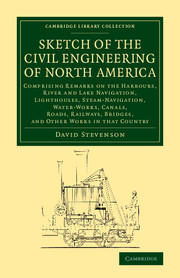
Comprising Remarks on the Harbours, River and Lake Navigation, Lighthouses, Steam-Navigation, Water-Works, Canals, Roads, Railways, Bridges, and Other Works in that Country
A distinguished civil engineer, David Stevenson (1815–86) continued his father's work of designing and building lighthouses around the coast of his native Scotland. His three-month tour of the United States and Canada in 1837 resulted in this highly detailed and unprecedented survey, first published in 1838. Stevenson covers a large number of engineering works, ranging from lighthouses and canals through to roads, bridges and railways. Notably, Stevenson's praise for North America's faster and sleeker steam vessels led British shipbuilders to emulate the models he describes and illustrates in this text. The work remains a historically valuable assessment of the continent's infrastructure at a time of great industrial expansion. Stevenson's The Principles and Practice of Canal and River Engineering, 2nd edition (1872) and his Life of Robert Stevenson (1878), a biography of his father, are also reissued in this series.
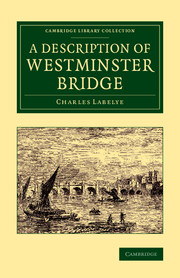
The construction of the first Westminster Bridge, upon which Wordsworth composed his famous sonnet, presented many challenges in terms of the materials and methods with which a sturdy bridge could be built in tidal water and on a gravelly riverbed. A number of candidates presented their surveys to the commissioners of the bridge, but it was the Swiss-born Charles Labelye (1705–62) who was appointed to oversee construction in 1738. The bridge opened to traffic in 1750. This 1751 publication expands upon the shorter work that Labelye had prepared in 1739 to address the laying of the foundations. Significantly, he used caissons - vast wooden structures sunk into the riverbed - within which the stone piers were built. Although the promised illustrations did not appear in this work, the book provides a valuable insight into the technical problems of a major engineering project, and the solutions available at that time.
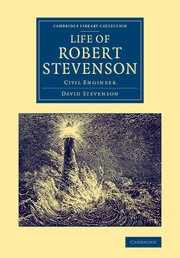
Published in 1878, this biography of the civil engineer Robert Stevenson (1772–1850) was written by his second-youngest son David (1815–86), also a civil engineer and uncle to the author Robert Louis Stevenson. Having already published The Principles and Practice of Canal and River Engineering in 1872 (also reissued in this series), he set about writing this survey of his father's life and works, based on extracts from Robert's professional reports, notes from his diary, and communications to scientific journals and societies between 1798 and 1843. Perhaps most widely known for his practical and persuasive leadership in building many lighthouses for the Northern Lighthouse Board - including that on the notorious Bell Rock, over which he came into conflict with engineer John Rennie regarding the design - Stevenson ensured that the Scottish coastline became a much safer place for shipping for decades to come.
The Setting Out of the Works, Shaft-Sinking and Heading-Driving, Ranging the Lines and Levelling under Ground, Sub-Excavating, Timbering, and the Construction of the Brickwork of Tunnels
The engineer and technical writer Frederick Walter Simms (1803–65) ranked as a leading authority on tunnel construction for railways. After working for a time at the Royal Observatory, Simms assisted Henry Robinson Palmer and later Sir William Cubitt on the South Eastern Railway. He was awarded the Telford medal by the Institution of Civil Engineers in 1842 for his articles on tunnelling, and further employment on railways in England and France was followed by engineering consultancies to the East India Company and the London, Chatham and Dover Railway. He gained greatest recognition, however, as the author of authoritative engineering textbooks, notably this work, first published in 1844. Considered the standard textbook on the subject at the time, it sets out the approved practices of the day, using the Bletchingley and Saltwood tunnels, whose construction Simms supervised, as key examples. A number of technical illustrations accompany the text.
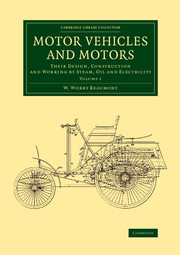
'Cheap or rapid or convenient road transport for man and goods is one of the most important of all contributions to national comfort and prosperity.' An early evangelist for the automobile, William Worby Beaumont (1848–1929) drew on his engineering background to produce the first volume of this work in 1900, when motor vehicles were still relatively new to British roads. Rapid developments in the automotive industry prompted the publication of a second volume in 1906. Replete with technical drawings and photographs, the work describes in great detail the design, construction and operation of the earliest motor vehicles, including those powered by steam, electricity and fuels derived from oil. Volume 1 traces the development of the automobile, from various attempts to produce steam vehicles light enough to run on roads through to the advances of Daimler and Benz. It also includes an overview of attempts to harness electrical power to propel road vehicles.
Containing an Explanation of the Terms, and an Account of the Several Subjects, Comprized under the Heads Mathematics, Astronomy, and Philosophy, Both Natural and Experimental
Born into a Newcastle coal mining family, Charles Hutton (1737–1823) displayed mathematical ability from an early age. He rose to become professor of mathematics at the Royal Military Academy and foreign secretary of the Royal Society. First published in 1795–6, this two-volume illustrated encyclopaedia aimed to supplement the great generalist reference works of the Enlightenment by focusing on philosophical and mathematical subjects; the coverage ranges across mathematics, astronomy, natural philosophy and engineering. Almost a century old, the last comparable reference work in English was John Harris' Lexicon Technicum. Hutton's work contains many historical and biographical entries, often with bibliographies, including many for continental analytical mathematicians who would have been relatively unfamiliar to British readers. These features make Hutton's Dictionary a particularly valuable record of eighteenth-century science and mathematics. Volume 2 ranges from kalendar to zone. Among the other topics covered are knots, Newton, magnets, and the Moon.
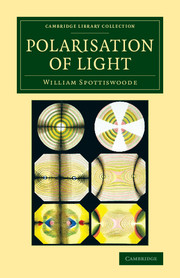
Before his untimely death from typhoid, William Spottiswoode (1825–83) had served as president of the London Mathematical Society, the British Association, and the Royal Society. In addition to publishing widely in mathematics and the experimental physical sciences, he restored the fortunes of his family printing firm, Eyre and Spottiswoode, the Queen's printers. An enthusiast for the popularisation of science, he lectured to large audiences at the Royal Institution, the South Kensington College of Science, and at British Association meetings. He also gave scientific talks at the school set up for the employees of his family firm. This illustrated 1874 work is based on these talks, and provides an introduction to 'this beautiful branch of optics'. Spottiswoode covers methods of polarisation, and the contemporary theory accounting for these effects. He describes various experiments, and explains how polarisation causes patterns and colours to appear in light.
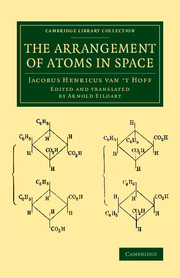
Awarded the first Nobel Prize in Chemistry in 1901 for his work on chemical dynamics and on osmotic pressure in solutions, the Dutch scientist Jacobus Henricus van 't Hoff (1852–1911) was also a pioneer in the field of stereochemistry - the three-dimensional analysis of chemical structures. This 1898 publication is based on the revised and expanded German translation of his Dix années dans l'histoire d'une théorie (1887), itself an updated version of his major work La chimie dans l'espace (1875). Translated and edited by the English chemist Arnold Eiloart, it covers the stereochemistry of carbon and nitrogen compounds, and contains an appendix on inorganic compounds by the Swiss chemist Alfred Werner (another future recipient of the Nobel Prize in Chemistry). Using experimental results, van 't Hoff shows how the varying spatial arrangement of similar compounds leads to differing chemical and optical behaviour.
First published in 1892, this important work by the mathematician Karl Pearson (1857–1936) presents a thoroughly positivist account of the nature of science. Pearson claims that 'the scientific method is the sole gateway to the whole region of knowledge', rejecting additional fields of inquiry such as metaphysics. He also emphasises that science can, and should, describe only the 'how' of phenomena and never the 'why'. A scholar of King's College, Cambridge, and later a professor at King's College and University College London, Pearson made significant contributions to the philosophy of science. Including helpful chapter summaries, this book explores in detail a number of scientific concepts, such as matter, energy, space and time. The work influenced such thinkers as Albert Einstein, who considered it to be essential reading when he created his study group, the Olympia Academy, at the age of twenty-three.
'Cheap or rapid or convenient road transport for man and goods is one of the most important of all contributions to national comfort and prosperity.' An early evangelist for the automobile, William Worby Beaumont (1848–1929) drew on his engineering background to produce the first volume of this work in 1900, when motor vehicles were still relatively new to British roads. Rapid developments in the automotive industry prompted the publication of a second volume in 1906. Replete with technical drawings and photographs, the work describes in great detail the design, construction and operation of the earliest motor vehicles, including those powered by steam, electricity and fuels derived from oil. Volume 2 describes the advances made both in the technological development of automobiles and in the volume produced. Detailed descriptions and illustrations are provided for the leading examples of the time from manufacturers such as Renault, Cadillac, Daimler and Wolseley.
The Scottish mathematician and natural philosopher Sir John Leslie (1766–1832) had set out at the end of the eighteenth century to explore the nature of heat radiation, which he felt was a 'dubious and neglected' area of physics. Leslie's inquiry, published in 1804, details his many experiments, notably the use of two self-devised instruments: Leslie's cube and his differential thermometer. Establishing several basic laws of heat radiation and rejuvenating the debate about the physical composition of heat, Leslie's work gained him the Rumford medal of the Royal Society in 1805. Nevertheless, the same publication jeopardised his chances of obtaining an academic position at Edinburgh. A single, allegedly atheistic endnote, supporting David Hume's views on causation, prompted protests by the local clergymen when his candidature for the chair of mathematics was under consideration. Leslie secured the professorship, however, and remained with the university until his death.
In 1876 the South Kensington Museum held a major international exhibition of scientific instruments and equipment, both historical and contemporary. Many of the items eventually formed the basis of collections now held at London's Science Museum. In May 1876, organisers arranged a series of conferences at which leading British and European scientists explained and demonstrated some of the items on display. The purpose was to emphasise the exhibition's goal not merely to preserve archaic treasures (such as Galileo's telescopes or Janssen's microscope) but to juxtapose them with current technology and so inspire future scientific developments. Volume 2 of the proceedings covers chemistry, biology, and earth sciences including geology, mining, meteorology and hydrography. The contributors include Joseph Dalton Hooker, William Thiselton-Dyer, Andrew Crombie Ramsay and John Rae, all of whom have other works reissued in the Cambridge Library Collection, which also includes the full catalogue of the exhibition itself.
The amateur scientist George John Singer (1786–1817) worked in the family business of artificial flower and feather making, but all his spare time was absorbed in the study of electricity and electromagnetism. He invented his own apparatus, including a gold-leaf electrometer, and built a laboratory-cum-lecture room at the back of his house: his public demonstrations were attended by Faraday and Francis Ronalds, and he was also a friend of the pioneering 'electrician' Andrew Crosse. This significant book, published in 1814, demonstrates the breadth of Singer's knowledge of his subject and of other contemporary work in the field. It describes in detail electric phenomena, in nature and in the laboratory, covering a wide range of experiments with and applications of electricity, and discussing the work of Franklin, Volta, Crosse and Dalton, among others. Sadly, Singer's promising scientific career was brought to an early end by tuberculosis: he died aged only thirty-one.
Clerk of works to an aristocratic landowner, Thomas Potter possessed considerable practical experience when he published this work in 1877. His intention was to provide a source of helpful information relating to a building material that was being increasingly used in Victorian construction, yet not without detractors, who objected on aesthetic as well as technical grounds. Clearly enthusiastic about concrete's potential applications, Potter seeks to give a balanced assessment of its usefulness and versatility. While the text does not discuss the chemical processes involved, it does cover aggregates, matrices, how to mix the two, the apparatus needed, the construction of walls, floors and roofs, and the costs and disadvantages of using concrete. The book also features several contemporary advertisements, including one for 'Potter's Concrete Building Apparatus and Appliances'. Of related interest, Charles William Pasley's Observations on Limes, Calcareous Cements, Mortars, Stuccos, and Concrete (1838) is also reissued in this series.
Professor of civil engineering at University College London, Leveson Francis Vernon-Harcourt (1839–1907) drew on considerable practical experience, having worked most notably on London's East and West India docks. The present work was first published in two volumes in 1885. This reissue combines in one volume the text and the plates, including plans and maps of important examples. The topics discussed include natural and artificial harbours; the impact of waves, tides and currents; and general principles of construction. Furthering Vernon-Harcourt's aim to educate readers on both the theory and practice of hydraulic engineering, the work features case studies on specific projects (including their origins and condition at that time), shedding much light on the history and operation of infrastructure that proved essential for the development of modern trade. Of related interest, Thomas Stevenson's The Design and Construction of Harbours (second edition, 1874) is also reissued in this series.
In the 1840s, the civil engineer Peter Bruff (1812–1900) designed what was then the largest brick structure in Britain, the 1,000-foot-long Chappel Viaduct in Essex. He went on to become a railway entrepreneur and developer, and was responsible for the creation of the resort town Clacton-on-Sea, where he also designed many of the buildings. In this illustrated guide, first published in 1838 and here reissued in the revised and expanded two-volume second edition of 1840–2, he discusses the theory and practice of surveying (calculating the accurate position of points in the landscape) and levelling (calculating the accurate height of points). Volume 2 covers levelling; Bruff gives a brief overview of the theory, then describes the typical equipment used. By discussing such examples as the levelling of a projected railway route, he explains what information should be recorded, and how to avoid common errors of technique that affect accuracy.