To save content items to your account,
please confirm that you agree to abide by our usage policies.
If this is the first time you use this feature, you will be asked to authorise Cambridge Core to connect with your account.
Find out more about saving content to .
To save content items to your Kindle, first ensure no-reply@cambridge.org
is added to your Approved Personal Document E-mail List under your Personal Document Settings
on the Manage Your Content and Devices page of your Amazon account. Then enter the ‘name’ part
of your Kindle email address below.
Find out more about saving to your Kindle.
Note you can select to save to either the @free.kindle.com or @kindle.com variations.
‘@free.kindle.com’ emails are free but can only be saved to your device when it is connected to wi-fi.
‘@kindle.com’ emails can be delivered even when you are not connected to wi-fi, but note that service fees apply.
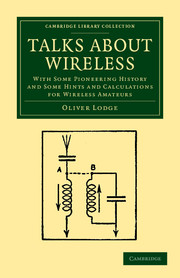
In the 1860s, radio waves were predicted by James Clerk Maxwell in his work on electromagnetism. It took a further twenty years for the first experiments to produce a working demonstration. In this guide to radio technology, first published in 1925, eminent physicist Sir Oliver Lodge (1851–1940) provides a concise history of the development of the wireless radio, explains the theory behind it, and includes some practical tips for amateurs. Having lived through and contributed to the discovery, he explains the difficulty of the early experiments, which took place in a time when terms like 'frequency' and 'inductance', now taken for granted, did not exist in the scientific vocabulary. His first-hand account reveals the incredible efforts poured into the development of a revolutionary modern technology, rekindling the sense of wonder that once surrounded this strange new science.
William Thomson, first Baron Kelvin (1824–1907), is best known for devising the Kelvin scale of absolute temperature and for his work on the first and second laws of thermodynamics, though throughout his 53-year career as a mathematical physicist and engineer at the University of Glasgow he investigated a wide range of scientific questions in areas ranging from geology to transatlantic telegraph cables. The extent of his work is revealed in the six volumes of his Mathematical and Physical Papers, published from 1882 until 1911, consisting of articles that appeared in scientific periodicals from 1841 onwards. Volume 3, published in 1890, includes articles from the period 1858–1890, the majority of which relate to questions around elasticity and heat, and are accompanied by extensive appendices.
The Austrian physicist Ludwig Eduard Boltzmann (1844–1906), educated at the University of Vienna, was appointed professor of mathematical physics at the University of Graz in 1869 at the age of only twenty-five. Boltzmann did important work in the fields of statistical mechanics and statistical thermodynamics; for instance, he contributed to the kinetic theory concerned with molecular speeds in gas. Boltzmann also promoted atomic theory, which at the time was still highly controversial. He was a member of the Imperial Austrian Academy of Sciences from 1885 and became a member of the Royal Swedish Academy of Sciences in 1888. This three-volume work, prepared in 1909 by the physicist Fritz Hasenöhrl, one of Boltzmann's students, comprises all his academic publications from 1865 to 1905. Volume 2 contains work from 1875 to 1881 on the thermal conduction of gases, the mechanic theory of heat and its problems, and the friction of gas.
James Croll (1821–90) was self-educated, but on gaining a post at the Glagow Andersonian Museum had the time to explore his academic interests. Despite his lack of formal training, he quickly became a leading light of the Scottish Royal Geological Society. Using physics, mathematics, geology and geography he explored the pressing scientific questions of the time. In this, his final book, published in 1889, Croll divides his focus between 'the probable origin of meteorites, comets and nebulae', the age of the sun and the impact of the pre-nebular condition of the universe on star evolution. Using both proven facts and theories, Croll explores the ideas and hypotheses then current, frequently crediting colleagues for their work, and building on it. Croll, who from humble beginnings became a Fellow of The Royal Society and of St Andrew's University, writes in a style which makes his works accessible to a lay readership.
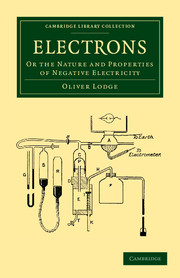
The discovery in 1897 of the electron, the first subatomic particle, led to rapid advances in our knowledge of atomic structure, the solid state, radioactivity and chemistry. It also raised major questions. Was the electron point-like or did it have structure? Was there a positive electron? What did the positive part of the atom look like? Did a hydrogen atom have one electron or a thousand? Published in 1906, this expository account by leading physicist Sir Oliver Lodge (1851–1940) examines the spectacular phenomena of cathode rays in evacuated tubes, the fixed units of charge observed in electrolysis, and the puzzling regularities in atomic spectra. Lodge knew most of the pioneers in the field, and his enthusiastic descriptions of their work and clear analyses of the problems as well as successes paint a vivid picture of the excitement of cutting-edge research and the scientific process in action.
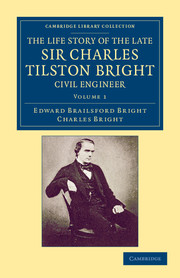
Sir Charles Tilston Bright (1832–88) was a renowned telegraph engineer, best known for his role in laying the first successful transatlantic cable in 1858, for which he was knighted. Bright later worked on the telegraph networks that would span not only the British Empire but the entire globe. Written by his brother Edward Brailsford Bright (1831–1913) and son Charles (1863–1937), both telegraph engineers who worked alongside him, this two-volume biography, first published in 1898, would do much to cement Bright's reputation as an electrical engineer, providing an insider account of telegraphy's formative years. Volume 2 traces Bright's work on the burgeoning telegraph network, laying imperial cables to the Mediterranean, India, the West Indies, and further afield. Bright's significant contributions to the field of electrical engineering are also acknowledged in these pages, along with his personal qualities and political pursuits.
In 1889, a year after both he and Heinrich Hertz discovered electromagnetic waves and for the first time demonstrated the truth of Maxwell's great theory of the electromagnetic field, physicist Oliver Lodge (1851–1940) published his deepest reflections on the nature and meaning of electricity, how it originates, and its different manifestations. There had been great scientific advances - the work of Faraday and Maxwell, his own experiments and those of Hertz - and a revolution in technology. There were also puzzling questions. What is the connection between electricity and the ether that occupies space? How does electricity manifest itself in matter? Why does it come in fixed units? The discovery of the electron eight years later would offer crucial answers. Always lucid and direct, with a gift for making the difficult seem simple, Lodge engages the reader with his fascination for the subject, much as he did in his famous lectures.
Robert Fitzroy (1805–65) is best remembered as the commander of HMS Beagle who took on Charles Darwin as the Ship's naturalist, but his most important scientific contribution was probably the establishment of the Meteorological Office in 1854. Convinced that falling barometric pressure was an indicator of storms, he had barometers set up at ports around the coast, so that boats would be aware of impending bad weather, and later had reports telegraphed to his office in London for collation; he invented the term 'forecasting the weather'. This work, published in 1863, gives an account of observations by himself and others, experiments, and proposals for future developments. Almost unbelievably, the Government declared that Fitzroy was exceeding his remit: he was instructed to restrict himself to collecting data, and it is believed that the depression he suffered at this setback was one of the factors which led to his suicide in 1865.
By the late nineteenth century, twenty-nine Chinese ports were open for foreign trade. Often run by foreign commissioners and no longer subject to the stringent local laws, these ports levied one of the smallest import taxes in the world, and Chinese commerce therefore exploded. Originally published in 1900, this account by William Barclay Parsons (1859–1932) investigates the ensuing surge of economic and industrial development in the eastern provinces. Including an introduction to China's history and the structure of its civil service, the book analyses the corrupt but ingenious world of customs officials, the importance of American cotton interests, and export statistics which reveal the multimillion-dollar smuggling operations that slipped around official embargoes. Set against a backdrop of electric lights and western labels in even the most closed of cities, this book offers a fascinating glimpse into the early stages of today's global market.
This first book by James Croll (1821–90), published in 1875, includes many of the original geophysical theories that he had formulated throughout the early years of his career. A self-educated amateur, Croll obtained work at the Glasgow Andersonian Museum, which gave him leisure time to pursue his scientific interests. The fluidity of scientific disciplines at the time allowed him to virtually invent the field of geophysics, and his unique insights united ideas previously thought unconnected, such as using physics to explore the causes of the glacial epochs, climatic changes and the circulation and temperature of ocean currents. Croll, whose Stellar Evolution and its Relations to Geological Time is also reissued in this series, later became a Fellow of the Royal Society and of St Andrew's University, but (possibly because of his non-scientific background) he writes in a style which makes his works accessible to a lay readership.
Sir Oliver Lodge (1851–1940) was a physicist instrumental in the discovery of electromagnetic waves: the basis of today's radio and X-ray technology. He came from humble beginnings. After suffering at the hands of violent masters and schoolmates during his childhood, Lodge went on to teach physics and chemistry to young women at Bedford College in London. Later, he was appointed professor of physics at the University of Liverpool, and became known for his public lectures on a vast range of topics, from the comic faults of phonographs to the medical applications of X-rays. Whether seeing the cells of a voltaic battery in a pile of plates or appreciating the enunciation of Alexander Graham Bell, Lodge had a warm enthusiasm that shines through in this touching autobiography, first published in 1931. It remains ideal for general readers as well as students in the history of science.
Published between 1839 and 1852, this two-volume work records the contribution of William Scoresby (1789–1857) to magnetic science, a field he considered one of 'grandeur'. The result of laborious investigations into magnetism and (with James Prescott Joule) electromagnetism, Scoresby's work was particularly concerned with improving the accuracy of ships' compasses. A whaler, scientist and clergyman, he epitomised the contribution which could be made to exploration and science by provincial merchant mariners - men often less celebrated than their counterparts in the Royal Navy or in metropolitan learned societies. In addition to his pioneering work on magnetic science, Scoresby furthered knowledge of Arctic meteorology, oceanography and geography. Volume 2 records Scoresby's investigations into the problem of navigating on iron-built ships, the section on shipwrecks proving just how pressing this was.
A Treatise on the Protection of Buildings, of Telegraph Instruments and Submarine Cables, and of Electrical Installations Generally, from Damage by Atmospheric Discharges
As a result of being asked to give public lectures on the subject, the eminent physicist Oliver Lodge (1851–1940) published in 1892 a pioneering study of the protection of buildings, cables and telegraphic instruments from the devastation caused by lightning strikes. This work led him almost immediately to the discovery of electromagnetic wave transmission and ultimately to the development of a version of radio telegraphy. Lodge also saw that many of the current theories about the nature of lightning were seriously in error, and his investigations led to a number of significant changes in the design of lightning conductors and lightning guards. Some of the methods and procedures that Lodge advocated have since become standard practice. They are described with Lodge's characteristic flair and accompanied by a wealth of illustrations that give a fascinating insight into how contemporary scientists and engineers tackled this significant problem.
Sir Charles Tilston Bright (1832–88) was a renowned telegraph engineer, best known for his role in laying the first successful transatlantic cable in 1858, for which he was knighted. Bright later worked on the telegraph networks that would span not only the British Empire but the entire globe. Written by his brother Edward Brailsford Bright (1831–1913) and son Charles (1863–1937), both telegraph engineers who worked alongside him, this two-volume biography, first published in 1898, would do much to cement Bright's reputation as an electrical engineer, providing an insider account of telegraphy's formative years. Volume 1 traces Bright's career as an early employee of the world's first public telegraphy company, the Electric Telegraph Company, and his work on land and submarine cable telegraphy, culminating in the laying of the first transatlantic telegraph cables in the mid-nineteenth century.
Among the widely agreed facts of physics in the late nineteenth century was the existence of luminiferous ether: the medium through which light was thought to travel. Theorised to be a highly rarefied substance, the ether accounted for the movement of light, gravity and even heat across a vacuum. It also had great implications for spiritualism. Where thought was not proven to be a result of chemistry in the brain, the presence of ether allowed for the idea that cognition and emotion might exist independently of a physical body. First published in 1925, this monograph by the eminent physicist and ether advocate Sir Oliver Lodge (1851–1940) was written for the non-scientific reader. With a focus on straightforward explanations rather than mathematical theory, his book still represents a fascinating introduction to the topic today.
A political and social reformer, Samuel Smiles (1812–1904) was also a noted biographer in the Victorian period. Following the engineer's death in 1848, Smiles published his highly successful Life of George Stephenson in 1857 (also reissued in this series). His interest in engineering evolved and he began working on biographies of Britain's most notable engineers from the Roman to the Victorian era. Originally published in three volumes between 1861 and 1862, this work contains detailed and lively accounts of the educations, careers and pioneering work of seven of Britain's most accomplished engineers. These volumes stand as a remarkable undertaking, advancing not only the genre, but also the author's belief in what hard work could achieve. Volume 1 charts the engineering of early roads, embankments, bridges, harbours and ferries, as well as the lives of the engineers Sir Hugh Myddelton (c.1560–1631) and James Brindley (1716–72).
A political and social reformer, Samuel Smiles (1812–1904) was also a noted biographer in the Victorian period. Following the engineer's death in 1848, Smiles published his highly successful Life of George Stephenson in 1857 (also reissued in this series). His interest in engineering evolved and he began working on biographies of Britain's most notable engineers from the Roman to the Victorian era. Originally published in three volumes between 1861 and 1862, this work contains detailed and lively accounts of the educations, careers and pioneering work of seven of Britain's most accomplished engineers. These volumes stand as a remarkable undertaking, advancing not only the genre, but also the author's belief in what hard work could achieve. Volume 3 includes a revised version of Smiles's biography of George Stephenson (1781–1848), as well as a biography of his equally famous son, Robert (1803–59).
A political and social reformer, Samuel Smiles (1812–1904) was also a noted biographer in the Victorian period. Following the engineer's death in 1848, Smiles published his highly successful Life of George Stephenson in 1857 (also reissued in this series). His interest in engineering evolved and he began working on biographies of Britain's most notable engineers from the Roman to the Victorian era. Originally published in three volumes between 1861 and 1862, this work contains detailed and lively accounts of the educations, careers and pioneering work of seven of Britain's most accomplished engineers. These volumes stand as a remarkable undertaking, advancing not only the genre, but also the author's belief in what hard work could achieve. Volume 2 includes accounts of the lives of three important engineers of the eighteenth and early nineteenth centuries: John Smeaton (1724–92), John Rennie (1761–1821) and Thomas Telford (1757–1834).
A political and social reformer, Samuel Smiles (1812–1904) was also a noted biographer in the Victorian period, paying particular attention to engineers. His first biography was of George Stephenson (1781–1848), whom he met at the opening of the North Midland Railway in 1840. After Stephenson died, Smiles wrote a memoir of him for Eliza Cook's Journal. With the permission of Stephenson's son, Robert, this evolved into the first full biography of the great engineer, published in 1857 and reissued here in its revised third edition. This detailed and lively account of Stephenson's life, which proved very popular, charts his education and youth, his crucial contribution to the development of Britain's railways, and his relationships with many notables of the Victorian world. It remains of interest to the general reader as well as historians of engineering, transport and business.
The publication in 1890 of the two-volume Scientific Papers of James Clerk Maxwell, edited by W. D. Niven, was one of the two objects of a committee formed 'for the purpose of securing a fitting memorial of him' (the other object being the commissioning of a marble bust for the Cavendish Laboratory). Before his death in 1879 at the age of 48, Clerk Maxwell had made major contributions to many areas of theoretical physics and mathematics, not least his discoveries in the fields of electromagnetism and of the kinetic theory of gases, which have been regarded as laying the foundations of all modern physics. He is generally considered the third most important physicist of all time, after Newton and Einstein. These collected shorter works, beginning with a paper written at the age of 15, show the wide range of Clerk Maxwell's interests across mathematics, physics and chemistry.