To save content items to your account,
please confirm that you agree to abide by our usage policies.
If this is the first time you use this feature, you will be asked to authorise Cambridge Core to connect with your account.
Find out more about saving content to .
To save content items to your Kindle, first ensure no-reply@cambridge.org
is added to your Approved Personal Document E-mail List under your Personal Document Settings
on the Manage Your Content and Devices page of your Amazon account. Then enter the ‘name’ part
of your Kindle email address below.
Find out more about saving to your Kindle.
Note you can select to save to either the @free.kindle.com or @kindle.com variations.
‘@free.kindle.com’ emails are free but can only be saved to your device when it is connected to wi-fi.
‘@kindle.com’ emails can be delivered even when you are not connected to wi-fi, but note that service fees apply.
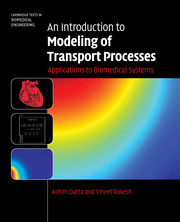
Organised around problem solving, this book gently introduces the reader to computational simulation of biomedical transport processes, bridging fundamental theory with real-world applications. Using this book the reader will gain a complete foundation to the subject, starting with problem simplification, implementing it in software, through to interpreting the results, validation, and optimisation. Ten case studies, focusing on emerging areas such as thermal therapy and drug delivery, with easy to follow step-by-step instructions, provide ready-to-use templates for further applications. Solution process using the commonly used tool COMSOL Multiphysics is described in detail; useful biomedical property data and correlations are included; and background theory information is given at the end of the book for easy reference. A mixture of short and extended exercises make this book a complete course package for undergraduate and beginning graduate students in biomedical and biochemical engineering curricula, as well as a self-study guide.
This is an ideal text for an introduction to biomedical engineering. The book presents the basic science knowledge used by biomedical engineers at a level accessible to all students and illustrates the first steps in applying this knowledge to solve problems in human medicine. Biomedical engineering encompasses a range of fields of specialization including bioinstrumentation, bioimaging, biomechanics, biomaterials, and biomolecular engineering. This introduction to bioengineering assembles foundational resources from molecular and cellular biology and physiology and relates them to various sub-specialties of biomedical engineering. The first two parts of the book present basic information in molecular/cellular biology and human physiology; quantitative concepts are stressed in these sections. Comprehension of these basic life science principles provides the context in which biomedical engineers interact. The third part of the book introduces sub-specialties in biomedical engineering, and emphasizes - through examples and profiles of people in the field - the types of problems biomedical engineers solve.
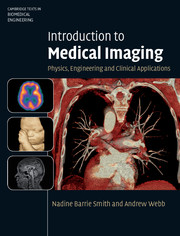
Covering the basics of X-rays, CT, PET, nuclear medicine, ultrasound, and MRI, this textbook provides senior undergraduate and beginning graduate students with a broad introduction to medical imaging. Over 130 end-of-chapter exercises are included, in addition to solved example problems, which enable students to master the theory as well as providing them with the tools needed to solve more difficult problems. The basic theory, instrumentation and state-of-the-art techniques and applications are covered, bringing students immediately up-to-date with recent developments, such as combined computed tomography/positron emission tomography, multi-slice CT, four-dimensional ultrasound, and parallel imaging MR technology. Clinical examples provide practical applications of physics and engineering knowledge to medicine. Finally, helpful references to specialised texts, recent review articles, and relevant scientific journals are provided at the end of each chapter, making this an ideal textbook for a one-semester course in medical imaging.
This book is designed to introduce the reader to the fundamental information necessary for work in the clinical setting, supporting the technology used in patient care. Beginning biomedical equipment technologists can use this book to obtain a working vocabulary and elementary knowledge of the industry. Content is presented through the inclusion of a wide variety of medical instrumentation, with an emphasis on generic devices and classifications; individual manufacturers are explained only when the market is dominated by a particular unit. Designed for the reader with a fundamental understanding of anatomy, physiology, and medical terminology appropriate for their role in the health care field and assumes the reader's understanding of electronic concepts, including voltage, current, resistance, impedance, analog and digital signals, and sensors. The material covered will assist the reader in the development of his or her role as a knowledgeable and effective member of the patient care team.
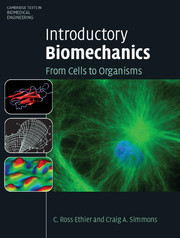
Introductory Biomechanics is a new, integrated text written specifically for engineering students. It provides a broad overview of this important branch of the rapidly growing field of bioengineering. A wide selection of topics is presented, ranging from the mechanics of single cells to the dynamics of human movement. No prior biological knowledge is assumed and in each chapter, the relevant anatomy and physiology are first described. The biological system is then analyzed from a mechanical viewpoint by reducing it to its essential elements, using the laws of mechanics and then tying mechanical insights back to biological function. This integrated approach provides students with a deeper understanding of both the mechanics and the biology than from qualitative study alone. The text is supported by a wealth of illustrations, tables and examples, a large selection of suitable problems and hundreds of current references, making it an essential textbook for any biomechanics course.
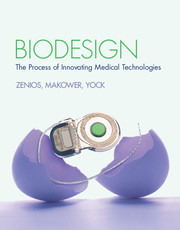
Recognize market opportunities, master the design process, and develop business acumen with this 'how-to' guide to medical technology innovation. A three-step, proven approach to the biodesign innovation process - identify, invent, implement - provides a practical formula for innovation. The experiences of hundreds of innovators and companies, in the form of case studies, quotes and practical advice, offer a realistic, action-orientated roadmap for successful biodesign innovation. Real-world examples, end-of-chapter projects, and Getting Started sections guide the reader through each of the key stages of the process and provide a template to create their own new medical devices. Addressing common medical, engineering, and business challenges to develop well-rounded expertise, this book is the complete package for any biodesign entrepreneur. The text is supported by valuable resources, including up-to-date industry changes: found at ebiodesign.org.
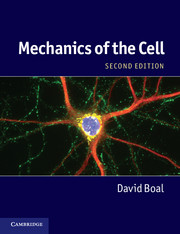
Exploring the mechanical features of biological cells, including their architecture and stability, this textbook is a pedagogical introduction to the interdisciplinary fields of cell mechanics and soft matter physics from both experimental and theoretical perspectives. This second edition has been greatly updated and expanded, with new chapters on complex filaments, the cell division cycle, the mechanisms of control and organization in the cell, and fluctuation phenomena. The textbook is now in full color which enhances the diagrams and allows the inclusion of new microscopy images. With around 280 end-of-chapter exercises exploring further applications, this textbook is ideal for advanced undergraduate and graduate students in physics and biomedical engineering. A website hosted by the author contains extra support material, diagrams and lecture notes, and is available at www.cambridge.org/Boal.
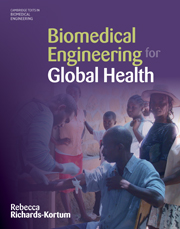
Can technology and innovation transform world health? Connecting undergraduate students with global problems, Rebecca Richards-Kortum examines the interplay between biomedical technology design and the medical, regulatory, economic, social and ethical issues surrounding global health. Driven by case studies, including cancer screening, imaging technologies, implantable devices and vaccines, students learn how the complexities and variation across the globe affect the design of devices and therapies. A wealth of learning features, including classroom activities, project assignments, homework problems and weblinks within the book and online, provide a full teaching package. For visionary general science and biomedical engineering courses, this book will inspire students to engage in solving global issues that face us all.
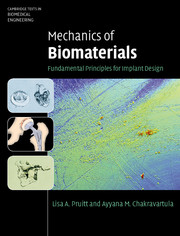
Teaching mechanical and structural biomaterials concepts for successful medical implant design, this self-contained text provides a complete grounding for students and newcomers to the field. Split into three sections: Materials, Mechanics and Case Studies, it begins with a review of sterilization, biocompatibility and foreign body response before presenting the fundamental structures of synthetic biomaterials and natural tissues. Mechanical behavior of materials is then discussed in depth, covering elastic deformation, viscoelasticity and time-dependent behavior, multiaxial loading and complex stress states, yielding and failure theories, and fracture mechanics. The final section on clinical aspects of medical devices provides crucial information on FDA regulatory issues and presents case studies in four key clinical areas: orthopedics, cardiovascular devices, dentistry and soft tissue implants. Each chapter ends with a list of topical questions, making this an ideal course textbook for senior undergraduate and graduate students, and also a self-study tool for engineers, scientists and clinicians.
This overview of diffusion and separation processes brings unsurpassed, engaging clarity to this complex topic. Diffusion is a key part of the undergraduate chemical engineering curriculum and at the core of understanding chemical purification and reaction engineering. This spontaneous mixing process is also central to our daily lives, with importance in phenomena as diverse as the dispersal of pollutants to digestion in the small intestine. For students, Diffusion goes from the basics of mass transfer and diffusion itself, with strong support through worked examples and a range of student questions. It also takes the reader right through to the cutting edge of our understanding, and the new examples in this third edition will appeal to professional scientists and engineers. Retaining the trademark enthusiastic style, the broad coverage now extends to biology and medicine.
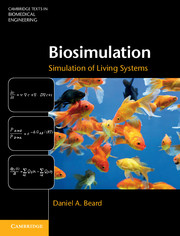
This practical guide to biosimulation provides the hands-on experience needed to devise, design and analyze simulations of biophysical processes for applications in biological and biomedical sciences. Through real-world case studies and worked examples, students will develop and apply basic operations through to advanced concepts, covering a wide range of biophysical topics including chemical kinetics and thermodynamics, transport phenomena, and cellular electrophysiology. Each chapter is built around case studies in a given application area, with simulations of real biological systems developed to analyze and interpret data. Open-ended project-based exercises are provided at the end of each chapter, and with all data and computer codes available online (www.cambridge.org/biosim) students can quickly and easily run, manipulate, explore and expand on the examples inside. This hands-on guide is ideal for use on senior undergraduate/graduate courses and also as a self-study guide for anyone who needs to develop computational models of biological systems.
Chemical Biophysics provides an engineering-based approach to biochemical system analysis for graduate-level courses on systems biology, computational bioengineering and molecular biophysics. It is the first textbook to apply rigorous physical chemistry principles to mathematical and computational modeling of biochemical systems for an interdisciplinary audience. The book is structured to show the student the basic biophysical concepts before applying this theory to computational modeling and analysis, building up to advanced topics and research. Topics explored include the kinetics of nonequilibrium open biological systems, enzyme mediated reactions, metabolic networks, biological transport processes, large-scale biochemical networks and stochastic processes in biochemical systems. End-of-chapter exercises range from confidence-building calculations to computational simulation projects.
This is the first textbook to integrates both general and specific topics, theoretical background and biomedical engineering applications, as well as analytical and numerical approaches. This quantitative approach integrates the classical concepts of mechanics and computational modelling techniques, in a logical progression through a wide range of fundamental biomechanics principles. Online MATLAB-based software along with examples and problems using biomedical applications will motivate undergraduate biomedical engineering students to practise and test their skills. The book covers topics such as kinematics, equilibrium, stresses and strains, and also focuses on large deformations and rotations and non-linear constitutive equations, including visco-elastic behaviour and the behaviour of long slender fibre-like structures. This is the definitive textbook for students.
Edited by
M. Laroussi, Old Dominion University, Virginia,M. G. Kong, Loughborough University,G. Morfill, Max-Planck-Institut für Plasmaphysik, Garching, Germany,W. Stolz, Ludwig-Maximilians-Universität Munchen
Edited by
M. Laroussi, Old Dominion University, Virginia,M. G. Kong, Loughborough University,G. Morfill, Max-Planck-Institut für Plasmaphysik, Garching, Germany,W. Stolz, Ludwig-Maximilians-Universität Munchen
Edited by
M. Laroussi, Old Dominion University, Virginia,M. G. Kong, Loughborough University,G. Morfill, Max-Planck-Institut für Plasmaphysik, Garching, Germany,W. Stolz, Ludwig-Maximilians-Universität Munchen
Edited by
M. Laroussi, Old Dominion University, Virginia,M. G. Kong, Loughborough University,G. Morfill, Max-Planck-Institut für Plasmaphysik, Garching, Germany,W. Stolz, Ludwig-Maximilians-Universität Munchen
Edited by
M. Laroussi, Old Dominion University, Virginia,M. G. Kong, Loughborough University,G. Morfill, Max-Planck-Institut für Plasmaphysik, Garching, Germany,W. Stolz, Ludwig-Maximilians-Universität Munchen
Edited by
M. Laroussi, Old Dominion University, Virginia,M. G. Kong, Loughborough University,G. Morfill, Max-Planck-Institut für Plasmaphysik, Garching, Germany,W. Stolz, Ludwig-Maximilians-Universität Munchen
Edited by
M. Laroussi, Old Dominion University, Virginia,M. G. Kong, Loughborough University,G. Morfill, Max-Planck-Institut für Plasmaphysik, Garching, Germany,W. Stolz, Ludwig-Maximilians-Universität Munchen