To save content items to your account,
please confirm that you agree to abide by our usage policies.
If this is the first time you use this feature, you will be asked to authorise Cambridge Core to connect with your account.
Find out more about saving content to .
To save content items to your Kindle, first ensure no-reply@cambridge.org
is added to your Approved Personal Document E-mail List under your Personal Document Settings
on the Manage Your Content and Devices page of your Amazon account. Then enter the ‘name’ part
of your Kindle email address below.
Find out more about saving to your Kindle.
Note you can select to save to either the @free.kindle.com or @kindle.com variations.
‘@free.kindle.com’ emails are free but can only be saved to your device when it is connected to wi-fi.
‘@kindle.com’ emails can be delivered even when you are not connected to wi-fi, but note that service fees apply.
This article explores the potentials of intergenerational collaboration as a long-term research strategy for shifting social and political imaginaries around climate change. It brings together academics and youth researchers who began working together on the Climate Change and Me project in 2014, along with colleagues who joined them for a public panel, book launch and exhibition ten years later. Climate Change and Me was the first large-scale study of climate change education applying a child- and youth-framed methodology, and has led to numerous exhibitions, curriculum resources, digital platforms, and publications co-created with children and young people. This article gives voice to young people’s reflections on the impact of their involvement with this project a decade on, drawing on the transcript of a public panel conversation at the Design Hub Gallery in Naarm (Melbourne). It explores how young people’s early experiences as child researchers have intersected with political, social and educational change across time, while opening new conversations with intergenerational colleagues working in related areas of climate justice education, activism and research.
This paper compares concerted efforts to unify early instructional practice in the US in the early twentieth century and in the twenty-first century. The first effort began with the founding of the National Council for Primary Education in 1915; the second began in 2005 with calls for pre-K-3 alignment. Analysis of relevant sources indicates that today’s unifiers are attempting to achieve three of the same goals that their predecessors pursued in 1915: increased child activity, teacher autonomy, and use of early instructional practices up through grade 3. During the early twentieth century, kindergarten served as both the model for the upward extension of activity-based early instructional practice into the early primary grades and the locus of efforts to defend against the downward extension of skill-based elementary practice from the primary to the lower levels. During the second round of unification in the twenty-first century, however, preschool has become the model for extending and the locus of defending early instructional methodology.
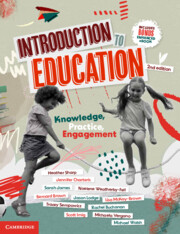
The transition from student to classroom teacher presents many opportunities and challenges. Introduction to Education welcomes pre-service teachers to the field of education, providing an overview of the context, craft and practice of teaching in Australian schools. Each chapter poses a question about the nature of teaching and explores authentic classroom examples, contemporary research and literature, and the professional, policy and curriculum contexts of teaching. Thoroughly updated, the second edition continues to cover both theoretical and practical topics, with chapters addressing assessment, planning, safe learning environments, professional experience, and working with colleagues, families, caregivers and communities. Each chapter features: chapter opening stimulus materials and questions to activate prior learning and challenge assumptions; connections to policy and research with questions to encourage critical thinking and professional literacy; voices of educators and students that provide authentic classroom examples of the practical application of theory.
The article examines the challenges that urban teachers faced in unitary systems, where students of different ages and educational levels shared the same classroom and were taught by a single teacher. It aims to compare these challenges across several cities including Alicante, Badajoz, Cádiz, Canary Islands, Málaga, and Zaragoza to determine common issues within Spain. The study is based on sixteen technical reports from 1916 to 1926 and uses qualitative methods to analyze teachers’ narratives for deeper insights. Additionally, a literature review and quantitative analysis of Spanish statistical sources were conducted. Key findings highlight parental disinterest as a significant cause of school absenteeism. The article concludes by stressing the importance of understanding historical educational contexts in informing current educational policies and practices.
This paper explores the implementation and enduring significance of the German language program in Milwaukee Public Schools between 1867 and 1918. Despite the German language program facing challenges, notably the Bennett Law of 1889—which sought to restrict foreign language instruction statewide—the program persisted, highlighting the tension between local identity and state mandates. This study argues that the creation of the German course initiated a process of consolidation and standardization in Milwaukee Public Schools, shifting decision-making to school administrators who sought to accommodate the largest cultural group in Milwaukee. This case study of the Milwaukee Public Schools’ German Language Program reveals how school policies prioritized a multilingual approach to Americanization. The paper is structured in three sections, examining the evolution of language policy, the political implications of the Bennett Law, and the post-Bennett landscape of language education, ultimately demonstrating the interplay between consolidation and cultural inclusivity.
The information contained in this text covers literacy instruction in kindergarten, primary grades, middle school, and secondary school. It gives the background on the developmental aspects of all attributes needed for successful reading. It presents a balanced body of information for instruction between wholistic approaches and traditional approaches for the total literacy curriculum. This book includes the complete developmental aspects of skills necessary for competence in all literacy tasks from birth to adolescent literacy, the need for availability for teachers to assess the progress of all these skills as they are presented in a wholistic fashion on a regular basis, the criteria of how decisions are made for remedial reading instruction, the interface of special education considerations for students experiencing literacy deficits, approaches for adolescent literacy programs, and extensive information on teaching English language learners.
In this chapter, we focus on the implementation of the planning cycle in infant and toddler settings and how it might be co-constructed, documented and shared with key stakeholders. Throughout this book, we have examined how the first three years constitute a foundational period with particular competencies, vulnerabilities and opportunities for growth and learning. Infants and toddlers deserve, and indeed have a right to experience, curriculum that is specifically designed to nurture their unique ways of being, belonging and becoming. At the same time, very young children are not a homogenous group but individuals with their own interests, dispositions, strengths and challenges. Quality curriculum is planned to be responsive to these individual differences. Planning curriculum is an important professional practice requiring educators to act with what the Early Years Learning Framework (EYLF) calls intentionality, meaning their curriculum and practice is deliberate, thoughtful and purposeful.
Infants and toddlers are immersed in the social culture of their family, community and society from before they are born. Every family has distinct social practices and ways of interacting which shape very young children’s holistic physiological, cognitive and emotional learning, development and wellbeing. These practices reflect the values, beliefs, norms and expectations of their community and culture. Over time, through repeated social encounters and experiences, the social culture of their family and community is passed on as infants and toddlers become socialised into these specific ways of engaging with others. Social practices and interactions thus form the basis of the relationships that infants and toddlers form with significant others. As a result, the social opportunities that very young children experience and participate in during their everyday existence have far-reaching consequences for their sense of identify and belonging.
Chapter 4 discusses the different modes of teaching that teachers can employ in class: direct, discussion, activity, enquiry, collaborative and group approaches are all examined in detail, with the advantages and disadvantages of each mode considered and practical advice given on when and where to employ them within a pupil-centred environment. The predominance of particular modes in class is examined, and the importance of teachers using a wide range is stressed, in addition to a discussion of what each mode is particularly suited to achieving. The chapter also examines Resource-Based Learning and Task Based Language Teaching in detail.
Like reading, writing is an essential part of academic studies and professional work. Through writing, we form and communicate clear thoughts so that we can collaborate with each other and refine critical understandings. In the Australian Curriculum, writing is about students using expressive language and composing different types of texts for a range of purposes as an integral part of learning in all curriculum areas. Different text types include ‘spoken, written, visual and multimodal texts’, while students can also create ‘formal and informal’ written, visual and multimodal texts for presentation.
Chapter 11 looks at how skills and competences necessary for successful language learning can be developed in the language classroom through the use of drama, music and games. Developing an understanding of the culture and literature of countries where the foreign language is spoken and what is appropriate at different ages and stages of learning is also examined in this chapter. The use of music and rhyme helps to embed the foreign language in learners’ minds, promoting pedagogical diversity and consolidating learning, particularly with regards to pronunciation, fluency, listening comprehension, memorisation of vocabulary and grammatical structures, as well as increasing cultural awareness. Drama and games can motivate learners and create a relaxed atmosphere where language skills can develop, thus promoting learner interaction, improving skills and consolidating knowledge.
Most simply, the words ‘pedagogy and care’ capture and describe the core work that is done in the earliest years of education with very young children. Early childhood education (ECE) shares the same general aims as primary, secondary and tertiary education, with an overarching focus on learning and development. Educators working with infants and toddlers practice in a space where pedagogy and care are inextricably linked. It could thus be argued that ideas about pedagogy in relation to infants and toddlers are hardest to reconcile. This challenge may be due to the particular history of infants and toddlers as the youngest children in society, driven by discourses of maternalism and inherently tied to an image of their place in the home, where they were for many centuries. However, infants and toddlers are attending ECE settings in ever-increasing numbers and upholding their right to quality pedagogy is a professional responsibility of all ECE services, leaders and educators.
From the moment they are born, infants are active and competent learners. Before birth, they perceive and respond to stimuli from the outside world and the people in it. Newborns recognise and respond socially to other people and pay attention to interesting objects and events. Infants are born ‘ready to learn, and during their first three years, they learn, develop and grow at a faster rate than at any other time in their lives. Rapid physical development enables mobility, exploration and physical manipulation; emerging social and emotional skills foster relationships, wellbeing, and belonging; increasing communication and language competence support social interactions, literacy development and learning; and cognitive advancements cultivate critical ways of thinking and understanding. The skills and understandings that infants and toddlers achieve during their first three years form the cornerstone from which all future learning, development and wellbeing is built.