To save content items to your account,
please confirm that you agree to abide by our usage policies.
If this is the first time you use this feature, you will be asked to authorise Cambridge Core to connect with your account.
Find out more about saving content to .
To save content items to your Kindle, first ensure no-reply@cambridge.org
is added to your Approved Personal Document E-mail List under your Personal Document Settings
on the Manage Your Content and Devices page of your Amazon account. Then enter the ‘name’ part
of your Kindle email address below.
Find out more about saving to your Kindle.
Note you can select to save to either the @free.kindle.com or @kindle.com variations.
‘@free.kindle.com’ emails are free but can only be saved to your device when it is connected to wi-fi.
‘@kindle.com’ emails can be delivered even when you are not connected to wi-fi, but note that service fees apply.
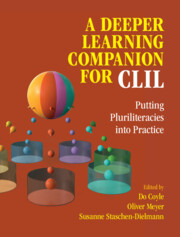
If education is to prepare learners for lifelong learning, there needs to be a shift towards deeper learning: a focus on transferable knowledge and problem-solving skills alongside the development of a positive or growth mind-set. Deeper learning is inextricably linked with CLIL (Content and Language Integrated Learning) – a revolutionary teaching approach where students study subjects in a different language. Designed as a companion to the influential volume Beyond CLIL, this highly practical book offers step-by-step instruction for designing and implementing innovative tasks and materials for pluriliteracies development. It contains annotated case studies of deeper learning lesson plans across a wide range of school subjects, using an innovative and proven template, to help teachers explore the potential of deeper learning inside their own classrooms. Theoretically grounded, this book offers a roadmap for schools, ranging from exploratory first steps, to transdisciplinary projects, to whole school moves for curriculum development and transformative pedagogies.
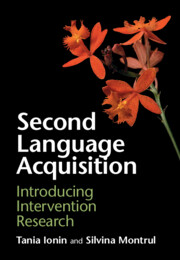
Based on classic and cutting-edge research, this textbook shows how grammatical phenomena can best be taught to second language and bilingual learners. Bringing together second language research, linguistics, pedagogical grammar, and language teaching, it demonstrates how linguistic theory and second language acquisition findings optimize classroom intervention research. The book assumes a generative approach but covers intervention studies from a variety of theoretical perspectives. Each chapter describes relevant linguistic structures, discusses core challenges, summarizes research findings, and concludes with classroom and lab-based intervention studies. The authors provide tools to help to design linguistically informed intervention studies, including discussion questions, application questions, case studies, and sample interventions. Online resources feature lecture slides and intervention materials, with data analysis exercises, ensuring the content is clear and ready to use. Requiring no more than a basic course in linguistics, the material serves advanced undergraduates and first-year graduate students studying applied linguistics, education, or language teaching.
In this position paper, we argue that second language (L2) pragmatic research needs to explore new avenues for integrating speech acts and interaction, by proposing a radically minimal, finite and interactional typology of speech acts. While we will introduce what we mean by integrating speech acts and interaction in detail below, the following argument helps us to summarise the issue we consider in this study:
When we describe language behaviour, we sometimes use terms such as ‘suggest’, ‘request’ and so on, which roughly indicate illocutionary values, and sometimes terms such as ‘agree’, ‘accept’, ‘contradict’, ‘turn down’, ‘refuse’, which are more indicative of the significance of the utterance relative to a preceding one. What we need to do is to distinguish between these two aspects of a communicative act – the illocutionary and the interactional. (Edmondson et al., 2023, pp. 25–26)
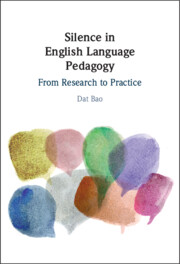
Silence in language learning is commonly viewed negatively, with language teachers often struggling to interpret learner silence and identify whether it is part of communication, mental processing, or low engagement. This book addresses silence in language pedagogy from a positive perspective, translating research into practice in order to inform teaching and to advocate greater use of positive silence in the classroom. The first half of the book examines the existing research into silence, and the second half provides research-informed practical strategies and classroom tasks. It offers applicable principles for task design that utilises rich resources, which include visual arts, mental representation, poetry, music, and other innovative tools, to allow both silence and speech to express their respective and interrelated roles in learning. Comprehensive yet accessible, it is essential reading for academic researchers and students in applied linguistics, TESOL, and language teaching, as well as for language teachers and educators.
This article examines children's literature written by African American teachers during the first part of the twentieth century. Drawing on theories of racialization, I analyze children's books written by two African American teachers: Helen Adele Whiting (1885-1959) and Jane Dabney Shackelford (1895-1979). I argue that their books represented more than an effort toward greater Black representation in schools; they also served as a contribution to a larger discourse on Blackness and identity that emerged during the “New Negro” movement. In this view, African American teachers were not mere passive recipients of an outside Black culture, but rather intellectual actors involved in the production of racial identity during the interwar period.
In 1963 and 1964, organizers in Boston held Freedom Stay-Outs—one-day school boycotts—to protest the neglect of predominantly Black schools from the Boston School Committee, the governing body of the Boston Public Schools. Boycotting students attended Freedom Schools, where they learned about Black history and discussed issues facing Black youth. This article examines the 1964 Stay-Out and Freedom Schools as spaces where Black educators, organizers, parents, and students developed and enacted a vision of integrated education distinct from the dominant models of integration proposed in Boston and across the nation post-Brown v. Board (1954). The 1964 Freedom Schools modeled reciprocal integration, a vision for integrated education that promotes bidirectional physical and cultural movement, rather than the dominant model of integration that moved Black children into white schools to be taught white history and culture. Reciprocal integration was developed through Black parents’ and students’ educational testimony, the Stay-Out organizers’ own educational analysis, and the practical necessity of interracial organizing.
Wasteful, irregular expenditure and theft happen so often that people don't even think of it as theft.
It was easily one of the most humiliating spectacles that could occur in a place of higher learning. Students stormed into the office of the university vice-chancellor, a highly respected man of letters, lifted him up by the armpits, and frog-marched the bespectacled academic to the gates of the university as an act of ejection. They had done this before. In fact, most leaders of this university were at some point ousted from their offices and taken to the campus exit, where the police would sometimes rescue the professor from the mob.
About 300 kilometres south of this northern campus, another vicechancellor experienced something even worse. Five or six campus bullies came into one of the offices of the ‘no-nonsense leader who insisted that staff and students work strictly according to the rules and regulations … so they got fed up with him’. The invaders told the vice-chancellor that this was his last day in office and that he was leaving ‘right now’. One of the deputy vice-chancellors tried to intervene, saying, ‘You cannot treat our vice-chancellor like this,’ but he was told to shut up and get on with this work. The VC having collected his belongings, the thugs drove him off campus in his own car. Council, his nominal boss, did nothing. The vice-chancellor was never seen on campus again.
These acts of institutional thuggery targeting principled leaders are visible, in-your-face confrontations that work to undermine the managerial authority of a public university. What is much less obvious is the hundreds of smaller events that, as a senior adviser to government put it, ‘silently eat away at the institutional integrity of a university’.
This chapter makes visible in finer detail the micropolitics of corruption in South Africa's dysfunctional universities – how and why it happens, by and for whom, and with what consequences for higher education institutions. The chapter also gives some conceptual flesh to the myriads of corrupt activities that occur in dysfunctional institutions.
There is a broader intellectual interest in this endeavour, for we still do not have research that, in the words of education scholar Jacky Lumby, ‘unravel[s] the nuances and subtleties of daily activity at the micropolitical level’.
In its simplest form, political economy can be described as the relationship between power and resources. More extensive reflections on the subject define it as ‘the study of the social relations, particularly the power relations, that mutually constitute the production, distribution, and consumption of resources’. Yet another authority places emphasis on the processes that constitute political economy: ‘all the activities of cooperation, conflict and negotiation involved in decisions about the use, production and distribution of resources’.
With these framing ideas in mind, this work applies a political economy perspective to investigate the micropolitics of a particular institution, the university. It examines not only the relationship between power and resources, but how that interaction contributes to chronically dysfunctional institutions. However, in the course of this study, existing conceptions of political economy were found to be somewhat too restrictive for the study of universities in highly contested environments in developing countries like South Africa.
A review of standard texts on the subject typically takes the reader on an intellectual tour of the major traditions, starting with the classical political economy of Adam Smith and David Ricardo, and including the Marxian political economy first developed by Karl Marx and Friedrich Engels. Between and beyond these two well-established traditions, there are variations, critiques and departures, including feminist political economy, environmental political economy, and moral political economy. In these readings, and their rebuttals, the state and markets feature prominently as the focus of analysis. There is seldom any attention paid to school education as the subject of political economy outside the interests of government funding agencies. One exception is the landmark study of Samuel Bowles and Herbert Gintis, Schooling in Capitalist America, which remains a classic reference point for students of the political economy of education.
On the other hand, the term ‘political economy of higher education’ is often loosely applied to externalities such as the global knowledge economy or the financing of higher education. But there are few studies that turn political economy inwards, to the study of the nexus between power and resources inside higher education institutions. By applying a political economy analysis to dysfunctional universities, therefore, this book expands the perspective to a specific kind of institution (the university) by undertaking an in-depth examination of the interplay between power and resources.
By any measure of social change, the end of apartheid appeared suddenly, even if, in the longue durée of southern African politics, it was inevitable. Given P. W. Botha's calamitous Rubicon speech of August 1985, which some had expected to move the country towards the end of racial rule, political observers had grounds to be cautious when the so-called reformer F. W. de Klerk replaced the Old Crocodile. For this reason, the announcement in February 1990 of the unbanning of black political parties and the release of Nelson Mandela and other prominent prisoners caught most citizens off guard.
In the middle of an ongoing anti-apartheid struggle, the announcement meant that new strategies and tactics had to be adopted by the liberation movements outside the country, and by the democratic opposition on the inside, even as negotiating parties started working on the terms of the transition to democracy. How do you resist even as you cooperate? How do you reconcile and repair in the face of a low-intensity civil war, from the streets of Johannesburg to the lush green fields of the Natal Midlands? And how do you build democratic education institutions while the old structures are still in place?
In this period of high uncertainty about South Africa's political future, much conciliatory symbolism was offered for the public mind: from the fish hook caught in the hand of one of the negotiators and taken out by the other,1 to the imagery of a rainbow nation touted by the popular cleric Desmond Tutu, and the symbolic act of Nelson Mandela donning the jersey of the white Springbok captain during the rugby World Cup of 1995. Antonio Gramsci's notion of interregnum was no longer a theoretical construct invoked by the more intellectual comrades, but the lived experience of leaders and institutions struggling to make sense of the old that was dying and of the new not yet born. The former liberation movement and soon-to-be ruling party felt compelled to put out an unbidden pamphlet intended to reassure, called Ready to Govern!
As elsewhere in the society, this anxious transition was made with great difficulty in South Africa's public universities.
The first South African university was the University of the Cape of Good Hope, which was established by an Act of Parliament of the Cape Colony in 1873. It was not a teaching university, but set standards and examinations for what were known in those early years as ‘university colleges’. It was renamed the University of South Africa in 1916, relocated from the Cape to Pretoria in 1918, and only started to offer ‘postal tuition’ about three decades later, in 1946.
The South African College, established in 1829, was a high school for boys, but it contained within it a small tertiary education component, which developed into a fully fledged institution, the University of Cape Town (UCT), in 1918. The Victoria College, so named in 1887, also developed out of smaller constituent parts, including an arts department, and became the University of Stellenbosch (now Stellenbosch University [SU]) in 1918. It was not, in fact, uncommon in those times for ordinary schools to have ‘university college departments’ as part of their facilities.
Apart from the two former colleges that became independent teaching universities (UCT and SU), the rest were organised as a ‘federation of colleges’ under the aegis of the University of South Africa (Unisa). These included Natal University College in Pietermaritzburg, founded in 1910; Grey University College in Bloemfontein, founded in 1906; Transvaal University College in Pretoria, founded in 1910; Rhodes University College in Grahamstown, founded in 1904; the School of Mines and Technology in Johannesburg, founded in 1910; and the Potchefstroom University College for Christian Higher Education, founded in 1919.
These affiliate colleges of Unisa would in time gain independent university status – as the University of Natal in 1949; the University of the Orange Free State in 1950; the University of Pretoria in 1930; Rhodes University in 1951; the University of the Witwatersrand in 1922; and Potchefstroom University for Christian Higher Education in 1951. All of these were racially segregated white universities.
The first black institution of higher learning was the South African Native College, founded in 1916, which became the University College of Fort Hare in 1951, and the University of Fort Hare in 1970. Unlike the white colleges, this ‘Native College’ was not a constituent college of Unisa, but it did prepare its students for Unisa's external examinations.
This article provides a historiographical survey of significant African American historians researching, writing, and interpreting Black people's education history. At the heart of this article are the following questions: Who were the African American historians of education who produced this work? What has been the significant scholarship of African American education historians from the late nineteenth century to the present? Although much scholarship has been published on African American education, its history remains underrepresented in the study of educational history. Nonetheless, this historiography is burgeoning thanks to Black educational historians’ scholarship.
This article explores the All-Day Neighborhood Schools (ADNS) program, operated as a partnership between the New York City Board of Education and local philanthropists from 1936 to 1971. Designed to expand the resources available to children and parents, the program included after-school activities, additional teachers, professional development, social workers, and parent engagement at fourteen public elementary schools across the city. Through a study of two program sites, I examine how this public-private partnership functioned, and trace changes in the motivations of its leadership, from a focus on recreation and democracy during World War II, to juvenile delinquency prevention, to compensatory education. I argue that ADNS's ability to transform public schooling in New York City was limited by its separation from the rest of the school system, which came about through its dependance on outside philanthropy and its consistent formulation as a supplemental program rather than as a fundamental part of children's education.