To save content items to your account,
please confirm that you agree to abide by our usage policies.
If this is the first time you use this feature, you will be asked to authorise Cambridge Core to connect with your account.
Find out more about saving content to .
To save content items to your Kindle, first ensure no-reply@cambridge.org
is added to your Approved Personal Document E-mail List under your Personal Document Settings
on the Manage Your Content and Devices page of your Amazon account. Then enter the ‘name’ part
of your Kindle email address below.
Find out more about saving to your Kindle.
Note you can select to save to either the @free.kindle.com or @kindle.com variations.
‘@free.kindle.com’ emails are free but can only be saved to your device when it is connected to wi-fi.
‘@kindle.com’ emails can be delivered even when you are not connected to wi-fi, but note that service fees apply.
Prior to the First World War, the operations of the British financial sector primarily fell under the jurisdiction of a banking aristocracy. The Old Guard, comprising prominent bankers and industrialists based in the City of London, oversaw a system of indirect regulation, characterized by the lack of direct government intervention and the self-sustaining operations of the classical gold standard. Yet the outbreak of the war fundamentally upended the traditional balance between the state and the economy. With the abandonment of the gold standard and the closure of the London Stock Exchange in 1914, the nation faced a series of unprecedented crises that threatened Britain’s hegemonic position in the global order. By war’s end, the Bank of England had begun to reconsider its position in the City, throughout Europe, and across the empire.
Following the abandonment of the gold standard in 1931, the Bank of England searched for a policies that would stabilize the international financial system. Its officials turned to the empire as a potential solution to pervasive economic problems. Over the course of the 1930s, they sought to create new independent central banks that promoted intra-imperial trade and the use of sterling as a reserve currency. Neither upholding a particular set of “gentlemanly values” nor seeking to exert complete imperial dominance, the Bank envisioned a network of Empire Central Banks would appease rising nationalism and facilitated imperial monetary cooperation. It worked with foreign governments and economists who provided additional legitimacy to these reforms. With the establishment of the Reserve Bank of India and the Bank of Canada, the Bank was able to secure British financial interests abroad amidst the fracturing of the global economy.
During and after the Second World War, the influence of the Bank of England in shaping economic governance remained ambiguous. It did not play a significant role in the formative negotiations at the 1944 Bretton Woods Conference, nor was sterling viewed as the definitive international reserve currency in the decades thereafter. Yet with the repeated threats to the British economy, from two devaluations to the devastating IMF loan, the central bank again turned to experts who could offer new perspectives on monetary policy. Over the course of the twentieth century, the Bank began to employ economists who brought novel macroeconomic models into policy discussions. Although the initial postwar years saw its power remain in a state of uncertainty, the Bank was able to reestablish its reputation as a leading monetary authority from the 1980s onward.
In the 19th century the United States had no formal central bank or lender of last resort, but it did have J. P. Morgan. His unique knowledge of financial markets gave him almost omniscient knowledge for crafting solutions to financial crises. Before the Fed examines Morgan's unusual role in resolving the National Banking Era crises in the U. S., exploring the rocky relationships and ultimatums he used to settle financial panics. It traces how he learned crisis management lessons from his father, passing it along to his son in turn. Citing his own ledgers, telegrams and testimony, Jon Moen and Mary Tone Rodgers detail how Morgan applied and modified routine business practices to solve non-routine crises, managing risk and reward in emergency lending. Analyzing forty last resort loans made over his fifty-year career, the authors challenge the invincibility folklore surrounding Morgan, uncovering how he stabilized American markets when others could not.
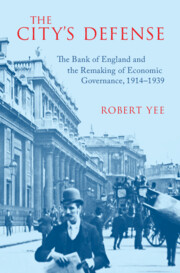
In The City's Defense, Robert Yee examines how the City of London maintained its status as an international financial center. He traces the role of the Bank of England in restructuring the domestic, imperial, European, and international monetary systems in the aftermath of the First World War. Responding to mass unemployment and volatile exchange rates, the Bank expanded its reach into areas outside the traditional scope of central banking, including industrial policy and foreign affairs. It designed a system of economic governance that reinforced the preeminence of sterling as a reserve currency. Drawing on a range of archival evidence from national governments, private corporations, and international organizations, Yee reevaluates our understanding of Britain's impact on the global economic order.
This chapter examines how exchange participants resolve uncertainties in corrupt transactions by focusing on the buying and selling of government positions, a typical form of corruption in China. Drawing on sixty-two in-depth interviews, this chapter suggests that corrupt transactions are highly embedded in strong-tie relationships, the power structure of which is often imbalanced. Exchange participants who are connected through strong ties have a strong incentive to cooperate and exchange favors because the cost of losing “hostages” (e.g., ganqing – deep feelings of emotional attachment – and human capital investment in maintaining exchange relations) and mianzi (“face,” which is used to describe reputation and social esteem) is high and difficult to recover. We also find that favor-seekers, who are often low-power actors, develop power-balancing strategies, such as bribe payments and disclosing compromising information, to win exchange opportunities and lower the risk of exploitation by high-power actors (power-holders who are favor-givers). Given that corrupt intermediaries are commonly brought in when a strong tie between favor-seeker and favor-giver does not exist, this chapter also empirically examines how corrupt exchanges involving intermediaries are governed. We find that face functions as a primary assurance and enforcement mechanism regulating corrupt transactions facilitated by intermediaries.
This chapter reviews essential works on anarchism and extralegal (private) governance institutions, suggesting that there is a lack of high-quality research focusing on the operation of extralegal governance institutions in authoritarian China’s illegal markets. It then discusses the puzzles this book aims to investigate and the ways in which the Chinese state facilitates the growth of illegal markets. It also outlines the objectives of the book, summarizes the key contributions it makes to the existing literature, and sets out a road map for the book.
This chapter examines the major extralegal governance institutions employed by participants to secure cooperation and mitigate uncertainties in China’s small property right housing market, where housing is built on collectively owned land without legal title. Although illegal, these large-scale communities often house numerous immigrants and are consequently often tolerated by local governments. However, these governments may intervene in the market if they perceive threats to social order, the local economy, or government revenue. The small property right housing market is illegal but socially legitimate, making it a unique form of illegal market. Participants develop private institutions to facilitate exchanges, protect informal property rights, and avoid government interference. Empirical data shows that builders and buyers use informal documents, contracts, lawyer testimonies, and signing rituals to define ownership and assess the trustworthiness of exchange participants. Sellers utilize WeChat groups for information sharing and reputation management. Village committees perform multiple roles in the market: They act as builders, sellers, and third-party enforcers; they establish ownership and transaction databases to protect informal property rights; and they also organize collective action and seek political patronage to deter government interference.