To save content items to your account,
please confirm that you agree to abide by our usage policies.
If this is the first time you use this feature, you will be asked to authorise Cambridge Core to connect with your account.
Find out more about saving content to .
To save content items to your Kindle, first ensure no-reply@cambridge.org
is added to your Approved Personal Document E-mail List under your Personal Document Settings
on the Manage Your Content and Devices page of your Amazon account. Then enter the ‘name’ part
of your Kindle email address below.
Find out more about saving to your Kindle.
Note you can select to save to either the @free.kindle.com or @kindle.com variations.
‘@free.kindle.com’ emails are free but can only be saved to your device when it is connected to wi-fi.
‘@kindle.com’ emails can be delivered even when you are not connected to wi-fi, but note that service fees apply.
The “Arctic Uchronotopias” special issue of Polar Record is an important contribution to scholarly reflection on resource extraction. The ideas, perspectives, and empirical cases that we encounter have significance for extractivism wherever it takes place, both inside and outside of the Arctic region. To see extractivism through an Arctic lens is particularly useful since it brings up many of the issues that are often at stake in extraction activities, but not always at the same time: geopolitics, transboundary relations, environmental and climate impacts, cultural and natural heritage, indigenous relations, rights issues, local and regional development, and lives and fates of communities. Above all, these papers bring out the full spectrum of issues and tensions related to ongoing major global shifts, such as the Great Acceleration and Overheating, and those transformations of which resource extraction forms a major part. The research presented in Arctic Uchronotopias demonstrates that affect and emotions have explanatory value in the geopolitics of Arctic resource extraction. It also shows that emotional and cognitive experience and wisdom carry values and properties that conventional Environmental Impact Assessments and other technologies of evaluation and decision-making can capture.
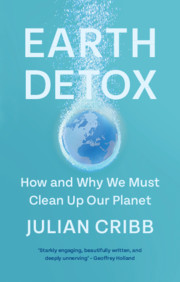
Every person on our home planet is affected by a worldwide deluge of man-made chemicals and pollutants - most of which have never been tested for safety. Our chemical emissions are six times larger than our total greenhouse gas emissions. They are in our food, our water, the air we breathe, our homes and workplaces, the things we use each day. This universal poisoning affects our minds, our bodies, our genes, our grandkids, and all life on Earth. Julian Cribb describes the full scale of the chemical catastrophe we have unleashed. He proposes a new Human Right - not to be poisoned. He maps an empowering and hopeful way forward: to rid our planet of these toxins and return Earth to the clean, healthy condition which our forebears enjoyed, and our grandchildren should too.
Lessons from Minamata, Seveso, Bhopal and other cases of corporate chemical negligence. Attempts to corrupt the political process. Climate denial linked to chemical denial. The ‘dirty dozen’ supertoxics. Offshoring of toxics industry to unregulated countries. Chemical codes, guidelines and the failure of regulation. Who is really responsible? How the consumer drives chemical demand.
Describes mounting scientific evidence for individual, lifelong poisoning by man-made chemical emissions, showing how it begins in the womb, continues through childhood, accumulates through life and persists after death. Chemical exposure is mainly from food, drinks, cosmetics and air in the home, workplace, urban and rural environments. Pollution the largest environmental cause of disease and premature death in the world today.
Describes major categories of chemical pollution and poisoning of which the public is still largely unaware: e-waste, nanopollution, plastics, novel pesticides, chemical intensification, chemical weapons, illicit drugs, eutrophication of waters. Humanity fated to poison itself. Role of the educated consumer in detoxing the Earth.
How modern chemistry misleads consumers. Mounting scientific and medical concerns over the effects of chemical mixtures arising from substances released, deliberately and unintentionally, into the biosphere by human activity, breakdown processes etc. Emerging patterns of disease and medical concerns associated with human exposure to complex chemical mixtures.
Story of early life and the oxygen Holocaust >2400 million years ago. Impact of oxygen overload on early life. Worst extinction event. Evolution of oxygen-dependent life. Irony of human chemical deluge. Moral of the tale.
Success stories in clean-up of toxic sites. Sydney, Singapore, US Superfund. Key global chemical treaties. New approaches to chemical clean-up. Shortcomings in scientific, medical and chemical training. Curbing the global toxic deluge. Citizen responsibility for a cleaner Planet.
Describes growing human health issues linked to exposure to a multiplicity of chemicals and mixtures. Impacts on the human brain, intelligence and mental disorders, autism, ADHD, depression, child and adult cancers, developmental diseases of children, sexual, gender and reproductive disorders, obesity and diabetes, ‘mystery’ disorders, re-emergence of ‘old’ conditions. The epigenetic curse. The case for precaution.
Explains how man-made ‘pollution’ – often seen as a local problem – has become a virtual river flowing round the entire planet. Describes contamination of oceans, remote regions, air in homes and cities, effect of plastics, impacts on wildlife. Defines six modes of chemical transport. Pollution is now universal, affecting all people and most of life on Earth
Parents inspiring the fightback against the toxic deluge. Learning to think ‘as a species’ about global threats. How consumers can help clean up the Earth. A Global Detox Alliance. A scientific plan for global clean-up. A chemist’s oath to ‘do no harm’. A human right not to be poisoned. A ten-point plan for a cleaner, safer, healthier Earth.
The ‘greatest existential emergency in history’ facing humanity. The ten mega-threats and the need to solve them together and in an integrated way. How the chemical threat interacts with the other nine threats. Solution of all ten threats is the key to human survival, wellbeing and prosperity.
Using latest science, explains the quantum of man-made chemical emissions, the main sources and the cost in human life. First global estimate of total anthropogenic chemical emissions and circulation. The issue is far larger than most people or governments imagine.