To save content items to your account,
please confirm that you agree to abide by our usage policies.
If this is the first time you use this feature, you will be asked to authorise Cambridge Core to connect with your account.
Find out more about saving content to .
To save content items to your Kindle, first ensure no-reply@cambridge.org
is added to your Approved Personal Document E-mail List under your Personal Document Settings
on the Manage Your Content and Devices page of your Amazon account. Then enter the ‘name’ part
of your Kindle email address below.
Find out more about saving to your Kindle.
Note you can select to save to either the @free.kindle.com or @kindle.com variations.
‘@free.kindle.com’ emails are free but can only be saved to your device when it is connected to wi-fi.
‘@kindle.com’ emails can be delivered even when you are not connected to wi-fi, but note that service fees apply.
This Element compares the 1951 Festival of Britain with the 2022 Unboxed Festival to explore both continuities and shifts in the British state's relationship to empire, power and extraction as expressed in celebrations of national culture. The ideological projects underpinning these governments, distanced by more than seventy years, might be seen as fundamentally opposed. Yet approaching this comparative study through a conjunctural analysis focusing on the narrations of British identity and both events' wilful intertwining of technology and art reveals the continuities between both periods, especially as they pertain to historical practices of the imperial state and its far-reaching consequences.
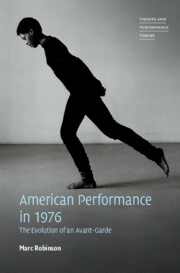
1976 was a febrile, transitional year in cultural history, coming after Watergate and Vietnam and before the AIDS epidemic and the rise of the Conservative movement. Bicentennial triumphalism sounded dissonant against a violent past and uncertain future. Marc Robinson here explores how innovative artists across disciplines – drama, dance, music, film, visual art – responded to this period, before zeroing in on avant-garde theater. Over 1976, five landmark productions could be seen within months of one another: Cecil Taylor's A Rat's Mass / Procession in Shout, Meredith Monk's Quarry, the Robert Wilson / Philip Glass opera Einstein on the Beach, Joseph Chaikin's production of Adrienne Kennedy's A Movie Star Has to Star in Black and White, and, finally, the Wooster Group's first open rehearsal of Spalding Gray and Elizabeth LeCompte's Rumstick Road. In close readings of these five works, Robinson reveals the poetics of a transformative moment in American culture.
Theatre does not merely use technology – it is a technology. In this paradigm-shifting study, W. B. Worthen shows how the dynamics of obsolescence and affective nostalgia that shape the passing of technologies into history also shape and reshape theatrical practice. Locating theatre within rather than outside the orbit of media studies, Theatre as Technology traces the theatre's absorption of, and absorption by, digital culture. Treating subjects as wide-ranging as pandemic-era Zoom theatre, on-stage video and sound technologies, and artificial intelligence, Worthen locates a moment of transformational change in the idea of the theatre, change prompted by the theatre's always-changing, and so always obsolescing, material technologies.
With the majority of the global population living in cities, urbanisation and climate crisis have become urgent planetary issues. This Element examines 'urban eco-performance', exploring how theatre and performance intersect with urbanisation and ecological crises to reimagine equitable urban futures. Through rigorous ecodramaturgical analyses, this Element critiques the colonial and capitalist systems shaping cities and highlights performance's role in addressing climate justice. Performances from Canada, Mexico, Nigeria, Taiwan, UK and USA, as well as Indigenous performances, are brought together for the first time to examine how they challenge the human/nature divide, revealing cities as vibrant ecological spaces. These performances foreground underrepresented voices and reframe cities as 'bio-urban' spaces. This Element integrates decolonial and intersectional ecological frameworks over three thematic sections: Living Cities, Petro-Cities and Urban Futures Against the Apocalypse. It argues for justice for marginalised communities while envisioning cities as interconnected ecosystems that can foster collective action and ecological resilience.
This Element is the first scholarly study of the theatre of Lauren Gunderson (b. 1982), one of the most produced US playwrights and a self-declared feminist playwright. Her feminist claims and theatrical interventions are assessed through four key strands of her theatre making: parodies of Shakespeare's canon; women-centred revisions to history; women and illness; and 'entertaining' feminism through popular theatre forms. Moving between the mainstream and the experimental, her theatre ranges from realism and quasi well-made plays to the experimental in a postmodern/Brechtian fashion, inviting consideration of the form(s) deployed for staging feminism in the twenty-first century. The Element discusses how Gunderson adapts the legacies of second-wave feminist theatre in the US to provide accessible experimental theatre and how she adopts popular genres in the interest of popular feminisms, giving way to an 'in-between' feminist practice: a feminist-theatre pathway that lies somewhere 'in between' the second-wave past and new directions.
Beginning with an analysis of William Prinsep’s watercolour of nautch dancers (circa 1840), this chapter discusses the figure of the Indian nautch dancer as ‘homo sacer’, the killable target of anti-nautch dance bans introduced in British colonial India. It focuses on the British-controlled colonial city of Calcutta, a dynamic and experimental hub in nineteenth-century undivided Bengal, where the management of native populations, including sex workers and dancers, were led by colonial-era scientific and commercial agendas, and which resulted in an intersectional race-gender-caste-based violence against professional nautch women. Examining a series of newspaper reports from the colonial archive that prominently feature nautch events, the chapter tracks changing British attitudes towards nautch dancing, ranging from mild tolerance to total denouncement. A ‘corpo-active’ method of re-animating nautch archives through the body is introduced as a framework for the book, which resurfaces nautch subjects from visual and material archives as active agents rather than passive victims of tragedy. Overall, the chapter provides an overview of three broad tendencies against or with which the whole book moves: nautch as contagion, nautch as disappearance and nautch as ‘survivance’.
The chapter begins with a survey of literature on nineteenth-century colonial exhibitions and world’s fairs as a cultural practice and the complicity of academic disciplines such as anthropology and ethnology in promoting violent forms of pedagogy. It provides a brief overview of the ‘nasty’ Indian nautch, a racially charged practice framed simultaneously by colonial desire and abhorrence, which moved between the Empire’s exhibitions and theatres as disturbances. It then examines one particular colonial exhibition, the failed Liberty of London’s 1885 exhibition, and specifically analyses the work of nautch dancers whose moving bodies both engaged and disrupted the scopophilia framing live human exhibits. The chapter then listens to the dissenting voices of Liberty’s performers and delves into the legal proceedings they set in motion against their producers. In the final section, the chapter examines how re-imagining the Liberty’s nautch experience by embodying archival silences and slippages might be a usefully anarchic ‘corpo-active’ method that animates the memories of subaltern dancers forgotten by both British and Indian nationalist history.
This chapter examines the material trace – a scrapbook – belonging to a once-celebrated Bengali courtesan, Indubala Dasi (1899-1984). Part I, ‘My Name is Indubala!’, introduces Indubala’s life as a singer, actress and performer, and her activism in the domain of sexual labour rights in Calcutta’s red-light district. Part II, ‘Indubala’s Scrapbook’, offers a detailed analysis of the contents of her scrapbook. It reveals how the carefully curated documents within this quiet and intimate archive gives evidence of a dynamic homosocial world. Part III, ‘Lean Worlds, Voracious Bodies’, uses a multi-page party menu from the scrapbook to reflect on Bengali courtesan women’s appetite in colonial India. The concluding section examines amod (pleasure) and alladi (indulgence) – words found in the invitation cards inside the scrapbook – as coalitional strategies, affective states of organised inner-world resistance that Bengali courtesans and sex workers as queered subjects mobilised not just to survive but also to thrive in the world. This exuberance disrupts the trope of the ‘tragic courtesan’, offering an alternative view of Bengali courtesans as women who did not just endure the world but also curated other joyous ways of being in the world.
The concluding chapter offers three short ethnographic accounts of dance events in twenty-first-century Kolkata to argue how nautch has an afterlife. It persists, despite sustained bureaucratic attempts to legally annihilate it. It continues to be carried by bodies under compulsion and bodies with volition. Nautch has morphed into modern-day baiji dances in private rooms and into choreographed spectacles on public stages. A dance and performance studies lens shows how nautch has endured as a profession, a form of waged labour at times shrouded in secrecy, and in other moments displayed proudly in civic spaces. Its legacy of stigma hangs like a curse on multiple professional dance communities across India, who continue to grapple with the shame that accompanies a life of dancing, as other scholars have found. But the afterlife of nautch also features insistent and localised revolutionary movements, such as those led by sex workers’ collective Durbar Mahila Samanwaya Committee (DMSC) and its cultural wing Komal Gandhar in Kolkata. The chapter ends with a discussion of how Komal Gandhar’s dancing collectively activates spaces of possibilities, of new forms of decriminalised citizenship and of more equitable futures of social belonging.
This chapter examines the fictions of nautch dancers painted by local artists (patuas) in nineteenth-century Kalighat paintings from Bengal. Part I, ‘Bazaar Art, Bazaari Women’, highlights key features and techniques of Kalighat paintings in representing the female/courtesan figure (or Bibi). Part II, ‘Patuas and Performance’, discusses the intimacy between visual and performance worlds in Kalighat paintings, noticing how patuas borrowed gestures and bodies from Bengal’s performance forms such as jatra and khemta. Through contemporary social satires and reviews produced by caste-privileged, Bengali male authors, the chapter tracks a growing anti-nautch narrative targeting the baiji and khemta dancers of Bengal whilst popular circulation of their imagery through Kalighat paintings flourished. Part III, ‘Murdering Dance’, examines two real murders: the 1873 Tarakeshwar case, a sensational event that rocked Calcutta and was captured in several notable Kalighat paintings, and the 1875 Sonagachi murder case of Golap, a sex worker in Calcutta. Visual traces of these two murders are read as part of an anti-nautch discourse in which colonial law and native patriarchy centred violence against a dancer’s body within debates on female sexual desire and deviance, and against which subaltern women performed their insurgent gestures of refusal.
This chapter maps the prolific appearance of nautch sundaris (beauties) and jans (beloveds) in South Asian popular visual culture in a period of growing anti-colonial nationalism and anti-nautch regulation in India. Visual traces of dancer-actresses are studied alongside established theatre history primary texts to re-presence the overlooked labour of dancing, a fundamental part of innovative and seditious vernacular dramaturgies that inaugurated modern Bengali drama. Part I, ‘The Age of Mechanical Reprodarshan’, narrates the intimacy of the red-light district and the popular printing presses of Kansaripara Art Studio and Chorebagan Art Studio in Calcutta. It argues that actress-dancers proliferated in print in the unique visual participatory space of darshan. Part II, ‘The Sundaris (Beauties)’ traces the many sundaris – real and fictional – appearing in popular visual prints and in Calcutta’s theatres. Part III, ‘The Jans (Beloveds)’ examines nautch on the humble and ubiquitous matchbox label. A reading of the real and fictional beloveds – Khorshed Jan, Pokhraj Jan, Sanichar Jan, Bani Jan and the celebrated Gauhar Jan (1873 –1930) – explores how the circulation of the Jan series on matchboxes brought about a change in modes of patronage and spectatorship for nautch in the subcontinent in the early twentieth century.
This chapter examines secondary or subsidiary choruses in Greek tragedy, illustrating the manner in which ancient playwrights staged multiple choruses in conflict. I argue that secondary choruses complicate the standard model of the tragic chorus as a single and static entity by forcing spectators to confront various choral groups. My discussion focuses on the two modes enabled by these supplementary choruses across tragedy, comedy and satyr play: how these secondary collectives, when in the presence of the main chorus, create a ‘swarm’, and when they are not, act as ‘spectres’ that ‘haunt’ and inform audience perceptions of the main chorus. It offers extended readings of two plays which employ secondary choruses to achieve maximum dramatic effect: Aeschylus’ Suppliants, where the playwright uses the Danaids’ respective meetings with the secondary choruses of Egyptians and Argive soldiers to chart the women’s path to Greekness, and Euripides’ Phaethon, which uniquely brings together choral spectre and swarm in a remarkable scene in which the main chorus is forced to witness, silently, an alternative version of itself, as another chorus sings the song that they themselves had longed to sing.