To save content items to your account,
please confirm that you agree to abide by our usage policies.
If this is the first time you use this feature, you will be asked to authorise Cambridge Core to connect with your account.
Find out more about saving content to .
To save content items to your Kindle, first ensure no-reply@cambridge.org
is added to your Approved Personal Document E-mail List under your Personal Document Settings
on the Manage Your Content and Devices page of your Amazon account. Then enter the ‘name’ part
of your Kindle email address below.
Find out more about saving to your Kindle.
Note you can select to save to either the @free.kindle.com or @kindle.com variations.
‘@free.kindle.com’ emails are free but can only be saved to your device when it is connected to wi-fi.
‘@kindle.com’ emails can be delivered even when you are not connected to wi-fi, but note that service fees apply.
BL 3124 (TM 397934) is a, so far, unique papyrus containing a bilingual, ‘Latin’–Arabic, private letter entirely written in Latin script. The first six lines of the letter itself are in a form of Late Latin/Proto-Romance, while the rest of the text is in Arabic. The first editors dated this document between the end of the seventh and the ninth century and considered it as possible evidence for the existence of Latin-speaking communities in the Near East at the time. This chapter shows that important linguistic and palaeographical features of the letter link both the language of its ‘Latin’ section and its script to Italy and argues that it provides a potential very early document of the evolution of Italian vernacular, as well as suggesting connections between the peninsula and the Near East in this period.
The recto of Hamburg papyrus II 167, dated to the late first century CE, presents an intriguing case study of a text that has so far resisted generic classification. Rhetorical declamation and theatre (fabula togata/mime) are the two literary categories for which scholars have argued most strongly in their attempt to explain the papyrus and understand the story it presents – a conversation between characters with historically attested names involving a journey and family-related motifs, such as a husband’s faithlessness, a father-in-law, and a restored marital relationship: the text gives the impression of a ‘theatricalised’ novelistic tale. The difficulty in reaching consensus on the matter is only partly due to the lacunose state of the papyrus. This chapter favours the interpretation of the text as a theatrical script (an extract from a mime, perhaps written in prose, rather than a fragment from a literary fabula togata), but also points out the unique (dramaturgical, lexical, thematic, and visual) features of the text that challenge our assumptions about viewing Latin theatrical genres as forms of entertainment with fixed and rigid boundaries and about imagining how Latin literature was performed and circulated in antiquity.
Chapter 15 compares the personifications of philosophy which we find in Synesius’ De regno and in Boethius’ Consolation of Philosophy. I describe the relationship between philosophy and politics, as presented by Synesius, as ‘tense’. Synesius, ambassador for Cyrene at the court of Constantinople at the beginning of the fifth century (and later bishop of Cyrene), asserts the superiority and independence of true philosophy in relation to politics, while asserting the advantages that philosophy can bring to politics. Boethius, a high-ranking Roman official awaiting his execution in 524, is consoled by Philosophy; his mission to bring philosophy and rulership together was not in vain. I mention three factors which can limit the intervention of philosophy in the political sphere.
Proclus did not accept Plotinus’ position that matter is absolute evil and responsible for other evils. I return to his position in Chapter 12, as it is followed by Simplicius in explaining the evils of his period, the reign of the Emperor Justinian, a period which was afflicted by a series of natural catastrophes (earthquakes, fires, the plague) and human disasters (military, social, economic). Natural disasters, Simplicius explained, are part of the compensatory balance of forces of the natural world and are not evil, as such; human moral evil can be of benefit to those who suffer it. I contrast this account of evil with that given by a contemporary, Procopius of Caesarea, who explains the same evils of his time in terms of the Justinian’s demonic nature.
This chapter attempts to reconstruct the textual history of the Latin–Greek glossary known as Hermeneumata Celtis, from antiquity to the year 1495, when the Humanist Conrad Celtis transcribed the work from a medieval antigraph that was subsequently lost. The thematic glossary of Hermeneumata Celtis is unique among other extant bilingual glossaries because it was supplemented, at some time in Late Antiquity, with the inclusion of Greek words and definitions culled from a Greek alphabetical lexicon similar to Hesychius (but possibly earlier). Other increments came from contamination with other thematic glossaries; the most recognisable points of contact are with what modern scholars call the Hermeneumata Montepessulana.
Chapter 18 introduces the theory of natural law to be found in Plotinus and in Proclus in connection with the interpretation of Plato’s Timaeus. Natural law derives from the ‘law of being’ which is divine Intellect and from souls which, in their nature, are laws unto themselves (autonomous). Divine and natural law are considered as paradigmatic for human law. I explore this relationship as it is presented in Proclus and as exemplified in the idea of rulership for women. Appropriate knowledge in metaphysics and physics is required of the legislator in formulating corresponding human law.
The initial editions and, more importantly, the first reproductions of the few extant Latin papyri introduced a novel approach to our understanding of writing and provided new interpretative tools that generally remain relevant well beyond the Roman period. This brief reflection discusses several technical terms used to describe significant graphic features from the Roman era. The author maintains that a specialised vocabulary – essential in any discipline aspiring to scientific rigour, such as palaeography – is both a fundamental tool and a product of a systematic methodology and critical analysis.
Chapter 20 presents the way in which Proclus interpreted the figure of the tyrant in Plato’s dialogues. Tyranny is based on force, violates law, both cosmic and human, and is motivated by a misled desire for power, power divorced from goodness and knowledge. I argue that Proclus and other Platonists, Damascius and Simplicius, could use this interpretation of Plato to describe the political regimes of their period, in particular the rule of Emperor Justinian, as tyrannies. These tyrannies, in their metaphysical ignorance and moral turpitude, violated divine order and law in destroying pagan temples and statues. I consider finally the cases of two authors, John Lydus and Procopius of Caesarea, who describe Justinian’s rule in terms of kingship or tyranny.
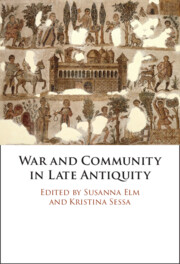
Late Antiquity (ca. 250–600 CE) was a world at war: barbarian migrations, civil wars, raids, and increasingly porous frontiers affected millions of its inhabitants. While military and political historians have long grappled with this history, scholars of late antique society and culture rarely interrogate the consequences of near constant warfare on civilian populations, fighting forces, and the built environment. War and Community in Late Antiquity responds to this oversight by assembling archeologists, art historians, social historians, and scholars of religion to examine the impact of war on communities (households, cities, religious groups, elites and non-elites) and their reactions to ongoing stressors. Topics include the violence of everyday life as backdrop to that of war; the rhetoric of warfare and its significance for Christian authors; the effects of captivity and billeting on households; communal agency and the fortification of civilian spaces; and the challenges of articulating Christian imperial power in wartime.
Hegel famously argues that the patriarchal, bourgeois nuclear family is a rational institution worth defending. Scholars have asked what exactly to do with this seemingly outdated part of his social and political philosophy. In particular, they have wondered whether Hegel's concept of the family can accommodate changes to our understanding of what counts as a family and what constitutes family relations. In this Element, I ask whether Hegel's defense of the family can be reconciled with family abolition, the project not of reforming the family as an institution, but of radically transforming it beyond recognition. By examining the three relationships that Hegel associates with the family – brothers and sisters, husbands and wives, and parents and children – I argue that Hegel's concept of the family can be reconciled with family abolition so described. What Hegel provides is an account of the family as a site at which important goods have been discovered and eveloped, without claiming that the family as an institution is necessary for, or even ideally suited to, their continued realization. These goods are singular individuality, ethical love, and material resources.
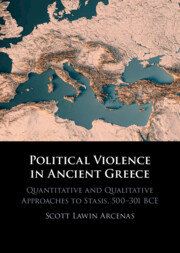
Political violence, which the ancient Greeks called stasis, was a fundamental aspect of Greek society. In this book, Scott Arcenas reshapes our understanding of this important phenomenon. He argues that it differed fundamentally from its analogues in both ancient and modern societies and that in most poleis it occurred with high frequency but very low levels of violence. Stasis therefore promoted economic growth, institutional innovation, and cultural creativity in a variety of important and surprising ways. In order to undertake this study, Dr Arcenas introduces new methods and tools to confront some of the greatest methodological challenges that face scholars of the ancient world: evidentiary scarcity, evidentiary bias, epistemic uncertainty, and lack of clarity regarding the explanatory value of our sources' silence. The book is therefore required reading for a wide range of scholars and students of ancient history.