To save content items to your account,
please confirm that you agree to abide by our usage policies.
If this is the first time you use this feature, you will be asked to authorise Cambridge Core to connect with your account.
Find out more about saving content to .
To save content items to your Kindle, first ensure no-reply@cambridge.org
is added to your Approved Personal Document E-mail List under your Personal Document Settings
on the Manage Your Content and Devices page of your Amazon account. Then enter the ‘name’ part
of your Kindle email address below.
Find out more about saving to your Kindle.
Note you can select to save to either the @free.kindle.com or @kindle.com variations.
‘@free.kindle.com’ emails are free but can only be saved to your device when it is connected to wi-fi.
‘@kindle.com’ emails can be delivered even when you are not connected to wi-fi, but note that service fees apply.
In Euripides’ Phoenician Women, produced around 410 BCE, actor’s lyric takes on a role of unprecedented importance in the shaping of plot and in the development of character, counterposed to and to some extent replacing choral lyric. Antigone, Jocasta, and Oedipus – all singing characters – are inextricably bound up in the ruin of their house. Three of the play’s four scenes of actor’s lyric feature Antigone; through song Euripides traces her progression from a sheltered maiden to a distraught mourner and finally to a mature woman who takes charge of her own and her father’s fate. Euripides here experiments with monody not only as a structural device to shape plot and create meaning but also as a means for the development of a complex female figure through the presentation of her evolving emotional state.
In Euripides’ Iphigenia among the Taurians, produced around 414–412 BCE, the two monodies highlight two critical stages of the heroine’s emotional journey from stasis to purposeful action. In her first monody, Iphigenia mourns the unfulfilled potential of her young life, where each status was canceled, each promised doing undone. Iphigenia’s second monody, delivered after the reunion scene with Orestes, marks a shift in her mind and a crisis in the plot. Here monody becomes a site for thought and decisive action, acting as a deliberative rhesis wherein the heroine formulates a plan for the future. The two monodies in this play thus mark two points in the inflection of Iphigenia’s character as she leaves behind her status as a passive victim and finds her purpose as the functional head of her family.
Monody is an essential part of Euripides’ mature dramatic art. All the surviving examples of actor’s lyric by Aeschylus and Sophocles are songs of lamentation, where the use of solo song emphasizes the relationship between the isolated singer and the larger group. Reacting against this tradition, in his late plays Euripides reconfigures monody by blending it with the other traditional forms of Greek tragedy, such as the agon, rhesis, choral ode, and messenger speech. These reconfigurations, or “liberations,” are signaled so that attention is drawn in each case to the poet’s ingenuity. In addition to this formal innovation, Euripides uses monody as a vehicle to express emotion and develop character on the tragic stage.
In Euripides’ Ion, produced around 414 BCE, the central conflict of the play receives its most explicit expression through the diametrical opposition of passionately held views. These views are expressed at length, but in song and separately, in the monodies of Ion and Creusa. In his opening monody, Ion manifests his devotion to Apollo, his concern with purity and propriety, and his position as an orphan. At the pivotal moment of the play, the Athenian queen Creusa delivers a musical accusation against the god who once violated her and, as she believes, left their infant son to die. Is Apollo benevolent and bright, or violent and uncaring? In the two monodies, Euripides brings together the legalistic exposition typical of agonistic rhesis and the emotionality of lyric song.
The Introduction situates the monodies of Euripides’ late plays in the context of theatrical and musical innovation in Athens in the late fifth century. In plays produced after 415 BCE – in particular Ion, Iphigenia among the Taurians, Phoenician Women, and Orestes – Euripides departs from the model of actor’s lyric established by Aeschylus and Sophocles and followed in his own previous work. Solo song is no longer restricted to women, to royalty, or to situations that call for lamentation; nor is the soloist necessarily closely tied to the chorus. In his late plays, Euripides successively redefines monody: each song takes over a traditional Bauform of tragedy and builds upon it. Monody becomes a site of formal innovation and experimentation. At the same time, solo song facilitates the creation of an individual voice of broad emotional and expressive range.
Euripides’ Orestes, produced in 408 BCE, stands as the culmination of a decade of experimentation with monody as a versatile dramatic form. At the climax of the play, the disappearance of Helen is reported not by a messenger in an iambic rhesis, but by an anonymous Phrygian slave in a virtuosic monody that is twice as long as all the combined songs of the chorus. The tonal and rhetorical ambiguities in the Phrygian’s song underscore the increasing fragmentation and chaos of the plot. This monody overturns the expectations of the audience through its combination of the traditionally antithetical genres of monody and messenger speech. The Phrygian is an unprecedented type of narrator in tragedy, offering instead of an objective reporting of events a “polyphonic” account that draws on multiple genres and styles.
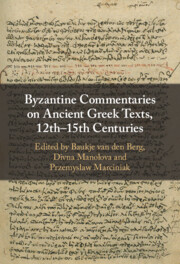
This is the first volume to explore the commentaries on ancient texts produced and circulating in Byzantium. It adopts a broad chronological perspective (from the twelfth to the fifteenth century) and examines different types of commentaries on ancient poetry and prose within the context of the study and teaching of grammar, rhetoric, philosophy and science. By discussing the exegetical literature of the Byzantines as embedded in the socio-cultural context of the Komnenian and Palaiologan periods, the book analyses the frameworks and networks of knowledge transfer, patronage and identity building that motivated the Byzantine engagement with the ancient intellectual and literary tradition.
The continued expansion of the Rāmāyaṇa tradition for the past two millennia and the flexibility of its expression hinges on the fact that the Rāmāyaṇa—as A. K. Ramanujan reminds us—is “always already” (1991, p. 46). The trouble is not in locating its stories. The trouble comes with trying to negotiate all the different ways the stories coexist—all the ways in which they have “already” existed and will continue to “already” exist. Throughout the course of this study, I have tried to connect some of these stories to each other and to the contexts of their creation to demonstrate just how complex the inner workings of the Rāmāyaṇa tradition really are. We must not take for granted the stories we receive; they have been through a long history of change and it is in the social propulsions behind such change that we locate literature's deeper meanings and its effects on the people who create it, read it, pass it on, and bring it into new avenues of expression.
Since the beginning of the Rāmāyaṇa tradition, whenever that may have been, people have evoked the Rāmāyaṇa and the many morals, controversies, truths, and fabrications buried within its stories to bolster any number of social, religious, and political viewpoints. The focus here has been one story that has splintered into numerous modes of narration depending on the needs and intentions of its tellers. As Śambūka's death toll climbs, his narrative tradition gets broader, more complex, and more all-encompassing. Each new iteration carries with it a new message and a fresh perspective on the meaning behind his life and death. Śambūka has died over and over again in a near endless stream of stories, poems, paintings, speeches, dramas, dances, movies, and more. With his story uniquely situated at the intersection of artistic innovation, caste politics, religion, and violence, each expression of his death is poised to comment on a range of social issues and even on the nature of the Rāmāyaṇa itself.
The purpose underlying Śambūka's death has been evolving since the first time his story was penned in the Vālmīki Rāmāyaṇa. By showing some concern for Śambūka's afterlife, Kālidāsa used the story to demonstrate Rāma's graciousness and authority in alignment with the Gupta Empire's religious innovations and political ambitions.
After Brahminism gained a strong footing in post-Mauryan South Asia—a footing typified by the codification of varṇadharma—the next great South Asian empire, the Guptas, crafted their own schematic for an imperial religion. With the Guptas came an imperially sponsored Vaiṣṇavism marked by a burgeoning temple culture that involved elaborate structures and public spaces that provided the public with a new kind of access to religion (Willis, 2009). The Guptas’ presentation of Vaiṣṇavism opened Viṣṇu worship up to an unprecedented level of popularity, which extended to Viṣṇu's various incarnations (avatāras), including Rāma. Naturally, a text that frames Rāma as both divine figure and avatāra of Viṣṇu as well as a hero in his own right was bound to benefit from the momentum of the religious movement spearheaded by the Guptas. The story of the Rāmāyaṇa, then, saw a rejuvenated life in this new era of South Asian history.
The story of Rāma was, at this point, still largely defined by Vālmīki's Rāmāyaṇa. As interest in the story grew, critical perspectives on this quintessential Rāma text began to emerge. In the world of the VR, it is Rāma's responsibility as king to maintain the prevailing social order by which his kingdom is to be governed and mete out the necessary punishments when that order is violated. The text's Śambūka episode exemplifies both a violation by a member of Ayodhyā's society and the proper response to it, carried out by the king himself. Be that as it may, Rāma's unquestioningly swift action against Śambūka placed him in a role of enforcer that is at odds with the compassionate image of Rāma that pervades a great deal of the epic. The difficulty in reconciling these two seemingly conflicting images of Rāma created a troubling puzzle for later authors who lived in a world where Rāma's divinity and the idealism it represented were becoming increasingly accepted. How could they reframe Rāma's involvement in Śambūka's death to better suit the changing expectations of their audience without abandoning the issue of Rāma upholding Ayodhyā's social structures?
Adjustments to the Śambūka episode covered up to this point have largely been part of a calculated reframing of this controversial moment in theUttarakānḍa in order to protect Rāma's image. The intent had not been to empathize with Śambūka, but rather to elevate Rāma and update the circumstances of their interaction to match prevailing religious sentiments regarding Rāma and his divinity. Throughout the twentieth century, however, we see a new battleground for the details surrounding Śambūka's death. In this new context, Śambūka is the central figure, not Rāma; the protagonist, not the antagonist. One reason for the shift in focus is the fact that new contributors to the Śambūka tradition came from the same social position as Śambūka himself, and their primary purpose in calling on his narrative was to present powerful challenges to the caste system. It is necessary to keep in mind, however, that the perspectives on Śambūka—or even on how to approach the problem of caste—within these groups have never been monolithic. Anticaste ideation has had many different expressions throughout history and figures in the twentieth century representing numerous activist groups sought to reframe the details of the Śambūka story to promulgate their specific anticaste messaging. In formulating such messaging, some made references to a generalized, skeletal Śambūka narrative in hopes of evoking the tragedy of his death to expose long-standing casteism in Indian society. Others created entirely new works on Śambūka, digging deep into the narrative and adjusting its nuances to suit the exact type of message they were promulgating. While the precise message varied, the narrative framework within which these authors were working was often the same: Śambūka was a charismatic leader and teacher of the oppressed classes of India and he died a martyr.
In this chapter, I detail the sociopolitical background that allowed for activists to mobilize the Śambūka narrative against the caste system and I provide several examples of how such mobilization manifested. The anticaste activism covered here operated largely in the realm of literature, which featured new ruminations on the Śambūka story coming from India's socially oppressed communities. However, given that this body of literature advocated for the abolition of caste and typically—though not always—depicted Rāma in an unfavorable light, it often encountered robust challenges from more dominant segments of India's religious and political society.