To save content items to your account,
please confirm that you agree to abide by our usage policies.
If this is the first time you use this feature, you will be asked to authorise Cambridge Core to connect with your account.
Find out more about saving content to .
To save content items to your Kindle, first ensure no-reply@cambridge.org
is added to your Approved Personal Document E-mail List under your Personal Document Settings
on the Manage Your Content and Devices page of your Amazon account. Then enter the ‘name’ part
of your Kindle email address below.
Find out more about saving to your Kindle.
Note you can select to save to either the @free.kindle.com or @kindle.com variations.
‘@free.kindle.com’ emails are free but can only be saved to your device when it is connected to wi-fi.
‘@kindle.com’ emails can be delivered even when you are not connected to wi-fi, but note that service fees apply.
The initial editions and, more importantly, the first reproductions of the few extant Latin papyri introduced a novel approach to our understanding of writing and provided new interpretative tools that generally remain relevant well beyond the Roman period. This brief reflection discusses several technical terms used to describe significant graphic features from the Roman era. The author maintains that a specialised vocabulary – essential in any discipline aspiring to scientific rigour, such as palaeography – is both a fundamental tool and a product of a systematic methodology and critical analysis.
Chapter 20 presents the way in which Proclus interpreted the figure of the tyrant in Plato’s dialogues. Tyranny is based on force, violates law, both cosmic and human, and is motivated by a misled desire for power, power divorced from goodness and knowledge. I argue that Proclus and other Platonists, Damascius and Simplicius, could use this interpretation of Plato to describe the political regimes of their period, in particular the rule of Emperor Justinian, as tyrannies. These tyrannies, in their metaphysical ignorance and moral turpitude, violated divine order and law in destroying pagan temples and statues. I consider finally the cases of two authors, John Lydus and Procopius of Caesarea, who describe Justinian’s rule in terms of kingship or tyranny.
This book destabilises the customary disciplinary and epistemological oppositions between medieval studies and modern medievalism. It argues that the twinned concepts of “the medieval” and post-medieval “medievalism” are mutually though unevenly constitutive, not just in the contemporary era, but from the medieval period on. Medieval and medievalist culture share similar concerns about the nature of temporality, and the means by which we approach or “touch” the past, whether through textual or material culture, or the conceptual frames through which we approach those artefacts. Those approaches are often affective ones, often structured around love, abjection and discontent. Medieval writers offer powerful models for the ways in which contemporary desire determines the constitution of the past. This desire can not only connect us with the past but can reconnect present readers with the lost history of what we call the medievalism of the medievals. In other words, to come to terms with the history of the medieval is to understand that it already offers us a model of how to relate to the past. The book ranges across literary and historical texts, but is equally attentive to material culture and its problematic witness to the reality of the historical past.
Despite dramatic changes in the dynamics between medieval studies and medievalism, the medieval is still seen as the originary moment of medievalism, which is still regarded in turn as a screen for projecting various fantasies and desires about the past. Scholarly medieval studies are supposedly characterised by their dispassionate enquiries into the past. Yet medieval studies has a long and mixed history of affective relationships with the past it fosters: passion and professionalism often go hand in hand. This complex history makes it hard to distinguish medieval scholarship from the amateurism – the love for the past – that is often said to characterise medievalism as well as scholarly antiquarianism. Debates about the efficacy of affect as a mode of reiy about the past lead to a discussion of two related terms: history and memory.
This chapter asks whether the mutual discontent we have diagnosed between medieval studies and medievalism is inevitable in future practice in these fields. Through its interest in recuperating the past, medievalism is an exemplary practice for the humanities and their understanding of history and culture. Facsimiles of medieval manuscripts further exemplify many of the similarities between medieval and medievalist study, and also our necessary discontent with most of the ways scholarship attempts to get back to and “touch” the past. In the face of contemporary critiques of disciplinarity, we suggest that medieval and medievalism studies together are well placed to model new forms of academic engagement and resistance to the utilitarianism and vocationalism that increasingly dominates our universities. Productive engagement with the medieval past, from a wide range of disciplinary approaches, remains an urgent task for understanding the world around us.
Medieval relics have the uncanny capacity to pleat time: to bring past and present into close relationship. In the sixteenth century, Protestant reformers attacked the cult of relics – objects that claimed to carry the “touch” of the past – in search of a greater truth about the medieval past. This process is analogous to many of the influential formations of medievalism, and the construction of the medieval period as the other to rational modernity. At the same time, the reformers’ discourse about relics was not absolute: this chapter argues that belief and disbelief are not binary opposites but are held in complex and enabling tension. Reformist thinkers and writers were suspicious of the medieval (that is, Catholic) capacity to be constantly remaking the past: that is, to be engaging in medievalism. But relics and reliquaries depend on the category of “wonder”, which resists conventional historical ontologies, and opens up such categories to the study of cultural affects.
Scholars of the medieval past are often drawn to a kernel of historical truth that might guarantee the truth of their enquiries, but medievalist scholarly and cultural practice reveals the impossibility of this secure knowledge. Affective responses to the past continue to structure our understanding of historicity and temporality; just as the strange familiarity of the Middle Ages in the present is a form of “uncanny” knowledge and feeling. Medievalism is a social and cultural practice, not a secure epistemological category. Indeed, as a practice, medievalism constantly troubles the apparently simple alterity of the Middle Ages, leading to intellectual and affective discontent from both medieval scholars and medievalist practitioners.
Conventional wisdom sees medievalism occurring “after” the Middle Ages; and indeed much medievalist practice seems to support this view, as the Middle Ages are often conceptualised in spatio-temporal terms, through the fictions of time travel and the specific trope of “portal medievalism”. But the two formations are more accurately seen as mutually constitutive. Medieval literature offers many examples of layered or multiple temporalities. These are often structured around cultural and social difference, which is figured in powerfully affective, not just epistemological terms. Several examples from medieval English literature demonstrate how medieval culture prefigures many of medievalism’s concerns with the alterity of the past.
As a disciplinary formation, medieval studies has long been structured by authoritative hierarchies and conservative scholarly decorums; the associated fear of error in medieval studies dates back to the Renaissance and the Protestant reformation. In contrast, medievalism increasingly celebrates creative play and imaginative invention. Such invention inevitably produces anxiety about historical accuracy. Popular scholarship and journalism in turn are often attracted to the abject otherness of the Middle Ages, especially the torture practices associated with its judicial systems. Such practices are designed to solicit the truth, and so, like illness, mortality and death, they are a useful double trope through which to analyse the relationship between medieval and medievalist approaches to the past.
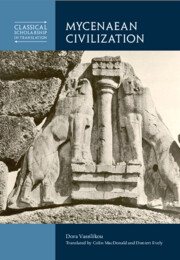
The Bronze Age of Greece was unknown until the end of the 19th century, when Heinrich Schliemann's excavations stunned the world by bringing to light the glamour of Mycenaean elite society. This book, by one of Greece's most distinguished archaeologists, provides a complete introduction to Mycenaean life and archaeology. Through both chronological and thematic chapters, it examines the main Mycenaean centres, the palaces and kingship, the social structure, writing, religion and its political implications, and the contacts and relations of the Mycenaeans with neighbouring countries, especially Asia Minor, Egypt, the coast of Syria-Palestine and Italy. Attention is paid to the distinctive Mycenaean art, including monumental architecture, gold and silver metalwork and jewellery, and the book is supported by over 300 illustrations. Dora Vassilikou concludes by examining the simultaneous catastrophes that brought the Bronze Age of the Eastern Aegean to its end and opened up a new era.
Medieval film' forces us into a double-take on chronology. This book argues that such a playful confusion of temporalities is a fundamental characteristic not just of the term but also of medieval films themselves. Medieval films reflect on the fact that they make present a past that was never filmable and offer alternatives to chronological conceptions of time. The book examines the contrasting uses, or non-uses, of medieval art objects in two medieval films and assesses how they contribute to the films' overall authenticity-effects. It makes tentative contribution to a list of such characteristics: that the fragmented visual profile of the medieval makes medieval authenticity-effects particularly troublesome to produce. The reliance of film theory on medievalism has never been acknowledged by film scholars. The book shows the ways in which preconceived notions of the Middle Ages filtered into and were influenced by film theory throughout the twentieth century; and to what extent film theory relies on knowledge about the Middle Ages for its basic principles. It explores to what extent medieval film engages with questions of language, and to what extent these engagements may be distinctive. Cinematic medievalism participated in and drew on a wider cultural and political preoccupation with the Middle Ages. Romanticism posited the Middle Ages as an alternative, utopian realm promising creative and political possibility. The book argues that certain films with medieval themes and settings, mostly dating from the 1940s to the 1960s, demonstrate a surprising affinity with the themes and techniques associated with film noir.
This book on Geoffrey Chaucer explores the relationship between Chaucer's poetry and the change and conflict characteristic of his day and the sorts of literary and non-literary conventions that were at his disposal for making sense of the society around him. Critics who consider the social meaning of Chaucer's Canterbury Tales fall into two main schools: those who present his social thought as an expression of the dominant spirit or ideology of his day and those who see Chaucer as possessing a more heterodox voice. Many of the present generation of Chaucer critics have been trained either as 'Robertsonians' or as 'Donaldsonians'. For D. W. Robertson, even those medieval poems which do not explicitly address religious issues were frequently intended to promote the Augustinian doctrine of charity beneath a pleasing surface; for E. Talbot Donaldson, there are 'no such poems in Middle English'. The book sets out the basics of the Augustinian doctrine of charity and of medieval allegorical theory and examines 'patristic' interpretations of Chaucer's work, particularly of the 'Nun's Priest Tale'. It looks at the humanist alternative to the patristic method and assesses the strengths and weaknesses of the patristic approach. The book also outlines some of the major medieval discourses about sexual difference which inform Chaucer's depiction of women, in particular, the tendency of medieval writers to polarise their views of women, condemning them to the pit or elevating them to the pedestal.