To save content items to your account,
please confirm that you agree to abide by our usage policies.
If this is the first time you use this feature, you will be asked to authorise Cambridge Core to connect with your account.
Find out more about saving content to .
To save content items to your Kindle, first ensure no-reply@cambridge.org
is added to your Approved Personal Document E-mail List under your Personal Document Settings
on the Manage Your Content and Devices page of your Amazon account. Then enter the ‘name’ part
of your Kindle email address below.
Find out more about saving to your Kindle.
Note you can select to save to either the @free.kindle.com or @kindle.com variations.
‘@free.kindle.com’ emails are free but can only be saved to your device when it is connected to wi-fi.
‘@kindle.com’ emails can be delivered even when you are not connected to wi-fi, but note that service fees apply.
Dispensing once and for all with the idea that Ennius’ Sacra historia was an exercise in Scipionic propaganda, this chapter argues that that prose text was integral to Ennius’ vision of Roman history and authorial self-fashioning. Despite the opacity of their transmission by Lactantius, the fragments of the Sacra historia reveal their author as an interpretative innovator exploiting linguistic effects only possible in translation. The way that this text mediates between Greek and Roman antiquities through multilingual interpretes, moreover, reveals a characteristic but underappreciated aspect of Ennius’ creative persona.
This pithy Introduction justifies the existence of the volume and explains why its contributors do not apply the term “minor works” to Ennius’ corpus. It then provides an overview of the diversity of this corpus, zooming in on the remains of his comedy as an example of what is not quite lost, and briefly shows that Ennius deeply influenced the Roman literary tradition as a multiform author (not just as an epicist). The Introduction closes by explaining the dispensation of the volume and what its contributors achieve.
It is well known that Ennius stands out among the early Roman writers by being active in a variety of literary (mainly poetic) genres. It is also obvious that there are clear distinctions in form and themes between the different types of works in line with their generic identity; at the same time, some stylistic features, motifs, and concepts may be observed in works assigned to different literary genres. This chapter explores such items in Ennius’ corpus and discusses the respective role of generic distinctions. Such a study contributes to identifying typical aspects of Ennius’ output as a whole as well as to describing specific generic manifestations.
This chapter takes a new look at Ennius’ Andromacha and particularly at her self-description as arce et urbe orba sum (23 TrRF II). Scholarship has well explicated how the formulaic words arce et urbe characterize Andromacha, to quote Jocelyn, as “a stateless person in terms of Roman law” (Jocelyn 1967). But scholarly focus on the religious formula has obscured the equally poignant allusion encoded in her choice of verb. Orbus is a word whose primary definition is of a child deprived of their parents or, conversely, of a parent who has lost a child. This chapter explores how Ennius boldly harnesses these familial connotations to create an arresting metaphor that totalizes Andromache’s loss. In doing so, he subtly genders Andromacha’s meditation on the loss of her recent past as well as significantly prefiguring the greater loss that the audience (but not yet Andromacha) knows is coming by the tragedy’s end, the tossing of Astyanax from the arx of Troy.
This chapter offers an analysis of the reception of Ennian tragedy in republican Latin poetry, focussing on Pacuvius, Accius, Lucretius, and Catullus. The main methodology employed is that of intertextual analysis. The main thesis advanced is that, while Ennian tragedy seems to have retained its generic distinction and importance in subsequent tragic poetry of the second century bce, by the late Republic, Ennius seems to be more important because of what he has come to represent as a poetic figure and as a repository of poetic material than as a tragedian or epicist.
This chapter argues that Ennius began his epic poem, the Annales, by boasting about his non-epic literary accomplishments, in particular his Saturae. It proceeds to corroborate this view by demonstrating that Ennius’ non-epic and non-tragic corpus – his Saturae, Sacra historia, Scipio, Sota, Epicharmus, and Hedyphagetica – continued to be read and engaged with by important Latin figures (e.g., Terence, Virgil, Apuleius, Lactantius) for hundreds of years. Multiplicity was key, therefore, both to Ennius’ self-representation and to his long Roman reception.
Contemporary scholarship has taken such pains to remove the label poeta cliens from the reputation of Ennius and to dissociate his Annales from the praise of any one individual that the apparent fixation on Scipio Africanus, much praised in the epigrammatic fragments and subject of the deeply problematic work bearing his name, can come as a shock. What is going on? How do we reconcile the testimony of these works with what we think the Annales preserves of the poet’s loyalties and civic ideology? This chapter explores the nature of praise in early Roman literature in the hope of casting at least a little light on this problematic aspect of Ennius’ career.
With roots in the Homeric scholarship produced in the Library of Alexandria in the third and second centuries BCE, the ancient scholia to the Iliad constitute the richest and most extensive collection of ancient criticism on the most widely read poem in Greco-Roman antiquity. Excerpted from lost works of ancient scholarship and transmitted as marginal and interlinear comments in medieval manuscripts of the Iliad, these scholia contain a remarkable wealth of insights into the constitution of the Homeric text, the readings and editorial principles of ancient grammarians, the literary interpretations of ancient critics, and the lessons that ancient readers took from Homer. This volume provides the first English translation of the ancient scholia to Iliad books 1–2. With a clear and accessible introduction, extensive explanatory notes, and a glossary of ancient scholars, this book serves as the ideal guide to this complex and fascinating tradition.
Diachronic Narratology in Greek Myth looks at ancient Greek mythology from the viewpoint of its storytelling through time. There are hundreds of different figures and stories in Greek mythology, interconnected in a complex narrative network. While earlier research often sought to penetrate the core of the seemingly 'true' or 'original' myths, it is now better understood that the way the myths were conveyed constitutes their actual essence: how a story is told, and retold, cannot be separated from the story itself. Based on brief introductions to the basics of mythology and narratology, this Element offers a discussion of three paradigmatic characters from Greek mythology and their voyage through literary history: Odysseus, Herakles and Helen. It demonstrates how a narratological approach can enrich our perspective on, and understanding of, mythology.
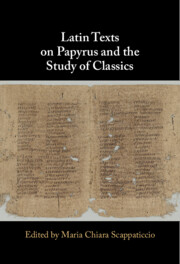
This volume gathers 25 chapters focused on Latin texts on papyrus, exploring them from multi- and cross-disciplinary perspectives. It serves as a companion to the texts published in The Corpus of Latin Texts on Papyrus (Cambridge, forthcoming). The chapters provide in-depth analyses of the chosen texts from literary, philological, linguistic, and historical perspectives, or offer methodological reflections on Latin texts on papyrus, promoting innovative approaches. They cover topics ranging from palaeography and philology to Latin literature and from ancient law to ancient and medieval history, and brilliantly demonstrate the potential of Latin texts on papyrus to inspire and illuminate the field of Classics.
Quintus Ennius (239–169 BCE) was Latin literature's extraordinary founding father: he composed a striking array of texts in a striking array of genres (tragedy, satire, philosophy, epigram, epic, and more), many of which he in fact introduced to, or invented at, Rome. Modern scholarship, however, has focused overwhelmingly on just one Ennian poem: his epic, the Annales. Assembling an international team of literary critics and philologists, Ennius Beyond Epic provides the first assessment of Ennius' corpus in all of its unruly totality. Its thirteen chapters range widely: some examine themes throughout the poet's fragmentary output; others offer analyses of particular non-epic texts (e.g., Andromacha, Sacra historia, Saturae); still others study the Roman reception of Ennius' corpus from Pacuvius to Catullus to Apuleius and beyond. The picture that emerges is of a New Ennius: a daring, experimental, and multiform author.
A range of sciences was taught in the Platonist schools of late antiquity (third to sixth centuries) with the purpose of leading the human soul up to a divine life. This curriculum constituted so to speak a ladder of the sciences. The ways in which these sciences were newly interpreted in this context have not, however, been fully appreciated. This volume brings together selected essays, some translated into English for the first time, which show how a new vision of these disciplines and sciences was reached as part of a Platonist philosophical education. They cover a wide range of topics, from rhetoric, ethics and politics to mathematics, music and metaphysics, and discuss the work of various philosophers. Dominic O'Meara is considered one of the foremost scholars of Platonism and this book provides readers with an indispensable tool for accessing his most important scholarship in this area.