To save content items to your account,
please confirm that you agree to abide by our usage policies.
If this is the first time you use this feature, you will be asked to authorise Cambridge Core to connect with your account.
Find out more about saving content to .
To save content items to your Kindle, first ensure no-reply@cambridge.org
is added to your Approved Personal Document E-mail List under your Personal Document Settings
on the Manage Your Content and Devices page of your Amazon account. Then enter the ‘name’ part
of your Kindle email address below.
Find out more about saving to your Kindle.
Note you can select to save to either the @free.kindle.com or @kindle.com variations.
‘@free.kindle.com’ emails are free but can only be saved to your device when it is connected to wi-fi.
‘@kindle.com’ emails can be delivered even when you are not connected to wi-fi, but note that service fees apply.
Homer’s epics constitute a combination of aggregation and antithesis. The most obvious expression of aggregation is the Catalogue of Greeks and Trojans in Iliad 2, which has Near Eastern parallels. This is combined with antithetical (balanced) duels between pairs of warriors. The shield of Achilles (Iliad 18) presents a series of human activities, sometimes in paired form, that suggest symmetrical oppositions (e.g. between war and peace, town and country), though these are introduced in aggregative, list-like language. The shield as a whole edges towards comprehensiveness of a kind we can associate with the emerging polis. The shield of Achilles can be compared with contemporary Phoenician bowls which also convey, in visual form, the combination of aggregation and antithesis. However, the different form of the epic, including extended and structured narrative, gives scope for less bounded forms of antithesis. One such example is the meeting of Achilles with Priam in Iliad 25, replacing extreme violence with peaceful reconciliation. Another, very striking, example is the meeting in battle of former guest-friends Diomedes and Glaukos in Iliad 6 and exchange of armour, gold for bronze. The second incident combines verbal antithesis with a transaction that prefigures commercial exchange.
Antithesis in the form of the unity of opposites appears to a limited extent in the early mythic cosmogonies. However, this theme emerges much more strongly in subsequent presocratic thought. This phenomenon was analysed closely by Geoffrey Lloyd without being explained; here, presocratic speculation on the cosmos is explained as ‘cosmisation’, that is, interpretation shaped by a combination of political and economic factors alongside mystery cult. Anaximander’s idea of the universe as apeiron (‘unlimited’) is interpreted as a projection of the qualities of money, reflecting the emerging process of monetisation. Anaximander’s characterisation of the interchange of different elements within the unlimited in terms of ‘order’ and ‘retribution’ reflects both monetisation and emerging political structures. Similar factors underlie Herakleitos’ sustained focus on antithesis in the sense of the unity of opposites. Herakleitos’ universe is one of continuity within constant change, unity within interchange, expressed as fire or logos (‘reason’ or ‘calculation’). This worldview reflects the expanding influence of commercial exchange that underpins the emergence of a unified polis. It also reflects the paradoxical combination of unity and opposites within mystery cult, which is formulated in ritual language and gestures couched as antithetical dyads.
This chapter defines the terms used throughout the book to analyse prevalent patterns in literature, thought and visual art in Ancient Greece (eighth to fourth centuries bce) and corelate them with the contemporary economic and political situation. Aggregation is defined as a paratactic sequence or assemblage of otherwise unrelated items. Antithesis is defined as the symmetrical representation of opposites. Antithesis is subdivided into antagonistic or peaceful, balanced or unbalanced, focused or unfocused. These are the central terms for this book. A further category, of less importance for this purpose, is asymmetrical opposition, which is subdivided into antagonistic and balanced or antagonistic and unbalanced or non-antagonistic.
Fifth-century Greek tragedy and visual art centres on interaction between people, including antithetical relations, reflecting a society shaped by monetised exchange and commerce. Platonic metaphysics is focused on unchanging being, placing supreme value on the possession of money and devaluing or excluding exchange and interaction. Although dialogues such as the Phaedo contain the idea of the unity of opposites, and binary opposites such as body and soul, Platonic metaphysics aims at the negation of opposites, and thus of antithesis. The contrast between being and seeming emerges in fifth-century tragedy and philosophy, but it is given much greater prominence by Plato and is linked with the theory of Forms. One of the Platonic accounts of the relationship between Forms and particulars is in terms of original (Form) and copy or image (particulars). Plato is the first to offer a theorization of the idea of the image (in the Sophist) and to define the idea of mere image (not reality). Plato’s treatment of the being-seeming relation, like the theory of Forms generally, expresses the reification of the value of money, treated as the basis of possession, excluding exchange.
This chapter discusses the increasing presence of antithesis, rather than aggregation, in fifth-century Greek historiography, tragedy and vase-painting. In certain key incidents and in narrative patterns in Herodotus and Attic tragedy, we find antithesis in the form of the unity of opposites and the reversal of an apparently stable situation. This reflects the influence of mystic initiation, Pythagorean thinking (in the case of Aeschylus), and, in a broader sense, the emergence of the polis, in which social oppositions are contained within a political unit. In fifth-century Attic vase-painting and sculptural groups, there is also a progressive shift from aggregation to antithesis, paralleling the pattern found in the newly emerging genres of historiography and tragedy. This too reflects the increasing prevalence of monetary exchange and interactions within the unified framework of the polis.
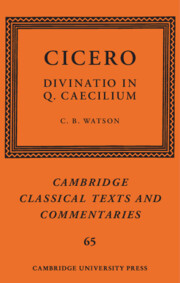
This is the first scholarly commentary on Cicero's Divinatio in Caecilium and the first new critical edition in over 100 years. The commentary demonstrates that the Divinatio was atypical of the genre. In both form and content, the speech is styled as a forensic prosecution rather than a pre-trial deliberation. It also functions as an effective piece of literary criticism and a pedagogical treatise to preface the Verrine corpus. Consequently scholars are encouraged to reconsider how published oratory in Rome functioned as teaching aid, personal propaganda, historical record, and literary production. The Divinatio touches on issues with strong resonance for contemporary society: the responsibility of the government to represent and defend marginalised communities, cultural identity and integration in a multi-ethnic society, the perils of persuasive speech, abuses of political and military power, due process of law, and changing notions of intellectual and cultural property.
Explores two instances early in the Metamorphoses where chaos exerts itself on the formed world, namely the climate crises triggered by the flood and Phaethon narratives. These narratives frequently occur as a pair in philosophical discourses, where conflagrations and floods are seen as part of a regular cosmic cycle, whereby the world moves between phases of increasing and decreasing entropy, such as in the Stoic theory of the Great Year or in Empedocles’ cosmogony. In such cases, the Phaethon and flood narratives are seen as myths that can be mined for evidence of a ‘true’ scientific doctrine. In the Metamorphoses, however, the narratives of Phaethon and the flood do not indicate a stable cycle but rather are expressions of a world continually veering towards a chaotic collapse. This becomes evident when reading these narratives through the cosmic theories of Empedocles, Plato, and Lucretius.
Provides a short epilogue that discusses how the works of Ovid and especially the Metamorphoses were aligned with Platonist and Neoplatonist views of the cosmos in the eleventh and twelfth centuries before making some concluding remarks.
Explores the interaction between love poetry and philosophy in Ovid and Plato. The philosophical uncertainty that results from Ovid’s visions of fluid ontologies is not restricted to the Metamorphoses but can also be identified in his earlier elegiac work, as love too is subject to constant change. Love and desire are also frequently theorized in ancient philosophy, with Ovid’s didactic Ars Amatoria integrating and distorting elements of this tradition. Its combination of a speculative approach to love with manipulative rhetoric, all with the goal of fostering and pursuing the object of desire, has clear precedents in the philosophical tradition, most notably Plato’s Symposium and Phaedrus. The nature of love, however, remains fundamentally elusive, and its definition something of a paradox. The dangers of abduction and sexual assault, however, remain a dark undercurrent in both Ovid’s and Plato’s works. This danger is closely associated with poetry in the Phaedrus, which includes myths of abduction and metamorphosis that internally disrupt the philosophical dimensions of the dialogue. Comparisons are also drawn between passages from the Symposium and Phaedrus and Ovid’s narratives of Narcissus and Hermaphroditus from the Metamorphoses.
Explores how Ovid in the Tristia and Ex Ponto adopts imagery associated with the eschatological exile of the soul and instead applies it to his own fate at the shores of Tomis so as to give his geographical banishment cosmic significance. Ovid plays upon a longstanding association between philosophy and exile and the notion that the philosopher may be seen as a citizen of the world and so is effectively immune to banishment; Ovid instead views himself as superseding the philosophers and especially Socrates in the hardships he endures in Tomis. The dangers of misreading and the potential destructive dimensions of the text are discussed in relation to Ovid’s Ibis and Plato’s myth of Theuth from the Phaedrus. Connections are also traced with Plato’s Phaedo and the Epistles, as we turn our attention back to ideas of misreading and failures of communication that result from the dislocations of exile.