To save content items to your account,
please confirm that you agree to abide by our usage policies.
If this is the first time you use this feature, you will be asked to authorise Cambridge Core to connect with your account.
Find out more about saving content to .
To save content items to your Kindle, first ensure no-reply@cambridge.org
is added to your Approved Personal Document E-mail List under your Personal Document Settings
on the Manage Your Content and Devices page of your Amazon account. Then enter the ‘name’ part
of your Kindle email address below.
Find out more about saving to your Kindle.
Note you can select to save to either the @free.kindle.com or @kindle.com variations.
‘@free.kindle.com’ emails are free but can only be saved to your device when it is connected to wi-fi.
‘@kindle.com’ emails can be delivered even when you are not connected to wi-fi, but note that service fees apply.
Plato criticizes Homer’s effort to promote religious skepticism through his portrayal of the gods for overestimating the power of human reason and underestimating the power of human passions, and he criticizes Homer’s education concerning human excellence for inadvertently glamorizing the passionate and tragic hero Achilles and all too effectively hiding his own example as a philosophic thinker behind the mask of the divinely inspired singer. Plato therefore replaces the Homeric education with a new, poetic, Platonic education that presents Socrates – the fearless, dispassionate, self-sufficient, apolitical philosopher who promulgates the pious, edifying, and reassuring doctrines of the separate Forms and the Immortality of the Soul – as an explicit object of admiration and model for imitation.
A study of Homer in conjunction with Plato, Machiavelli, and Nietzsche confirms that Homer was a philosophic thinker and that he plays an illuminating role in the thought of each of the three political philosophers. This study also shows that there are many ways of living a philosophic life; that philosophers may present themselves in different guises depending on the political, religious, and intellectual circumstances they may find themselves in; that their most fundamental choice is whether or not to present themselves explicitly as philosophers; and that therefore we must broaden our understanding of who a philosopher is beyond those who explicitly present themselves as philosophers and consider the possibility that a number of poets, statesmen, historians, and even theologians of the past may also be philosophers in their own right.
Homer plays an important but overlooked role in the history of political philosophy. Plato criticizes the philosophic tradition founded by Homer and establishes a new one in its place; Machiavelli and Nietzsche, two leading philosophic critics of Plato, invoke Homer in their arguments against Plato and his legacy.
Nietzsche criticizes Plato for having praised the philosophic life in such a way as to deprive the active political and military life of the honor and vitality it enjoyed in the Greek culture founded by Homer and therefore seems to call for a reversal of the moral and political legacy of Platonism and Christianity and a revival of Homeric culture. But Nietzsche ultimately criticizes Plato more seriously, not for explicitly celebrating the philosophic life as the best way of life for a human being, but rather for presenting the philosopher as a champion of morality and religion and thereby obscuring the skeptical nature of the philosopher and he therefore seeks, through his rhetorical presentation of philosophy as emphatically opposed to morality and religion, to reintroduce the radical moral and religious skepticism of philosophy to a world that has lost sight of it.
Homer first presents as a model of human excellence the hero Achilles, who lives a life of political and military virtue to the fullest, who becomes painfully aware of the limits of that way of life, and whose example as a tragic, suffering, questioning hero points to the contemplative singer Homer as the true model of human excellence in the Homeric poems. Through his explicit, skeptical judgments concerning gods and heroes; his scientific but compassionate accounts of death; and his similes, Homer points to himself as a philosophic thinker, but he deliberately hides his philosophic life in the poems to avoid incurring popular hostility and to encourage the most thoughtful members of his audience to discover the independent-minded life of philosophy on their own and for themselves.
Plato identifies Homer as the philosophic educator of Greece but severely criticizes the Homeric education for his portrayal of the gods, his portrayal of heroes as exemplars of human excellence, and his portrayal of himself. Homer reveals through his poems that nature limits the power of the gods and that the gods’ own immortal nature renders them incapable of understanding and caring for humans and hence incapable of providing for them.
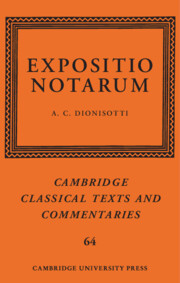
This is the first edition of a Latin text unlike any other surviving one : at first sight an extensive, jumbled list of words with explanations, on closer inspection a window on the teaching of Latin shorthand in North Africa c. AD 400, when we find notarii, those trained in shorthand, prominently employed everywhere in state and church. The text reveals in detail how that training could relate to literary Latin and the classical Roman past. The single manuscript of it in our possession descends from a copy that must have been in Anglo-Saxon England by AD 700, and we can see how it was used for the earliest Latin glossary from that context. The edition seeks to make this story accessible both in general and in detail, with copious indices for those who may wish to consult it from various viewpoints: classical and later Latin, linguistic and historical.
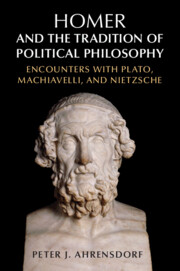
In this book, Peter Ahrensdorf explores an overlooked but crucial role that Homer played in the thought of Plato, Machiavelli, and Nietzsche concerning, notably, the relationship between politics, religion, and philosophy; and in their debates about human nature, morality, the proper education for human excellence, and the best way of life. By studying Homer in conjunction with these three political philosophers, Ahrensdorf demonstrates that Homer was himself a philosophical thinker and educator. He presents the full force of Plato's critique of Homer and the paramount significance of Plato's achievement in winning honor for philosophy. Ahrensdorf also makes possible an appreciation of the powerful concerns expressed by Machiavelli and Nietzsche regarding that achievement. By uncovering and bringing to life the rich philosophic conversation among these four foundational thinkers, Ahrensdorf shows that there are many ways of living a philosophic life. His book broadens and deepens our understanding of what a philosopher is.
Chapter 2 investigates how identity in Senecan tragedy is achieved via sympathetic identification with others, whether individuals or groups. The chapters focuses on Roman practices of exemplarity, which encouraged the formation of individual selves via the appropriation of others’ - often normative - characteristics. This habit of coyping and becoming a copy of other people connects the human individual to the fictional character, which is by nature inherently replicable. The two plays discussed in this chapter are Troades, where Astyanax is constantly characterised as a ‘second Hector’, and Hercules, where the protagonist pursues self-aemulatio in place of family attachments.
Chapter 1 examines behavioural coherence as a marker of both fictional and actual identity. Concentrating on the recognition scenes in Medea and Thyestes, this chapter contends that Senecan recognition is less about revelation than about validation of an identity achieved through consistent, habitual conduct. It discusses key concepts of decorum and Stoic persona-theory as ways of evaluating Atreus‘ and Medea’s self-construction. It also demonstrates how such behavioural repetition has gone largely unnoticed, as scholars have focused instead on the textual repetition highlighted by dominant methods of intertexual analysis.
The literary culture of early modern England was bilingual; literature of all kinds, including poetry which is the focus of this book, was read and written in both English and Latin throughout the whole of the period that we call Renaissance or early modern. Both the overlap and the lack of overlap between Latin and English poetry make a difference to our understanding of this literary culture. It matters that so many apparently innovative moves in English poetics – including the fashion for epyllia, epigrams and Cowley’s ‘irregular’ Pindaric odes – can be traced back to continental Latin poetry: that is, to ‘neo-’ Latin rather than primarily classical verse; it is also important that there are some forms – such as sonnets in English and (until Marvell’s First Anniversary) short panegyric epic in Latin – that were a characteristic feature of verse in one language but not the other. This introduction outlines the educational and literary context in which this poetic bilingualism emerged and developed, with a particular emphasis upon the cultural centrality of 'paraphrase' broadly understood.
Unlike some ofthe poetic forms discussed in subsequent chapters, which have a discernible ‘vogue’ and then fall out of fashion, the 'moralizing lyric'was consistently popular throughout the whole of the period covered by this book, and several are among the most widely circulated poems of early modernity. Key examples, composed between the 1530s and the early eighteenth century, from Wyatt to Watts (and indeed well beyond that, far beyond the scope of this book), recognizably belong together. But this most ostensibly English of forms has its roots in the translation and imitation of classical poetry, and emerged in the sixteenth century in both Latin and English, with influence moving in both directions. As a starting point for this book, it demonstrates what can be learnt by a serious attention to literary bilingualism: repeatedly, it is the Latin versions , including translations of the best-known English examples into Latin, which point to the classical texts (especially Horace, Seneca and Boethius) that underpin these poems, and the (broadly) Latin lyric context to which they were understood to belong by contemporary readers.
The Introduction sets forth the book’s main parameters and situates its study within the current landscape of Senecan scholarship. In addition, it provides a detailed overview of major theoretical approaches to literary character from the late nineteenth century to the present, arguing against the limitations inherent in both the formalist/structuralist method of character criticism, and the humanist/psychological method, and proposing instead a blended theory of character that recognises both structural and person-like qualities. The final section of the Introduction narrows focus to theatrical contexts and considers how stage performance affects the presentation and reception of fictional character.