To save content items to your account,
please confirm that you agree to abide by our usage policies.
If this is the first time you use this feature, you will be asked to authorise Cambridge Core to connect with your account.
Find out more about saving content to .
To save content items to your Kindle, first ensure no-reply@cambridge.org
is added to your Approved Personal Document E-mail List under your Personal Document Settings
on the Manage Your Content and Devices page of your Amazon account. Then enter the ‘name’ part
of your Kindle email address below.
Find out more about saving to your Kindle.
Note you can select to save to either the @free.kindle.com or @kindle.com variations.
‘@free.kindle.com’ emails are free but can only be saved to your device when it is connected to wi-fi.
‘@kindle.com’ emails can be delivered even when you are not connected to wi-fi, but note that service fees apply.
Contemporaries as Cambridge undergraduates in the late 1840s, Joseph Barber Lightfoot (1828–89), Fenton John Anthony Hort (1828–92), and John Eyton Bickersteth Mayor (1825–1910) all went on to distinguished careers. Mayor, a classical scholar, became President of St John's, while Lightfoot and Hort - members, along with Brooke Foss Westcott (1825–1901) of the 'Cambridge triumvirate' - were eventually appointed respectively Bishop of Durham and Lady Margaret Professor of Divinity at Cambridge. This short-lived triannual journal, which they founded and edited from 1854 to 1859, is interesting both for its combination of classical and patristic material, illuminating the close relationship between theology and classics in the period, and as an example from the early history of academic journals, an emerging genre which would develop into its current form over the following decades. Volume 3, published in 1857, contains the previous year's issues and two responses concerning 'the Route of Hannibal'.
Contemporaries as Cambridge undergraduates in the late 1840s, Joseph Barber Lightfoot (1828–89), Fenton John Anthony Hort (1828–92), and John Eyton Bickersteth Mayor (1825–1910) all went on to distinguished careers. Mayor, a classical scholar, became President of St John's, while Lightfoot and Hort - members, along with Brooke Foss Westcott (1825–1901), later Regius Professor of Divinity, of the 'Cambridge triumvirate' - were eventually appointed respectively Bishop of Durham and Lady Margaret Professor of Divinity at Cambridge. This short-lived triannual journal, which they founded and edited from 1854 to 1859, is interesting both for its combination of classical and patristic material, illuminating the close relationship between theology and classics as disciplines in the period, and as an example from the early history of academic journals, an emerging genre which would develop into its current form over the following decades. Volume 2, published in 1855, contains the year's three issues.
Contemporaries as Cambridge undergraduates in the late 1840s, Joseph Barber Lightfoot (1828–89), Fenton John Anthony Hort (1828–92), and John Eyton Bickersteth Mayor (1825–1910) all went on to distinguished careers. Mayor, a classical scholar, became President of St John's, while Lightfoot and Hort - members, along with Brooke Foss Westcott (1825–1901), later Regius Professor of Divinity, of the 'Cambridge triumvirate' - were eventually appointed respectively Bishop of Durham and Lady Margaret Professor of Divinity at Cambridge. This short-lived triannual journal, which they founded and edited from 1854 to 1859, is interesting both for its combination of classical and patristic material, illuminating the close relationship between theology and classics as disciplines in the period, and as an example from the early history of academic journals, an emerging genre which would develop into its current form over the following decades. Volume 1, published in 1854, contains the year's three issues.
Contemporaries as Cambridge undergraduates in the late 1840s, Joseph Barber Lightfoot (1828–89), Fenton John Anthony Hort (1828–92), and John Eyton Bickersteth Mayor (1825–1910) all went on to distinguished careers. Mayor, a classical scholar, became President of St John's, while Lightfoot and Hort - members, along with Brooke Foss Westcott (1825–1901) of the 'Cambridge triumvirate' - were eventually appointed respectively Bishop of Durham and Lady Margaret Professor of Divinity at Cambridge. This short-lived triannual journal, which they founded and edited from 1854 to 1859, is interesting both for its combination of classical and patristic material, illuminating the close relationship between theology and classics in the period, and as an example from the early history of academic journals, an emerging genre which would develop into its current form over the following decades. Volume 4, published in 1859, contains the 1857–9 issues.
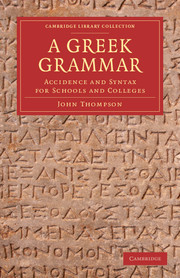
John Thompson (c.1866–1936) was Classics master and headmaster (1908–27) at the prestigious High School, Dublin. A competent linguist, he translated from German, produced a Latin primer, and wrote a Sanskrit course, though he opposed the teaching of Irish. He became a Member of the Royal Irish Academy (1912), President of the Classical Association (1918) and was appointed Officier d'Académie by the French government (1927). This work, first published in 1902, was intended for both the beginner and the more advanced student. It concentrates on Attic Greek, covering accidence in part one and syntax in part two, with appendices on accents and sound changes, Homeric accidence, and the weights, measures and calendar used by Attic Greeks. The work was popular with generations of teachers and pupils. It remains a useful resource for the modern student of Greek, and for readers interested in the history of Classics education.
Maurice Platnauer (1887–1974) published this seminal study of the metrical practices of the great Augustan elegists in 1951, and it is yet to be superseded. Principal of Brasenose College, Oxford, between 1956 and 1960, Platnauer examined every conceivable aspect of the versification of the three principal Latin elegiac poets, Tibullus, Propertius and Ovid, scrutinising in turn their prosody, word use and idiom. The book contains numerous tables of statistics comparing the frequency of various metrical and idiomatic usages among the three authors, including the placement of caesuras, use of elision, dactylic opening feet and polysyllabic line endings. This wealth of technical detail is offset by Platnauer's keen appreciation of the ultimate poetic purpose of these prosodic investigations: he explicitly hopes that the book will prove to be of use not only to teachers, but also to the 'not yet quite extinct genera' of writers of Latin verse.
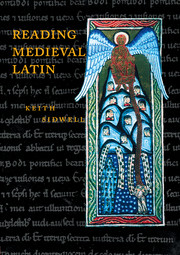
Reading Medieval Latin is an introduction to medieval Latin in its cultural and historical context and is designed to serve the needs of students who have completed the learning of basic classical Latin morphology and syntax. (Users of Reading Latin will find that it follows on after the end of section 5 of that course.) It is an anthology, organised chronologically and thematically in four parts. Each part is divided into chapters with introductory material, texts, and commentaries which give help with syntax, sentence-structure, and background. There are brief sections on medieval orthography and grammar, together with a vocabulary which includes words (or meanings) not found in standard classical dictionaries. The texts chosen cover areas of interest to students of medieval history, philosophy, theology, and literature.
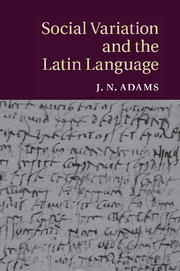
Languages show variations according to the social class of speakers and Latin was no exception, as readers of Petronius are aware. The Romance languages have traditionally been regarded as developing out of a 'language of the common people' (Vulgar Latin), but studies of modern languages demonstrate that linguistic change does not merely come, in the social sense, 'from below'. There is change from above, as prestige usages work their way down the social scale, and change may also occur across the social classes. This book is a history of many of the developments undergone by the Latin language as it changed into Romance, demonstrating the varying social levels at which change was initiated. About thirty topics are dealt with, many of them more systematically than ever before. Discussions often start in the early Republic with Plautus, and the book is as much about the literary language as about informal varieties.
With the publication in 1892–7 of this two-volume work, Swiss philologist Robert von Planta (1864–1937) cemented his reputation as one of the leading authorities on Indo-European grammar. After studying in his home country and Germany, he made his living as an independent researcher. He was also active in the movement against Italian irredentism and defended in writing the rights of the Swiss-German population. This work is an exhaustive account of the history and development of Osco-Umbrian phonology and syntax, adding to Mommsen's earlier contributions in the field. Volume 1 is dedicated to an overview of Osco-Umbrian phonology and stands as testimony to the development of phonological studies in the decade prior to its publication. With great diligence the author guides the reader through the history of the ancient populations of Italy and the different types of dialect found in the Osco-Umbrian area.