To save content items to your account,
please confirm that you agree to abide by our usage policies.
If this is the first time you use this feature, you will be asked to authorise Cambridge Core to connect with your account.
Find out more about saving content to .
To save content items to your Kindle, first ensure no-reply@cambridge.org
is added to your Approved Personal Document E-mail List under your Personal Document Settings
on the Manage Your Content and Devices page of your Amazon account. Then enter the ‘name’ part
of your Kindle email address below.
Find out more about saving to your Kindle.
Note you can select to save to either the @free.kindle.com or @kindle.com variations.
‘@free.kindle.com’ emails are free but can only be saved to your device when it is connected to wi-fi.
‘@kindle.com’ emails can be delivered even when you are not connected to wi-fi, but note that service fees apply.
The chapter asks if the first part of the Parmenides (including the “Third Man”) shows that Plato abandoned Platonic forms, and argues instead that Plato’s “Third Man” passage is not an indirect proof of anything: it simply shows the youthful Socrates not able to defend his views on forms. The exercise Parmenides then prescribes and demonstrates is the way forward Plato provided. It leads us to distinguish two kinds of predication, corresponding to two kinds of facts about forms. Better-organized thinking about forms lets us reject the notion that to perform their work in Plato’s theory, they must be perfect exemplars along the lines of “the Platonic ideal of the banana split.” This dispels the underlying problem which led to confusion over the “Third Man.” We can face down analogues of that argument for any form, from the Fox and Triangularity to Likeness and the Beautiful. This interpretation emerges from detailed construal of the text, taking account of both its literary and overtly philosophical aspects; the chapter brings together background for Plato’s agenda in his previous works, in the works of Anaxagoras and the historical Parmenides, and in Greek usage.
In Plato’s dialogues, Socrates calls things like justice, piety, and largeness “forms.” In several of these dialogues, he makes clear that forms are very different from familiar objects like tables and trees. Why, exactly, does he think that they differ and how are they supposed to do so? This chapter argues that in the Phaedo Socrates does not assume that they are different, but rather, over five stages of the dialogue, provides an account of how and why they do so. To fully understand the claims made in the first stage, one must look to the next stage, and so on until the final stage. Socrates' ultimate reason for distinguishing forms from ordinary objects does not depend on our intuitions about things like justice and largeness, nor on the distinction between universals and particulars. Ultimately, forms cannot be ordinary objects because the form of f-ness must cause every f-thing to be f, but no ordinary object could serve as such a cause. They cannot do so because they have multiple parts and are receptive of opposites; by contrast, the form of f-ness must be simple and unchanging, since it causes every f-thing to be f.
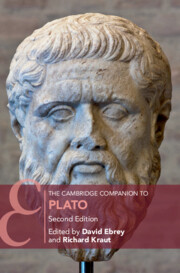
The first edition of the Cambridge Companion to Plato (1992), edited by Richard Kraut, shaped scholarly research and guided new students for thirty years. This new edition introduces students to fresh approaches to Platonic dialogues while advancing the next generation of research. Of its seventeen chapters, nine are entirely new, written by a new generation of scholars. Six others have been thoroughly revised and updated by their original authors. The volume covers the full range of Plato's interests, including ethics, political philosophy, epistemology, metaphysics, aesthetics, religion, mathematics, and psychology. Plato's dialogues are approached as unified works and considered within their intellectual context, and the revised introduction suggests a way of reading the dialogues that attends to the differences between them while also tracing their interrelations. The result is a rich and wide-ranging volume which will be valuable for all students and scholars of Plato.
Proclus' commentary on Plato's dialogue Timaeus is arguably the most important commentary on a text of Plato, offering unparalleled insights into eight centuries of Platonic interpretation. It has had an enormous influence on subsequent Plato scholarship. This edition offers the first new English translation of the work for nearly two centuries, building on significant recent advances in scholarship on Neoplatonic commentators. It provides an invaluable record of early interpretations of Plato's dialogue, while also presenting Proclus' own views on the meaning and significance of Platonic philosophy. The present volume, the fifth in the edition, presents Proclus' commentary on the Timaeus, dealing with Proclus' account of static and flowing time; we see Proclus situating Plato's account of the motions of the stars and planets in relation to the astronomical theories of his day. The volume includes a substantial introduction, as well as notes that will shed new light on the text.
This volume of Proclus' commentary on Plato's Timaeus records Proclus' exegesis of Timaeus 27a–31b, in which Plato first discusses preliminary matters that precede his account of the creation of the universe, and then moves to the account of the creation of the universe as a totality. For Proclus this text is a grand opportunity to reflect on the nature of causation as it relates to the physical reality of our cosmos. The commentary deals with many subjects that have been of central interest to philosophers from Plato's time onwards, such as the question whether the cosmos was created in time, and the nature of evil as it relates to physical reality and its ontological imperfection.
Proclus' Commentary on Plato's dialogue Timaeus is arguably the most important commentary on a text of Plato, offering unparalleled insights into eight centuries of Platonic interpretation. This edition offered the first new English translation of the work for nearly two centuries, building on significant advances in scholarship on Neoplatonic commentators. It provides an invaluable record of early interpretations of Plato's dialogue, while also presenting Proclus' own views on the meaning and significance of Platonic philosophy. The present volume, the third in the edition, offers a substantial introduction and notes designed to help readers unfamiliar with this author. It presents Proclus' version of Plato's account of the elements and the mathematical proportions which bind together the body of the world.
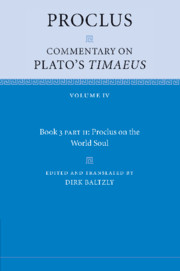
In the present volume Proclus describes the 'creation' of the soul that animates the entire universe. This is not a literal creation, for Proclus argues that Plato means only to convey the eternal dependence of the World Soul upon higher causes. In his exegesis of Plato's text, Proclus addresses a range of issues in Pythagorean harmonic theory, as well as questions about the way in which the World Soul knows both forms and the visible reality that comprises its body. This part of Proclus' Commentary is particularly responsive to the interpretive tradition that precedes it. As a result, this volume is especially significant for the study of the Platonic tradition from the earliest commentators onwards.
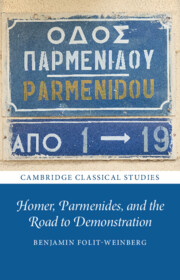
It is widely agreed that Parmenides invented extended deductive argumentation and the practice of demonstration, a transformative event in the history of thought. But how did he manage this seminal accomplishment? In this book, Benjamin Folit-Weinberg finally provides an answer. At the heart of this story is the image of the hodos, the road and the journey. Brilliantly deploying the tools and insights of literary criticism, conceptual history, and archaeology, Folit-Weinberg illuminates how Parmenides adopts and adapts this image from Homer, especially the Odyssey, forging from it his pioneering intellectual approaches. Reinserting Parmenides into the physical world and poetic culture of archaic Greece, Folit-Weinberg reveals both how deeply traditional and how radical was Parmenides' new way of thinking and speaking. By taking this first step toward providing a history of the concept method, this volume uncovers the genealogy of philosophy in poetry and poetic imagery.
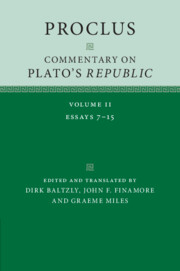
The commentary on Plato's Republic by Proclus (d. 485 CE), which takes the form of a series of essays, is the only sustained treatment of the dialogue to survive from antiquity. This three-volume edition presents the first complete English translation of Proclus' text, together with a general introduction that argues for the unity of Proclus' Commentary and orients the reader to the use which the Neoplatonists made of Plato's Republic in their educational program. Each volume is completed by a Greek word index and an English-Greek glossary that will help non-specialists to track the occurrence of key terms throughout the translated text. The second volume of the edition presents Proclus' essays on the tripartite soul and the virtues, female philosopher rulers, and the metaphysics and epistemology of the central books of the Republic. The longest of the essays in Volume II interprets the nature and significance of the 'marriage number' whose miscalculation leads to the degeneration of the ideal city-state.
This introduction has three goals: to locate this book’s arguments in contemporary scholarship on Parmenides, to outline its methodology and structure, and to establish the stakes of the project as a whole. The first considers Parmenides’ invention of extended deductive argumentation and the practice of demonstration – the central topic of this book – as a relic of the ‘Greek Miracle’ paradigm; it also addresses discussions of Parmenides’ use of poetry and his relationship to Homer. The second addresses distinctions between actors’ and observers’ categories and between reasoning and discourse, and explores the Foucauldian discourse analysis that anchors the book’s treatment of the relationship between Parmenides and Homer. The third requires setting out what this book does not intend to do in order to specify its main contribution: providing an account of how Parmenides’ use of the image of the hodos helps him invent extended deductive argumentation and the practice of demonstration. The Introduction sketches out the three axes of the book’s argument: an exploration of the physical reality of archaic and classical Greek roads, a discussion of the semantics of the word hodos, and an articulation of the relationship between Parmenides’ and Homer’s poems.
The previous chapter locates Parmenides in his physical and linguistic contexts; this chapter locates him in his poetic, intellectual, and cultural milieux. It argues that we need to understand Parmenides’ poem in light of the late archaic revolution in the way that Homer was conceptualized. This chapter examines the epistemological framework Parmenides inherits from Hesiod and Xenophanes in considering the nature of human enquiry; the way that other poets in the late archaic period make use of the newly emergent figure of Homer and the corpus of Homeric poetry, especially with respect to their claims to knowledge and their relationship to the Muses; and the ways that scholars have characterized developments between Homeric poetry and the poetry of the late archaic period. I show how Parmenides uses the resources this Homeric tradition offers to launch a multipronged response to the challenges set down by Hesiod and Xenophanes. These include: reinitiating contact with a Muse-like figure in the proem; the use of crossroads imagery to articulate fundamental distinctions; ceding the voice of the poem to the unnamed goddess; the use of argument; and the return to the privileged poetic form of epic dactylic hexameter.
This chapter outlines the key methodological framework to be used to analyse Homer and Parmenides and detail the specifics of their relationship. I first set out the terms that Foucault develops in his Archaeology of Knowledge, and then detail the ways that these terms do and do not make contact with established topics of classical and Homeric scholarship, including text-types and discourse modes, A-B-C patterns, the oimē and theme, and catalogues and catalogic discourse. I use the hodos that Circe spells out in Odyssey 10 as a sample text to analyse according to this methodology; the result is a clearly defined textual architecture that the image of the hodos governs more generally.